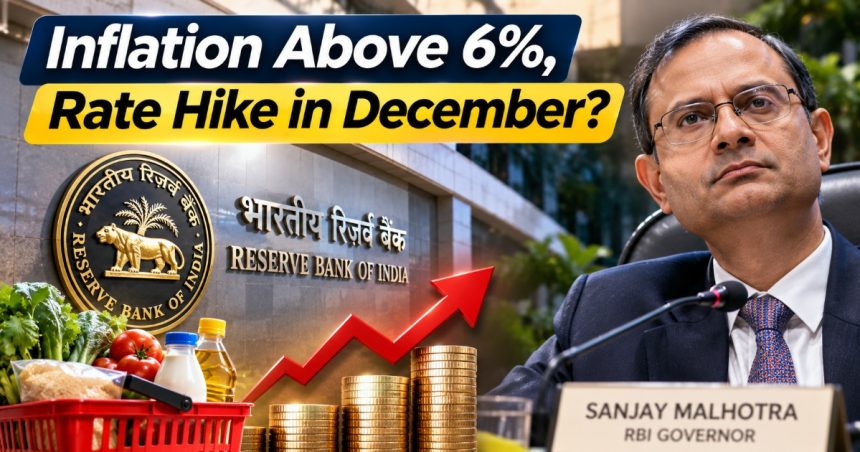
October India Inflation Hits 6%, Raising Fresh Concerns
Could Indian borrowers face another interest rate increase before the end of 2026? October’s retail inflation data has strengthened expectations of another rate hike by the Reserve Bank of India (RBI), putting investors, borrowers and stock market traders on alert.
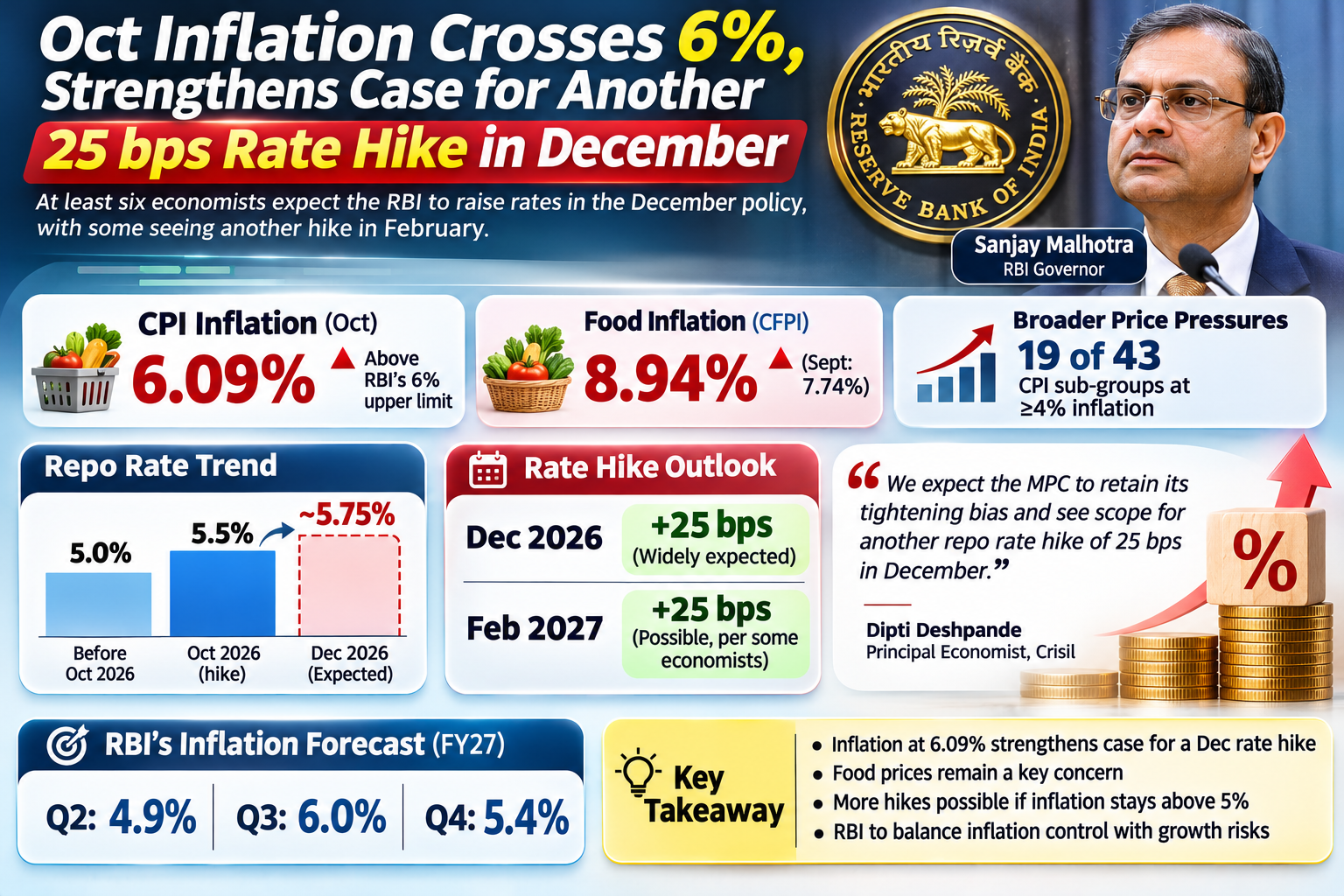
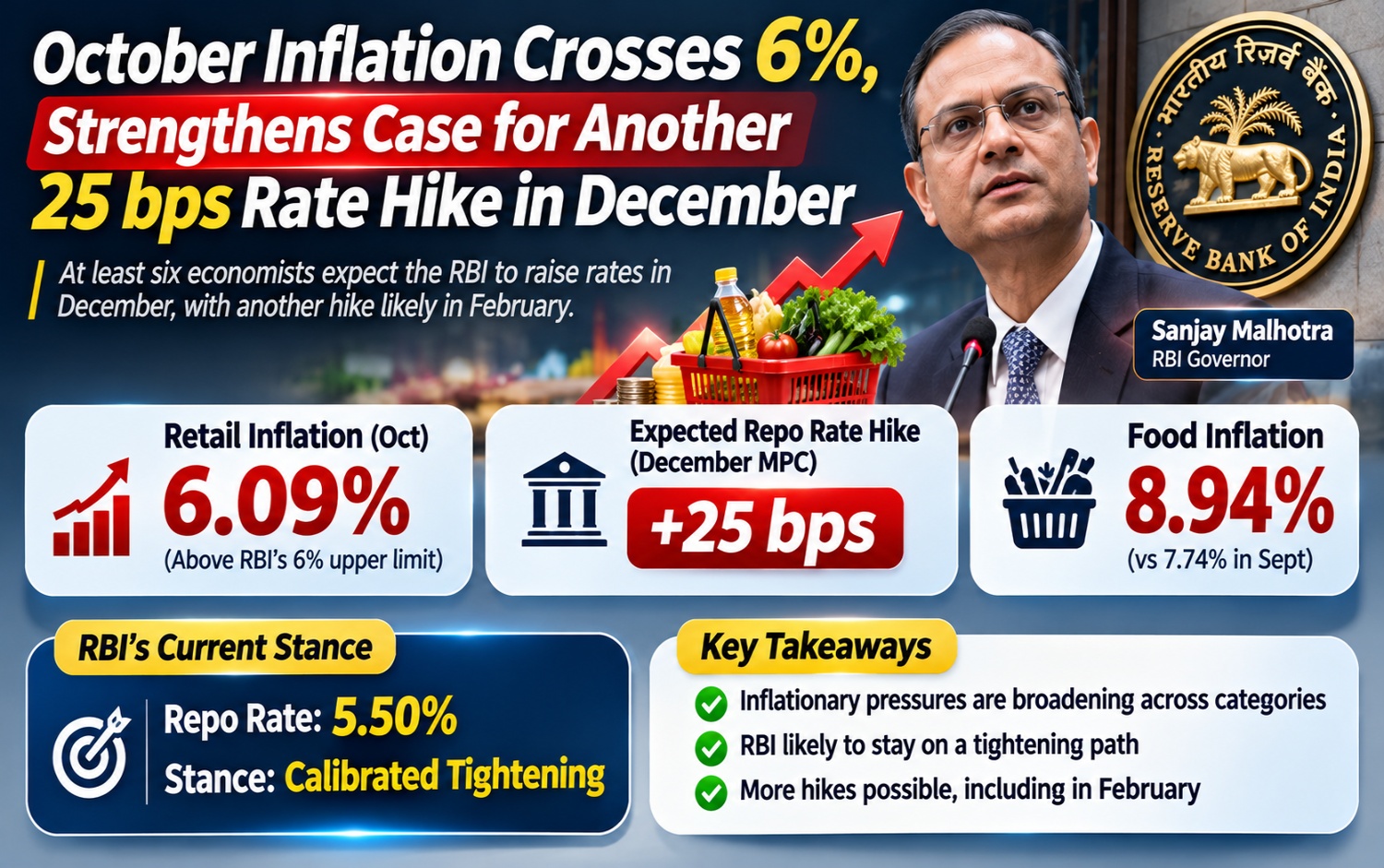
India’s Consumer Price Index (CPI)-based inflation climbed to 6.09% in October, breaching the RBI’s upper tolerance limit of 6% and increasing pressure on the central bank to control rising prices.
The latest inflation reading has strengthened expectations of a 25-basis-point repo rate hike during the December Monetary Policy Committee (MPC) meeting. At least six economists expect the RBI to increase interest rates, while some believe another hike could follow in February 2027.
India Inflation Hits : RBI May Increase Repo Rate by Another 25 Basis Points in December
Economists believe the latest inflation figures have strengthened the case for monetary tightening.
Dipti Deshpande, principal economist at Crisil, said, “We expect the Monetary Policy Committee of the RBI to retain its tightening bias and see scope for another repo rate hike of 25 basis points at its December review meeting.”
The RBI had already increased the repo rate by 25 basis points to 5.50% in October, marking its first rate increase in more than three years.
The central bank also shifted its monetary policy stance from neutral to calibrated tightening, signalling that further rate hikes or a pause were possible depending on inflation and economic conditions.
RBI Governor Sanjay Malhotra has indicated that interest rate cuts are unlikely in the near term.
RBI October 2026 Monetary Policy Decision
| Policy Instrument | October 2026 Rate |
|---|---|
| Repo Rate | 5.50% |
| Standing Deposit Facility (SDF) | 5.25% |
| Marginal Standing Facility (MSF) | 5.75% |
| Bank Rate | 5.75% |
Repo Rate Change
| Particulars | Interest Rate |
|---|---|
| Previous Repo Rate | 5.25% |
| New Repo Rate | 5.50% |
| Rate Hike | 25 basis points |
India Retail Inflation: October 2026
| Particulars | Inflation Rate |
|---|---|
| October 2026 CPI Inflation | 6.09% |
| September 2026 CPI Inflation | 5.54% |
| RBI Upper Tolerance Limit | 6.00% |
| Reuters Poll Estimate | 5.93% |
| Exceeding RBI’s Upper Limit | 0.09 percentage points |
October 2026 retail inflation exceeded both the Reuters poll estimate of 5.93% and the RBI’s upper tolerance limit of 6.00%.
Why is the 6% threshold important?
The RBI follows a flexible inflation-targeting framework with a medium-term CPI inflation target of 4%, allowing a tolerance range of 2% to 6%.
When inflation exceeds 6%, it moves outside the RBI’s prescribed tolerance band.
A single monthly reading above 6% does not automatically trigger a mandatory interest rate increase. However, sustained inflation above the upper limit increases pressure on the central bank to take corrective monetary policy action.
There is another important distinction: inflation has remained above the RBI’s 4% target for five months, while October marked its first breach of the 6% upper limit in two years under the current CPI series.
Food Inflation at 8.94% Adds Pressure on Household Budgets
Food prices remain one of the biggest challenges for India’s inflation outlook.
The Consumer Food Price Index (CFPI) increased to 8.94% in October, compared with 7.74% in September.
The pressure was not limited to food products. Nineteen of the 43 CPI sub-groups recorded inflation of at least 4%, indicating that price increases were spreading across multiple categories.
Higher household expenses could affect consumption demand, particularly among middle-income and lower-income households.
For investors, persistent food inflation is important because weaker consumption can affect companies operating in consumer goods, retail, restaurants and other domestic-demand-driven sectors.
| Inflation indicator | September 2026 | October 2026 |
|---|---|---|
| Overall CPI | 5.54% | 6.09% |
| Food inflation | 7.74% | 8.94% |
| Rural CPI | 6.08% | 6.63% |
| Urban CPI | 4.88% | 5.41% |
| Rural food inflation | 8.06% | 9.09% |
| Urban food inflation | 7.18% | 8.68% |
Why does food inflation matter?
Food accounts for a substantial portion of household expenditure, particularly among lower-income and rural households.
Higher prices of essential commodities can reduce disposable income and affect consumption of other goods and services.
The October report also highlights a difference between rural and urban inflation. Rural inflation reached 6.63%, compared with 5.41% in urban areas.
This suggests that rural households are experiencing relatively stronger price pressures.
The food and beverages category alone recorded inflation of 8.51% in October, according to the official CPI release.
Inflation pressures are spreading beyond food prices
Another important development is that inflation is no longer limited to food products.
Economists are concerned that higher input costs, energy prices and the pass-through of earlier commodity price increases are affecting a wider range of goods and services.
According to Reuters, 19 of the 43 CPI sub-groups recorded inflation of at least 4% in October.
The official MoSPI data also shows elevated inflation in several major categories.
| CPI category | October inflation |
|---|---|
| Food and beverages | 8.51% |
| Clothing and footwear | 4.96% |
| Transport | 5.84% |
| Restaurants and accommodation | 10.06% |
| Personal care and miscellaneous | 10.14% |
| Education services | 4.02% |
| Housing and utilities | 2.90% |
RBI’s December MPC meeting dates confirmed
The RBI has scheduled its next Monetary Policy Committee meeting for December 2–4, 2026.
The decision will be particularly important because the committee will have access to additional inflation and economic activity data before deciding whether further tightening is necessary.
| Event | Details |
|---|---|
| October MPC meeting | October 5–7, 2026 |
| Previous repo rate | 5.25% |
| Current repo rate | 5.50% |
| Next MPC meeting | December 2–4, 2026 |
| Economists’ expected hike | 25 basis points |
| Potential repo rate after hike | 5.75% |
A 25 bps increase would take the repo rate from 5.50% to 5.75%.
However, the final decision will depend on the latest inflation trajectory, growth conditions and the MPC’s assessment of future price pressures.
RBI’s inflation forecast is now facing an upside risk
One of the most important missing details in your original content is the RBI’s October inflation forecast.
Before the October inflation announcement, the central bank had projected average CPI inflation of 5.2% for FY2026-27.
| Period | RBI inflation projection |
|---|---|
| Q2 FY2026-27 | 4.9% |
| Q3 FY2026-27 | 6.0% |
| Q4 FY2026-27 | 5.7% |
| Q1 FY2027-28 | 5.6% |
October’s actual inflation reading of 6.09% is slightly above the RBI’s 6% projection for Q3.
This creates an upside risk to the central bank’s inflation outlook.
Crude Oil Prices and Inflation Could Complicate RBI’s Decision
International crude oil prices are another factor influencing India’s inflation outlook.
Brent crude has cooled to around $93 per barrel after previously trading near $110. However, economists believe lower oil prices may not immediately translate into lower domestic inflation.
Garima Kapoor, deputy head of research and economist at Elara Capital, expects headline inflation to remain around 6.1% in the third quarter of FY27.
She also warned that the pass-through of previous price increases could keep inflation elevated despite some relief from crude oil prices.
Read More : Jensen Huang Quits Nvidia and Loses $6 Billion in a Day, but Keeps $138 Billion
There are three reasons:
-
Imported inflation: Higher international energy prices increase India’s import bill and can put pressure on the rupee.
-
Production costs: Energy and transportation expenses can increase the cost of manufacturing and distributing products.
-
Delayed pass-through: Businesses may gradually transfer previously absorbed increases in input costs to consumers.
Economic growth versus inflation: RBI faces a difficult decision
Although rising inflation supports further monetary tightening, the RBI must also consider the impact of higher interest rates on economic growth.
The central bank cannot focus exclusively on controlling prices if tighter monetary conditions begin affecting consumption, investment and business activity.
The October MPC resolution projected India’s real GDP growth at 7.1% for FY2026-27.
Its quarterly growth projections were:
| Period | GDP growth forecast |
|---|---|
| Q1 FY27 | Actual 7.8% |
| Q2 FY27 | 7.2% |
| Q3 FY27 | 6.9% |
| Q4 FY27 | 6.8% |
| FY2026-27 | 7.1% |
At least six economists expect another 25 bps rate hike in December
The October inflation reading has strengthened expectations of another rate increase during the next MPC meeting.
Reuters reported that several economists expect the RBI to increase the repo rate by another 25 basis points in December.
| Economist / Institution | Assessment |
|---|---|
| Alexandra Hermann Prasad, Oxford Economics | Expects 25 bps hikes in December and February |
| Radhika Rao, DBS Bank | Expects another 25 bps hike in December |
| Upasna Bhardwaj, Kotak Mahindra Bank | Expects another 50 bps of hikes in FY27 |
| Aditi Nayar, ICRA | Expects a 25 bps December hike |
| Sakshi Gupta, HDFC Bank | Expects 25 bps hikes in December and February |
| Harshal Patel, Emkay Global | Retains expectation of 75 bps total hikes in the cycle |
| Vikram Chhabra, 360 ONE Asset | Expects another 25 bps hike |
| Teresa John, Nirmal Bang | Expects 50 bps over the next two meetings |
| Garima Kapoor, Elara Securities | Expects another 50 bps over the next 6–9 months |
What Another RBI Rate Hike Could Mean for Investors and Traders
If the RBI increases the repo rate in December, borrowing costs could rise further for businesses and households.
Banking stocks, NBFCs, real estate companies and automobile manufacturers could experience volatility as investors reassess borrowing costs, credit demand and profitability.
Higher interest rates may also increase the attractiveness of fixed-income investments relative to equities, potentially influencing portfolio allocation.
Madhavi Arora, chief economist at Emkay Global Financial Services, expects a cumulative 75 bps of rate hikes in the current cycle, including 25 bps increases in December 2026 and February 2027.
However, the RBI must balance inflation control against economic growth, particularly because supply-side pressures are contributing significantly to rising prices.