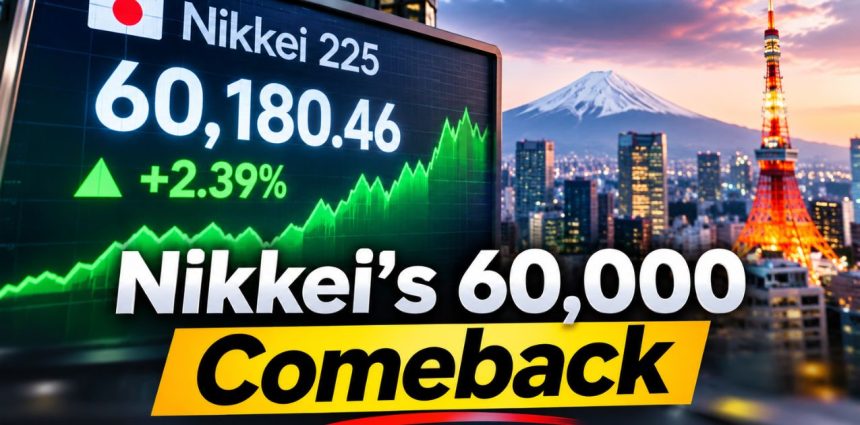
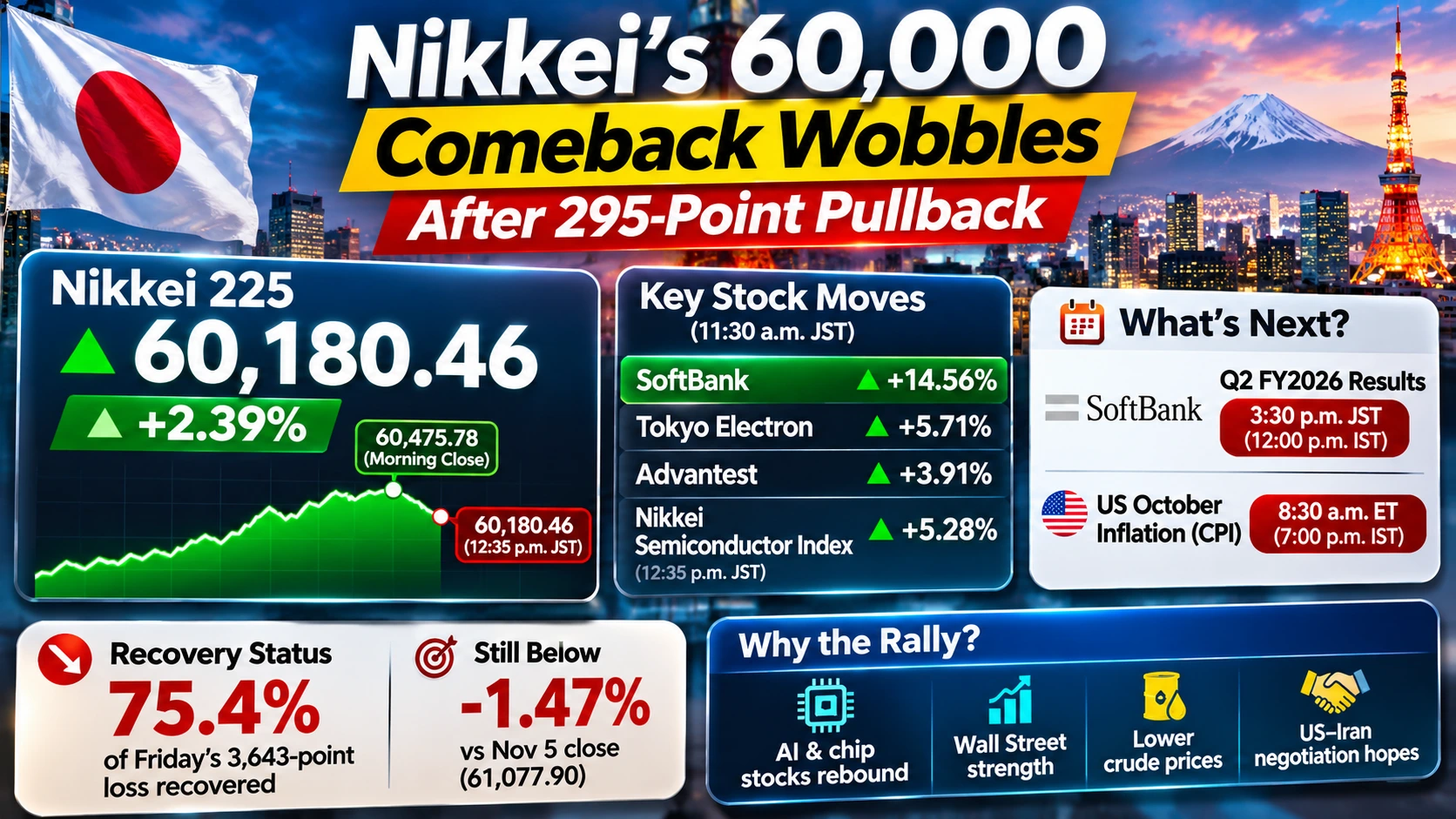
Japan’s Nikkei 225 was trading at 60,180.46, up 2.39%, at 12:35 p.m. JST on Tuesday, giving back part of its nearly 3% morning-session advance. The index had closed the morning session at 60,475.78 but surrendered 295.32 points during the first five minutes after afternoon trading resumed. SoftBank Group had surged 14.56% by the 11:30 a.m. snapshot, while Advantest and Tokyo Electron gained 3.91% and 5.71%, respectively.
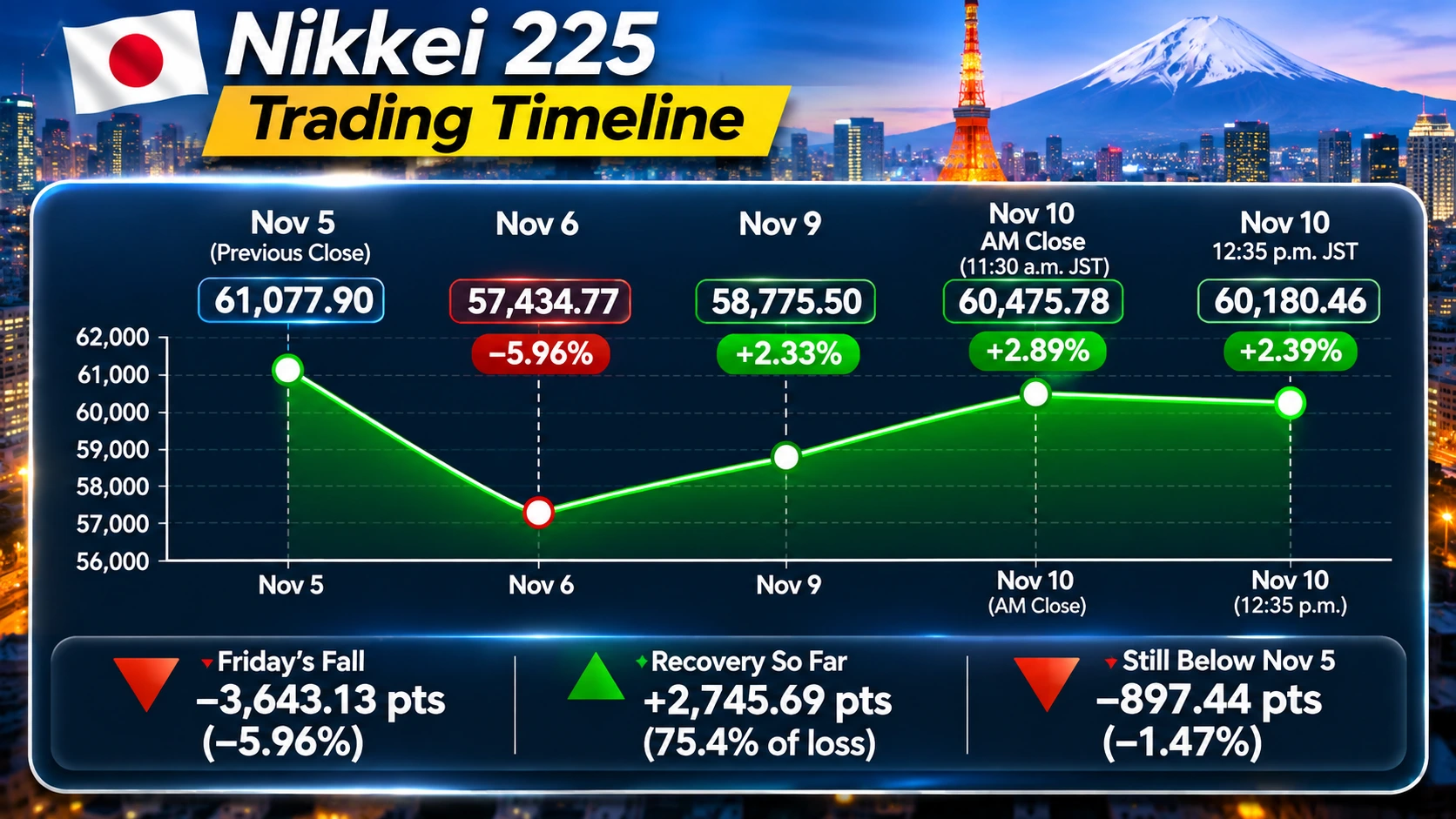
Despite the pullback, the benchmark remained above 60,000 and had recovered approximately 75.4% of the points lost during Friday’s 5.96% sell-off. However, it was still 897.44 points, or 1.47%, below its November 5 closing level of 61,077.90. Investors were also awaiting SoftBank’s Q2 FY2026 results, scheduled for later Tuesday, and the US October inflation report.
Market update: Nikkei 225 and Nikkei Semiconductor Stock Index figures are from 12:35 p.m. JST. Individual company share prices are from 11:30 a.m. JST unless otherwise specified. These are intraday quotations, not final closing prices.
Track Live: GIFT Nifty Live – Today Price, Chart, Timings and Nifty Opening Signal
Nikkei gives back part of its morning advance
The Nikkei’s latest movement highlights the difference between a strong opening recovery and sustained buying throughout the trading session.
The benchmark had advanced 2.89% to 60,475.78 at the official morning-session close of 11:30 a.m. JST. However, the index eased to 60,180.46 by 12:35 p.m. JST, reducing its gain to 2.39%.
The broader technology recovery remained visible in the semiconductor segment. The official Nikkei Semiconductor Stock Index stood at 17,869.38, up 5.28%, at 12:35 p.m. JST, compared with a 5.46% advance at 11:30 a.m.
The latest market figures were:
| Index / Stock | Latest reported value | Change |
|---|---|---|
| Nikkei 225 (12:35 JST) | 60,180.46 | +2.39% |
| Nikkei Semiconductor Index (12:35 JST) | 17,869.38 | +5.28% |
| SoftBank Group (11:30 JST) | ¥3,895 | +14.56% |
| Advantest (11:30 JST) | ¥29,485 | +3.91% |
| Tokyo Electron (11:30 JST) | ¥8,977 | +5.71% |
The index figures are available through Nikkei Indexes. Individual company quotations are from delayed market-price data.
The Nikkei had dropped 5.96% to 57,434.77 on November 6 from its November 5 close of 61,077.90. It subsequently recovered 2.33% on November 9, closing at 58,775.50, before extending its advance on Tuesday.
At 12:35 p.m. JST, the benchmark had recovered 2,745.69 points of Friday’s 3,643.13-point decline, equivalent to approximately 75.4%.
The recovery is significant, but the index has not yet fully reversed the previous correction.
Track Live: Nifty Levels Today
Why are Japanese AI and semiconductor stocks recovering?
The rebound reflects renewed buying in technology stocks, stronger Wall Street performance and improved sentiment following a decline in crude oil prices.
Investors had reduced exposure to AI-related shares during last week’s sell-off amid concerns about the sustainability of large-scale AI infrastructure spending and the potential returns from data-centre investments.
The sell-off intensified after Democrats secured strong gains in the US midterm elections. Investors became concerned that increased congressional scrutiny of AI businesses could slow data-centre expansion, affect investment approvals and weaken the expected returns from large-scale AI infrastructure projects.
However, these concerns were not the only factor behind the decline. Valuation pressures and uncertainty about the pace at which AI spending will translate into earnings also contributed to the technology-sector correction.
There is a counterargument within the market. In a November 9 report, Reuters cited Wall Street brokerages that considered the AI sell-off excessive. Some expected regulatory uncertainty to delay certain projects rather than derail investment altogether.
This creates a tension for investors: the immediate risk of slower AI infrastructure spending versus the possibility that the longer-term investment cycle remains intact.
Global market sentiment also improved on Tuesday.
According to Reuters, the S&P 500 advanced 2.35% on Monday, while the Nasdaq Composite gained 2.7%. The recovery in US technology shares provided support to Asian markets.
Brent crude futures slipped approximately 1% to $91.56 per barrel as investors assessed the possibility of diplomatic negotiations between the United States and Iran.
Lower crude prices helped ease immediate inflation concerns. South Korea’s KOSPI also advanced more than 5% during the reported session, reflecting the broader improvement in regional risk sentiment.
However, the geopolitical outlook remains uncertain. A breakdown in US-Iran negotiations could push crude prices higher again and reverse part of the improvement in market sentiment.
SoftBank jumps 14.56% ahead of Q2 earnings
SoftBank Group remained one of the biggest highlights of Tuesday’s technology-sector recovery.
Its shares climbed to ¥3,895, up ¥495 or 14.56%, at 11:30 a.m. JST. This followed a decline of approximately 4.20% on November 9 and 10.83% on November 6.
The recovery comes ahead of an important earnings announcement.
According to SoftBank Group’s official investor-relations calendar, its Q2 FY2026 financial results are scheduled for disclosure at 3:30 p.m. JST on November 10, followed by an earnings briefing at 4:30 p.m. JST.
These timings correspond to 12:00 p.m. and 1:00 p.m. IST, respectively.
The results cover the six months ended September 30, 2026.
Investors will be looking beyond the reported profit figure to assess the company’s AI investment strategy, investment valuations and funding requirements.
SoftBank has substantial exposure to the artificial intelligence ecosystem, including its investment in OpenAI. This makes its financial results particularly important for investors assessing the relationship between AI investment opportunities and the capital required to pursue them.
The earnings announcement could provide fresh information on how management intends to balance its aggressive AI expansion with financial discipline.
Given the sharp movement in the shares, the market reaction to the actual results and management commentary will be important. The 14.56% morning gain should not be interpreted as confirmation that investors have resolved their concerns about the company’s investment exposure.
JX Advanced Metals raises FY2027 profit forecast
The semiconductor recovery also coincides with improving earnings expectations at Japanese materials companies.
JX Advanced Metals raised its full-year forecast for profit attributable to owners of the parent to ¥160 billion from its previous estimate of ¥141 billion, an upward revision of 13.5%.
The company also increased its revenue forecast to ¥1.05 trillion and its operating profit estimate to ¥255 billion.
In its November 9 disclosure, the company cited higher sales volumes and selling prices in its focus businesses, supported by expanding AI data-centre-related demand. Higher copper prices also contributed to the improved outlook.
However, the company cautioned that reduced mine production could affect its Mineral Resources business.
The forecast revision is an important company-specific development because it provides an earnings-related basis for optimism in the semiconductor materials supply chain.
The full details are available in the JX Advanced Metals official financial disclosures.
Kikkoman shares fall 12.43% despite first-half profit growth
The recovery was not uniform across the Japanese stock market.
Kikkoman shares declined to ¥1,631, down 12.43%, at 11:30 a.m. JST, according to Investing.com’s delayed market quotation.
The movement came after the company published its first-half FY2027 financial results on November 9.
Kikkoman reported:
- Revenue of ¥405.49 billion, up 13.1% year-on-year.
- Operating profit of ¥49.18 billion, up 24.1%.
- Profit attributable to owners of the parent of ¥38.25 billion, up 22.1%.
However, its full-year forecast for attributable profit remained at ¥61.3 billion.
The difference between strong first-half earnings growth and an unchanged full-year profit forecast provides useful context for the market reaction. It also illustrates why investors assess future earnings expectations rather than relying solely on historical performance.
The results can be accessed through Kikkoman’s official FY2027 second-quarter financial report. The share-price figure is from Investing.com.
US October CPI is the next major market catalyst
Investors will also monitor the US October Consumer Price Index report, scheduled for November 10 at 8:30 a.m. Eastern Time, equivalent to 7:00 p.m. IST.
According to Reuters, economists expect headline consumer prices to increase 0.3% month-on-month, while core inflation is expected to rise 0.2%.
The inflation reading could influence expectations for the Federal Reserve’s December policy decision.
Reuters reported that traders were pricing in an 84% probability of a Federal Reserve rate hike next month, compared with 74% a week earlier, following stronger-than-expected US employment data.
A stronger-than-expected inflation reading could reinforce expectations of tighter monetary policy and put renewed pressure on growth-oriented technology stocks.
A softer inflation reading could support the global equity recovery, although uncertainty surrounding AI investments and geopolitical developments would remain.
The official release schedule is available from the US Bureau of Labor Statistics.
What should investors watch next?
The Nikkei’s ability to sustain its position above 60,000 will depend on whether the current recovery receives support from earnings and continued technology-sector demand.
Three developments deserve attention:
SoftBank’s Q2 earnings: The company’s financial results and commentary on AI investment funding could influence sentiment towards Japanese technology shares.
US October inflation: The CPI report could change interest-rate expectations and influence global technology valuations.
AI infrastructure spending and geopolitics: Investor confidence will depend on whether AI investments translate into sustainable earnings and whether lower crude prices persist amid developments in the US-Iran situation.
Bottom Line
Japan’s Nikkei 225 remained above 60,000 at 12:35 p.m. JST after giving back part of its nearly 3% morning-session advance. The index was up 2.39% at 60,180.46, while the official Nikkei Semiconductor Stock Index gained 5.28%.
SoftBank’s 14.56% advance at the morning-session close and gains in Advantest and Tokyo Electron highlighted renewed interest in AI-related stocks.
However, the Nikkei had recovered approximately 75.4% of Friday’s lost points, not the entire decline, and remained 1.47% below its November 5 close.
SoftBank’s Q2 results, the US inflation report and the sustainability of AI infrastructure spending will be important tests for the recovery.
For investors, the immediate question is not simply whether the Nikkei can remain above 60,000, but whether the renewed buying can withstand the next round of earnings and macroeconomic developments.
Read Next: Nvidia Sheds $190 Billion in Market Value as Board Probes Reports Huang Was Targeted
Disclaimer: This article is for informational and educational purposes only and should not be considered investment advice or a recommendation to buy or sell any securities. Market data and stock-price movements are based on specified timestamps and may change during trading. Readers should conduct their own research before making investment decisions.