Crude oil prices extended their losing streak for a fourth consecutive session on Thursday, with Brent crude testing the $94-per-barrel level and US West Texas Intermediate (WTI) falling below $88. The latest decline followed a massive sell-off on Wednesday, when both international benchmarks plunged more than 8% to their lowest closing levels since August 31.
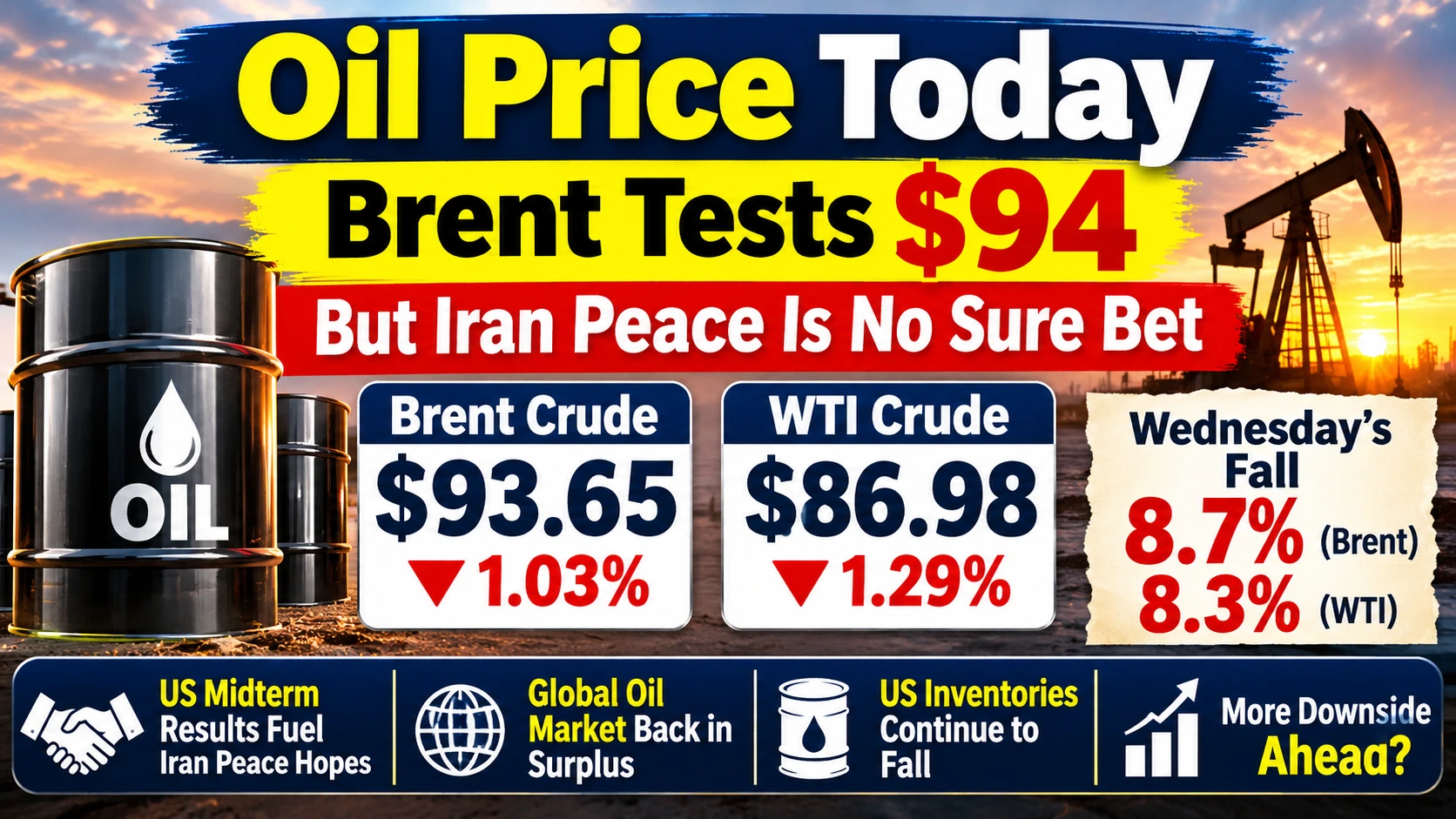
At 7:41 AM IST on November 5, Brent crude futures were trading at $93.65 per barrel, down $0.97 or 1.03%, while WTI crude futures stood at $86.98, lower by $1.14 or 1.29%, according to Reuters. On Wednesday, Brent settled at $94.62 after falling 8.7%, while WTI ended at $88.12, down 8.3%.
The immediate trigger is a dramatic shift in political expectations following the US midterm elections. Democrats’ sweeping victory over Republicans has raised speculation that President Donald Trump could face greater political pressure to seek a diplomatic exit from the US-Israeli war with Iran rather than escalate military action.
However, the oil market may be moving faster than diplomacy. There is no confirmed peace agreement, Middle Eastern supply routes remain exposed to geopolitical risks, and falling US inventories are offering an important counter-signal to the bearish global supply outlook.
Track Live: GIFT Nifty Live – Today Price, Chart, Timings and Nifty Opening Signal
Key Highlights
- Brent crude: $93.65 per barrel, down 1.03% at 7:41 AM IST on November 5.
- WTI crude: $86.98 per barrel, down 1.29% at the same snapshot.
- Wednesday’s crash: Brent fell 8.7% to $94.62, while WTI declined 8.3% to $88.12.
- Global supply outlook: JPMorgan estimates the oil market returned to a surplus of 1.4 million barrels per day in October.
- Goldman Sachs forecast: Its October outlook projects Brent at $90 in December 2026 and an average of $80 in 2027, with renewed conflict posing significant upside risks.
Why Are Crude Oil Prices Falling for a Fourth Day?
The latest sell-off reflects a reduction in the geopolitical risk premium that had been supporting oil prices during the Iran conflict.
Democrats secured control of both the US House of Representatives and the Senate in the November 3 midterm elections, ending unified Republican control of Congress. The outcome has raised expectations that Trump could face stronger legislative and political constraints over his handling of the conflict.
The election result has also increased pressure on the administration to address the economic consequences of the war, particularly higher gasoline and diesel prices.
Trump acknowledged that the Iran war had hurt his party’s electoral performance. Vice President JD Vance also attributed the Republican losses to the conflict.
Markets are now considering whether the administration will prioritise diplomatic negotiations over another military escalation.
However, the political transition will not happen immediately. The new Congress is scheduled to take office on January 3, 2027. Until then, the election result does not automatically change the administration’s military or energy policies.
This distinction matters for oil traders. Much of the recent decline reflects expectations of what Washington might do next, rather than a confirmed change in the situation on the ground.
Iran Peace Hopes Put the Strait of Hormuz Back in Focus
A diplomatic resolution to the conflict could improve the movement of crude oil and refined petroleum products from the Middle East, easing concerns about global energy supply.
The Strait of Hormuz remains central to this outlook because it is a critical shipping route for oil exports from the Gulf.
Reuters reported that crude shipments through the waterway have recovered close to pre-war levels, although transportation costs remain higher.
However, the recovery is not complete.
Vortexa data showed that Gulf exports of crude oil, condensate and refined products, excluding LPG, averaged 17.1 million barrels per day in October. This was lower than the 18.9 million barrels per day recorded in September and represented roughly three-quarters of pre-war levels.
There is another complication. Ship-tracking companies warned that October’s figures could be revised upwards because some tankers have switched off tracking signals to avoid detection amid heightened shipping risks.
This means the apparent improvement in exports should not be interpreted as a complete return to normal supply conditions.
For oil markets, a sustained recovery in Gulf shipments could increase available supply and put further pressure on prices. But renewed attacks or fresh restrictions around the Strait of Hormuz could quickly reverse that trend.
JPMorgan Sees Global Oil Market Returning to Surplus
The geopolitical shift is not the only factor weighing on crude oil prices. The underlying global supply-demand balance is also becoming less supportive.
According to a November 4 Reuters report, JPMorgan estimates that the global oil market returned to a surplus of 1.1 million barrels per day in September. The surplus widened to 1.4 million barrels per day in October, almost matching the average surplus of 1.3 million barrels per day recorded last year.
The recovery in Middle Eastern exports has contributed to this change, alongside additional production from other regions.
JPMorgan estimated that Middle Eastern oil exports had recovered to approximately 20.7 million barrels per day, compared with 9.8 million barrels per day in March, although exports remained below pre-war levels.
The bank also estimated that Latin America was supplying approximately 1.5 million barrels per day more crude than a year earlier, led by Brazil, Venezuela, Guyana and Argentina.
At the same time, global demand has weakened. JPMorgan estimated that demand had fallen by around 3.3 million barrels per day since the beginning of the conflict, partly because high fuel prices and supply disruptions had curtailed consumption.
The combination of recovering supply and weaker demand is creating a more bearish backdrop for crude prices, independent of the immediate political developments in Washington.
US Oil Inventory Decline Could Limit Further Downside
Despite the global surplus narrative, the latest US inventory data present a different picture.
The US Energy Information Administration (EIA) reported that crude oil, gasoline and distillate inventories all declined in the week ended October 30.
US commercial crude inventories fell by 865,000 barrels to approximately 409.8 million barrels. Gasoline stocks declined by 222,000 barrels, while distillate inventories dropped by approximately 3.57 million barrels.
The inventory declines came as US oil demand reached its highest level in a year, according to the EIA data cited by Reuters.
The sharp decline in distillate stocks is particularly significant because this category includes diesel and heating oil.
These figures provide an important counterweight to the bearish narrative. Although recovering Middle Eastern exports are improving the global supply balance, falling US inventories indicate that demand and near-term supply conditions remain tight in parts of the market.
Consequently, the recent crude oil sell-off does not necessarily mean prices will move lower in a straight line.
Goldman Sachs Oil Price Forecast: Brent at $90 in December, $80 in 2027
Goldman Sachs Research expects crude oil prices to moderate as Middle Eastern supply gradually recovers. However, the investment bank has warned that renewed geopolitical escalation could keep prices higher for longer.
In its October 16 research outlook, Goldman Sachs projected Brent crude at $90 per barrel in December 2026, revising its earlier forecast of $85. It expects Brent to average $80 per barrel in 2027.
The bank’s base case is built around the assumption that oil exporters will continue adapting to the disruption and that Middle Eastern supply will gradually return to the market.
However, the bank also highlighted significant upside risks if the US-Israeli conflict with Iran escalates again.
This creates an important distinction for investors. Goldman’s forecast points towards lower prices over the medium term, but it does not rule out sharp rallies if regional production, exports or shipping infrastructure face renewed disruption.
The October 16 forecast also predates Wednesday’s major market sell-off and the latest election results, so it should be treated as an existing base-case projection rather than a new post-election price target.
What Lower Crude Oil Prices Could Mean for India
For India, a sustained decline in international crude oil prices could provide relief on the import bill, given the country’s dependence on imported energy.
Lower crude prices could also reduce input-cost pressure for industries that rely heavily on petroleum-based raw materials, including aviation, paints, chemicals, tyres and other manufacturing segments.
However, the impact on domestic petrol and diesel prices may not be immediate or proportional to the fall in international benchmarks.
The rupee-dollar exchange rate, government taxes, refinery economics and oil marketing companies’ pricing decisions will also influence the final impact on consumers.
A sustained correction in crude prices would be more beneficial for India’s inflation and external balance than a short-lived decline driven mainly by geopolitical headlines.
Track Live: NSE Option Chain — Live
Crude Oil Price Outlook: More Downside, but Volatility Is Not Over
The near-term outlook for crude oil has turned weaker as traders reassess the likelihood of further military escalation and account for the recovery in Middle Eastern supply.
If diplomatic negotiations gain momentum, Gulf exports continue recovering and the global surplus persists, Brent and WTI could face additional downside pressure.
However, three factors could interrupt the decline: renewed military action against Iran, fresh disruptions around the Strait of Hormuz and a tighter-than-expected inventory position across major consuming economies.
The upcoming change in US Congressional control also needs to be viewed in context. Democrats will assume control of the new Congress only in January, leaving a gap between the market’s expectations and any actual policy changes.
For now, crude oil bears have gained the upper hand, but the possibility of a sharp recovery remains.
Bottom Line
Crude oil’s four-session decline reflects a combination of easing geopolitical concerns, recovering Middle Eastern exports and an improving global supply-demand balance. Wednesday’s 8.7% plunge in Brent and 8.3% fall in WTI mark a significant shift in market sentiment.
Yet the prospect of an Iran peace deal remains uncertain, while falling US inventories and vulnerable Gulf shipping routes continue to present upside risks.
The next major direction for crude oil will depend on whether diplomatic expectations translate into actual improvements in energy supply. Until then, the market could remain highly volatile, even as prices face a weaker overall supply-demand backdrop.
Major Oil Market Figures
| Indicator | Latest reported figure |
|---|---|
| Brent crude, November 5, 7:41 AM IST | $93.65/barrel |
| WTI crude, November 5, 7:41 AM IST | $86.98/barrel |
| Brent decline, November 4 settlement | 8.7% |
| WTI decline, November 4 settlement | 8.3% |
| JPMorgan-estimated global surplus, September | 1.1 million bpd |
| JPMorgan-estimated global surplus, October | 1.4 million bpd |
| Vortexa Gulf exports, October | 17.1 million bpd |
| Vortexa Gulf exports, September | 18.9 million bpd |
| US commercial crude stocks, October 30 | 409.8 million barrels |
| Goldman Sachs Brent forecast, December 2026 | $90/barrel |
| Goldman Sachs Brent forecast, 2027 average | $80/barrel |
Read Next: F&O Build-Up November 4: 117 Stocks Show Long Signals; MCX Leads Short Build-Up
Disclaimer: This article is for informational and educational purposes only and should not be considered investment or trading advice. Crude oil prices are subject to geopolitical developments, supply-demand changes, currency movements and market volatility. Readers should assess their risk tolerance and consult a qualified financial adviser before making investment decisions.