Fadnavis on Falling Rupee: Why Maharashtra Is Confident of Reaching a $1 Trillion Economy by 2030
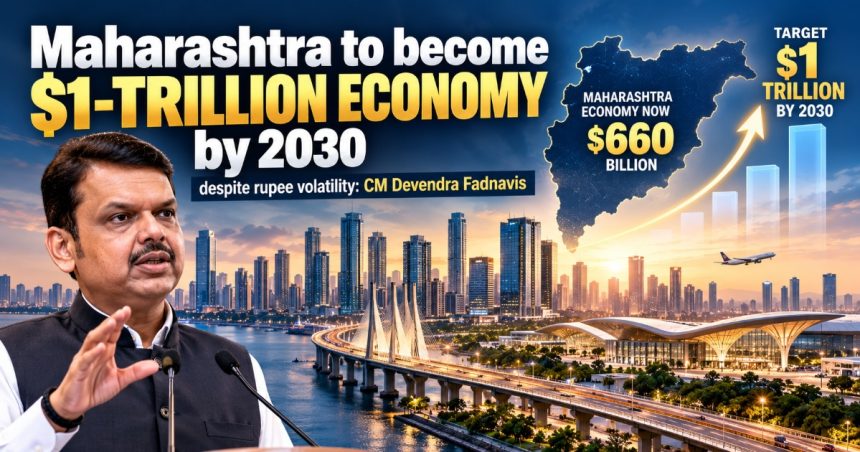
Maharashtra is targeting a $1 trillion economy by 2030 despite fluctuations in the dollar-rupee exchange rate. Chief Minister Devendra Fadnavis made the announcement on October 28 at the Rising Bharat Summit, highlighting the state’s economic expansion and growing investor interest.
According to Fadnavis, Maharashtra’s economy has reached $660 billion since the state set its trillion-dollar ambition in 2015. He expressed confidence that the target remains achievable despite global economic uncertainties and currency volatility.
“In 2015, we had decided to make Maharashtra a $1 trillion economy and the journey has been phenomenal. We are $660 billion, we will achieve our target by 2030,” Fadnavis said.
The chief minister also acknowledged that rupee depreciation can make dollar-denominated economic targets more challenging. However, he said exchange-rate movements would not deter the state from pursuing its goal.
“The dollar-rupee exchange rate keeps shifting the goalpost, but I am not worried about that,” he said.
Track Live : NSE Option Chain — Live | BSE Option Chain — Live Sensex & Bankex Options Data Today
Fadnavis on Falling Rupee: How Investment MoU Conversions Are Supporting Maharashtra’s Growth Plans
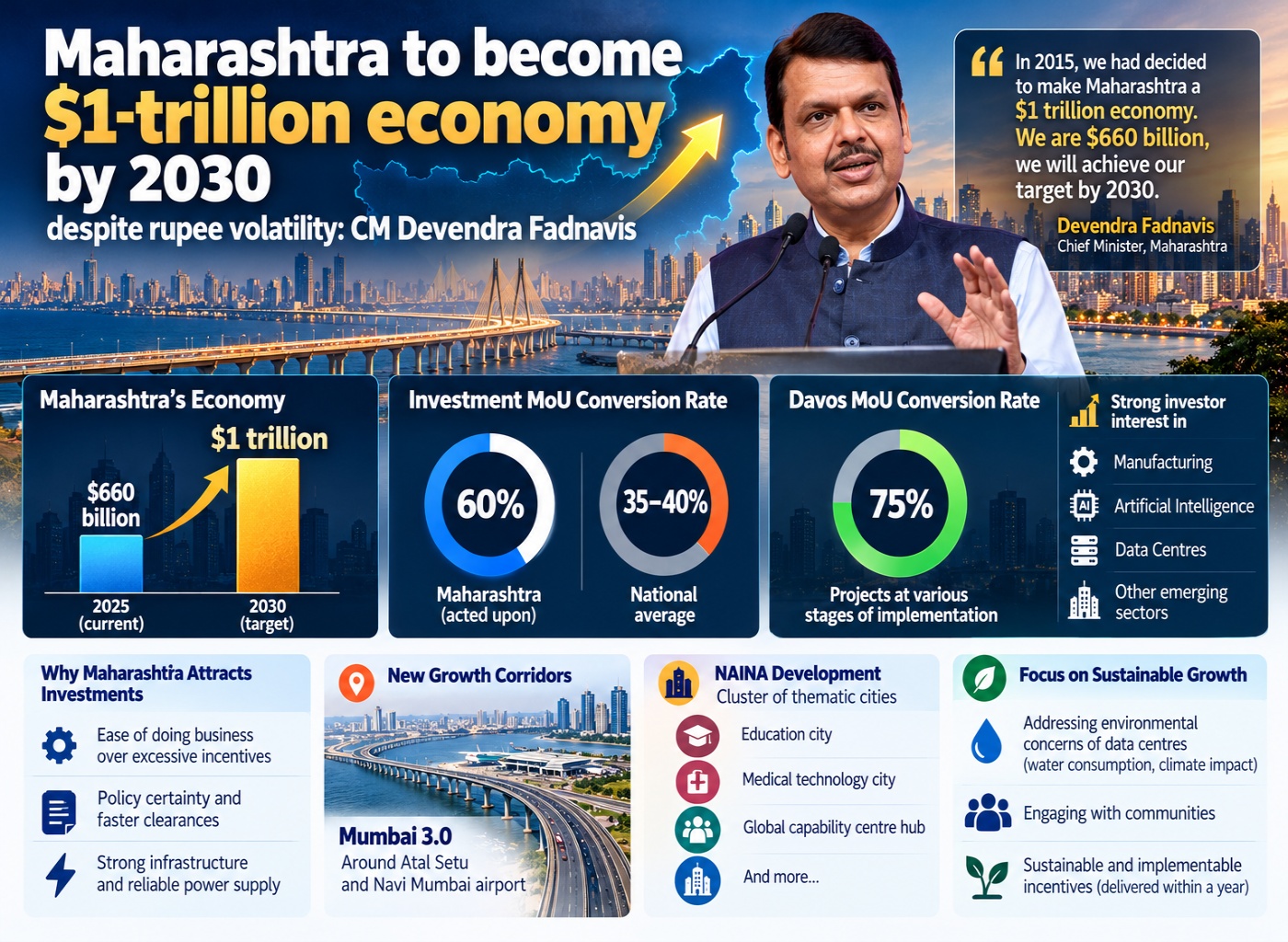
Beyond attracting investment proposals, Maharashtra is focusing on turning commitments into operational projects. Fadnavis said investor interest remained strong across manufacturing, artificial intelligence, data centres and emerging industries.
He stated that approximately 60% of investment memorandums of understanding (MoUs) signed in Maharashtra had been acted upon, compared with a national conversion rate of 35–40%.
Agreements signed at the World Economic Forum in Davos reportedly recorded an even higher conversion rate of 75%, with projects at different stages of implementation.
“There is one thing to get interest, but we are scoring conversions as well,” Fadnavis said.
These figures, presented by the chief minister, highlight the state’s emphasis on implementation. For investors, actual project execution, capital expenditure and operational timelines will be important indicators of whether these commitments translate into sustained economic growth.
Maharashtra’s economic size and the growth required to reach $1 trillion
|
Economic indicator |
Value |
Details |
|---|---|---|
| Current economy size | $660 billion | Figure cited by CM Devendra Fadnavis on October 28, 2026. |
| Target economy size by 2030 | $1 trillion | Maharashtra’s stated economic target. |
| Additional economic output required | $340 billion | Difference between the current cited value and the target. |
| Required increase | 51.5% | Approximate growth in dollar terms from $660 billion to $1 trillion. |
| Estimated annual growth requirement | 13.8% | Reported estimate of the growth needed over the coming years to reach the target. |
Why Maharashtra Is Prioritising Ease of Doing Business Over Incentives
Fadnavis said Maharashtra was focusing on policy certainty, infrastructure readiness and ease of doing business rather than competing primarily through financial incentives.
He noted that 12–13 states were actively competing to attract investment, describing the trend as positive for India’s economy. However, he cautioned that some states were offering incentives beyond their financial capacity.
According to Fadnavis, Maharashtra has developed a more sustainable framework and can deliver promised incentives within a year of signing investment agreements.
He also cited the state’s ability to manage a recent surge in electricity demand as an example of infrastructure preparedness. Reliable power and predictable policies can be important considerations for businesses evaluating long-term investments.
Maharashtra’s contribution to India’s economy
The article does not quantify Maharashtra’s broader economic importance.
-
More than 13.5% of India’s GDP: The state government identifies Maharashtra as one of India’s leading economic and industrial centres.
-
39% of India’s FDI: Maharashtra received ₹1,64,875 crore in foreign direct investment during FY2024–25, according to the state governor’s February 2026 address.
-
₹91,337 crore in FDI: The state reported this amount for the first half of FY2025–26.
-
₹30 lakh crore in proposed investments: MoUs signed at the World Economic Forum in Davos in January 2026 involved companies from 18 countries and were projected by the government to support 40 lakh jobs.
Track Live : Nifty Levels Today | Sensex Levels Today
Maharashtra’s ₹70.5 lakh crore investment target and 50 lakh jobs
According to the Maharashtra Industries, Investment and Services Policy 2025, notified on December 31, 2025, the state aims to attract ₹70.5 lakh crore in investments and create approximately 50 lakh direct jobs during the policy period.
Maharashtra Industry+1
|
Key indicator |
Target |
Details |
|---|---|---|
| Total investment | ₹70.5 lakh crore ($850 billion) | Target across manufacturing and eligible services sectors. |
| Manufacturing investment | ₹41.5 lakh crore ($500 billion) | Investment targeted in manufacturing industries. |
| Services investment | ₹29 lakh crore ($350 billion) | Target across eligible services subsectors. |
| Direct employment | 50 lakh jobs | Targeted job creation across manufacturing and services. |
| Manufacturing exports | ₹12.45 lakh crore ($150 billion) | Targeted value of manufacturing exports. |
| Manufacturing share of GSVA | 13.8% to 20% | Increase targeted between FY2024–25 and 2047. |
| Industry share of GSVA | 25% to 30% | Targeted increase between 2024 and 2047. |
| Policy period | 2025–2030 | The policy remains effective for five years from notification or until replaced. |
Source: Government of Maharashtra’s Industries, Investment and Services Policy 2025 and the Governor’s address to the state legislature.
How Data Centres and Mumbai 3.0 Could Create New Investment Opportunities
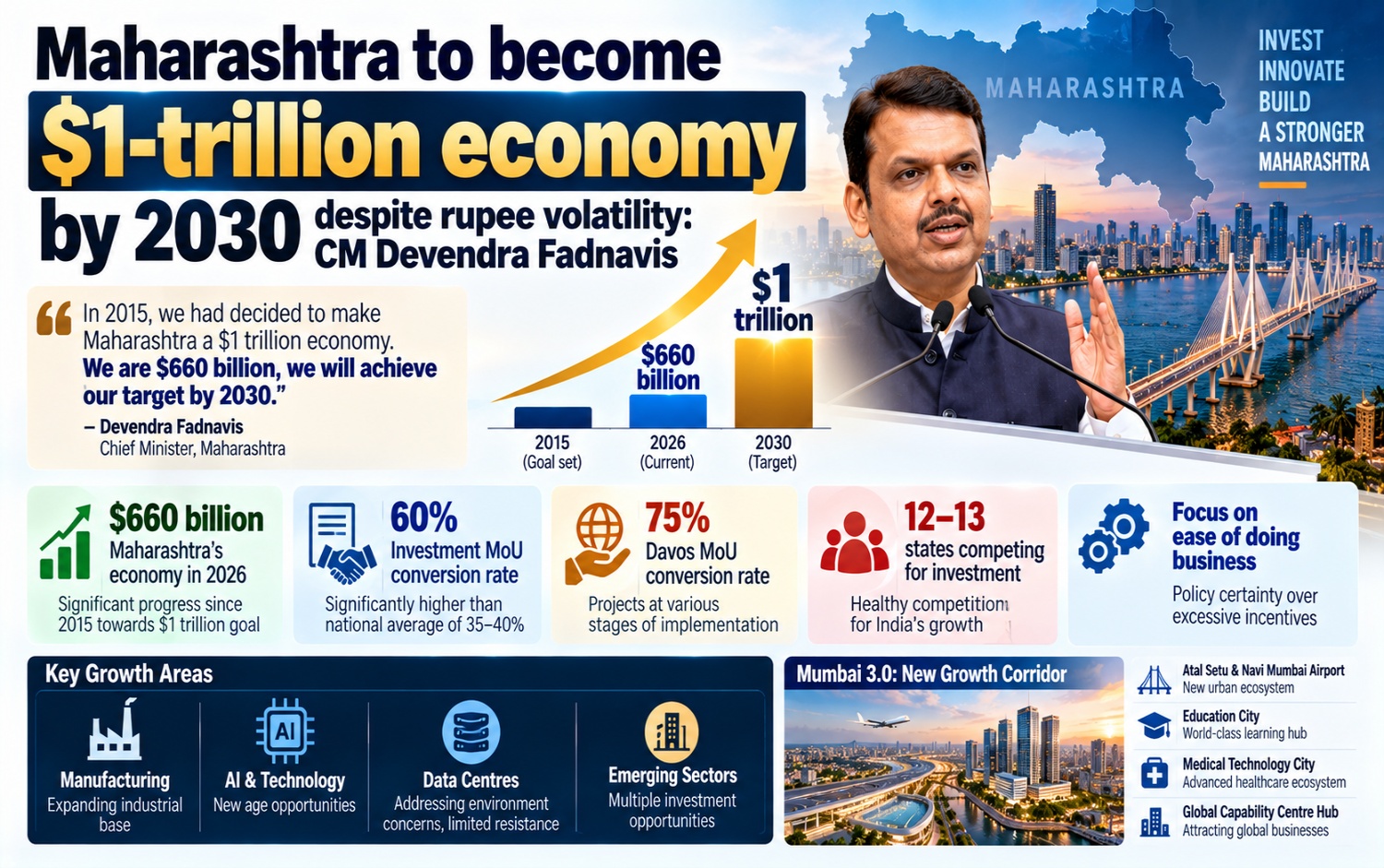
Maharashtra is addressing environmental concerns associated with data centres, particularly water consumption and climate-related challenges. The government is engaging with communities to explain how resources would be sourced and managed.
Fadnavis also outlined plans for Mumbai 3.0, a proposed urban growth ecosystem around Atal Setu and Navi Mumbai International Airport.
The NAINA development is expected to accommodate specialised clusters, including an education city, a medical technology city and a global capability centre hub.
If implemented successfully, these developments could support commercial real estate, construction, technology infrastructure and employment generation.
Read More : Maruti Suzuki Q2 FY27 Results: Why Selling a Record 6.97 Lakh Cars Did Not Mean Higher Profit
New investment commitments in semiconductors, renewable energy and advanced manufacturing
The article mentions investor interest in AI, manufacturing and data centres but does not give the latest examples of investment proposals.
On October 1, 2026, Maharashtra announced 67 MoUs involving 65 companies, representing proposed investments of ₹8.57 lakh crore and potential employment for approximately 2.91 lakh people. The proposals span data centres, semiconductors, renewable energy, aerospace and defence, advanced manufacturing, metals, healthcare and agro-processing.
Examples include:
-
Akshat Greentech: A proposed ₹1 lakh crore investment across Navi Mumbai and Pune, covering data centres, IT-enabled services and semiconductor-related projects.
-
Pi-Semicon: A proposed semiconductor facility in Nashik.
-
Shyam Metalics and Energy: A proposed metals and mining project in Chandrapur.
-
Astracity: A proposed data centre project in Ratnagiri.
-
Sterlite Group: Proposed digital infrastructure and semiconductor-related projects in Shahpur and Khalapur.
Data centres: Maharashtra’s next major growth engine
The original article mentions data centre investment but leaves out the scale of the state’s ambitions.
According to reporting published in September 2026, Maharashtra had attracted more than $300 billion in data centre investment interest and accounted for approximately 66% of India’s data centre capacity, according to the state’s chief investment adviser. The state was targeting 5.7 GW of data centre capacity by 2032.
The key additional points are:
-
Artificial intelligence and cloud computing: Data centres can support growing demand for digital infrastructure.
-
Power infrastructure: Large facilities require reliable electricity and substantial grid capacity.
-
Water availability: Cooling requirements make water sourcing and environmental management important considerations.
-
Regional investment: Projects in locations such as Navi Mumbai, Pune and Ratnagiri could expand investment beyond traditional business districts.