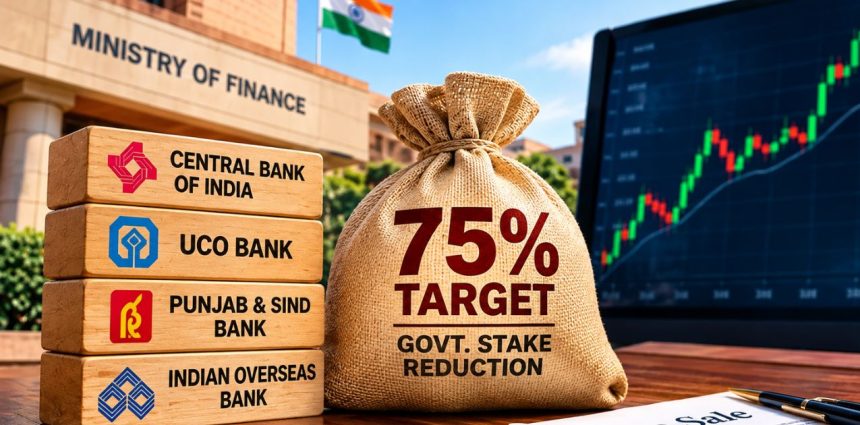
Four PSU bank stocks are in focus after a report on Friday, October 23, said the government is considering reducing its holdings in Central Bank of India, UCO Bank, Punjab & Sind Bank and Indian Overseas Bank to 75%.
The proposed reductions could increase public shareholding to 25%, bringing the lenders closer to the minimum public-shareholding threshold cited in the report. However, the government has not announced a confirmed timetable or individual offer sizes in the report, leaving investors uncertain about when additional shares could enter the market.
According to The Economic Times, officials said the first step would be to increase public shareholding in the four banks over the next year. The government could sell its existing holdings through offers for sale (OFS), depending on market conditions, while individual banks could also raise funds through the market. The report said queries sent to the Finance Ministry had not received a response by publication time.
Need to Know
- Four stocks: Central Bank of India, UCO Bank, Punjab & Sind Bank and Indian Overseas Bank.
- Reported target: Government ownership reduced to 75%, implying a 25% public float if achieved.
- No confirmed sale schedule: Offer sizes, prices and transaction dates remain undisclosed in the report.
- Market tension: Higher public float could improve trading liquidity, but a large OFS could put near-term pressure on share prices.
How Much Does the Government Hold in These Banks?
The latest official figures located show that government ownership remains above 80% at all four lenders, although the figures have different reporting dates.
| PSU bank | Government holding | Gap to 75% |
|---|---|---|
| Central Bank of India | 81.19% | 6.19 percentage points |
| UCO Bank | 90.95% | 15.95 percentage points |
| Punjab & Sind Bank | 93.85% | 18.85 percentage points |
| Indian Overseas Bank | 92.44% | 17.44 percentage points |
Source: Department of Financial Services and DIPAM. Central Bank of India’s holding is after its May 2026 OFS; the other three figures are as of March 31, 2026. Gaps are NiftyTrader calculations, not announced sale quantities.
The figures show that the potential scale of further dilution differs significantly across the four lenders. Punjab & Sind Bank has the largest percentage-point gap to 75%, followed by Indian Overseas Bank and UCO Bank. Central Bank of India is already closer to the reported target after its earlier stake sale.
That difference matters because a common ownership target does not mean every bank would face the same volume of additional shares or the same market impact.
Central Bank of India Offers a Recent Precedent
The government has already reduced its stake in the Central Bank of India through an OFS.
According to the Department of Investment and Public Asset Management (DIPAM), the government sold an 8.08% stake and received ₹2,266.13 crore in FY2026–27. Its holding after the transaction stood at 81.19%.
This provides a concrete example of the route that could be used for further dilution. It does not, however, confirm that another OFS is imminent or that the same method will be used for all four lenders.
Investors should also distinguish a government OFS from a bank issuing new equity. An OFS involves selling existing shares held by the government, whereas a fresh equity issue can increase the total number of shares outstanding. The implications for share supply and per-share financial metrics can therefore differ.
Could the Stake Sales Affect Share Prices?
The immediate market impact would depend on the size, timing and pricing of any transaction.
A larger public float can broaden investor participation and potentially improve liquidity. However, an OFS may create short-term selling pressure if the quantity offered is large relative to market demand or the offer price is discounted against the prevailing share price.
The opposite outcome is also possible: strong demand for an offer could absorb the additional supply. The ownership target alone is not enough to predict how any of the four shares will trade.
The next meaningful signals would be formal government disclosures, exchange filings by the banks, and details such as the OFS floor price, share quantity and offer dates. Until these become available, investors should avoid treating the reported plan as a confirmed near-term price catalyst.
Stake Dilution Is Not the Same as Privatisation
The report also points to a possible future round of public-sector-bank consolidation that could identify two more banks for privatisation. This remains a separate and unconfirmed development.
In a March 24, 2026, parliamentary reply, the government had said that no public-sector-bank merger or consolidation proposal was then under consideration. The October report may indicate a change in discussions, but it does not establish a formally approved consolidation plan.
Reducing government ownership to 75% would still leave the Centre with majority control. A strategic privatisation involving a transfer of control would be a different transaction and should not be inferred from the reported stake-reduction plan alone.
Bottom Line
Central Bank of India, UCO Bank, Punjab & Sind Bank and Indian Overseas Bank are worth tracking after the reported proposal to reduce government holdings to 75%. The Central Bank’s earlier ₹2,266.13-crore OFS demonstrates that stake sales can be executed, but no new offer schedule for these four banks has been confirmed in the report.
The key question for investors is whether the government moves from a reported plan to formal transactions. A larger public float could support liquidity over time, while the timing and pricing of future sales could determine whether the immediate effect is positive, negative or limited.
Read Next: Stocks to Watch Today, Oct 23: Jio IPO, Infosys, Swiggy, HPCL in focus
Disclaimer: This article is for informational and educational purposes only and is not investment advice or a recommendation to buy or sell any security. Investors should verify official disclosures and assess market risks before making investment decisions.