
Oil Hits $112 Again After Saudi Attacks. Will Petrol and Diesel Get Costlier?
Brent crude oil prices climbed more than 3% on Thursday, October 22, as fresh attacks in Saudi Arabia intensified concerns about global oil supplies. The rally puts crude prices back in focus for investors, with higher energy costs potentially creating fresh challenges for stock markets, businesses and consumers.
At around 1:30 p.m., Brent crude, the global oil benchmark, rose 3.23% to approximately $112.27 a barrel. US West Texas Intermediate (WTI) crude also moved higher, approaching $99 a barrel.
The latest increase comes as tensions across West Asia threaten to disrupt energy shipments. The United States has also ordered some personnel and their family members to leave American embassies in Saudi Arabia, adding to concerns about the regional security situation.
Track Live : NSE Option Chain — Live | BSE Option Chain — Live Sensex & Bankex Options Data Today
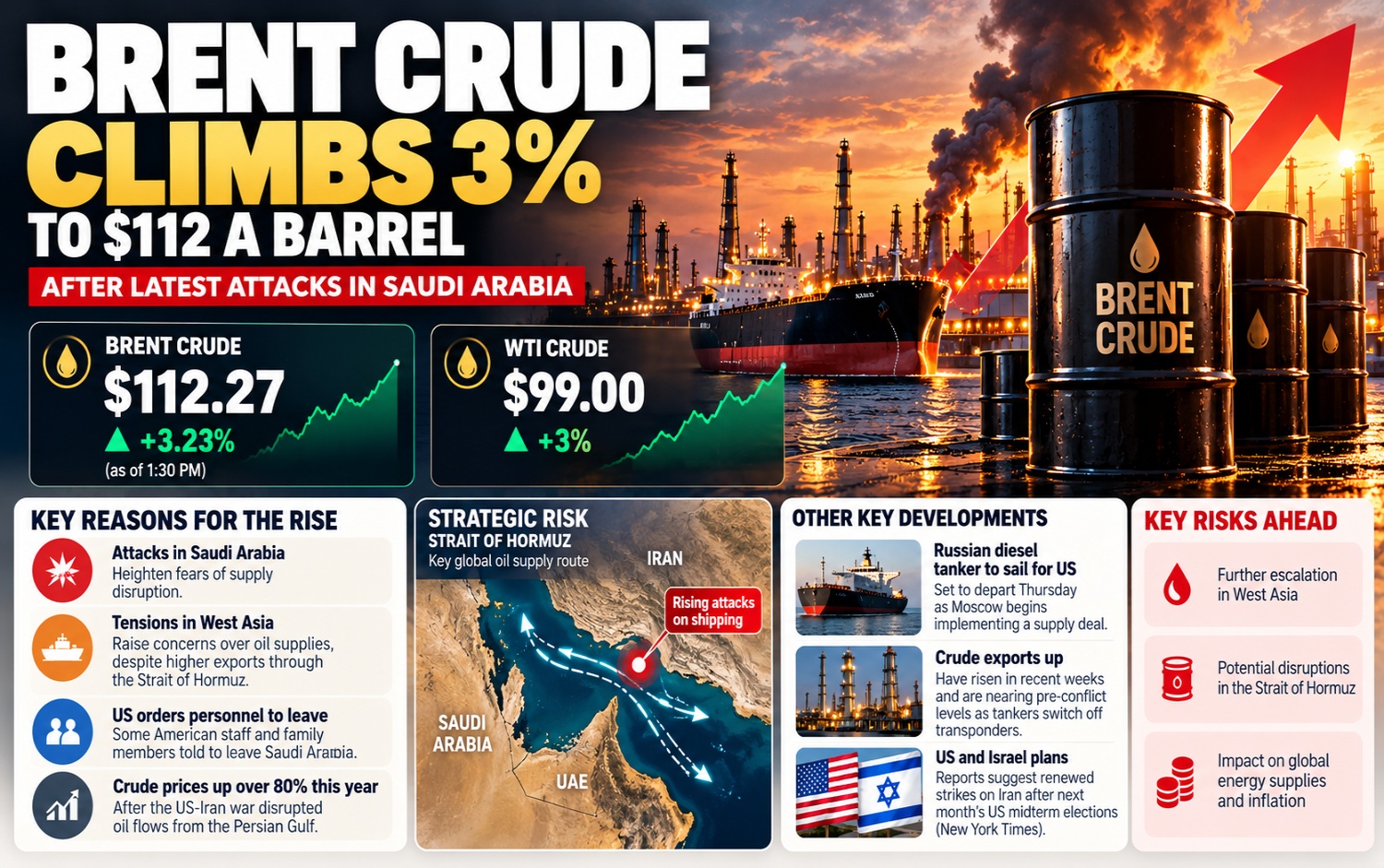
Oil Hits : Brent Crude Oil Climbs 3% to $112 After Attacks in Saudi Arabia
Brent crude oil prices rose sharply on Thursday, October 22, 2026, as fresh attacks in Saudi Arabia heightened concerns about potential disruptions to global oil supplies. According to the figures in the supplied report, Brent crude gained 3.23% to approximately $112.27 per barrel at around 1:30 p.m., while US West Texas Intermediate (WTI) crude moved towards $99 per barrel.
The increase highlights how geopolitical tensions in West Asia can affect oil prices, fuel costs, inflation and financial markets
worldwide. Meanwhile, a tanker carrying Russian diesel is reportedly preparing to sail to the United States as Moscow begins implementing a supply deal.
Brent and WTI Crude Oil: Combined Market Snapshot
| Category | Brent Crude | WTI Crude |
|---|---|---|
| Current Price | $112.18/bbl | $99.29/bbl |
| Session High | $112.55 | $100.04 |
| Year-over-Year Performance | +71.8% | +61.7% |
| Daily Price Change | +3.23%* | Near $99/bbl* |
| Main Market Driver | Geopolitical tensions in West Asia | Supply disruption concerns |
| Key Risk | Disruptions to Gulf oil exports | Tightening supply and inventory changes |
The prices, session highs and year-over-year returns are from your supplied figures and have not all been independently verified against a single timestamped source. Reuters reported Brent at $112.17, up 3.08%, and WTI at $99.83 during trading on October 22, 2026.
Strait of Hormuz Tensions Keep the Oil Market on Edge
The Strait of Hormuz remains a critical factor in the outlook for crude oil prices. Iran has intensified attacks on shipping in the waterway in recent weeks, while Houthi militants backed by Tehran have frequently targeted Saudi Arabia.
Any sustained disruption to shipping through the region could tighten global oil availability and push prices higher. However, a recovery in exports or a reduction in hostilities could ease some of the upward pressure.
The market is therefore reacting not only to confirmed supply changes but also to the possibility of further attacks. This uncertainty can contribute to sharp price movements and increased volatility in crude oil futures.
US-Iran Tensions Add Another Risk for Crude Oil Prices
Geopolitical uncertainty has also increased following a report by The New York Times that the United States and Israel have drawn up plans for renewed strikes against Iran after next month’s US midterm elections.
The report cited US officials and other people briefed on the deliberations. Any further military escalation could heighten concerns about energy infrastructure, shipping routes and regional oil exports.
However, the reported plans do not establish that new strikes will take place. Traders will continue to assess developments and their potential implications for supply.
Track Live : Nifty Levels Today | Sensex Levels Today
Russian Diesel Shipment to the US Adds a New Supply Development
Meanwhile, a tanker carrying Russian diesel is scheduled to sail for the United States on Thursday as Moscow begins implementing a supply deal, Russian Deputy Prime Minister Alexander Novak told reporters on Wednesday, according to Tass.
The shipment adds another development to an energy market already facing geopolitical uncertainty. However, its broader impact will depend on the scale and continuity of supplies, as well as the extent of disruptions elsewhere.
Read More : Jio IPO Is Nearly 4x Booked in Two Days. Should You Still Apply Before It Closes?
Petrol Price in India Today – October 22, 2026
Petrol prices vary across India due to differences in state taxes, VAT and transportation costs. According to fuel-price reports published on October 22, 2026, petrol costs ₹102.12 per litre in New Delhi and ₹111.21 in Mumbai. In Rajasthan, prices are higher, with Jaipur at approximately ₹112.66 per litre and Jodhpur at ₹113.20 per litre.
Petrol Prices in Major Indian Cities
| City | Petrol Price (₹/litre) |
|---|---|
| New Delhi | ₹102.12 |
| Mumbai | ₹111.21 |
| Kolkata | ₹113.51 |
| Chennai | ₹107.74 |
| Bengaluru | ₹110.93 |
| Hyderabad | ₹115.73 |
| Jaipur | ₹112.66 |
| Jodhpur | ₹113.20 |
| Ahmedabad | ₹101.83 |
| Lucknow | ₹101.86 |
| Udaipur | ₹113.46 |
Sources: Moneycontrol, AajTak and JanSevaPlus fuel-price reports.
Important Points
-
Daily price revisions: Oil marketing companies generally revise fuel prices daily, with the revised rates taking effect around 6 a.m.
-
State taxes: Differences in VAT and local transportation costs contribute to variations between cities.
-
GST: Petrol is currently outside India’s GST framework.
-
Crude oil impact: International crude prices can affect India’s fuel costs, although domestic retail prices do not necessarily change immediately with every movement in crude.
For Rajasthan: The reported petrol price is ₹112.66 per litre in Jaipur and ₹113.20 per litre in Jodhpur. Local pump prices may vary slightly, so check with your nearest fuel station for the final rate.
Why Are Oil Prices Rising?
The latest increase reflects fears that the conflict in West Asia could disrupt crude oil production, exports and tanker movements. Although crude exports through the Persian Gulf have recovered towards pre-conflict levels, security risks around the Strait of Hormuz continue to create uncertainty.
Meanwhile, the reported plan for renewed US-Israeli strikes against Iran adds to geopolitical uncertainty. The tanker carrying Russian diesel to the United States could provide additional supplies, but its impact would depend on the volume delivered and broader market conditions.
What Does This Mean for India?
India imports a substantial share of its crude oil requirements. If international oil prices remain elevated, the country could face a higher import bill, pressure on the rupee and increased inflation risks. Transport, aviation, logistics and other fuel-intensive industries may also face higher costs.
Here’s What Happened Today and Why Traders Reacted
Crude oil traders responded to the latest attacks by weighing the risk of further supply disruptions against signs that some oil exports are recovering.
Brent crude has gained more than 80% this year, according to the supplied report, following disruptions to Persian Gulf oil flows linked to the US-Iran war. The conflict is approaching its ninth month, keeping geopolitical risks firmly in focus.
Although crude exports have increased in recent weeks and are nearing pre-conflict levels, shipments of refined oil products remain constrained. Reports indicate that some tankers have switched off their transponders to avoid detection, complicating efforts to track shipments.
For traders, the key concern is whether the latest escalation will interrupt the recovery in oil exports or create additional pressure on global supplies.
What Higher Crude Oil Prices Mean for Investors and Traders
The latest rise in Brent crude oil prices could have different implications across financial markets.
- Oil companies: Higher crude prices may support upstream producers, although company-specific costs and production levels also matter.
- Airlines and transport stocks: Higher fuel costs can pressure operating margins if companies cannot pass on the increase.
- Oil marketing companies: Rising crude prices may squeeze margins if retail fuel prices do not adjust accordingly.
- Inflation and interest rates: Sustained energy price increases could add to inflationary pressure and complicate monetary policy decisions.
- Stock market sentiment: Continued geopolitical escalation may encourage caution among investors and increase volatility.
For traders, crude oil’s next move will depend on developments in West Asia, shipping conditions and evidence of actual supply disruptions. Investors should avoid assuming that a single-day price surge will continue.
What Investors Should Watch as Oil Prices Remain Volatile
Brent crude’s move to around $112.27 a barrel highlights how quickly geopolitical developments can influence energy markets. The immediate focus remains on Saudi Arabia, the Strait of Hormuz, US-Iran tensions and the flow of oil and refined products.
If supply disruptions intensify, crude prices could face further upward pressure. If exports remain resilient and tensions ease, prices could retreat from recent highs.