Fairfax’s IDBI Bank Takeover: Can It Build a Global Indian Banking Giant?
Fairfax Financial Holdings is preparing to reshape IDBI Bank into a broader financial services business, combining banking with insurance, wealth management and investment banking. But for investors, the biggest questions are how the strategy will be executed, whether it can improve the bank’s growth prospects, and what the proposed ownership change means for employees and existing businesses.
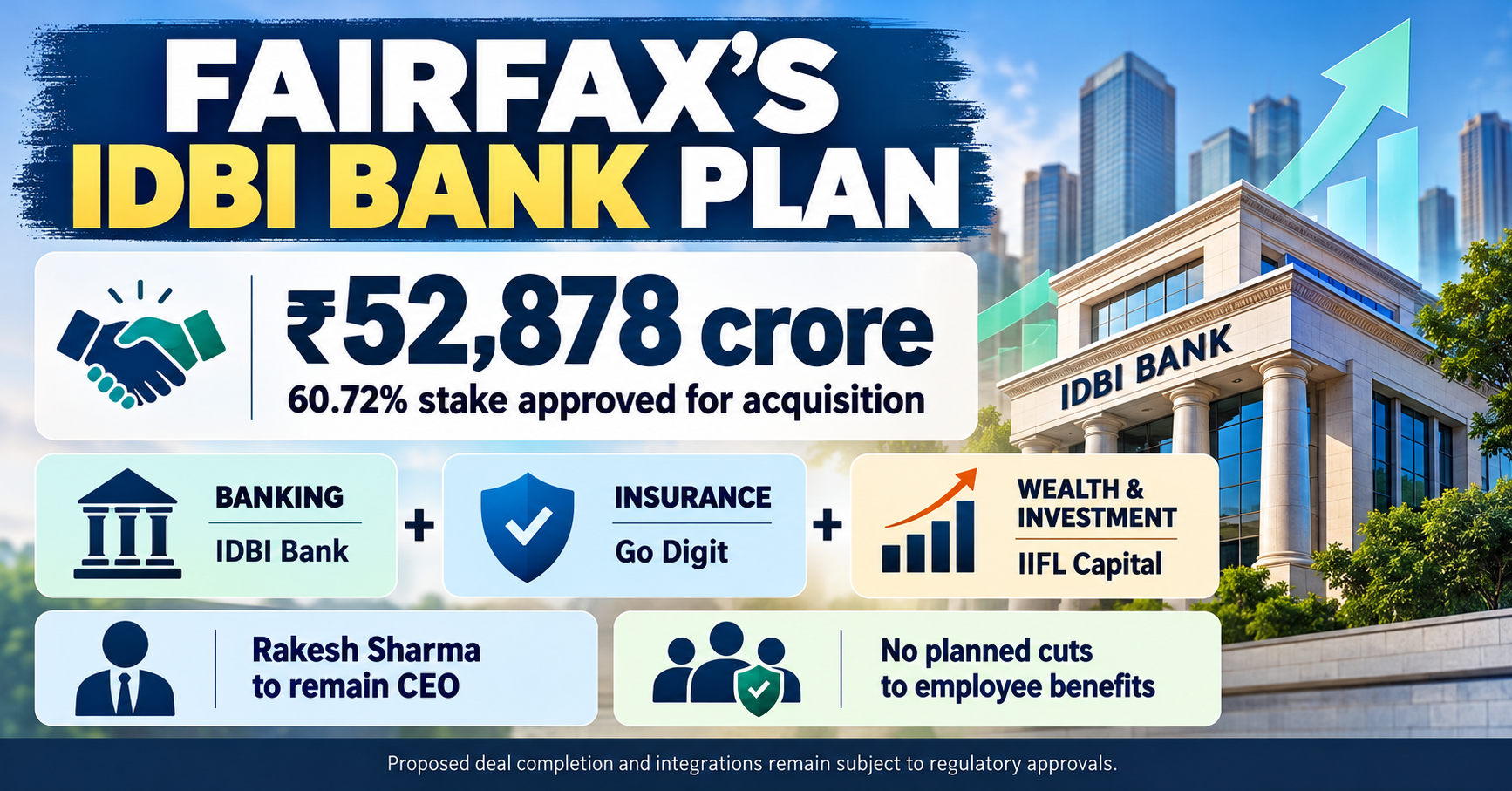
Fairfax chairman and CEO Prem Watsa says the group intends to retain IDBI Bank’s current chief executive, Rakesh Sharma, and protect employee benefits. The proposed ₹52,878-crore acquisition of a 60.72% stake has received government approval, according to the information provided, with completion targeted for early next year, subject to remaining formalities.
Track Live : Nifty Levels Today | Sensex Levels Today
Fairfax’s IDBI Bank Takeover, Go Digit and IIFL
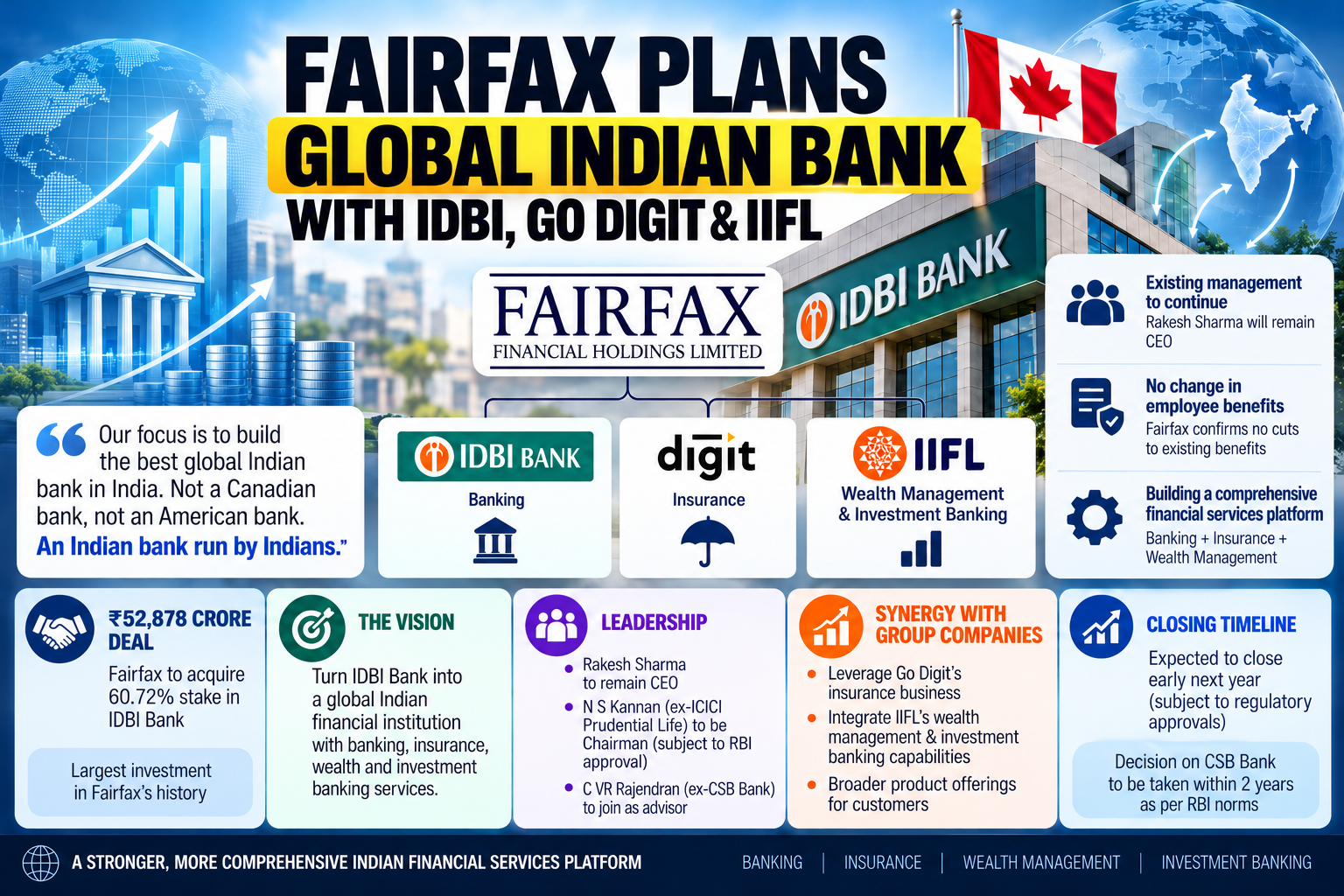
The proposed strategy goes beyond acquiring a controlling stake in IDBI Bank. Fairfax plans to bring its Indian financial services investments under the bank, creating a platform that combines deposits and lending with insurance, wealth management and investment banking.
Watsa explained the vision in clear terms: “Our focus is to build the best global Indian bank in India. Not a Canadian bank, not an American bank. An Indian bank run by Indians.”
The group believes the combined businesses could reach more customers through IDBI Bank’s distribution network while offering a wider range of financial products. However, the benefits will depend on execution, regulatory approvals and the ability to generate sustainable growth.
Fairfax–IDBI Bank deal: Key details
|
Particulars |
Details |
|---|---|
| Strategic buyer | Fairfax Financial Holdings, through its wholly owned subsidiary, 10955230 Canada Inc. |
| Total deal value | ₹52,878.08 crore |
| Stake to be acquired | 60.72% of IDBI Bank |
| Acquisition price | ₹81 per share |
| Government stake being sold | 30.48% |
| LIC stake being sold | 30.24% |
| Government’s remaining stake | 15% |
| LIC’s remaining stake | 19% |
| Approval status | Cabinet Committee on Economic Affairs approved Fairfax as the strategic buyer on October 14, 2026. RBI clearance and regulatory compliance steps remain. |
| Planned business strategy | Combine banking with Digit insurance and IIFL Capital’s investment banking and wealth management services. |
| Employee benefits | The government has stated that employee service conditions and pension benefits will be protected. |
| CSB Bank consideration | Fairfax must resolve its existing CSB Bank holding by exiting one bank or merging CSB Bank with IDBI Bank within the applicable two-year period, subject to regulatory requirements. |
What Prem Watsa plans to do with IDBI Bank
Fairfax wants to transform IDBI Bank into an integrated financial services group, combining traditional banking with insurance, investment banking and wealth management.
Watsa described the objective as building a global Indian bank that is managed by Indians, rather than turning it into a Canadian or American bank.
The proposed strategy has three major components:
-
Banking: Retain IDBI Bank’s core lending, deposit and customer services while pursuing expansion.
-
Insurance: Use the distribution network of IDBI Bank to create opportunities for Fairfax-backed Go Digit.
-
Wealth management and investment banking: Bring IIFL Capital Services’ capabilities into the broader financial services strategy.
IDBI Bank management will continue under Rakesh Sharma
Fairfax does not plan to replace IDBI Bank’s managing director and CEO, Rakesh Sharma, following the acquisition. Watsa said the group was comfortable with the existing leadership.
Former ICICI Prudential Life Insurance CEO N.S. Kannan is proposed as chairman, subject to Reserve Bank of India approval. Former CSB Bank chief C.V. Rajendran is also expected to support the leadership in an advisory role.
For employees, Watsa said existing benefits would remain protected. He also highlighted the importance of frontline staff in delivering customer service.
These assurances may help reduce uncertainty during the ownership transition, although investors should watch for formal announcements about governance, integration and future operating priorities.
Rakesh Sharma to remain CEO
- Prem Watsa said Fairfax does not intend to replace IDBI Bank’s current managing director and CEO, Rakesh Sharma.
No planned reduction in employee benefits
- Watsa said existing employee benefits would be protected. He also stated that pension and gratuity liabilities had been examined during due diligence.
Proposed leadership appointments
- N. S. Kannan, former CEO of ICICI Prudential Life Insurance, is proposed as chairman, subject to RBI approval. C. V. R. Rajendran is expected to assist in an advisory capacity.
Track Live : NSE Option Chain — Live | BSE Option Chain — Live Sensex & Bankex Options Data Today
What the IDBI Bank deal means for investors and traders
The Fairfax-IDBI Bank deal creates potential opportunities, but investors should avoid treating the proposed integration as a guarantee of higher earnings or stock appreciation.
Key factors to monitor include:
-
Growth potential: Whether banking, insurance and wealth management generate stronger customer relationships and additional revenue.
-
Valuation: How IDBI Bank’s market price compares with the acquisition price and the bank’s financial performance.
-
Regulatory approvals: Whether the proposed transaction and business restructuring proceed as planned.
-
CSB Bank decision: Fairfax must address its existing 40% holding in CSB Bank within the applicable two-year regulatory timeline.
Investors should also review upcoming earnings, asset quality, margins and operating costs before making portfolio decisions.
Read More : Jio’s Profit Engine: How It Grew EBITDA 17.8% in 3 Years, Per Akash Ambani
How the deal could affect stocks
The transaction has implications beyond IDBI Bank because Fairfax has existing interests in other Indian financial services businesses.
| Company | Potential implication for investors |
|---|---|
| IDBI Bank | Ownership change could create opportunities for business expansion, but execution and regulatory risks remain. |
| Go Digit General Insurance | Access to IDBI Bank’s customer and distribution network could support insurance sales, subject to approvals and commercial arrangements. |
| IIFL Capital Services | Its investment banking and wealth management capabilities could complement IDBI Bank’s existing business. |
| CSB Bank | Fairfax will need to decide how to address its existing 40% holding in CSB Bank under applicable banking regulations. |
The proposed integration is subject to regulatory approvals and should not be treated as guaranteed additional revenue or profit for any listed company.
Here’s what happened today and why traders reacted
The major development is Fairfax’s proposed ₹52,878-crore acquisition of a 60.72% stake in IDBI Bank, following government approval. The transaction is expected to close early next year, subject to remaining formalities.
However, the initial stock market reaction was not positive. IDBI Bank shares fell around 7% in early trade on October 15 after investors assessed the agreed acquisition price of ₹81 per share, which was approximately 11% below the previous closing price.
This highlights an important distinction for investors: a major acquisition can improve a company’s long-term strategic outlook without immediately lifting its share price. Traders may focus on the transaction price, valuation, timing and whether the deal offers additional upside to minority shareholders.
Fairfax’s biggest investment faces its next major test
Watsa described the IDBI Bank acquisition as Fairfax’s largest investment to date. The group’s ambition is to build a broader Indian financial services institution while retaining local leadership and protecting employee benefits.
The next phase will be crucial. For long-term investors, the real test will be whether the strategy translates into stronger earnings, sustainable growth and improved shareholder value.