
The Rupee Gains 2% in 5 Day, but the RBI’s next move could shape market sentiment
The Indian rupee has staged a notable recovery against the US dollar, reaching its strongest level in more than a month on Wednesday, October 14. But the bigger question for investors is whether the rally can continue or if fresh pressure will emerge from rising crude oil prices and foreign fund outflows.
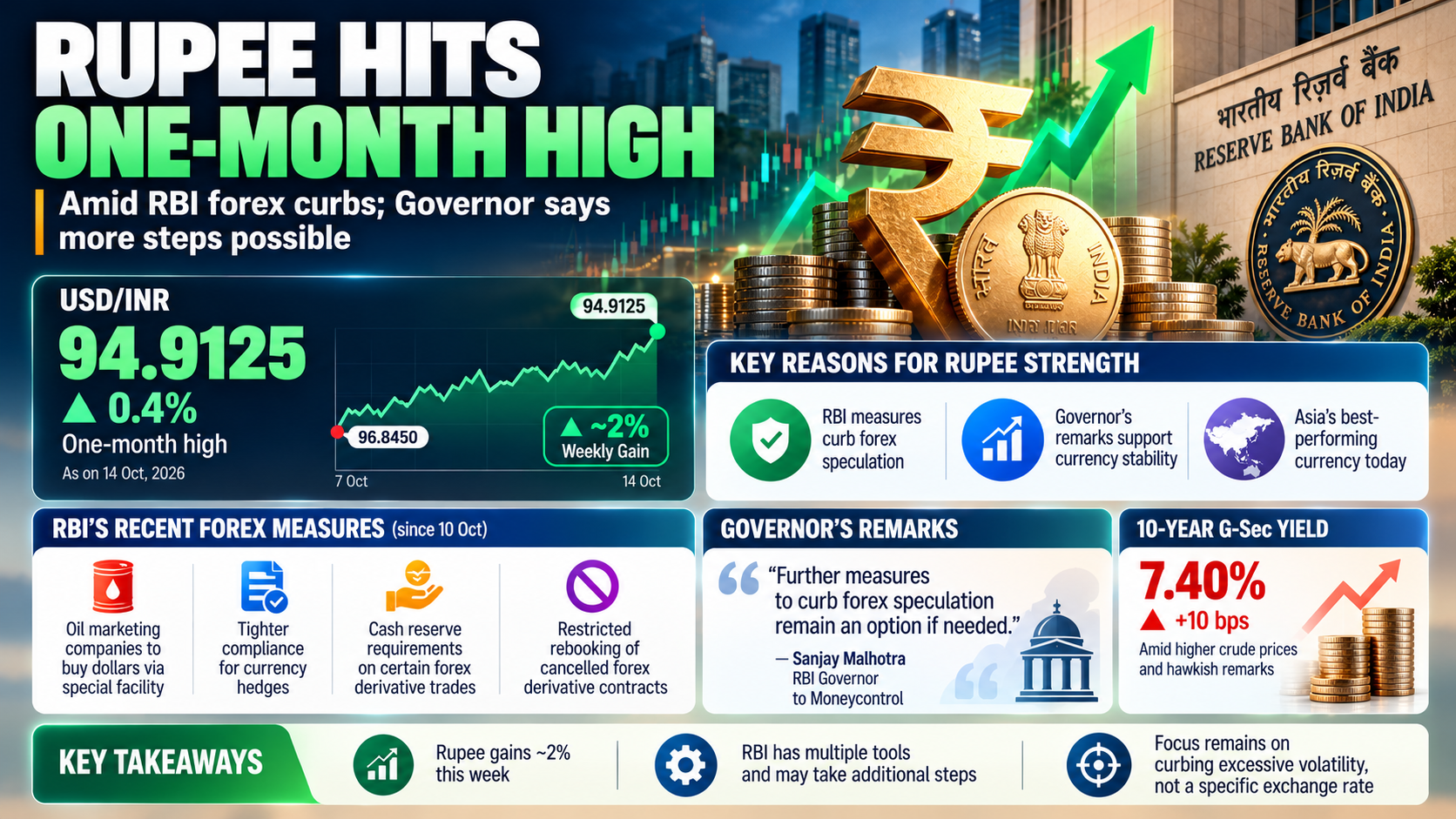
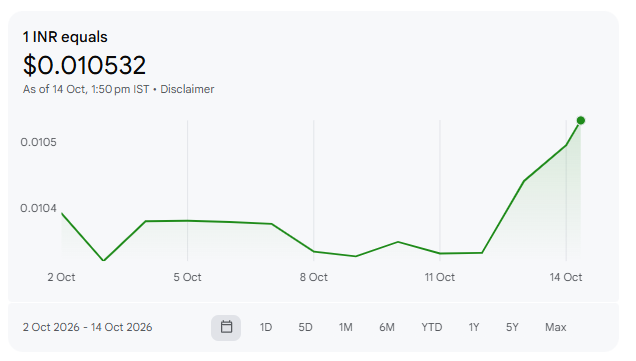
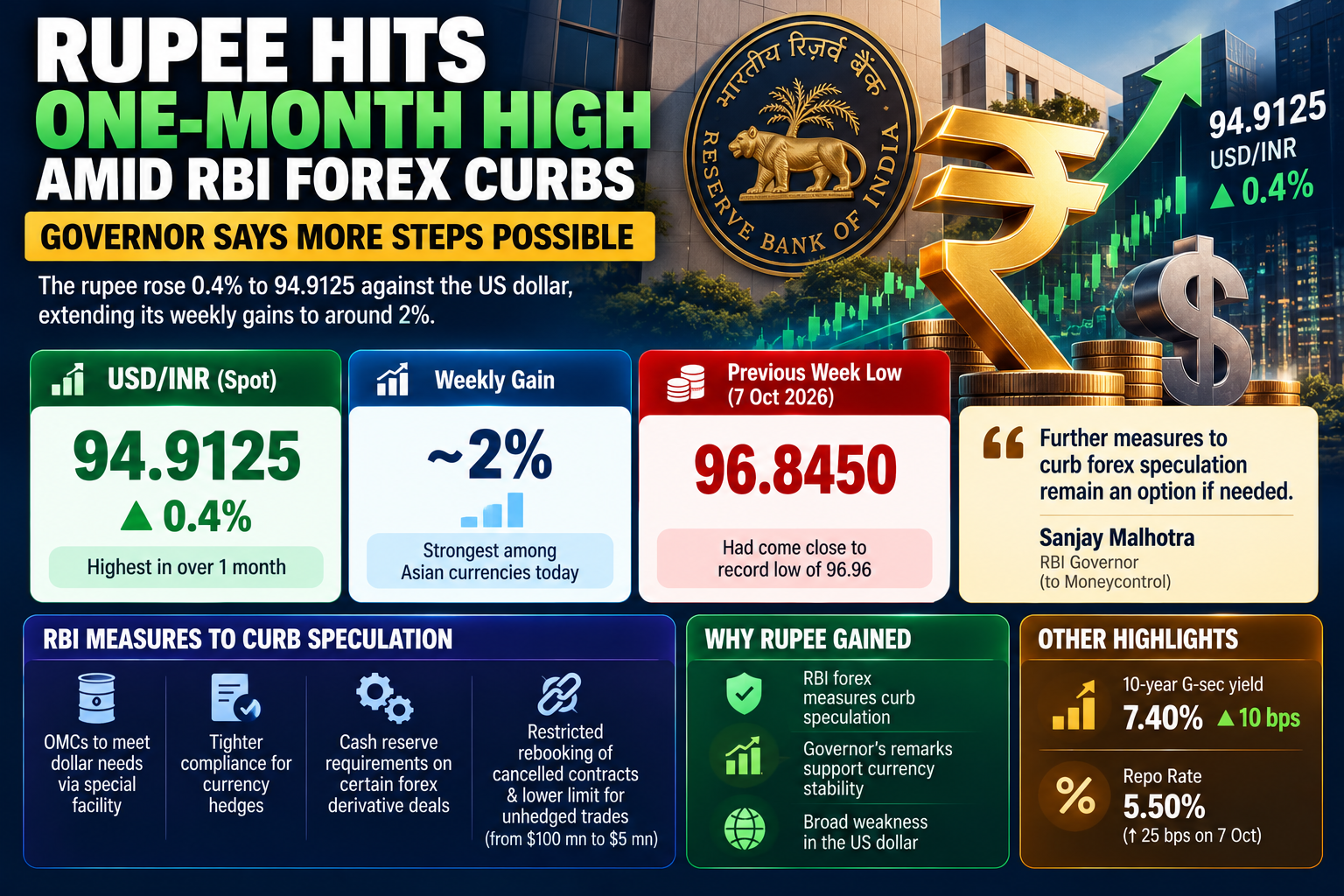
The rupee rose 0.4% to 94.9125 against the US dollar, extending its weekly gains to around 2%. Support came from recent Reserve Bank of India (RBI) measures aimed at curbing speculative currency trading and comments from RBI Governor Sanjay Malhotra indicating that further action remains possible.
The recovery offers some relief to financial markets after the currency approached record-low levels last week. However, investors will be watching whether the RBI’s measures can deliver lasting stability.
Track Live : NSE Option Chain — Live | BSE Option Chain — Live Sensex & Bankex Options Data Today
Rupee Gains 2% in 5 Day: RBI forex curbs target speculation without blocking foreign investment
Since October 10, the RBI has introduced several measures to reduce speculative pressure on the rupee.
These include directing oil marketing companies to meet dollar requirements through a special facility, tightening compliance rules for currency hedges and imposing cash reserve requirements on certain foreign exchange derivative transactions.
The central bank has also restricted the rebooking of cancelled forex derivative contracts and reduced the limit for transactions without an underlying exposure from $100 million to $5 million.
Malhotra said the RBI had observed excessive speculative positioning on the dollar-buying side over recent months. In some cases, around one-third of forex derivative trades were being closed or cancelled on the same day.
Importantly, the governor clarified that the restrictions were not capital controls and would not prevent foreign investors from bringing money into India or repatriating their investments.
Why is the rupee rising?
Three developments appear to be supporting the currency.
1. RBI is discouraging speculative dollar buying
The central bank has tightened rules on foreign exchange derivatives, increased compliance requirements and restricted certain trades. These steps can make speculative positions against the rupee more expensive or difficult to maintain.
2. Oil companies’ dollar demand is being redirected
The RBI introduced a special facility to meet the dollar requirements of three state-owned oil marketing companies. This reduces the need for those companies to purchase dollars directly from the regular spot market, potentially easing immediate pressure on the rupee.
3. The RBI governor has signalled readiness to act
Governor Sanjay Malhotra has said the RBI will consider further measures if needed to maintain orderly foreign exchange market conditions. His comments may discourage one-way speculative bets and improve short-term market confidence.
RBI’s Anti-Speculation Crackdown: How the New Forex Rules Target Dollar Bets
The Reserve Bank of India (RBI) introduced a series of foreign-exchange restrictions in October 2026 to curb speculative trading and ease pressure on the rupee. Governor Sanjay Malhotra said the central bank had observed excessive dollar-buying positions, with around one-third of certain forex derivative trades being cancelled or closed on the same day they were entered.
The five key RBI measures
| Measure | What changed | Intended effect |
|---|---|---|
| Derivative exposure limits | Threshold reduced from $100 million to $5 million under specified facilities | Restrict large positions without demonstrated underlying exposure |
| Rebooking restrictions | Rebooking of cancelled rupee-linked derivative contracts prohibited under the new rules | Discourage repeated speculative trading |
| Hedge compliance | Tighter documentation and confirmation requirements | Prevent duplicate hedging of the same exposure |
| Cash reserve requirements | A 20% cash reserve applies to specified eligible derivative contracts | Increase the cost of certain currency positions |
| Special dollar facility | Three state-owned oil companies can obtain dollars through a dedicated RBI facility | Redirect substantial oil-related dollar demand away from the spot market |
Impact on the Indian stock market
A stronger rupee can benefit some sectors while creating challenges for others. The effect depends on whether the currency’s recovery lasts and what happens to crude oil prices and interest rates.
Potential beneficiaries
Aviation companies
A stronger rupee can reduce the rupee cost of dollar-linked aircraft leases, fuel-related imports and maintenance expenses, although actual benefits depend on hedging and fuel prices.
Mixed impact
Pharmaceutical and IT exporters
Exporters earning substantial dollar revenue may receive fewer rupees when converting those earnings. Lower imported-input costs and currency hedges can partly offset the effect.
Potential beneficiaries
Oil-importing businesses
A stronger rupee can reduce the domestic currency cost of imported crude and other commodities if international prices remain unchanged. Refining margins, fuel pricing and government policy still matter.
Potential pressure
Banks, rate-sensitive stocks and bond markets
Higher expected interest rates can increase funding costs and put pressure on bond prices. Banks and other financial stocks may react differently depending on their margins, asset quality and balance-sheet exposures.
What the rupee’s recovery means for stock market investors
A stronger rupee can influence several sectors of the Indian stock market, although the impact varies from company to company.
Import-dependent businesses, including companies that purchase raw materials or equipment overseas, may benefit from lower currency-related costs. Aviation and other businesses with substantial dollar-denominated expenses could also receive some relief.
On the other hand, exporters and companies earning a significant share of revenue in dollars may face pressure when foreign earnings are converted into rupees.
Foreign portfolio investors will also watch currency stability closely. A weaker rupee can reduce the value of Indian investments when returns are converted back into dollars, while a more stable currency may help sentiment.
However, a stronger rupee alone does not guarantee fresh foreign inflows or a sustained stock market rally.
Track Live : FII DII Data Today | NSE F&O Lot Size
Rising bond yields add another concern for the market
Despite the rupee’s recovery, India’s government bond market remained under pressure on Wednesday. The benchmark 10-year government bond yield rose 10 basis points to 7.40%, amid higher crude oil prices and the governor’s hawkish remarks.
The RBI had raised its benchmark repo rate by 25 basis points to 5.50% on October 7 and shifted its policy stance to calibrated tightening. Meanwhile, swap markets were pricing in around 90 basis points of rate increases over the following 12 months.
Higher bond yields can increase borrowing costs for businesses and affect the valuations of interest-rate-sensitive stocks. Banks, non-banking financial companies, real estate firms and other debt-dependent businesses could therefore remain in focus.
Malhotra did not indicate whether the Monetary Policy Committee would raise interest rates specifically to support the rupee. He did, however, say monetary policy and financial stability could not be completely separated.
Read More : BHEL Q2 FY27 Results on October 14, 2026: Profit May Jump 78% to Rs.654 Crore as EBITDA Rises 52%
Here’s what happened today and why traders reacted
The rupee strengthened after the RBI stepped up efforts to address excessive speculation in the foreign exchange market. In an interview with Moneycontrol, Governor Sanjay Malhotra said the central bank had several tools available and could introduce additional measures if necessary.
The governor’s comments signalled that the RBI remains prepared to respond if speculative activity continues. That message helped support sentiment around the Indian rupee.
The currency had weakened to 96.8450 against the dollar on October 7, approaching its record low of 96.96. It subsequently recovered, gaining around 1% on Monday before closing at 95.28 on Tuesday.
For traders, the latest rally represents a sharp change in near-term momentum. However, the sustainability of the recovery will depend on dollar demand, crude oil prices and foreign investment flows.
What traders should watch in the coming days
The next phase of the rupee’s movement will depend on whether RBI restrictions continue to reduce speculative dollar demand and whether external pressures begin to ease.
Investors should track crude oil prices, foreign portfolio investment flows, the dollar’s global movement and further RBI announcements. These factors could influence the rupee, bond yields and equity market sentiment simultaneously.
For now, the currency’s recovery provides some relief, but uncertainty remains. The key question is whether the RBI’s intervention can stabilise the rupee without creating additional pressure elsewhere in financial markets.
Investors should assess individual company fundamentals and currency exposure rather than treating the rupee’s rally as a signal that every sector will benefit.