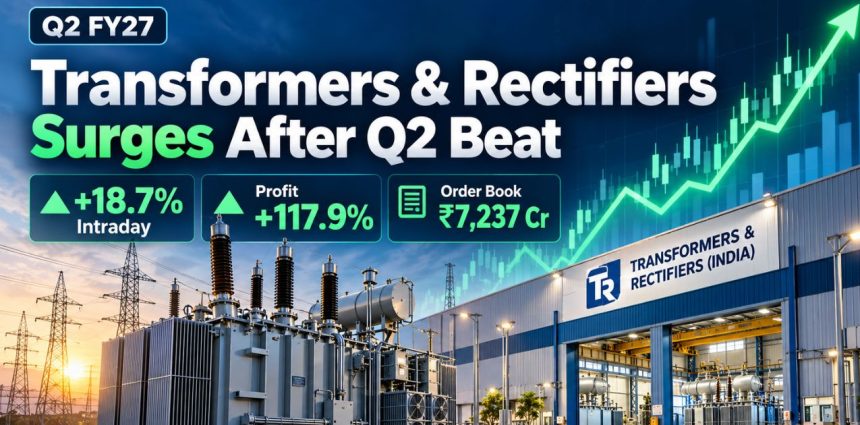
Transformers & Rectifiers’ consolidated revenue rose 61%, and quarterly profit more than doubled in Q2 FY27. The next test is converting a ₹7,237 crore order book into revenue while sustaining margins and improving cash conversion.
Transformers & Rectifiers (India) shares surged as much as 18.7% to ₹360.80 during Wednesday’s intraday session after the transformer manufacturer reported a sharp improvement in September-quarter earnings. Revenue increased 60.7% year-on-year, consolidated profit for the period rose 117.9%, and quarterly order inflows nearly doubled.
But the more important question for investors is what comes next. The company has an unexecuted order book of ₹7,237 crore and expects its Changodar manufacturing expansion to begin commercial production around Diwali. Converting those opportunities into revenue will depend on execution, capacity utilisation and working-capital discipline.
The rally follows a quarter of substantially improved profitability, but it does not by itself establish that the company’s margin recovery will persist.
TARIL’s latest performance follows earlier utility contract wins, including orders from GETCO and DVC, which had already put order-book execution in focus. Read more about TARIL’s recent GETCO and DVC order wins.
Need to Know
- Share-price move: The stock touched an intraday high of ₹360.80 on October 14, compared with the previous close of approximately ₹304. These are intraday prices, not closing prices.
- Consolidated results: Revenue from operations increased 60.7% to ₹739.44 crore. Profit for the period rose 117.9% to ₹81.38 crore.
- Order momentum: Q2 order inflows increased 97% to ₹1,169 crore. The unexecuted order book stood at ₹7,237 crore on September 30, up 32% year-on-year.
- Management guidance: FY27 targets remain approximately 25% revenue growth, a 16% EBITDA margin and a 9%–10% PAT margin.
- Key risk: The next phase depends on timely capacity commissioning, sustained operating margins and a reduction in the working-capital cycle.
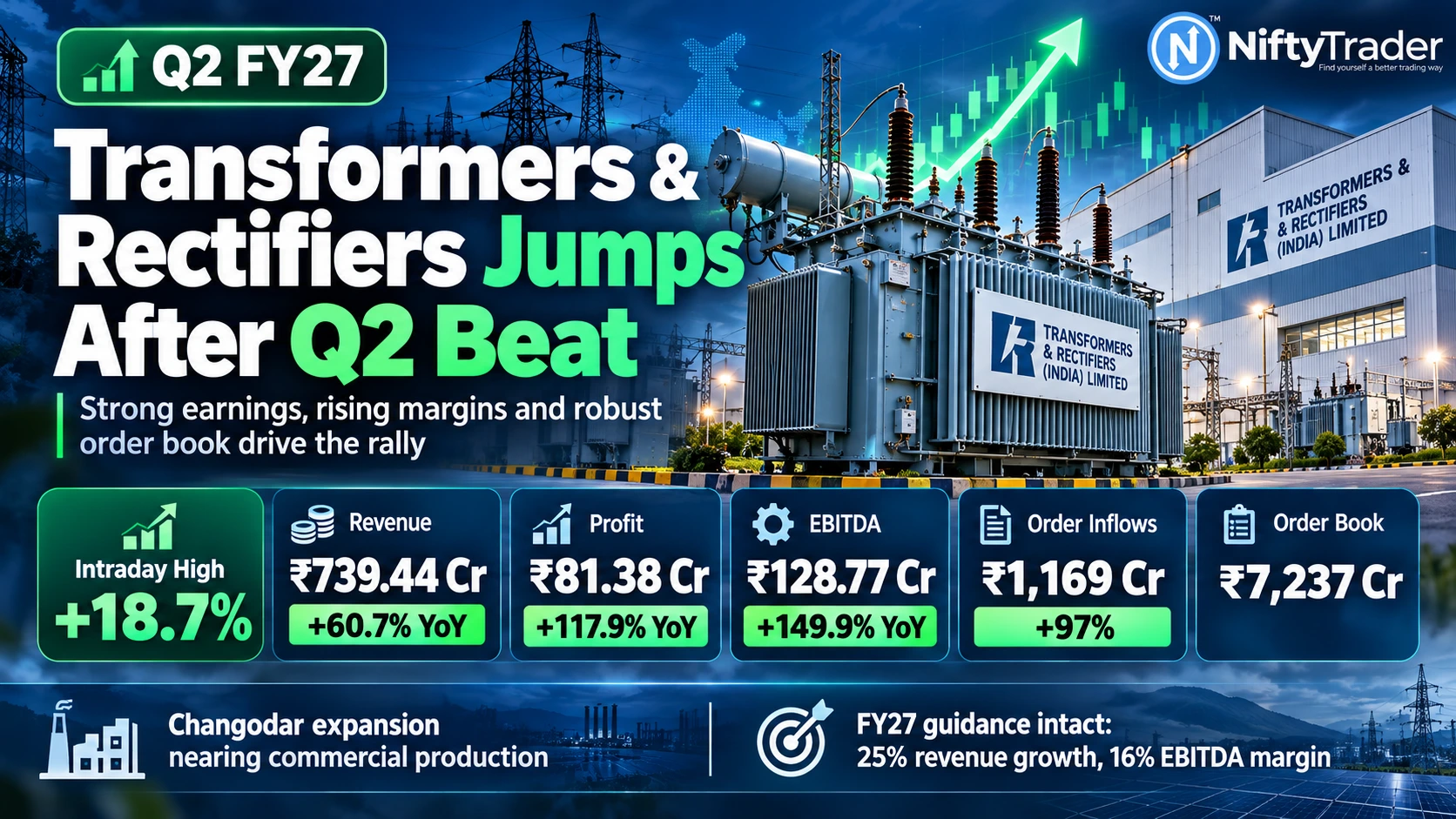
Transformers & Rectifiers Q2 FY27 results at a glance
| Consolidated metric | Q2 FY27 | Q2 FY26 | Change |
|---|---|---|---|
| Revenue from operations | ₹739.44 crore | ₹460.03 crore | +60.7% |
| EBITDA, excluding other income | ₹128.77 crore | ₹51.52 crore | +149.9% |
| EBITDA margin on the same basis | 17.4% | 11.2% | +621 bps |
| Profit for the period | ₹81.38 crore | ₹37.35 crore | +117.9% |
| Profit attributable to owners | ₹79.80 crore | ₹33.91 crore | +135.3% |
| Q2 order inflows | ₹1,169 crore | ₹592 crore | +97% |
| Unexecuted order book at September-end | ₹7,237 crore | ₹5,472 crore | +32% |
Source note: Consolidated figures are from the company’s detailed financial-results filing dated October 13, 2026. The operating EBITDA and margin figures exclude other income; the company’s separately reported standalone figures use a different presentation basis.
Why the earnings improvement matters—but needs context
Revenue from operations reached ₹739.44 crore in Q2 FY27, up from ₹460.03 crore a year earlier. The company attributed the improvement to better execution, higher utilisation at its Changodar and Moraiya facilities, and operating leverage.
Operating EBITDA, calculated excluding other income, increased to ₹128.77 crore from ₹51.52 crore. Its margin expanded to approximately 17.4% from 11.2%.
These gains matter because stronger manufacturing utilisation can improve profitability when fixed costs are spread across higher output. The question is whether utilisation and operating margins can remain at healthier levels as the company scales up.
The year-ago comparison also warrants caution. Q2 FY26 was a weak period for the company, and its results triggered a sharp stock sell-off in November 2025, when shares hit a 20% lower circuit. The depressed comparison base makes the latest year-on-year growth rates look particularly strong.
That does not make the recovery less meaningful, but it does mean investors should consider sequential performance and future execution rather than extrapolating a single quarter.
The ₹7,237 crore order book: visibility, not guaranteed revenue
TARIL reported Q2 order inflows of ₹1,169 crore, a 97% increase from a year earlier. Its unexecuted order book reached ₹7,237 crore as of September 30, up 32% year-on-year.
The company expects the order book to be executed over the next 18–24 months. This offers revenue visibility, although the timing of recognised revenue will depend on manufacturing schedules, customer milestones, testing and delivery.
The inquiry pipeline under negotiation stood at approximately ₹21,000 crore, with about 80% of opportunities domestic and 20% export-related. Management also cited a historical order-win ratio of 10%–15%.
That pipeline should not be treated as confirmed business. The win ratio is a historical indicator, not a guarantee that a fixed percentage of the current pipeline’s value will become orders.
The company has also expanded its opportunity set. During the quarter, it entered the nuclear-power segment through the NPCIL Kaiga Units 5 and 6 project and reported orders from customers including Damodar Valley Corporation and Gujarat Energy Transmission Corporation.
These developments broaden the range of opportunities being pursued, but their eventual financial contribution will depend on order values and execution schedules.
The latest backlog builds on the record ₹6,630 crore order book reported in Q1 FY27. Read NiftyTrader’s earlier coverage of TARIL’s Q1 order book and MEIL contract.
Changodar expansion is the next operational milestone
Management said the Changodar manufacturing expansion was nearing completion, with commercial production expected around Diwali. The investment in this expansion is approximately ₹150 crore.
During the Q2 earnings call, management described Changodar’s post-expansion manufacturing capacity at approximately 35,000 MVA. The additional capacity is intended to support a larger opportunity pipeline and improve the company’s ability to execute orders.
The timing matters. A new facility can expand the company’s production capability, but its financial contribution depends on the commissioning schedule, utilisation, testing and customer delivery requirements.
The company is also progressing with backwards integration. Its investor presentation targets commercial commissioning of the facilities by Q1 FY28, allowing for a delay of up to one quarter. The benefits of these projects will therefore need to be assessed over time rather than assumed immediately after commissioning.
FY27 guidance: what the remaining year needs to deliver
Management reiterated its FY27 targets of approximately 25% revenue growth, a 16% EBITDA margin and a 9%–10% PAT margin.
Consolidated revenue from operations during H1 FY27 was ₹1,311.78 crore, compared with ₹989.37 crore a year earlier—a rise of approximately 32.6%.
As an illustrative NiftyTrader calculation, applying 25% growth to FY26 consolidated revenue of ₹2,508.80 crore implies FY27 revenue of approximately ₹3,136 crore. After H1 revenue of ₹1,311.78 crore, the second half would need to contribute about ₹1,824 crore.
That would be around 20% higher than the approximately ₹1,519 crore recorded in H2 FY26. This is a calculation based on consolidated results, not a separate half-year target issued by the company.
The implication is that the company has room for slower growth in the second half while still meeting the annual growth rate. However, the timing of Changodar’s commercial ramp-up and the pace of order execution will influence whether this cushion is realised.
The margin target needs to be read on a consistent calculation basis. The 17.4% consolidated margin cited above excludes other income, while the company’s press release separately reports standalone EBITDA margins using its stated definition. Those percentages should not be compared as if they were identical measures.
Working capital may be the more important test
The company’s growth plans require more than a strong profit-and-loss statement. Transformer manufacturing involves long production cycles, inventory requirements, testing and milestone-based customer payments.
At September 30, management reported standalone inventory of approximately ₹654 crore and trade receivables of around ₹1,053 crore. It put the standalone working-capital cycle at approximately 154 days.
Management said it was targeting a reduction towards 110–120 days during FY27. Achieving that reduction would help improve cash conversion while the company funds manufacturing expansion and backward integration.
If receivables remain elevated or inventory requirements rise as output increases, working-capital demands could absorb cash even as reported profit grows. That is why tracking operating cash flow and the working-capital cycle alongside EBITDA will be important.
What investors should watch next
Changodar commissioning: Whether commercial production begins around Diwali and the new capacity ramps up as planned.
Order execution: Whether the ₹7,237 crore unexecuted order book converts into revenue within the expected 18–24-month period.
Margin sustainability: Whether operating profitability holds as utilisation improves, input costs change and the company increases production.
Cash conversion: Whether the working-capital cycle moves towards management’s 110–120-day target.
FY27 delivery: Whether the company meets its revenue and margin guidance without allowing expansion-related costs or working-capital requirements to undermine the improvement in profitability.
Read Next: SEBI Extends 50% IPO Relief: What Changes for a ₹1,000 Crore Fresh Issue?
FAQs
What were Transformers & Rectifiers’ Q2 FY27 results?
Consolidated revenue from operations rose 60.7% to ₹739.44 crore. Profit for the period increased 117.9% to ₹81.38 crore, while profit attributable to owners rose 135.3% to ₹79.80 crore.
Why did Transformers & Rectifiers shares rally on October 14?
Shares rose after the company reported stronger revenue, sharply higher operating profitability and a 97% increase in quarterly order inflows. The unexecuted order book also grew 32% year-on-year to ₹7,237 crore.
What is TARIL’s order book after Q2 FY27?
The company’s unexecuted order book stood at ₹7,237 crore on September 30, 2026. Management expects execution over the next 18–24 months.
Why do some reports cite 338% standalone profit growth?
Those reports use standalone figures rather than consolidated results. However, the company’s press release and detailed standalone results statement contain differences in the reported profit figures. This article uses the detailed consolidated results for its headline financial comparisons.
What is the main risk after the Q2 results?
The main execution risks are the timing of Changodar’s commercial production, the conversion of orders into revenue, the sustainability of improved margins and the ability to reduce working-capital days.
Disclaimer: This article is for informational and educational purposes only and is not investment advice. Financial results and management guidance do not guarantee future performance. Readers should review company disclosures and assess their own financial circumstances before making investment decisions.