
Equity Mutual Fund SIP Hits Record High 31% as SIPs Hit Record High in September
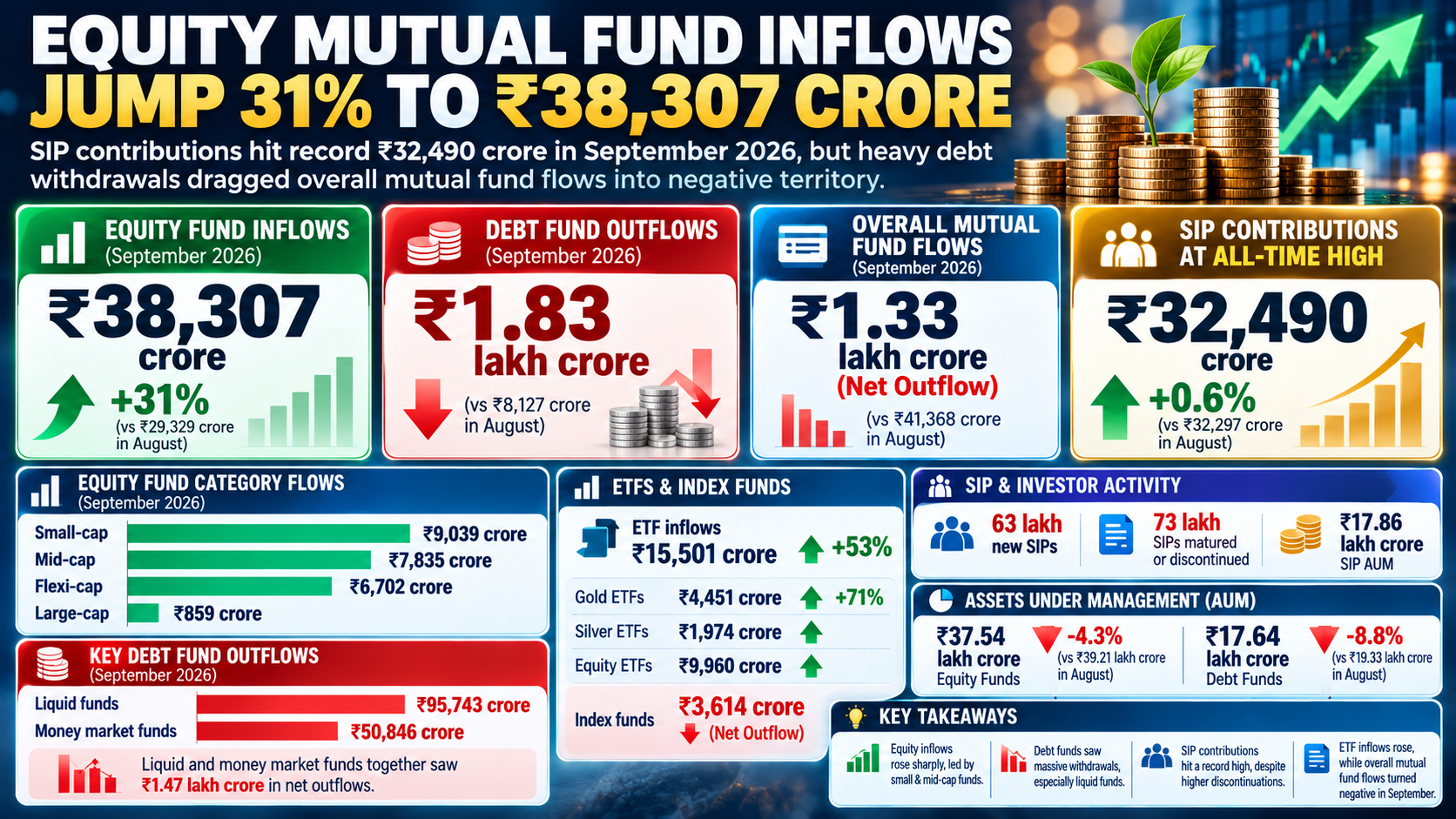
Investors continued to pour money into equity mutual funds in September 2026, but the broader mutual fund industry faced a sharp reversal. While equity inflows jumped nearly 31% and monthly SIP contributions touched a record high, massive withdrawals from debt schemes pushed overall industry flows deep into negative territory.
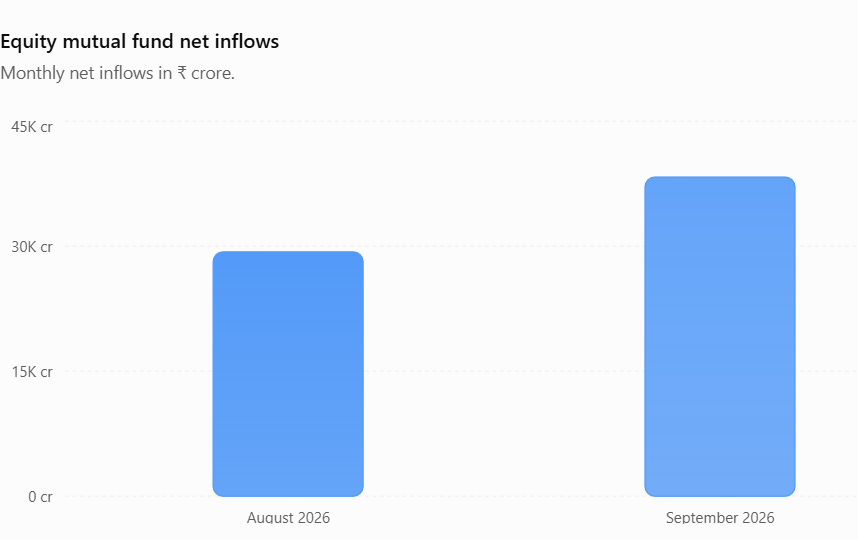
According to the latest data from the Association of Mutual Funds in India (AMFI), equity-oriented mutual funds attracted Rs 38,306.55 crore in September, compared with Rs 29,328.62 crore in August. However, debt funds recorded net outflows of Rs 1.83 lakh crore, turning total mutual fund industry flows negative.
The contrasting figures raise an important question for investors: does stronger equity investment signal sustained confidence, or do the withdrawals point to changing liquidity needs across the market?
Track Live : NSE F&O Lot Size | FII DII Data Today
Mutual Fund SIP Hits Record High : Small-Cap and Mid-Cap Funds Lead Equity Investment
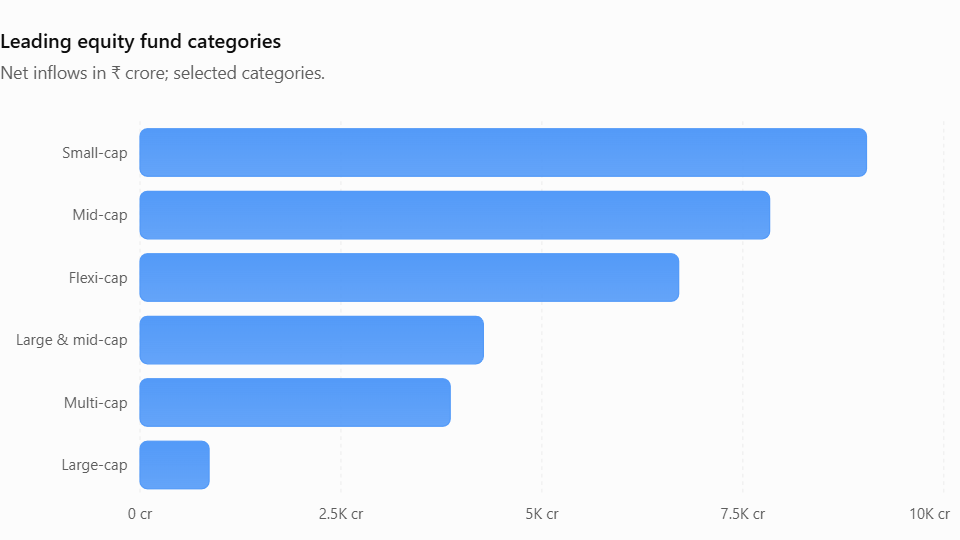
Small-cap mutual funds attracted Rs 9,038.57 crore in September, making them the largest recipients among equity fund categories. Mid-cap funds followed with Rs 7,834.84 crore.
Together, these two categories collected Rs 16,873.41 crore, accounting for approximately 44% of total equity mutual fund inflows. Flexi-cap funds also gained momentum, with inflows rising to Rs 6,701.80 crore from Rs 5,059.42 crore in August.
Large-cap funds returned to positive territory, attracting Rs 859.47 crore after outflows in July and August.
The numbers suggest continued investor interest in growth-oriented equity categories. However, small-cap and mid-cap stocks can experience sharper price swings, making investment horizon, diversification and risk tolerance important considerations.
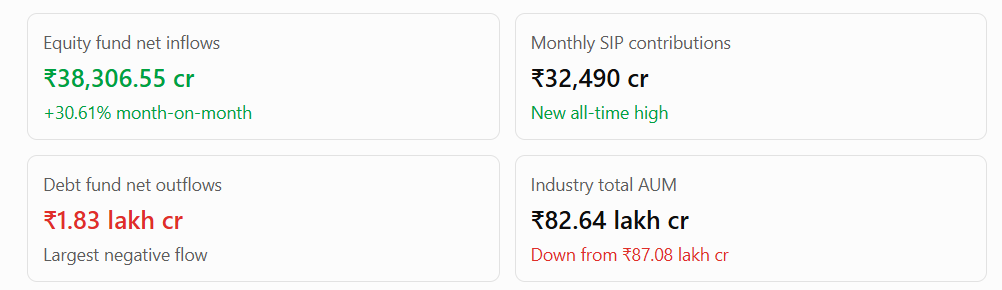
Equity schemes attracted an additional ₹8,977.93 crore in September compared with August, representing a 30.61% increase. This was the second consecutive month of strong growth in equity fund inflows, according to reported AMFI data.
Monthly Flow of Mutual Funds – September 2026
According to the reported AMFI data, the Indian mutual fund industry recorded net outflows of ₹1,33,214.25 crore in September 2026, primarily due to heavy withdrawals from debt mutual funds. Equity schemes and ETFs continued to attract investments.
|
Category |
Net flow (₹ crore) |
|---|---|
| Equity | 38,306.55 |
| Debt | −1,83,155.76 |
| Hybrid | −456.68 |
| Solution-oriented schemes | 373.90 |
| Closed-ended and interval schemes | −313.38 |
| Life cycle funds | 143.75 |
| Index funds | −3,614.03 |
| ETFs | 15,501.40 |
| Overseas funds | −159.18 |
| Total | −1,33,214.25 |
Key highlights
-
Equity: Net inflows reached ₹38,306.55 crore, up around 31% from August.
-
Debt: Net outflows of ₹1,83,155.76 crore were the biggest drag on industry-wide flows.
-
ETFs: Net inflows stood at ₹15,501.40 crore.
-
Overall industry: Net outflows reached ₹1,33,214.25 crore, reversing August’s positive flows.
Debt Mutual Fund Outflows Cross Rs 1.83 Lakh Crore
Debt mutual funds recorded net outflows of Rs 1,83,155.76 crore in September, compared with Rs 8,127.32 crore in August. The month-on-month difference exceeded Rs 1.75 lakh crore.
Liquid funds accounted for Rs 95,743.20 crore in net outflows, reversing August’s inflows of Rs 19,934.29 crore. Money market funds recorded withdrawals of Rs 50,846.21 crore, compared with inflows of Rs 11,734.71 crore in the previous month.
Together, these categories accounted for approximately Rs 1.47 lakh crore in withdrawals. September also marked the end of the financial year’s second quarter, when companies and institutional investors may adjust short-term investments to meet liquidity requirements.
Such withdrawals should not automatically be interpreted as a loss of confidence in debt markets. The reasons behind the outflows, including seasonal cash requirements, are important when assessing their significance.
Track Live : Opening Price Clues – What Pre-Market Data Says Today

Debt mutual funds witness massive withdrawals
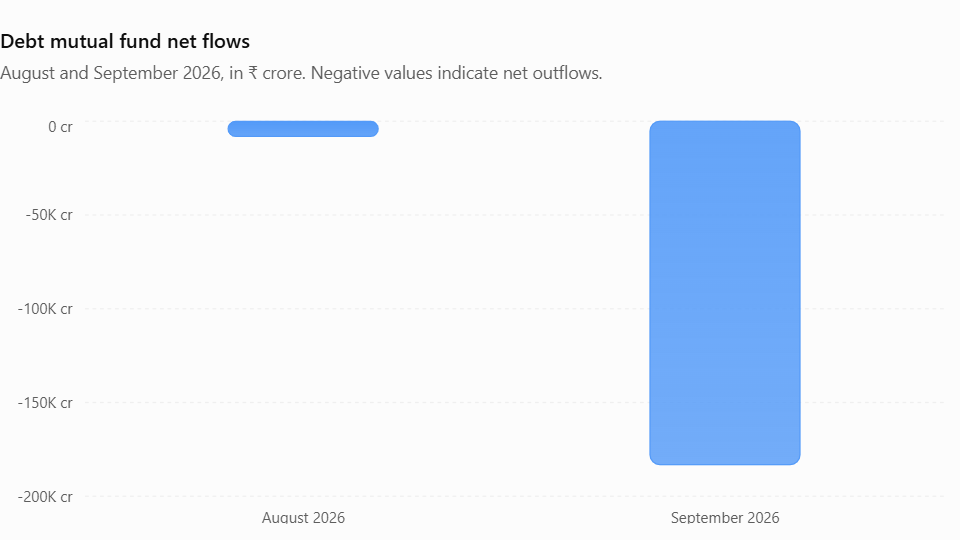
Debt mutual funds recorded net outflows of ₹1,83,155.76 crore in September, compared with ₹8,127.32 crore in August. This reversal was the main reason the mutual fund industry’s overall monthly flows turned negative.
The biggest withdrawals came from short-term debt categories:
| Debt fund category | September net flows |
|---|---|
| Liquid funds | −₹95,743.20 crore |
| Money market funds | −₹50,846.21 crore |
| Combined outflows | −₹1,46,589.41 crore |
These two categories accounted for most of the debt segment’s withdrawals. Quarter-end liquidity needs, advance-tax payments and corporate cash management are possible explanations for such movements, although the flow figures alone do not establish the reason for every redemption.
Equity mutual fund inflows: August vs September
Leading equity fund categories
-
Small-cap funds: ₹9,038.57 crore, the highest among equity categories.
-
Mid-cap funds: ₹7,834.84 crore.
-
Flexi-cap funds: ₹6,701.80 crore.
-
Large-and-mid-cap funds: ₹4,271.22 crore.
-
Multi-cap funds: ₹3,859.55 crore.
-
Large-cap funds: ₹859.47 crore, returning to positive inflows after outflows in August.
Small-cap and mid-cap funds together attracted ₹16,873.41 crore, or approximately 44% of total equity net inflows.
SIP Contributions Hit a Record Rs 32,490 Crore
Monthly systematic investment plan (SIP) contributions reached an all-time high of Rs 32,490 crore in September, up from Rs 32,297 crore in August. The increase was approximately 0.6%, highlighting continued participation through regular investments.
SIP assets under management stood at Rs 17.86 lakh crore. However, account activity offered a more mixed picture: around 63 lakh new SIPs were registered, while 73 lakh matured or were discontinued.
That left maturities and discontinuations approximately 10 lakh higher than new registrations. Reported SIP accounts stood at 10.06 crore, compared with an opening balance of 10.75 crore.
For investors, record SIP contributions are encouraging, but contribution values and account numbers measure different aspects of investor participation. The data does not, by itself, establish whether investors are becoming more or less confident about future market returns.
ETF Inflows Rise While Hybrid Funds Turn Negative
Exchange-traded funds (ETFs) attracted Rs 15,501.40 crore in September, nearly 53% more than August’s Rs 10,160.87 crore.
Gold ETF inflows jumped approximately 71% to Rs 4,450.61 crore, while silver ETFs attracted Rs 1,974.32 crore. Equity ETFs received Rs 9,959.96 crore.
In contrast, index funds recorded outflows of Rs 3,614.03 crore after attracting Rs 787.49 crore in August. Hybrid mutual funds also shifted to net outflows of Rs 456.68 crore from inflows of Rs 10,045.34 crore.
Arbitrage funds recorded outflows of Rs 3,956.38 crore, while balanced-advantage funds lost Rs 912.43 crore. Multi-asset allocation funds remained positive, attracting Rs 3,666.98 crore.
Overseas funds recorded outflows of Rs 159.18 crore. Life cycle funds and solution-oriented schemes attracted Rs 143.75 crore and Rs 373.90 crore, respectively.
Mutual Fund AUM Declines Despite Strong Equity Inflows
Equity mutual fund assets under management (AUM) fell to Rs 37.54 lakh crore in September from Rs 39.21 lakh crore in August, a decline of approximately 4.3%.
Debt fund AUM also dropped to Rs 17.64 lakh crore from Rs 19.33 lakh crore, falling around 8.8%.
AUM reflects both investor flows and changes in the market value of underlying investments. Therefore, rising equity inflows can coincide with falling AUM if portfolio valuations decline sufficiently or other factors offset the new money entering funds.
Here’s What Happened Today and Why Traders Reacted
The September mutual fund data revealed a clear divide between equity investments and debt fund withdrawals. Equity mutual fund inflows increased by Rs 8,977.93 crore month-on-month, following an approximately 19% rise in August.
Yet, the industry reported total net outflows of Rs 1,33,214.25 crore, against net inflows of Rs 41,368.05 crore in August. The sharp reversal was largely driven by debt schemes rather than equity funds.
For traders and investors, this distinction matters. Strong equity inflows can support market sentiment, but they do not automatically mean stock prices will rise. Market movements also depend on earnings, valuations, foreign investment, interest rates and broader economic conditions.
What September’s Mutual Fund Data Means for Investors
September’s figures show that equity mutual fund inflows and SIP contributions remained strong, even as debt and hybrid schemes experienced withdrawals. ETF inflows also increased, particularly in gold and silver products.
For investors, the key takeaway is to avoid treating one month’s flows as a standalone buy or sell signal. Monitor company earnings, valuations, market volatility and portfolio allocation alongside AMFI data.
The coming months will reveal whether equity inflows remain resilient and whether debt fund withdrawals reverse after quarter-end liquidity adjustments. Until then, diversification and investment decisions aligned with individual financial goals remain more useful than reacting to a single month’s headline numbers.