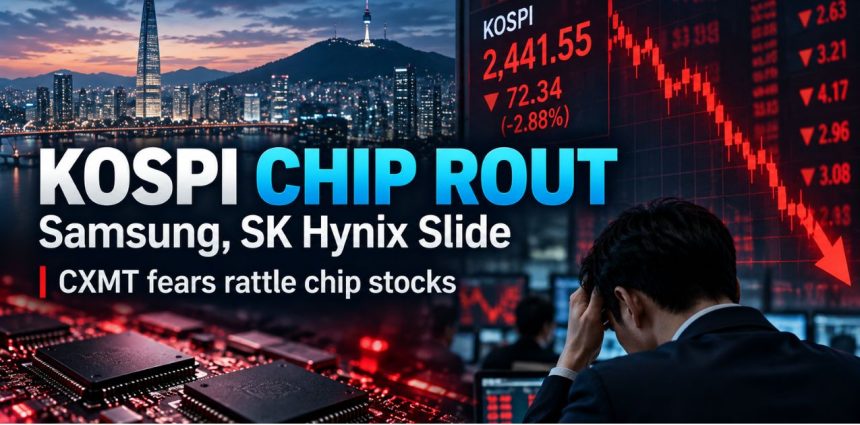
Samsung’s record $80 billion quarterly operating-profit forecast fails to reassure investors as Chinese memory-chip advances and concerns over the AI boom trigger a sharp semiconductor selloff.
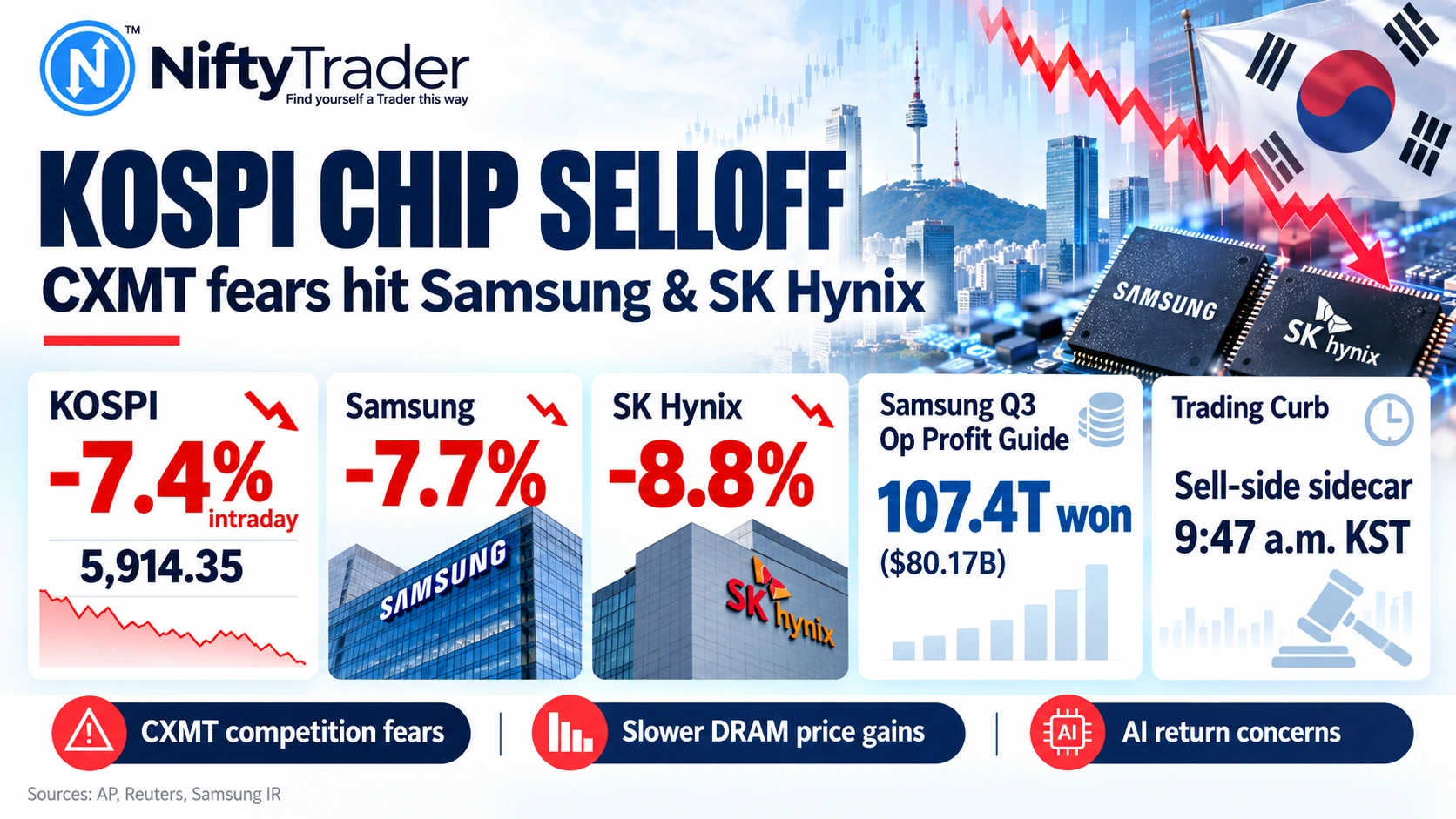
South Korea’s Kospi index plunged as much as 7.4% to 5,914.35 in intraday trading on Tuesday, October 13, as fears over growing competition from Chinese memory-chip maker ChangXin Memory Technologies (CXMT) triggered a selloff in semiconductor stocks.
Samsung Electronics fell 7.7%, while SK Hynix declined 8.8%, according to an Associated Press market report. The Kospi touched its lowest level since late July, with the decline severe enough to trigger a temporary restriction on automated sell orders.
The sharp fall came just days after Samsung projected approximately 107.4 trillion won ($80.17 billion) in third-quarter operating profit, highlighting a widening gap between the semiconductor industry’s exceptionally strong current earnings and investors’ concerns about its future.
The market’s central question is no longer simply whether artificial intelligence is driving demand for memory chips. It is whether record profits and elevated chip prices can be sustained as Chinese manufacturers expand and investors reassess the returns from massive AI infrastructure spending.
Korea Exchange Triggers Trading Curb as Kospi Losses Accelerate
The Korea Exchange activated a sell-side sidecar at 9:47:58 a.m. Korean time (6:17:58 a.m. IST) after Kospi 200 futures fell 5.08% to 955.02.
The mechanism suspended programme sell orders for five minutes to limit the impact of rapid market movements. It was not a full suspension of stock-market trading.
According to Seoul Economic Daily, citing Korea Exchange data, the intervention was the first sell-side sidecar on the main market since August 19.
Selling pressure continued after the restriction. By 10:40 a.m. Korean time, the Kospi was trading at 5,996.16, down 6.08%, while foreign investors had sold a net 1.81 trillion won worth of shares, according to Seoul Economic Daily’s intraday report.
The subsequently reported 7.4% decline represented a deeper intraday snapshot, not the market’s final closing performance.
The weakness spread beyond South Korea. Japan’s Nikkei 225 fell 2.5% in the AP snapshot, while Taiwan Semiconductor Manufacturing Company (TSMC) also declined. The previous US session had seen losses in memory-chip maker Micron Technology and other major semiconductor stocks.
The simultaneous declines suggest investors were reassessing risks across the global chip industry rather than reacting to a single Korean company.
Why Samsung’s $80 Billion Profit Forecast Failed to Support Chip Stocks
Samsung’s third-quarter earnings guidance was exceptionally strong.
In its official October 8 announcement, the company estimated:
- Consolidated revenue: approximately 195 trillion won.
- Operating profit: approximately 107.4 trillion won.
- Year-on-year operating-profit growth: approximately 782.5%.
The dollar equivalent of operating profit was approximately $80.17 billion, based on Reuters’ conversion.
These figures represent preliminary operating-profit guidance, not final audited earnings or net profit. Samsung’s detailed third-quarter results were expected on October 29.
The extraordinary earnings were supported by strong demand for memory used in AI infrastructure, including high-bandwidth memory (HBM), alongside elevated prices for conventional memory chips.
However, semiconductor stocks are highly sensitive to expectations about future pricing and margins.
Reuters reported that TrendForce expected conventional DRAM contract prices to increase by approximately 10%–15% quarter on quarter in the fourth quarter, compared with a rise of about 60% in the second quarter.
That does not mean memory prices are expected to collapse. It means their rate of increase could slow considerably.
For investors valuing chipmakers on unusually strong profits, slower price growth raises questions about whether future earnings can continue exceeding expectations.
What Is CXMT, and Why Is It Worrying Samsung and SK Hynix?
ChangXin Memory Technologies, better known as CXMT, is a major Chinese producer of dynamic random-access memory, or DRAM. These chips are used in computers, smartphones, servers and data centres.
The company’s technological progress has become increasingly important to investors because Samsung, SK Hynix and Micron have historically dominated the global DRAM industry.
Two separate CXMT developments have contributed to the current debate.
September: CXMT announces DRAM mass production
On September 20, Reuters reported that CXMT said its fifth-generation DRAM manufacturing platform had entered mass production.
The company also introduced two 24-gigabit LPDDR5X memory products that it said were already being manufactured in volume.
The announcement suggested progress in memory density and manufacturing economics, potentially improving China’s ability to compete in conventional DRAM.
However, the company’s claims do not independently establish its production yields, long-term reliability or ability to match every product offered by established competitors.
October: A new server-memory roadmap raises concerns
A separate development emerged ahead of the October 13 selloff.
According to an October 12 Seoul Economic Daily report, CXMT plans to introduce a server DDR5 registered memory module using a 4F² memory-cell architecture before the end of 2026.
The architecture is intended to fit memory cells into a smaller area, potentially increasing capacity and improving manufacturing efficiency.
This matters because server memory is a valuable market for leading DRAM manufacturers.
But the distinction is critical: CXMT’s 4F² server-memory product remains a reported plan, not a verified high-volume manufacturing achievement.
Its eventual production yields, performance, customer qualification and ability to scale remain uncertain.
That uncertainty makes the development a potential competitive risk rather than proof that Chinese manufacturers have already overtaken Samsung or SK Hynix in advanced memory technology.
Is the Global AI Chip Boom Losing Momentum?
The Kospi selloff also reflects a broader debate about the sustainability of artificial-intelligence investment.
Technology companies have committed substantial capital to AI data centres, computing equipment and supporting infrastructure. This spending has increased demand for advanced processors and the memory required to operate them.
Yet strong chip demand does not automatically guarantee strong share-price performance.
Investors are increasingly asking whether AI-related revenue and productivity gains will justify the cost of building and running the infrastructure.
Reuters highlighted the fragility of the AI trade as semiconductor shares weakened amid concerns about Chinese competition and future investment returns.
Two different risks are therefore affecting valuations.
The first is supply competition: if manufacturers such as CXMT significantly expand conventional DRAM production, they could eventually reduce the pricing power of established suppliers.
The second is demand sustainability: if AI infrastructure investment slows or produces weaker-than-expected financial returns, expectations for future semiconductor earnings could fall.
Neither risk establishes that the AI boom has ended.
Demand for advanced memory remains significant, and translating new manufacturing technology into reliable, large-scale production can be difficult.
The selloff instead shows how quickly market sentiment can change when earnings expectations are exceptionally high.
What Does the Korea Chip Selloff Mean for Indian Investors?
The decline in South Korean semiconductor stocks has implications for global technology sentiment, but it does not necessarily translate into an identical move in Indian equities.
In fact, Reuters reported that India’s Nifty 50 and Sensex were up approximately 0.9% during early trading on October 13, supported by gains in information-technology stocks following strong earnings from HCLTech.
That contrast shows how domestic earnings and sector-specific developments can offset broader global weakness.
For Indian investors, the more relevant factors include changing global risk appetite, memory-chip prices and the potential effect of semiconductor supply trends on technology hardware costs.
Companies buying large quantities of memory for servers, consumer electronics or other devices could eventually benefit from slower component-price increases.
Conversely, prolonged global technology-market volatility could affect investor confidence and the valuations of companies exposed to international technology spending.
These are possible channels of impact, not evidence that the Korean selloff will directly determine Indian market performance.
Check Live to Explore: NIFTY50, SENSEX, BANK NIFTY, INDIA VIX
What Investors Should Watch Next
Three developments could help determine whether the selloff remains a short-term reaction or develops into a broader semiconductor-sector reassessment.
Samsung’s October 29 results: The company’s detailed earnings and management commentary will offer more insight into memory-chip demand, pricing, profitability and the outlook for coming quarters.
CXMT’s manufacturing progress: Investors will need evidence of actual production scale, yields, product reliability and customer adoption before assessing how strongly the company’s newer technologies threaten established manufacturers.
DRAM prices and AI spending: Future contract-price trends and capital-spending plans from major AI infrastructure customers will help show whether today’s unusually strong memory-industry profits are sustainable.
Bottom Line
The October 13 Kospi plunge illustrates an unusual tension in the semiconductor market: Samsung is forecasting extraordinary profits at the same time investors are becoming increasingly concerned about the durability of those profits.
CXMT’s advances have introduced a credible competitive question, while the slowing pace of DRAM price increases and uncertainty over AI investment returns have added pressure.
That does not mean Samsung and SK Hynix have lost their technological leadership or that demand for AI memory has collapsed.
It means investors are looking beyond record quarterly earnings for evidence that high margins, strong demand and competitive advantages can endure.
Market figures cited above are intraday observations from October 13, 2026, and may differ from the closing levels.
Read Next: Stocks to Watch Oct 13: HCLTech Profit Jumps 21%, RBL Bank, IRCON ₹862 Cr Order in Focus
Disclaimer: This article is for informational and educational purposes only. It does not constitute investment advice or a recommendation to buy or sell securities.