NPCI UPI MDR Fees on Hold Until After Diwali: What It Means for Investors
India’s digital payments ecosystem has received temporary relief ahead of the festive shopping season. The National Payments Corporation of India (NPCI) has postponed the proposed Merchant Discount Rate (MDR) on select UPI transactions until after Diwali.
The decision follows objections from merchants, fintech companies and payment service providers. While the delay offers businesses more time to prepare, uncertainty remains over when the new charges will take effect.
Track Live : NSE Option Chain — Live | BSE Option Chain — Live Sensex & Bankex Options Data Today
NPCI UPI MDR Fees on Hold Rollout After Merchant Pushback
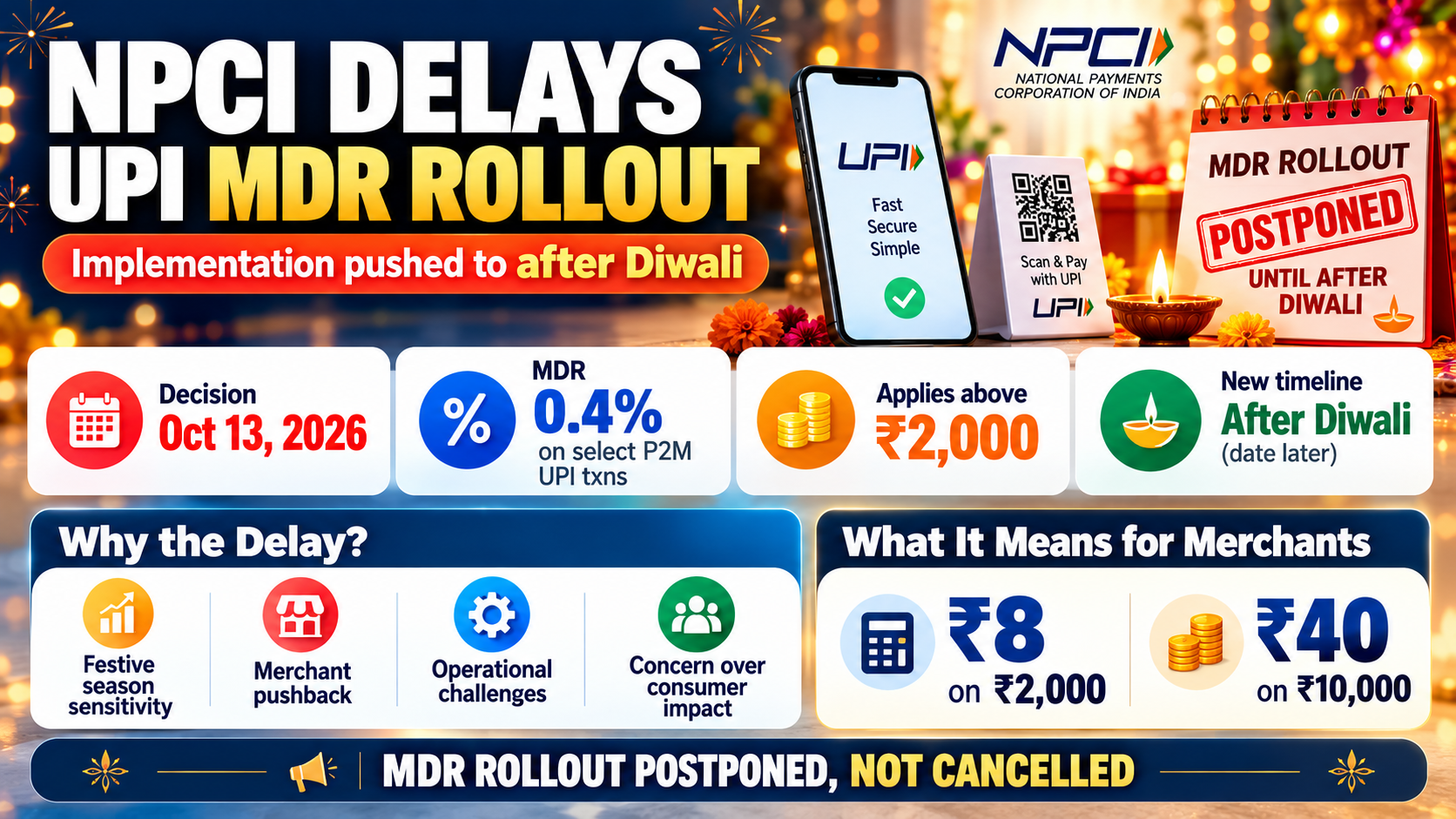
On October 13, the UPI Steering Committee decided to postpone the implementation of MDR charges that had been scheduled to begin later this week.
NPCI said the charges would be introduced immediately after Diwali, with the exact date to be announced separately.
In its statement, NPCI said, “keeping in mind the festive season, MDR on select Person-to-Merchant (P2M) UPI transactions shall be implemented immediately post Diwali on a date to be notified separately.”
The decision follows requests from merchant associations, fintechs and payment companies. They raised concerns about operational readiness, differences in applicable fee rates and the potential impact on consumer sentiment during festive sales.
Moneycontrol reported on October 8 that NPCI was considering proposals to postpone the rollout until January 2027. However, the latest announcement does not confirm January 2027 as the implementation date.
Key highlights
-
Implementation delayed: The proposed MDR framework will take effect immediately after Diwali, on a date to be notified separately.
-
Original deadline: October 15, 2026.
-
Proposed standard rate: 0.4% on eligible merchant transactions exceeding ₹2,000, subject to applicable conditions and caps.
-
Reason for postponement: Festive-season concerns and requests from merchants and payment industry participants.
-
Important distinction: The fee has been postponed, not cancelled.
What the Proposed 0.4% UPI MDR Fee Means
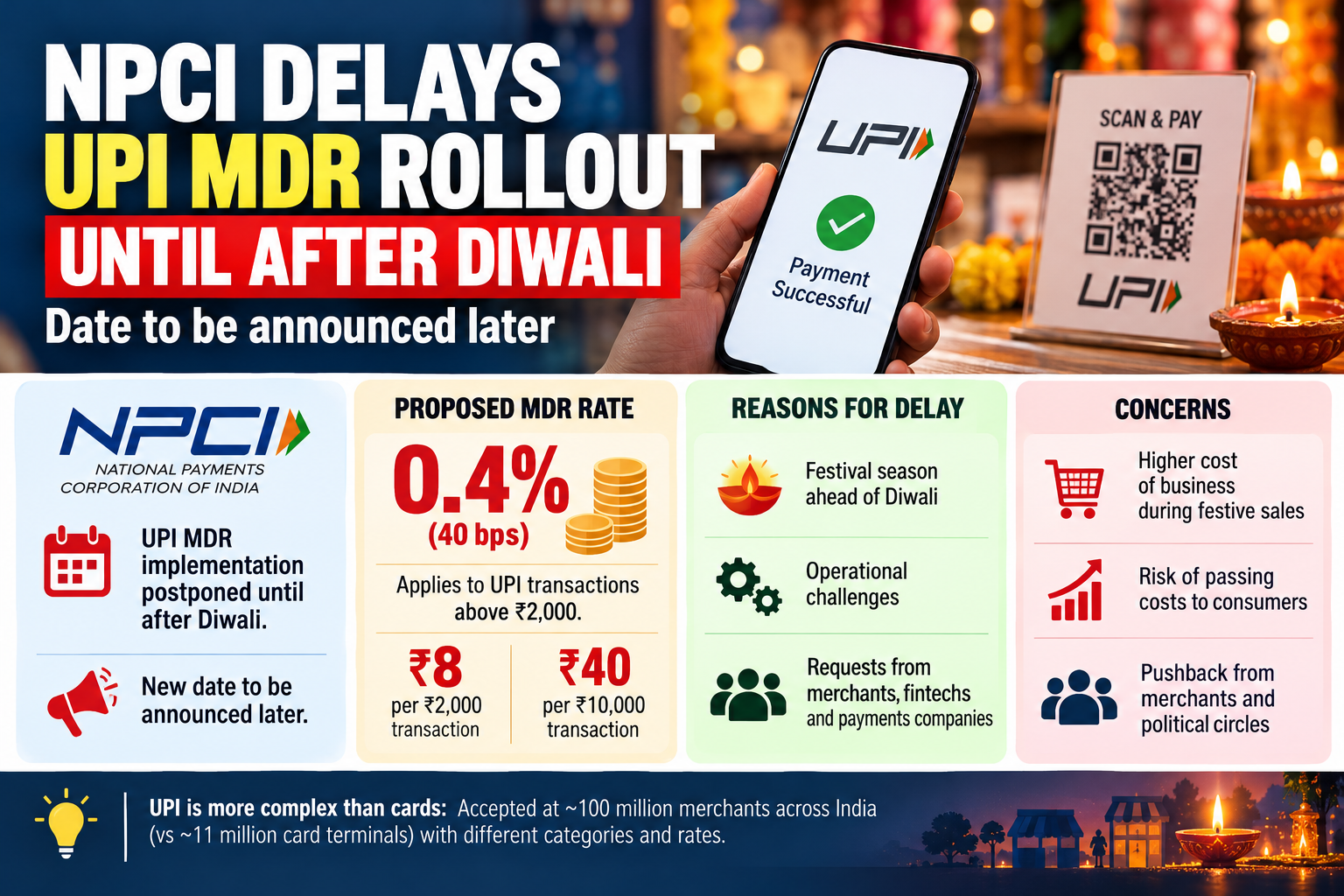
Last month, the UPI Steering Committee fixed the proposed MDR at 0.4%, or 40 basis points, for eligible transactions above Rs 2,000.
MDR is the fee charged to merchants for processing digital payments. At the proposed rate, a qualifying payment of Rs 2,000 would attract a fee of Rs 8, while a payment of Rs 10,000 would attract Rs 40.
The charges would apply to select person-to-merchant UPI transactions, not every UPI payment. The final scope and applicability of the fee structure will therefore be important for businesses.
For merchants operating on thin margins, even small transaction fees can add up when payment volumes are high. The postponement gives businesses additional time to assess the potential costs.
Track Live : FII DII Data Today | NSE F&O Lot Size
- What Stays Free:
- Person-to-Person (P2P) transfers remain completely free.
- P2M transactions up to ₹2,000 remain free.
- Small merchants with low annual/monthly turnovers (such as small local shopkeepers under specific P2PM thresholds) continue to enjoy zero-MDR benefits.
- Over 95% of UPI merchant transactions by volume are expected to remain unaffected.
NPCI Defers UPI MDR Rollout Until After Diwali
The National Payments Corporation of India (NPCI) has postponed the implementation of Merchant Discount Rate (MDR) charges on select UPI merchant transactions until after Diwali. Originally scheduled for October 15, the revised implementation date will be announced separately. The decision follows concerns from merchants and payment companies about additional costs during the festive shopping season.
What is UPI MDR?
Merchant Discount Rate (MDR) is a payment-processing fee borne by merchants. Under the proposed framework, eligible merchant UPI transactions above ₹2,000 will attract a standard fee of 0.4%, capped at ₹300 per transaction. Certain categories will have different rates, while person-to-person transfers and eligible low-value merchant payments will remain free.
The postponement delays the rollout but does not cancel the proposed charges.
| Eligible transaction value | MDR at 0.4% |
|---|---|
| ₹2,500 | ₹10 |
| ₹5,000 | ₹20 |
| ₹10,000 | ₹40 |
| ₹25,000 | ₹100 |
| ₹50,000 | ₹200 |
| ₹75,000 | ₹300, subject to the cap |
Which UPI transactions will attract charges?
According to the framework published by the government on September 15, the proposed MDR structure distinguishes between ordinary transfers, regular merchant payments and certain specified business categories.
| Transaction type | Proposed MDR treatment |
|---|---|
| Person-to-person transfers (P2P) | Free, regardless of amount |
| Merchant payments up to ₹2,000 | Free |
| Eligible merchant payments above ₹2,000 | 0.4%, subject to the cap and exemptions |
| Selected essential-sector transactions above ₹2,000 | Flat ₹5 per transaction |
| Eligible capital-market transactions | 0.02%, capped at ₹300 |
| Qualifying small merchants | Exempt under the applicable framework |
The exact eligibility and category-specific rules should be checked against the official framework and subsequent NPCI instructions. The October 13 announcement confirmed the postponement but did not announce a new effective date.
Will customers have to pay for UPI payments?
The proposed MDR is a merchant-side fee, not a direct transaction charge on individual customers.
The government’s September framework states that person-to-person transfers will remain free regardless of amount. Merchant payments up to ₹2,000 and qualifying small-merchant transactions will also remain outside the MDR framework. Approximately 96% of merchant transactions were expected to remain unaffected.
For example:
-
Sending ₹10,000 to a friend: no MDR.
-
Paying ₹500 at a neighbourhood shop: no MDR.
-
Paying an eligible merchant ₹10,000: the proposed standard MDR would be ₹40, paid within the merchant payment ecosystem.
-
Paying an eligible merchant ₹1,00,000: the standard rate’s ₹300 cap would apply, subject to the transaction’s category and eligibility.
Although the fee is intended to be borne by merchants, businesses’ overall pricing decisions could still affect consumers indirectly. The government has stated that consumers will not face a direct UPI transaction fee under the proposed framework.
Read More : Inside the TVS Family Rift: Rs.485.85 Crore Deal, Tax Worries and a Possible Control Risk
Why UPI MDR Is More Complicated Than Card Payments
UPI’s extensive reach makes the proposed fee structure particularly significant. According to the figures cited in the supplied report, cards are accepted at around 11 million terminals, while UPI reaches approximately 100 million merchants, including businesses in smaller towns and villages.
Unlike relatively standardised card-processing arrangements, UPI’s proposed MDR framework includes different rates for categories such as utility payments, loan repayments and capital market transactions.
This creates operational challenges for payment providers and merchants, who must identify eligible transactions and apply the appropriate fee.
There are also regulatory differences. RBI rules restrict credit card use for certain transactions, including loan repayments and capital market transactions. Before UPI became widespread, many such payments were processed through net banking, IMPS, NEFT or RTGS, which could involve different charges.
What does the decision mean for payment companies and investors?
The postponement has implications beyond retail merchants.
-
Payment companies: MDR revenue from eligible transactions will be delayed, postponing the expected financial benefit of the new framework.
-
Banks and payment service providers: They will have more time to prepare operational systems and revenue-sharing arrangements.
-
Merchants: They avoid the proposed new charges during the Diwali shopping period.
-
Investors: The eventual implementation date, eligible transaction volumes and revenue-sharing arrangements will be important factors in assessing the financial impact on payment businesses.
What the UPI MDR Delay Means for Investors
The postponement offers temporary relief to merchants but does not settle the broader debate over who should pay for digital payment processing.
Finance Minister Nirmala Sitharaman said on October 8 that MDR on UPI transactions would be handled by stakeholders, leaving the timing decision to the payments ecosystem.
For investors, the next important trigger will be NPCI’s announcement of the implementation date and final fee structure.
Payment companies could see changes in transaction economics, while merchants may need to reassess their payment costs. The actual impact on earnings will depend on transaction volumes, applicable rates, commercial agreements and whether businesses absorb or pass on the charges.
What Investors Should Watch Next
NPCI has delayed the proposed UPI MDR charges until immediately after Diwali, but the specific date remains unannounced in the supplied information.
Investors should monitor official NPCI announcements, the transactions covered by the fee and any changes to the proposed 0.4% rate.
The key question is whether the final MDR framework can balance payment-processing costs with merchant affordability while supporting the continued growth of digital payments across India.