
BHEL Q2 FY27 Results on October 14, 2026: What Analysts Expect From the PSU
Bharat Heavy Electricals Ltd (BHEL) shares came under pressure ahead of the company’s September-quarter earnings, as investors assessed whether improving execution could translate into stronger profits and margins. The state-run engineering company is scheduled to announce its Q2 FY27 results on Wednesday, October 14.
Analysts expect significant year-on-year growth in revenue, EBITDA and net profit. However, muted order inflows and working capital management remain important factors that could influence investor sentiment after the results.
Track Live : NSE Option Chain — Live | BSE Option Chain — Live Sensex & Bankex Options Data Today
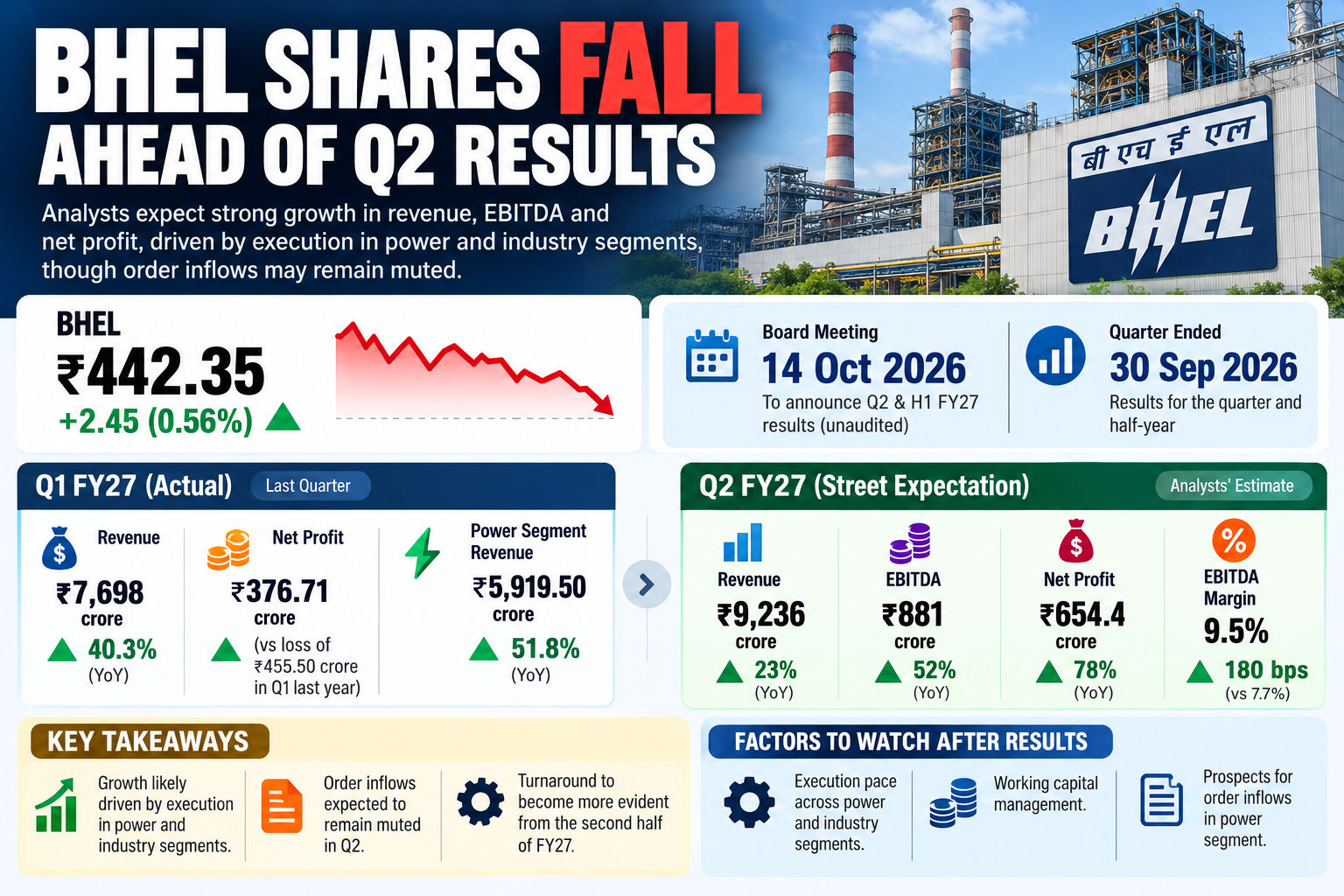
BHEL Q2 FY27 Results on October 14, 2026: Revenue and Profit Expected to Rise
According to analyst estimates reported by CNBC-TV18, BHEL’s revenue is expected to increase 23% year-on-year to ₹9,236 crore in Q2 FY27, compared with ₹7,511 crore in the corresponding quarter last year.
EBITDA, a measure of operating profitability, is projected to rise 52% to ₹881 crore from ₹581 crore. Net profit is expected to grow 78% to ₹654.4 crore, against ₹368 crore a year earlier.
Analysts also expect BHEL’s EBITDA margin to expand to 9.5% from 7.7%, representing an improvement of 180 basis points.
These estimates suggest that investors will be looking beyond revenue growth to determine whether better project execution is improving the company’s operating performance.
Key Q2 FY27 estimates
| Metric | Q2 FY27 estimate | Year-on-year growth |
|---|---|---|
| Revenue | ₹9,236 crore | 23% |
| EBITDA | ₹881 crore | 52% |
| EBITDA margin | 9.5% | Up 1.8 percentage points |
| Net profit | ₹654.4 crore | 78% |
The estimates are based on the analyst poll cited in the supplied report and are not actual quarterly results.
What Drove BHEL’s Recovery in the Previous Quarter?
BHEL reported a strong year-on-year recovery in Q1 FY27, supported by higher revenue and a return to profitability.
The company recorded revenue of approximately ₹7,698 crore in the June quarter, up around 40.3% from a year earlier. Net profit reached ₹376.71 crore, compared with a loss of ₹455.50 crore in the corresponding quarter of the previous financial year.
The power segment remained the key growth driver, generating revenue of ₹5,919.50 crore, an increase of 51.8% year-on-year.
Investors will now watch whether this momentum continued during Q2. Sustained execution in the power and industry segments could support revenue growth and improve operating margins.
Track Live : FII DII Data Today | NSE F&O Lot Size
Key factors to watch after results
-
Power and industry execution: Whether project execution meets expectations.
-
Working capital: Whether cash flow and payment cycles improve.
-
Order inflows: Whether BHEL secures enough new orders to sustain future growth.
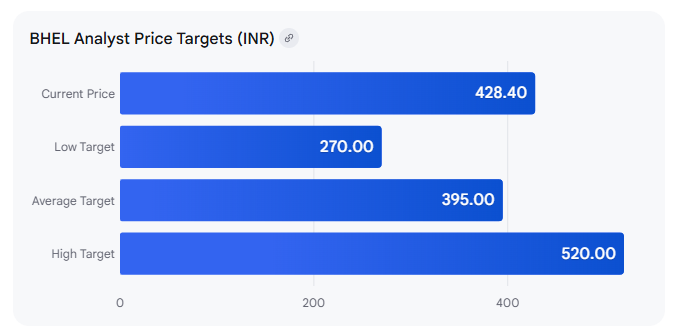
BHEL Analyst Price Targets: Bullish and Bearish Views Diverge
Analysts remain divided on Bharat Heavy Electricals Ltd. (BHEL) as investors weigh its earnings recovery against concerns over execution, margins and working capital. Recent brokerage reports show a wide gap between optimistic growth expectations and more cautious valuation assessments.
Analyst price targets
Targets reported in 2026 research; not necessarily updated to October 13.
| Brokerage | Rating | Target price |
|---|---|---|
| ICICI Securities | Buy | ₹520 |
| Jefferies | Sell | ₹220 |
| Macquarie | Sell | ₹315 |
| UBS | Hold | ₹460 |
| Kotak | Sell | ₹150 |
These brokerage targets are reported by Investing.com; ICICI Securities’ ₹520 target is also documented in its July 17 research note.
The supplied figures of ₹270 for Jefferies and ₹220 for J.P. Morgan were not both independently verified in the latest sources retrieved. Avoid attributing those targets without confirming the relevant research reports.
BHEL Margins and Order Inflows Remain Key Concerns
Despite expectations of stronger profitability, analysts anticipate muted order inflows during the September quarter. This could make the company’s existing project pipeline and execution pace particularly important.
A stronger EBITDA margin would indicate that BHEL is converting revenue into operating earnings more efficiently. However, the sustainability of this improvement will depend on project execution, costs and the mix of business.
Working capital management is another factor to watch. Delays in collecting payments or higher funds tied up in projects can affect cash flow, even when reported revenue and profits improve.
Analysts expect BHEL’s turnaround to become more evident in the second half of FY27. The upcoming results could provide further clues about whether that recovery is progressing as anticipated.
Read More : NPCI UPI MDR Fees on Hold: What Rs.40 on Every Rs.10,000 Means for Merchants After Diwali
Here’s What Happened Today and Why Traders Reacted
BHEL shares traded lower on Tuesday, October 13, ahead of the earnings announcement. The stock was reported at ₹428.40, down around 2.6% during the session, although another supplied market quote showed ₹442.35, up 0.56%. These figures may reflect different reporting times and should be checked against the official closing price.
The decline ahead of results highlights the uncertainty surrounding quarterly earnings. Investors are assessing whether the expected improvement in profits is already reflected in the share price and whether the company can deliver results in line with market expectations.
BHEL shares have gained approximately 47% so far in 2026, according to the supplied report. After such a rally, the earnings announcement could become an important near-term trigger for trading activity.
What BHEL Investors Should Watch After Q2 Results
Investors should focus on three key factors when BHEL announces its September-quarter results: execution in the power and industry segments, working capital management, and fresh order inflows.
Revenue and net profit growth will be important, but margins and management commentary could provide a clearer picture of the company’s operating momentum.
If BHEL delivers results close to or above analyst expectations, investor attention may shift towards the sustainability of its recovery. A weaker-than-expected performance or continued softness in order inflows could create pressure.
For traders, the immediate focus will be on the earnings surprise and the market’s reaction. Long-term investors should also assess cash flow, execution quality and order visibility before drawing conclusions from a single quarter.