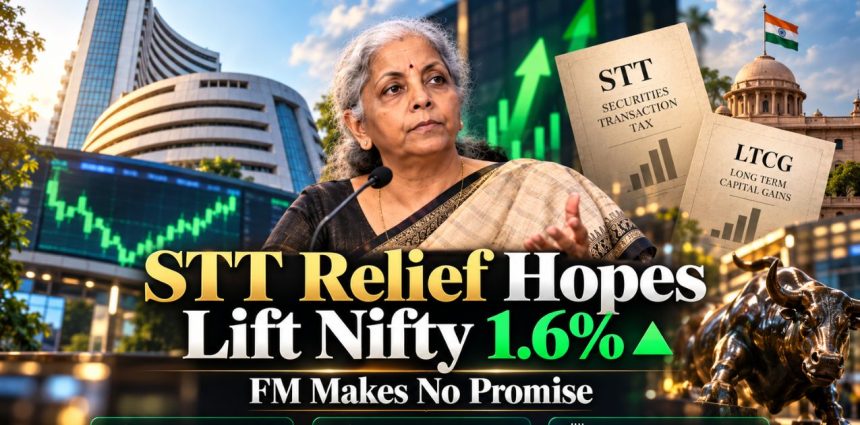
Finance Minister Nirmala Sitharaman welcomed the debate over market transaction taxes but made no commitment to a reduction. IT earnings and expiry-related short-covering also supported Tuesday’s rally, while elevated crude prices and foreign selling threaten its momentum.
Indian equities staged a sharp rebound on Tuesday, but investors hoping for lower market taxes still have no concrete policy commitment. The Nifty 50 climbed 358.60 points, or 1.60%, to close at 22,721.95, while the Sensex advanced 1,109.10 points, or 1.54%, to settle at 73,033.78.
The gains followed Finance Minister Nirmala Sitharaman’s remarks on securities transaction tax (STT) and came alongside strong IT-sector earnings and expiry-related short-covering.
Need to Know
-
Nifty rally: The index gained 1.60% on October 13, closing at 22,721.95.
-
Finance Minister’s remarks: Sitharaman called the debate over STT healthy but made no tax-cut commitment.
-
Earnings support: The Nifty IT index rose 5.2%, led by HCLTech and TCS.
-
Trader impact: Higher STT rates have increased transaction costs for futures and options sellers and for purchasers of exercised options.
-
Risk to the rebound: Crude oil near $107 a barrel and continued foreign selling remain concerns.
What Did Nirmala Sitharaman Say About STT and LTCG Tax?
Speaking at the Bloomberg New Economy Forum in New Delhi, Sitharaman acknowledged the debate over securities transaction tax as investors raised concerns about the taxation of market activity.
According to Bloomberg’s October 13 report, she said:
“There’s a lot of debate” over STT. “It’s healthy to have this debate, and I will be keenly hearing them.”
She did not specify what changes, if any, the government might consider ahead of the Union Budget due in February.
The distinction is particularly important because the two taxes serve different purposes. STT applies to specified securities transactions, while LTCG tax applies to eligible profits on investments sold under the applicable tax rules. A change to one would not automatically mean a change to the other.
Why Did the Nifty Rise 1.6% on October 13?
Tax-relief expectations helped sentiment, but company earnings and trading activity also contributed to the rebound.
IT stocks provided a strong earnings catalyst
The Nifty IT index jumped 5.2%, its strongest daily performance since May 2025, according to Reuters. HCLTech shares surged 8.4% after its quarterly profit beat expectations, while TCS gained 6.8%.
Expiry-related short-covering added to the rally
The Economic Times reported that Sunny Agrawal, head of fundamental research at SBI Capital Securities, attributed the market advance partly to expiry-related short-covering.
The combination of earnings optimism, tax-related expectations and position adjustments makes Tuesday’s advance more complex than a straightforward policy-driven rally.
Current STT Rates: What Changed in April 2026?
The revised STT rates under the Finance Act 2026 took effect on April 1, 2026. The NSE’s official STT schedule confirms the following rates and payment responsibilities.
| Taxable transaction | Rate up to March 31, 2026 | Rate from April 1, 2026 | Paid by |
|---|---|---|---|
| Sale of futures | 0.02% | 0.05% | Seller |
| Sale of options, on premium | 0.10% | 0.15% | Seller |
| Exercised options, on intrinsic value | 0.125% | 0.15% | Purchaser |
For futures, STT is calculated on the traded value. For an ordinary options sale, it is calculated on the premium. For an exercised option, the tax is calculated on intrinsic value and paid by the purchaser. These are different taxable values, so the rates should not be compared without considering the basis of calculation.
How Much More STT Are F&O Traders Paying?
The increase can be illustrated using two hypothetical transactions.
| Illustrative transaction | Earlier STT | Current STT | Extra tax |
|---|---|---|---|
| Futures sale with taxable value of ₹10 lakh | ₹200 | ₹500 | ₹300 |
| Options sale generating ₹20,000 in premium | ₹20 | ₹30 | ₹10 |
In the futures example, the current 0.05% rate on ₹10 lakh results in ₹500 of STT, compared with ₹200 at the previous 0.02% rate.
In the options example, the 0.15% rate on ₹20,000 of premium results in ₹30, compared with ₹20 at the previous 0.10% rate.
These examples isolate STT only. They exclude brokerage, exchange transaction charges, GST and other applicable charges, and are not estimates of the total cost of a real trade.
The practical significance is that a lower STT rate could reduce costs for traders who frequently incur taxable transactions. However, any reduction remains hypothetical until the government announces a specific change.
Why the Recovery Still Faces Risks
The October 14 opening suggested that Tuesday’s rally had not immediately resolved concerns about the broader market.
At 9:15 a.m. IST on October 14, the Nifty 50 dipped 0.03% to 22,715.75, while the Sensex edged 0.02% higher to 73,049.76. Twelve of the 16 major sectoral indices declined at the open, and the broader small-cap and mid-cap indices each lost 0.1%. These are opening figures, not live prices for later in the session.
What Should Investors Watch Next?
The next relevant developments are concrete Budget signals on market taxation, further quarterly earnings, crude oil prices and institutional investor flows.
For derivatives traders, the existing STT rates, not an anticipated rollback—remain the applicable rates. Any change would need to be assessed against the government’s actual proposal and implementation details.
Tuesday’s rally may have improved sentiment, but its durability remains uncertain. Stronger earnings and broader market participation would provide more convincing evidence of a sustained recovery than tax-related expectations alone.
Read Next: Stocks to Watch Today, Oct 14: Hyundai’s $15.5B India Plan, Adani AI JV, BHEL and Groww
Frequently Asked Questions
1. Has Nirmala Sitharaman announced an STT cut?
No. She acknowledged the debate over STT and said she was keen to hear views on the subject. She did not announce a reduction or removal of STT.
2. Why did the Nifty rise 1.6% on October 13?
The rally reflected improved sentiment around the market-tax debate, strong IT-sector earnings and expiry-related short-covering. HCLTech and TCS were among the major contributors.
3. What is the current STT rate on futures?
The STT rate on the sale of futures is 0.05% of the taxable traded value from April 1, 2026. It is paid by the seller.
4. What is the current STT rate on options?
The rate on an options sale is 0.15% of the premium and is paid by the seller. If an option is exercised, STT is 0.15% of intrinsic value and is paid by the purchaser.
5. Can the market rally further if STT is reduced?
A confirmed reduction could lower the transaction-tax burden for affected trades, but its effect on market direction would depend on the policy details and broader conditions. Earnings, crude prices and foreign investor flows remain important factors.
Disclaimer: This article is for informational and educational purposes only and does not constitute investment or tax advice. STT rates and market conditions are subject to change. The transaction-cost examples are illustrative and exclude other applicable charges. Readers should verify official announcements and consult qualified professionals before making financial decisions.