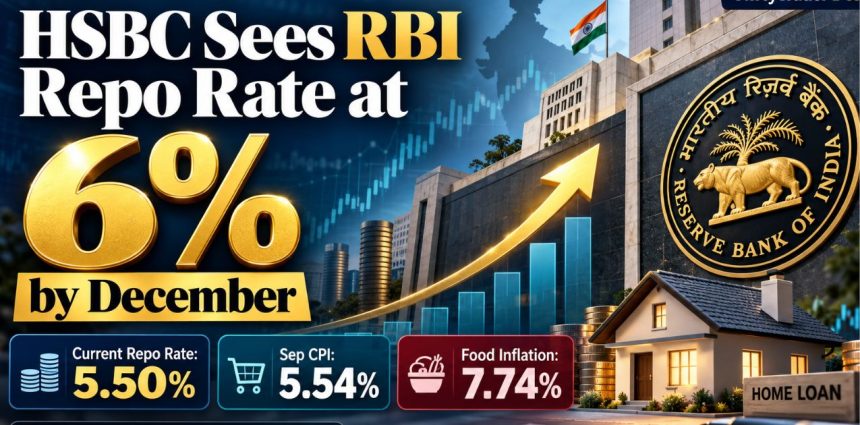
HSBC expects the repo rate to reach 6% by December as September inflation rises to 5.54% and short-term Treasury-bill yields hit 18-month highs. Here are the three signals that could determine whether the forecast holds.
The Reserve Bank of India’s next rate decision is facing a tougher test: HSBC expects the repo rate to reach 6% by December, while short-term government borrowing costs have already climbed well above the current policy rate.
The RBI raised its repo rate by 25 basis points to 5.50% on October 7 and shifted its stance to “calibrated tightening”. HSBC subsequently raised its forecast for cumulative rate increases during the current cycle to 75 basis points, implying a repo rate of 6% by the end of December.
But there is an important distinction. Reaching 6% from the current 5.50% rate requires another 50 basis points of tightening. That is the arithmetic implied by HSBC’s year-end forecast, not confirmation that the bank expects one single 50-basis-point increase at the next meeting.
A second signal has emerged from the debt market. On October 14, the government sold six-month and one-year Treasury bills at yields of 6.29% and 6.49%, respectively. Both were at their highest levels in around 18 months, while their premiums over the repo rate reached four-year highs.
The combination of rising inflation, higher short-term borrowing costs and external pressure from crude oil makes HSBC’s forecast important to watch. It does not, however, make a 6% repo rate inevitable.
Need to know
-
Repo rate: 5.50% after the October 7 RBI increase.
-
HSBC’s call: 6% by December, requiring another 50 bps from the current rate.
-
Inflation: September CPI at 5.54%; food inflation at 7.74%.
-
Bond-market signal: October 14 Treasury-bill auction yields reached 18-month highs.
-
Main uncertainty: Whether inflation, oil and currency pressures persist long enough to justify further tightening.
HSBC’s RBI Forecast: What Has Changed?
HSBC has raised its forecast for cumulative rate increases in the current tightening cycle by 25 basis points, taking its expected total to 75 basis points.
Before the October 7 decision, the repo rate stood at 5.25%. The subsequent 25-basis-point increase took it to 5.50%. HSBC’s projected 6% year-end rate therefore implies another 50 basis points of increases from the current level.
The revised call follows the RBI’s more restrictive policy stance and rising inflationary pressure. The bank also expects the central bank to continue using foreign-exchange intervention and regulatory measures rather than depend entirely on interest rates.
That matters because the RBI faces two related but different challenges: containing domestic inflation and limiting instability in the currency market. Higher rates can help restrain demand and inflation expectations, but they cannot directly bring down global crude prices or resolve every source of foreign-exchange pressure.
The RBI’s next scheduled policy decision is due in December, with the policy meeting scheduled for December 2–4. The precise size and timing of any further increase will depend on incoming data and the Monetary Policy Committee’s assessment.
HSBC’s forecast is an external estimate. The RBI has not committed to taking the repo rate to 6% by December.
The Numbers Behind the Rate-Hike Debate
The latest inflation and Treasury-bill data show why the outlook has become more complicated.
| Indicator | Latest reported figure | What it signals |
|---|---|---|
| RBI repo rate | 5.50% | Current policy benchmark |
| September CPI inflation | 5.54% | Higher domestic price pressure |
| September food inflation | 7.74% | A key household-budget concern |
| 182-day Treasury-bill yield, October 14 auction | 6.29% | 79 bps above the repo rate |
| 364-day Treasury-bill yield, October 14 auction | 6.49% | 99 bps above the repo rate |
Sources: RBI policy reporting, the Ministry of Statistics and Programme Implementation’s September CPI release, and Reuters’ October 14 Treasury-bill auction report.
India’s retail inflation increased from 4.83% in August to 5.54% in September, according to the government’s official CPI release. Food inflation rose to 7.74%.
Inflation remains within the RBI’s 2%–6% tolerance band, but it is approaching the upper limit. The increase in food prices also matters because food has a direct impact on household spending and can influence broader inflation expectations.
The debt market is sending a separate signal. According to Reuters’ October 14 report, the 182-day and 364-day Treasury-bill yields rose by more than 20 basis points compared with a week earlier.
The 79-basis-point and 99-basis-point premiums over the repo rate were their highest since November 2022.
These figures suggest investors are preparing for tighter monetary conditions. They are not guaranteed predictions of the RBI’s next move: Treasury-bill yields also respond to liquidity, government borrowing requirements, auction demand and other market conditions.
Three Signals That Could Decide the December Rate Move
1. Inflation must stop moving towards the upper limit
September’s CPI reading of 5.54% puts the inflation trajectory firmly in focus. Food inflation of 7.74% adds to the pressure, particularly if food prices remain elevated across several months.
The important question is whether the increase proves temporary or spreads into more persistent price pressures.
If inflation continues rising, the RBI could face a stronger case for further tightening. If food inflation and the headline CPI begin to moderate, the central bank may have more room to proceed cautiously.
2. Crude oil and the rupee could complicate the decision
Crude oil prices near $105 per barrel have added to India’s external pressure. High oil prices can increase the import bill, influence domestic fuel costs and make it harder to stabilise the rupee.
The currency’s movement also needs to be dated carefully. The rupee briefly touched approximately ₹96.8 per US dollar on October 7. It subsequently recovered towards ₹95 in Reuters reporting around October 14. The earlier level should therefore not be treated as the latest spot rate.
A renewed oil-price surge or sustained currency weakness could increase pressure on the RBI to keep policy restrictive. Conversely, easing oil prices and more stable foreign-exchange conditions could reduce the need for additional rate increases.
Track Live: foreign investor flows through NiftyTrader’s FII–DII Tracker
3. Treasury-bill yields will show whether tightening expectations persist
The October 14 auction showed that short-term government borrowing costs had climbed well above the repo rate.
If those yields remain elevated or rise further, the move would indicate that investors continue to price in tighter conditions, although yields alone cannot establish what the RBI will do.
A moderation in yields could suggest that some of the anticipated tightening is being reassessed. Changes in liquidity and government borrowing can also influence the figures, so the trend needs to be read alongside inflation and policy communication.
HSBC Is Not the Only One Expecting More Rate Hikes
Other market participants also expect further tightening, but their forecasts differ in timing and scale.
Reuters reported on October 14 that PIMCO expected cumulative RBI rate increases of 75 basis points during the current cycle. The same report said swap-market pricing indicated the possibility of 100–125 basis points of increases over the following 12 months.
These are different types of signals. PIMCO’s view is an institutional forecast, while swap-market pricing reflects the rates embedded in traded contracts and is not a formal forecast from the RBI.
There is also a more aggressive December scenario. State Bank of India Group Chief Economic Adviser Soumya Kanti Ghosh had called for a 50-basis-point hike in December or earlier, depending on global conditions, according to The Indian Express.
That was an individual economist’s call, not a statement of market consensus.
Together, these assessments show the uncertainty surrounding the next move. There is a credible case for additional tightening, but the expected pace remains unsettled.
What Could the Repo Rate Mean for a ₹50 Lakh Home Loan?
A higher repo rate can eventually increase borrowing costs for customers whose loans are linked to benchmarks that reflect RBI policy changes. The actual impact depends on the lender, loan agreement and timing of the rate reset.
For a practical illustration, consider a hypothetical ₹50 lakh home loan with a 20-year repayment period and an interest rate of 8.50%.
| Illustrative loan rate | Approximate monthly EMI | Increase from 8.50% |
|---|---|---|
| 8.50% | ₹43,391 | — |
| 8.75% | ₹44,186 | ₹794 |
| 9.00% | ₹44,986 | ₹1,595 |
Illustration assumes a ₹50 lakh outstanding principal, a 20-year remaining tenure, unchanged tenure at each rate and full pass-through to the loan rate. Actual lender terms and EMI changes may differ.
If the loan rate rose by 50 basis points from 8.50% to 9%, the illustrative EMI would increase by about ₹1,595 a month. This is a loan-rate scenario, not a prediction that HSBC’s repo-rate forecast will automatically cause a 50-basis-point increase in every home loan.
Some lenders may initially adjust the remaining repayment period instead of the EMI. Borrowers should check their benchmark, spread and reset terms before estimating the impact on their own finances.
What Higher Rates Could Mean for Depositors, Bond Investors and Stocks
Bank depositors: Banks may offer more competitive fixed-deposit rates if their funding costs rise, but the timing and scale vary by bank and product. A repo-rate increase does not automatically translate into an equivalent deposit-rate increase.
Bond investors: Rising market yields can reduce the value of existing fixed-rate bonds. New investors may find better yields on newly issued securities, depending on maturity and credit risk.
Equity markets: Higher interest rates can raise financing costs for rate-sensitive businesses and potentially weigh on demand. The impact on banks is more mixed because lending income, deposit costs, credit growth and asset quality all matter.
Borrowers: Customers on floating-rate loans may face higher EMIs or longer repayment periods if their lending rates rise. The effect depends on contractual terms and how quickly lenders pass through the change.
These are potential transmission channels, not guaranteed outcomes. Market prices may already reflect some expected tightening, and the eventual impact will also depend on economic growth and the persistence of inflation.
Could the Repo Rate Rise Beyond 6%?
HSBC’s base case is not its worst-case scenario.
The bank also sees a higher-risk possibility in which cumulative rate increases reach 150 basis points during the cycle. Starting from the pre-cycle repo rate of 5.25%, that would imply a rate of 6.75%.
Such an outcome would require materially worse conditions, including sustained foreign-exchange reserve losses or inflation remaining well above 6% for several months. It should be treated as a risk scenario, not the bank’s central forecast.
There is a possible offset. HSBC expects manufacturing-oriented foreign direct investment linked to recent free-trade agreements to strengthen in 2027. If those inflows materialise alongside softer crude oil prices, pressure on the currency could ease and reduce the need for a more aggressive interest-rate response.
Whether that offset arrives soon enough is uncertain. The next inflation readings, oil-price movements and currency conditions will be central to the December decision.
The Bottom Line: Watch the Data, Not Just the 6% Forecast
HSBC’s call matters because it puts a specific year-end rate target on the current tightening cycle. But rising Treasury-bill yields, higher food inflation and external pressure do not guarantee that the RBI will follow the projected path.
The key test is whether those pressures persist into the next policy meeting. If inflation and currency risks intensify, the case for additional tightening strengthens. If they ease, the RBI may have room to take a more measured approach.
For now, 6% by December is HSBC’s forecast—not an announced RBI decision. The next inflation data and the behaviour of short-term borrowing costs will help determine whether that call remains on track.
Read Next: IMF Forecasts Asia Growth at 4.4% in 2027: 3 Risks for India
Disclaimer: This article is for informational and educational purposes only and is not investment advice. HSBC’s forecasts and market expectations may change as economic conditions evolve. Readers should assess their own financial circumstances before making investment or borrowing decisions.