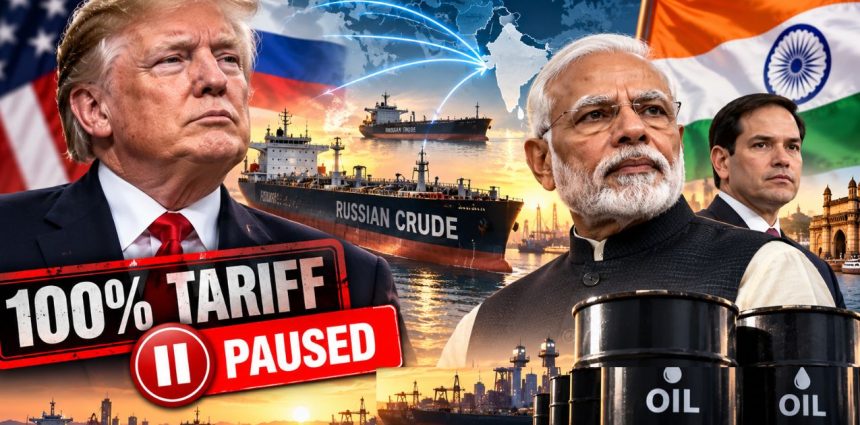
The 100% tariff threat tied to qualifying Russian-energy purchases is paused, not repealed. Record tanker costs squeeze Russian crude economics, and Marco Rubio’s October 20 Mumbai talks put India-US energy and trade ties in focus.
October 17, 2026
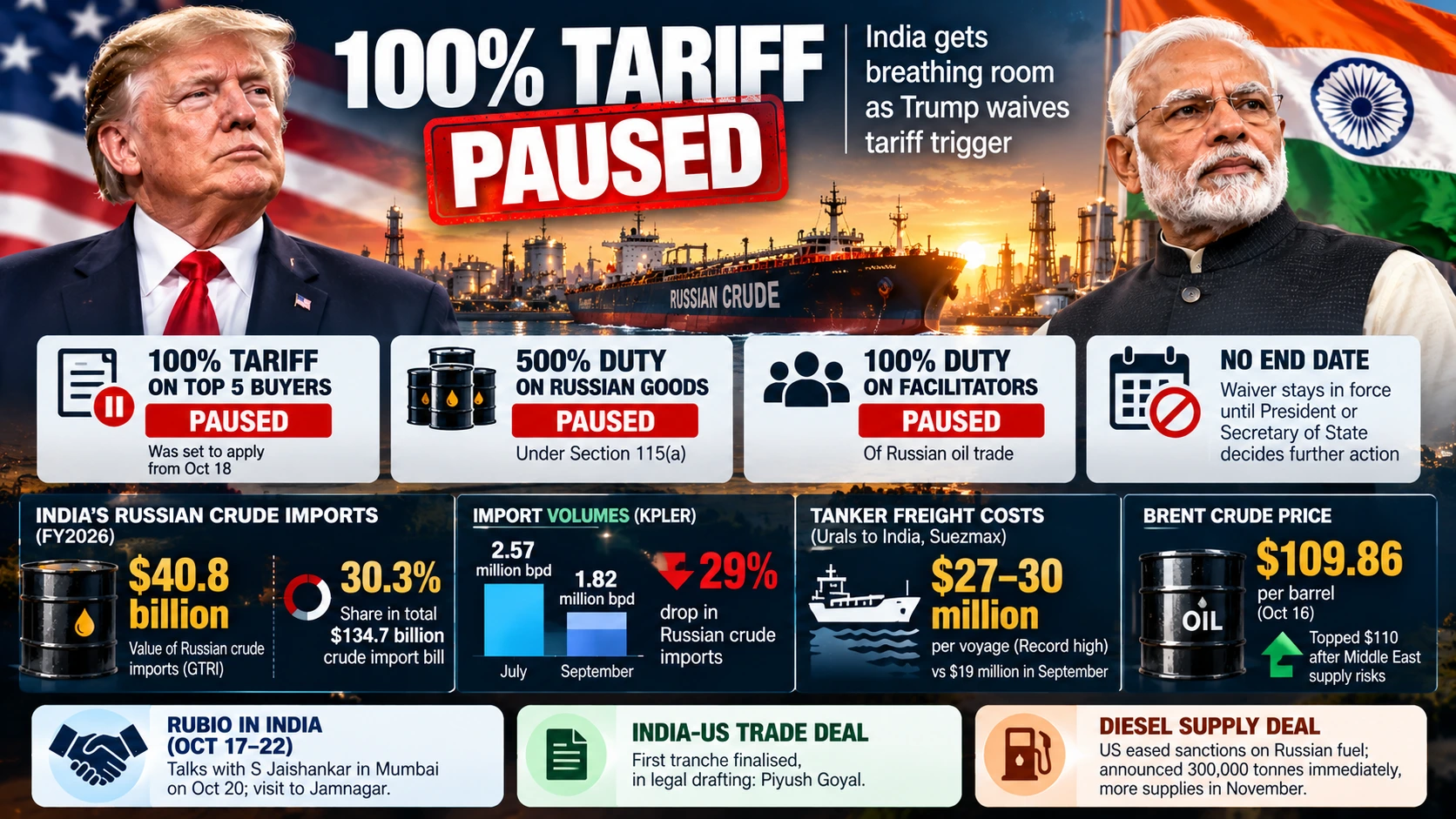
President Donald Trump has waived the Graham Act’s tariff trigger two days before it was due to switch on, sparing India a potential 100% duty on goods it sells to the US. The threat applied to goods from the five largest importers of Russian crude and gas that knowingly made new purchases on or after October 18.
It was a duty on imports into the US, not a tax on the oil India buys. The October 16 order waives specified duties and sanctions under the Act but does not repeal it, and earlier Russia sanctions are untouched. India spent $40.8 billion on Russian crude in FY2026, 30.3% of its $134.7 billion crude import bill, according to GTRI figures cited by The Economic Times.
Under the order, a 500% duty on Russian goods, the 100% duty on the top five buyers and a separate 100% duty on the top five facilitators of Russian oil sanctions evasion are all waived under Section 115(a).
Trump says a certification and report have gone to Congress. ABC News reported that the order gives the administration much wider latitude over which penalties to keep. The Economic Times names China and Turkey as the other major buyers gaining breathing room.
The waiver has no end date. It stays in force until the President or the Secretary of State decides further action is appropriate. The US Trade Representative must keep monitoring Russian energy purchases and promptly flag anything that might call for further action, including on the waivers. The lever is unloaded, not removed.
WHY TRUMP MOVED NOW: THE DIESEL GAMBIT
The waiver follows a week of diesel diplomacy. On October 9, the administration temporarily eased sanctions on Russian fuel so diesel could flow to global markets.
Trump said Vladimir Putin had agreed to supply more than 300,000 tonnes immediately, another 500,000 tonnes in November and 1 million tonnes soon after. These are announced volumes, not confirmed deliveries.
Traders are still assessing how much diesel Russia can actually supply, and a drone attack forced Russia’s Ryazan refinery to suspend a primary crude distillation unit.
The pressure is domestic. When the deal was announced, the US national average diesel price was $6.23 a gallon per AAA, after a record $6.52 in September. Midterm elections are on November 3.
The deal drew bipartisan fire. Six Republican and six Democratic senators wrote to Trump that Russian diesel would barely move fuel prices while giving Moscow revenue to prolong its war. An energy analyst quoted by CBS News noted the world uses roughly 3.5 to 4 million tonnes of diesel a day, so the extra Russian supply is small.
Also Read: Trump’s 100% Drone Tariff: 4 Indian Stocks to Watch as US Supply Chain Shifts
INDIA’S EXPOSURE: WHAT THE NUMBERS SAY
Two measures are in play and should not be mixed. GTRI’s FY2026 figures are import values, while Kpler’s monthly figures are volumes. On volumes, Kpler data show India imported about 1.82 million barrels per day of Russian crude in September, roughly 29% below July’s 2.57 million. India still remained the largest buyer, ahead of China at 1.49 million.
Kpler’s Sumit Ritolia cautioned against reading the drop purely as a reaction to tariff threats. Tighter availability and stronger Chinese competition for barrels also played a part.
He indicated refiners tend to trim rather than halt Russian purchases while they assess enforcement, possible waivers and alternative supply. Gulf crude has filled much of the gap. Middle East imports were about 3 million barrels per day in September, close to pre-war levels.
THE FREIGHT SQUEEZE: WHY CHEAPER RUSSIAN OIL IS NOT GUARANTEED
Reuters reported that moving Urals crude from the Black Sea to India on a Suezmax tanker hit a record $27 million to $30 million per voyage, against about $19 million in September. Reuters calculations put Urals freight to Asia at around $30 a barrel or more, and the agency said record rates are cutting into Moscow’s profits from high prices.
These are voyage costs that vary by ship and route, and who absorbs them depends on contract terms. The practical point is that a diplomatic reprieve does not by itself lower the delivered cost of a Russian cargo for Indian refiners.
WHY THE REPRIEVE IS NOT A PASS
Law firm Squire Patton Boggs had flagged that the tariff provisions might work first as negotiating tools and that extensive waivers could weaken their force. That is now the live scenario.
Pressure is building from several directions. Democratic Representative Don Beyer said Trump had waived all of the Act’s Russia sanctions, just as he and others had warned. Ukrainian President Volodymyr Zelenskyy told the Wall Street Journal that Russia would be forced to end the war quickly if India, China and Turkey stopped buying its energy.
There is also a precedent that links oil to trade. In February, Trump rolled back an extra 25% tariff on India after announcing a trade deal. Rubio later said India had committed to stop buying additional Russian oil, while New Delhi said national interest would guide its energy sourcing.
RUBIO, MUMBAI AND THE TRADE-DEAL CLOCK
The timing matters. Rubio travels to Samarkand, Mumbai and Jamnagar from October 17 to 22, with talks with External Affairs Minister S Jaishankar in Mumbai on October 20. The itinerary includes Jamnagar, home to Reliance Industries’ refining complex.
Commerce Minister Piyush Goyal said on Thursday that the first tranche of the India-US trade agreement is finalised and in legal drafting. He hopes to operationalise it soon, once India gets a competitive advantage over peer countries.
MARKET WATCH: OIL STILL SETS THE TONE
Brent settled at $109.86 a barrel on Friday, October 16, after touching $110 for the first time since May, as traders weighed Middle East supply risks and how much diesel Russia can supply. The IEA said on October 15 that members would accelerate the remaining releases from the March emergency-stock pledge, including more than 20 million barrels of diesel as soon as possible.
Indian markets reopen on Monday, October 19. The waiver does not by itself signal gains for Indian equities or lower pump prices. Those depend on crude, product prices, taxes and domestic pricing decisions. Crude-sensitive sectors such as refining, oil marketing and aviation are where traders are likely to look first.
Track how foreign and domestic institutions position themselves through the oil shock on NiftyTrader’s FII-DII Tracker: niftytrader.in/fii-dii-data
BOTTOM LINE
The waiver buys India time, not certainty. It removes a hard October 18 trigger but leaves the tariff authority intact, with no expiry date on the waivers and the US Trade Representative still watching. The next moves come from three places: Rubio’s October 20 talks in Mumbai, whether Congress tries to restore the law’s force, and October’s Kpler import data, which will show whether refiners rebuild Russian volumes or keep diversifying. For Indian refiners and exporters, the question is no longer whether Washington holds a tariff lever, but when it chooses to use it.
Read Next: Starlink India Launch: Network Ready, but Final Clearances Pending
Disclaimer: This article is for informational purposes only and is not investment advice or a recommendation to buy, sell or hold any security. Consult a SEBI-registered advisor before making investment decisions.