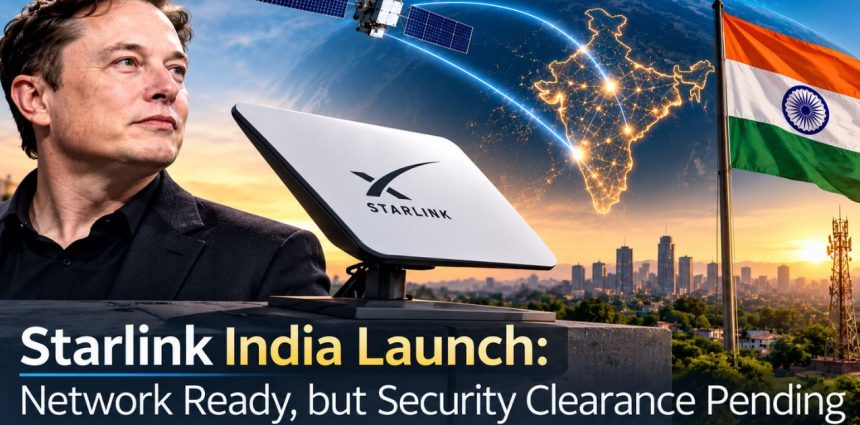
Starlink says its dedicated systems and gateways in India have the requisite government approvals. However, the government’s latest published update says security assessments for all three licensed satellite operators are underway, while separate spectrum assignment remains another key step before commercial services can proceed.
At a glance
- Starlink’s claim: The company says its dedicated systems, gateways and other Indian infrastructure have the requisite government approvals.
- The government’s position: On October 8, the Ministry of Communications said security assessments for Starlink, Jio Satellite Communications and OneWeb India were underway.
- The regulatory distinction: A satellite communications licence does not automatically authorise spectrum use. A separate spectrum assignment is required.
- What remains uncertain: The public announcements reviewed do not establish a confirmed commercial launch date, completion of every outstanding clearance or final Indian subscription pricing.
Starlink India regulatory status: What is approved and what remains pending?
| Milestone | Status established by the cited sources |
|---|---|
| DoT service licence | The government confirms that Starlink, Jio Satellite Communications and OneWeb India have received satellite communications licences. |
| Starlink infrastructure | Starlink says its dedicated Indian systems, gateways and other infrastructure have the requisite government approvals. |
| Security assessments | The government’s October 8 update said assessments were underway for all three licensed operators. |
| Technical demonstrations | Media reports describe demonstrations by the operators at different times. Completing a demonstration does not, by itself, establish that every security requirement has been fulfilled. |
| Spectrum assignment | A separate process; the DoT licence does not automatically confer the right to use spectrum. |
| Commercial launch date | No confirmed date is established by the public announcements reviewed for this article. |
Sources: Ministry of Communications statement dated October 8, 2026, DoT GMPCS guidance and the government’s Starlink authorisation backgrounder.
Starlink’s entry into India’s satellite internet market has returned to the spotlight after the Elon Musk-led company said its dedicated infrastructure was ready and had the requisite government approvals. The statement, made on October 16, followed Reliance Industries’ response to the escalating dispute over competition in India’s satellite communications sector.
But the main question is no longer just whether Starlink has built its Indian network. It is whether the company has completed the remaining regulatory requirements needed to begin commercial services.
In its October 8 statement, the Ministry of Communications said security assessments for all three licensed satellite operators were underway. It added that an operator could proceed to the next step of seeking spectrum assignment once its assessment was completed. The ministry also described the three companies as being at broadly the same regulatory stage.
This creates an important distinction between Starlink’s stated infrastructure readiness and the government’s published description of the approval process. Neither the company’s latest statement nor the ministry’s October 8 release establishes a confirmed date on which Indian customers can begin subscribing.
What did Starlink say about its India launch?
In its post on X, reproduced in The Economic Times’ October 17 report, Starlink said it had worked closely with Indian regulators, industry participants and operators for more than five years.
The company said it had built dedicated systems, gateways and other infrastructure within India to serve Indian traffic safely and securely. It described itself as ready to connect India with high-speed internet.
The statement reinforces Starlink’s argument that it has invested in preparing for the Indian market. However, it does not detail the status of every security condition or independently establish that spectrum has been assigned for commercial operations.
Having approved infrastructure does not necessarily mean that every regulatory condition for launching a telecommunications service has been fulfilled. That distinction is central to understanding the current dispute.
Which approvals has Starlink already received?
Starlink has obtained important authorisations for its Indian operations.
A government backgrounder published by the Press Information Bureau records that Starlink Satellite Communications Private Limited received a Department of Telecommunications (DoT) Unified Licence on June 6, 2025. It covers Global Mobile Personal Communications by Satellite (GMPCS), Commercial Very Small Aperture Terminal (VSAT) and Internet Service Provider Category A services.
The same backgrounder records an IN-SPACe approval dated July 8, 2025, for provisioning first-generation Starlink satellite constellation capacity in India.
These milestones show that Starlink’s India plans have progressed beyond the initial application stage. They should not, however, be described as proof that commercial launch permission is complete.
DoT’s official GMPCS service guidance explicitly states that a licence does not automatically confer the right to assignment and use of spectrum. A separate, specific frequency assignment is required.
The government has therefore identified distinct parts of the process: service authorisation, security compliance and spectrum assignment. Progress on one milestone should not be interpreted as automatic completion of the others.
Why security clearance matters
Satellite broadband operates differently from conventional terrestrial mobile networks. Satellite operators rely on spacecraft and ground systems to deliver connectivity, raising questions about network control, traffic routing and compliance with lawful interception and other security requirements.
DoT’s GMPCS guidance sets out conditions concerning security compliance and the use of satellite communications infrastructure in India. These rules help explain why installing gateways is not necessarily the end of the approval process: authorities must also assess compliance with the applicable conditions.
An October 15 report by The Economic Times, citing an unnamed senior government official, said security agencies had raised questions about Starlink’s compliance with Indian requirements. The report referred to issues involving data storage, traffic routing and the possibility that inter-satellite links could allow traffic to bypass Indian ground infrastructure.
The same report discussed Starlink’s investment in domestic gateway infrastructure. This is an important part of the story because physical readiness and security acceptance are separate questions.
The reported concerns must remain attributed to the official cited by the publication. They are not equivalent to a detailed, publicly issued government finding that Starlink has breached the rules. Likewise, Starlink’s statement that its infrastructure has the requisite approvals does not prove that every outstanding security question has been resolved.
The ministry’s October 8 statement confirms that security assessments were underway, but it does not publicly detail each outstanding technical query. Starlink’s public post, meanwhile, does not disclose the status of individual security discussions.
The precise regulatory status of those issues therefore remains uncertain in the public record reviewed for this article.
Technical demonstrations are not the same as final clearance
Technical demonstrations can show that a network or service has reached a particular stage of readiness. They do not necessarily establish that a company has completed every security assessment or received the spectrum assignment required for commercial operations.
A report by The Financial Express, citing DoT records, said Jio Satellite Communications completed its security and technical compliance demonstration in March 2025, OneWeb completed its demonstration in the second half of 2025, and Starlink’s demonstration took place in early 2026. The report also said the operators remained subject to further clearance requirements.
The distinction matters because the government subsequently stated on October 8 that security assessments for all three licensed satellite operators were underway.
The dates of technical demonstrations should not be used to assert that one company has received final launch permission or is officially first in line. The ministry described the operators as being at broadly the same regulatory stage.
For readers, the key question is not simply which company demonstrated its technology first. It is which operator completes the remaining requirements and receives the necessary permission to proceed.
Reliance welcomes competition but insists on compliance
Reliance Industries responded to the controversy by saying it welcomed competition in satellite communications, including from Starlink. It maintained that all operators, Indian or foreign, must comply with the country’s laws and policies.
In its statement, Reliance also said Jio’s own satellite services were awaiting clearances. The company pointed to Jio’s growth since entering India’s mobile telecommunications market in 2016, arguing that competition is the test of which provider serves customers best.
The Reuters report on Reliance’s October 16 response sets out the context of the exchange, including Musk’s allegations that powerful business interests were obstructing Starlink’s entry into India.
The Ministry of Communications rejected claims that India’s regulatory framework was unfair or discriminatory. In its October 8 statement, it said the three licensed satellite operators were at broadly the same regulatory stage.
Bharti Enterprises Chairman Sunil Bharti Mittal has separately said that he believes Eutelsat OneWeb is ahead of Starlink in the queue for launching satellite services. His comments reflect the company’s assessment of the process; they do not constitute a formal ranking announced by the regulator.
The dispute should therefore be reported as a disagreement over competition, regulatory timing and compliance—not as established proof that a particular operator is being deliberately blocked.
Track Live: Reliance Option Chain Live – RIL Options Data
Jio and Airtel have agreements with SpaceX. Why does clearance still matter?
Starlink’s potential relationships with established telecom operators add another dimension to the market.
In March 2025, Bharti Airtel announced an agreement with SpaceX to explore bringing Starlink services to Indian customers. Airtel explicitly stated that the agreement was subject to SpaceX receiving its own authorisations to sell Starlink in India.
The agreement envisaged exploring opportunities involving retail equipment, business customers, communities, schools and healthcare centres. Such arrangements could help extend satellite connectivity to locations where conventional infrastructure is difficult to deploy.
Reliance also announced a potential collaboration in its official release, Jio To Bring SpaceX’s Starlink High-Speed Internet to Its Customers, dated March 12, 2025.
These arrangements could help Starlink reach business customers and underserved areas through established distribution networks. However, a commercial partnership is not the same as regulatory authorisation, and it does not mean that Indian customers can immediately order or activate the service.
Each operator remains subject to the regulatory conditions governing its own operations. The existence of a distribution agreement therefore does not remove the need for the applicable clearances.
Will Starlink be cheaper than Jio?
Pricing could become one of the biggest tests of Starlink’s commercial prospects after the necessary permissions are obtained.
Musk has said Starlink would need to offer affordable pricing in India. However, Reuters reported on October 11 that he had not specified Indian prices.
A statement about affordability is not the same as a published Indian tariff, equipment cost or subscription plan. No price comparison should be presented as confirmed until the companies provide comparable plan details.
Satellite broadband may be especially useful in remote villages, geographically difficult locations and businesses that lack reliable terrestrial connectivity. DoT describes GMPCS services as relevant to rural, remote and underserved areas.
That does not automatically mean satellite internet will replace conventional mobile data or fibre broadband in cities. Consumers will compare equipment costs, recurring subscriptions, service availability and connection quality against alternatives already available to them.
For customers in underserved areas, the value may come from obtaining a reliable connection where terrestrial options are limited. For the broader market, adoption will depend on whether Starlink can deliver a compelling combination of coverage, performance and price.
The expectation gap is clear: Starlink’s entry could widen consumer choice, but its commercial impact will remain uncertain until regulatory approval, Indian pricing and customer availability are established.
What happens next in the Starlink India launch process?
The next meaningful milestones are a documented update on the security assessment, progress on the separate spectrum-assignment process, and a formal announcement of customer availability.
DoT’s published guidance makes clear that spectrum use does not automatically follow from a GMPCS licence. The government’s October 8 statement also says that an operator can proceed to seek spectrum assignment after completing the security-assessment process. Seeking assignment is itself not the same as receiving it.
Readers should therefore watch for three concrete developments:
- An official update confirming the status of Starlink’s security assessment.
- A formal update on spectrum assignment and any remaining operational requirements.
- An official commercial launch announcement with service availability, equipment costs and pricing.
The public announcements reviewed for this article do not establish a confirmed launch date or final Indian subscription tariff. They also do not establish that all outstanding security conditions have been satisfied.
Also Read: Starlink Returns to India With Bid for 30,000 Satellites That Can Reach Your Phone
What it means for Indian consumers
Starlink’s infrastructure-readiness statement is an important development, but the next stage will determine whether that preparation translates into a commercially available service.
For customers in underserved areas, satellite broadband could offer another connectivity option. For Jio and Airtel, the arrival of a new satellite provider could create more competition while also offering opportunities for distribution partnerships. The scale of the impact will depend on pricing, performance and practical availability.
The regulatory question remains central. The government has publicly said security assessments were underway for all three licensed operators, while Starlink says its Indian infrastructure is ready. Those statements can coexist because physical readiness and regulatory completion are different milestones.
Until the remaining clearance requirements and spectrum-assignment status are confirmed, Starlink’s readiness to connect India should not be treated as confirmation that commercial services can begin.
Read Next: SEBI IPO Observations: Cult.fit’s ₹950 Crore Issue Leads 4 IPO Plans
Disclaimer: This article is for informational purposes only and is not investment advice. Regulatory status and company plans may change. Verify relevant announcements against official sources before making decisions.