
Tata Communications Bets $450 Million on India’s AI Infrastructure Boom
India’s artificial intelligence expansion is creating a new infrastructure opportunity, and Tata Communications wants to capture a significant share of it. The company plans to invest up to $450 million over the next three to five years to build an AI-ready fibre network connecting major data centres and technology hubs across the country.
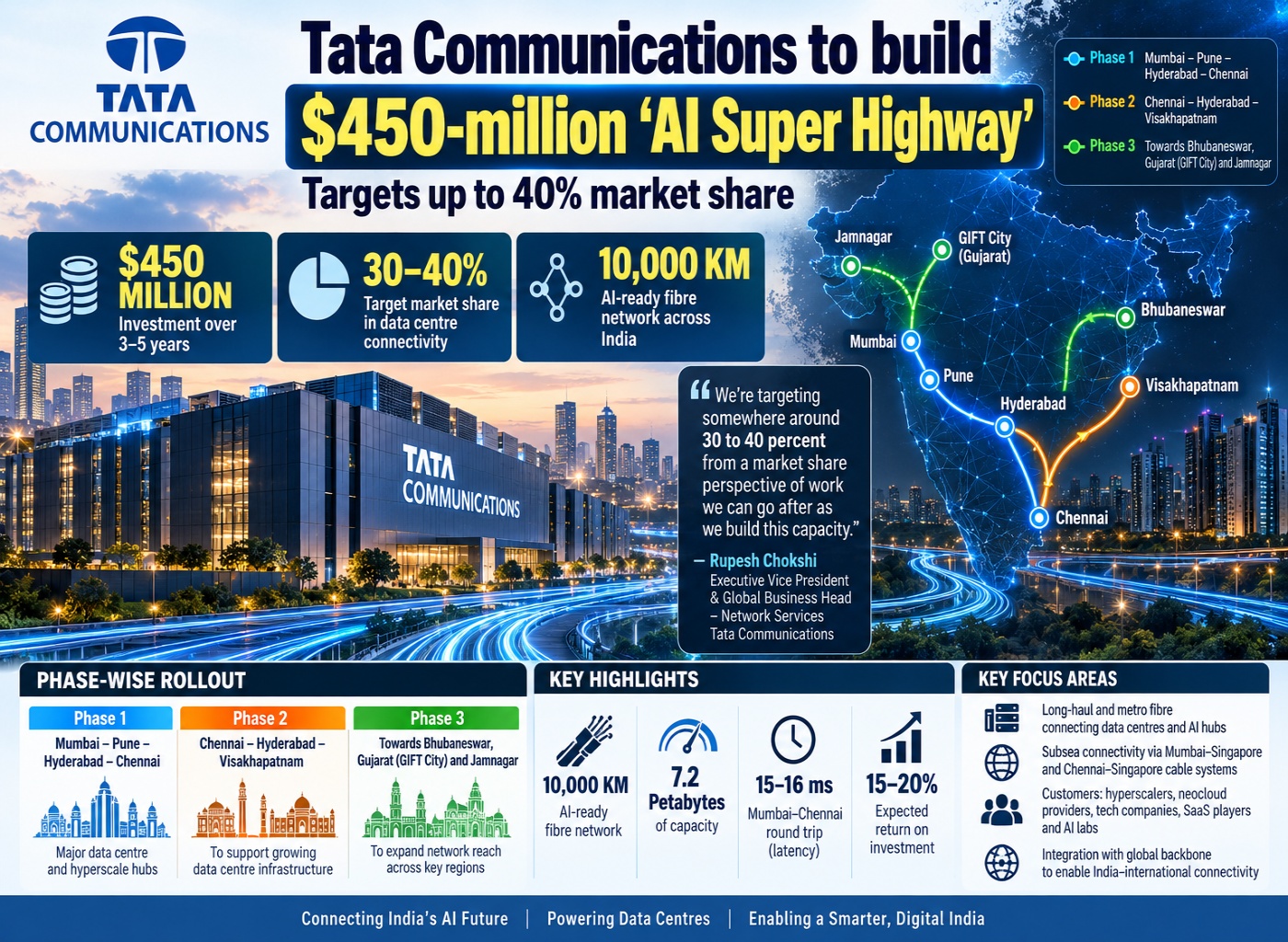
The proposed “AI Super Highway” will span approximately 10,000 kilometres and target a market share of 30–40% in data centre-to-data centre connectivity, according to executive vice president Rupesh Chokshi, who spoke to Moneycontrol.
The ambitious plan comes as investments in AI computing, cloud services and data centres accelerate. However, the company has not yet announced contracts for the proposed network, despite being in advanced discussions with potential customers.
Track Live : Nifty Levels Today | Sensex Levels Today
Tata Communications Targets a $1 Billion Data Centre Connectivity Market
Tata Communications estimates that India’s data centre-to-data centre connectivity market could exceed $1 billion over the medium term. The company intends to capitalise on growing demand for high-speed connections that allow AI systems to transfer enormous volumes of data between computing facilities.
The planned investment will primarily support long-haul and metropolitan fibre infrastructure, while subsea connectivity will complement the network through international routes.
Chokshi said the company expects to target 30–40% of the addressable market as capacity is developed.
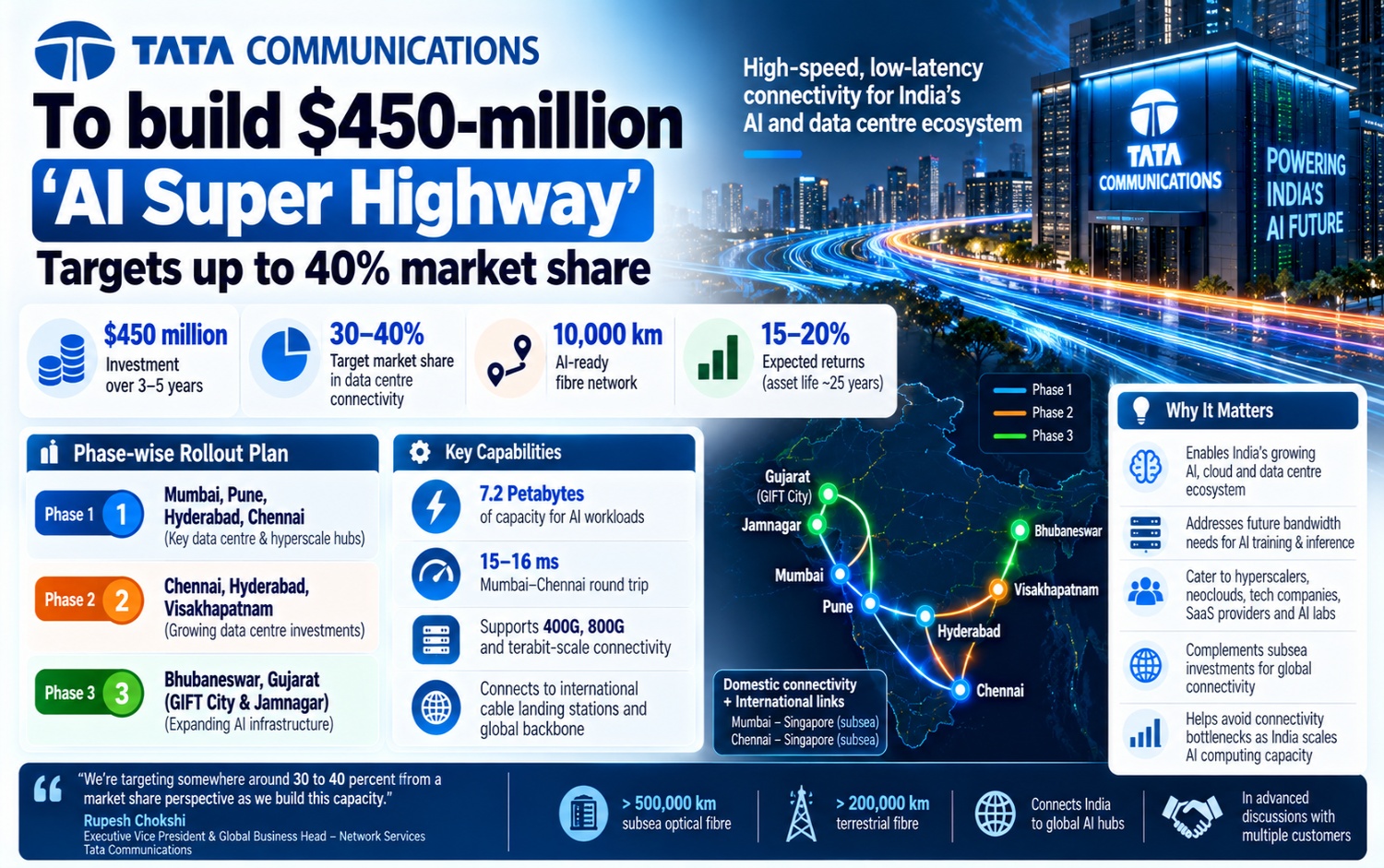
He also indicated that investments of this nature typically target benchmark returns of 15–20%, supported by long-term infrastructure assets and customer contracts.
“Think of it as owner economics. This is very durable revenue,” Chokshi said, explaining that customer deals could run for five to 10 years, while the underlying assets have an estimated lifespan of 25 years.
Key project details at a glance
| Particulars | Details |
|---|---|
| Company | Tata Communications Ltd |
| Project name | AI Super Highway / AI Network Fabric |
| Planned investment | $400–450 million (approximately ₹3,350–₹3,800 crore at illustrative exchange rates) |
| Network length | Approximately 10,000 km of new fibre |
| Planned additional capacity | Approximately 6 petabits per second (Pbps), according to the exchange-filing reports |
| Capacity target | 7.2 petabytes of capacity, as described in the Moneycontrol interview; this differs from the 6 Pbps figure reported elsewhere |
| Target market share | 30–40% of the addressable data-centre connectivity market, according to the interview |
| Estimated market opportunity | More than $1 billion over the medium term |
| Funding | Operating cash flows, according to the company’s announcement and exchange-filing reports |
| Rollout | Three phases |
| Expected capacity deployment | FY2030–FY2036, according to reports on the exchange filing |
| Customer contracts | Discussions underway; no specific new contracts for the proposed network had been announced in the interview |
Why is the AI Super Highway important?
| Technology feature | What it means |
|---|---|
| High-speed fibre | Moves large amounts of data between AI computing facilities |
| Low latency | Reduces delays when data travels between connected locations |
| 400G, 800G and terabit-scale connections | Supports increasingly demanding AI and cloud workloads |
| Network resilience | Helps maintain connectivity when a route or component fails |
| Global connectivity | Links Indian data centres with overseas cloud and AI infrastructure |
According to the Moneycontrol interview, Tata Communications expects a Mumbai–Chennai round trip to take approximately 15–16 milliseconds. Actual latency depends on the route, network equipment and operating conditions.
Market opportunity and potential returns
| Metric | Reported estimate |
|---|---|
| Indian data-centre-to-data-centre connectivity market | More than $1 billion over the medium term |
| Tata Communications’ target share | 30–40% of the addressable market |
| Implied annual market opportunity at $1 billion | $300–$400 million at the target share |
| Reported benchmark investment return | 15–20%, according to the executive interviewed |
| Typical customer contract duration | 5–10 years |
| Indicative infrastructure asset life | Approximately 25 years |
The $300–$400 million figure is an illustration of market revenue at the target share only if the addressable market reaches $1 billion. It is not a company revenue forecast, confirmed contract value or profit estimate. The 15–20% return is a benchmark cited by the executive, not a guaranteed return on this specific project.
Mumbai, Pune, Hyderabad and Chennai Will Lead the First Phase
The first phase of the AI Super Highway will connect Mumbai, Pune, Hyderabad and Chennai, creating links between important data centre and hyperscale computing hubs.
The second phase will extend connectivity between Chennai, Hyderabad and Visakhapatnam, where data centre investment and infrastructure development are gathering pace.
The third phase will expand towards Bhubaneswar and Gujarat, including GIFT City and Jamnagar.
Across the approximately 10,000-km network, Tata Communications plans to deliver 7.2 petabytes of capacity for bandwidth-intensive AI workloads and data centre interconnect requirements.
The company says a Mumbai–Chennai round trip could be completed in 15–16 milliseconds, highlighting the importance of low latency for customers operating demanding AI applications.
Track Live : NSE Option Chain — Live | BSE Option Chain — Live Sensex & Bankex Options Data Today
AI Connectivity Could Become India’s Next Infrastructure Bottleneck
AI expansion depends on more than graphics processing units, electricity, cooling systems and land. Data centres must also exchange information quickly and reliably, making fibre connectivity increasingly important.
Chokshi warned that network infrastructure could become a constraint if capacity fails to keep pace with AI computing demand.
“The demand is real. It’s here,” he said, referring to discussions with multiple prospective customers.
The network is designed to support hyperscalers, neocloud providers, technology companies, software-as-a-service businesses and AI laboratories. Customer requirements are also moving beyond traditional 10-gigabit and 100-gigabit connections towards 400-gigabit, 800-gigabit and terabit-scale capacity.
Read More : E2E Networks Share Price: Why This AI Stock Staged a Dramatic U-Turn on Monday
International Cable Investments Will Strengthen the AI Super Highway
Tata Communications also plans to complement its domestic network with international connectivity. Proposed subsea cable systems linking Mumbai with Singapore and Chennai with Singapore are expected to support international capacity and route diversity.
The company already operates more than 500,000 kilometres of subsea optical fibre and over 200,000 kilometres of terrestrial fibre. It has also previously built a dedicated network for Amazon Web Services.
These existing assets could help support its broader AI infrastructure ambitions, connecting Indian data centres with international cable landing stations and overseas AI hubs.
What Tata Communications’ AI Investment Means for Investors
The $450 million AI Super Highway proposal positions Tata Communications to benefit from rising demand for AI connectivity and data centre infrastructure. Long-term contracts could provide recurring revenue if the company secures sufficient customers and achieves its targeted market share.
However, investors should distinguish between a proposed investment and confirmed commercial revenue. Contract announcements, capital expenditure, project execution, debt requirements and realised returns will be important indicators to monitor.