
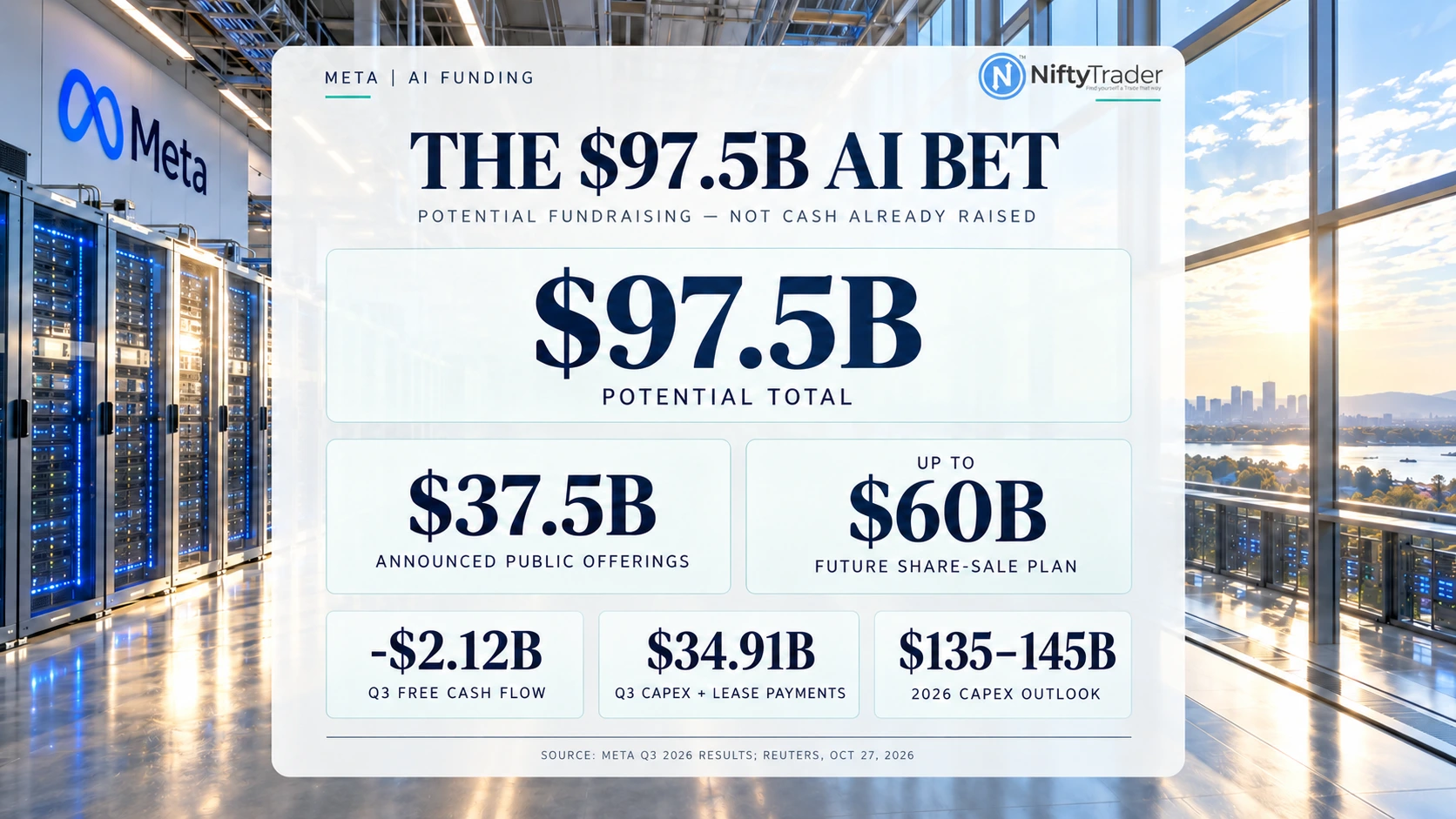
Meta Platforms is pursuing a potential $97.5 billion equity-funding programme to support its artificial intelligence (AI) expansion, as negative third-quarter free cash flow highlights the financial demands of building AI infrastructure. The plan combines $37.5 billion in announced public offerings with a separate share-sale programme of up to $60 billion that remains unfinalised.
The distinction matters for investors: Meta has priced its public offerings, but the headline $97.5 billion is not cash already raised or immediately available to fund its expansion. The timing of the common-stock proceeds and the uncertain status of the future share-sale programme make the financing structure as important as the headline amount.
Meta’s $97.5 Billion AI Funding Plan: What Is Confirmed?
Meta increased its planned Class A common-stock offering from $22.5 billion to $25 billion, priced at $625 per share. It also priced 250 million depositary shares representing mandatory convertible preferred stock at $50 each, giving the preferred-stock offering a value of $12.5 billion.
The two public offerings therefore total approximately $37.5 billion.
However, the common-stock offering is structured through forward sale agreements. Meta does not expect to receive the proceeds initially and expects settlement on or before November 19, 2027. Its pricing announcement estimates net proceeds of approximately $24.9 billion before expenses upon settlement, subject to the agreements’ terms and adjustments.
The separate at-the-market (ATM) programme could allow Meta to sell up to $60 billion in Class C common stock after the new shares begin trading, which the company expects in the first quarter of 2027. Meta has not entered into an agreement for this programme, and its final timing, size and terms have not been determined. There is no guarantee the programme will be established or that the full amount will be sold.
The potential total is therefore $97.5 billion, not $97.5 billion in completed fundraising.
Sources: Meta’s official pricing announcement and offering terms.
Meta’s Negative Free Cash Flow Shows the Cost of AI Expansion
Meta’s third-quarter results help explain why investors are scrutinising the financing plan.
The company reported revenue of $64.60 billion, up 26% year over year, while total costs and expenses increased 68% to $51.61 billion. The results included a $9.89 billion legal charge related to an August agreement with 52 US attorneys general over litigation involving teen mental health and social media.
Operating cash flow was $32.79 billion, while capital expenditure, including principal payments on finance leases, reached $34.91 billion. The difference resulted in negative free cash flow of $2.12 billion, compared with positive free cash flow of $10.63 billion a year earlier.
Meta also reported $82.45 billion in cash, cash equivalents and marketable securities at September 30. Its 2026 capital-expenditure guidance stands at $135 billion to $145 billion, narrowed from the previous range of $130 billion to $145 billion.
The negative free cash flow does not by itself establish that Meta’s AI investments are unprofitable. It shows that quarterly capital spending exceeded operating cash generation under the company’s reported free-cash-flow measure. The central question is whether future AI-related revenue and productivity gains can justify the size of the investment.
Meta’s SEC filing says the agreement with the attorneys general could involve payments of up to approximately $18.59 billion, with portions conditional on specified requirements. The $9.89 billion charge recognised in the third quarter should not be confused with the entire potential settlement amount.
Alphabet’s $84.75 Billion Funding Plan Shows a Wider AI Trend
Meta is not alone in turning to equity markets to finance AI ambitions. Reuters reported in June that Alphabet had expanded its planned equity fundraising to $84.75 billion through a broader package of offerings and financing arrangements.
The structures are not identical, but the comparison highlights a wider change in the technology sector. Major companies are increasingly considering equity and debt financing alongside internally generated cash to support the data centres, computing capacity and infrastructure required for AI.
For shareholders, the issue is not simply how much a company can raise. It is whether the resulting investments create enough additional revenue and profitability to justify the financial commitment.
The stakes are significant because strong AI demand does not guarantee equally strong returns for every company involved. Competitive pressure, infrastructure costs, financing conditions and the pace of monetisation can all affect the eventual payoff.
Fed Decision and Big Tech Earnings Could Test Investor Confidence
The financing debate comes ahead of the Federal Reserve’s October 28 policy decision and earnings announcements from Alphabet, Microsoft and Amazon.
The Fed’s statement is scheduled for 2:00 p.m. Eastern Time on Wednesday, followed by a press conference at 2:30 p.m. ET. Markets broadly expect rates to remain unchanged at this meeting, although inflation and the longer-term interest-rate outlook remain uncertain.
Investors will also examine the three technology companies’ results and guidance for evidence that AI expenditure is translating into sustainable growth. Cloud revenue, AI monetisation and capital-spending plans are likely to remain important indicators.
Better-than-expected results and convincing evidence of returns could support the technology sector. However, higher investment requirements without clearer progress on profitability could revive concerns about valuations and financing costs.
What Indian Investors Should Watch
The timing of these announcements matters for Indian markets because the major catalysts arrive after domestic cash-market hours.
The Fed statement is scheduled for 11:30 p.m. IST on Wednesday, October 28. Alphabet’s earnings call is scheduled for 2:00 a.m. IST on Thursday, October 29, while Microsoft’s call is scheduled for 3:00 a.m. IST that day. Amazon’s call is scheduled for 2:30 a.m. IST on Friday, October 30.
These events could influence sentiment towards GIFT Nifty and Nifty IT during subsequent trading sessions. The direction is not predetermined: it will depend on the Fed’s guidance, actual earnings, capital-expenditure outlooks and investors’ assessment of AI returns.
Track Live: GIFT Nifty Live – Today Price, Chart, Timings and Nifty Opening Signal
Bottom Line
Meta’s potential $97.5 billion equity-funding programme highlights the growing financial requirements of the AI race. The headline total combines priced public offerings with a separate future share-sale programme that is not yet committed, while settlement of the common-stock forward-sale agreements is expected by November 19, 2027.
Negative third-quarter free cash flow and capital-expenditure guidance of $135 billion to $145 billion make the eventual financial payoff an important issue for investors. Alphabet’s earlier fundraising expansion suggests that financing AI infrastructure is a broader sector concern, not just a Meta-specific development.
The next test comes from the Fed’s policy guidance and Big Tech earnings. Continued AI demand may support the investment cycle, but whether that spending generates sufficient returns remains uncertain.
Read Next: F&O Buildup Today: 113 Long Signals, Nifty Nov Shows Short Buildup
Disclaimer: This article is for informational and educational purposes only and does not constitute investment advice or a recommendation to buy or sell any security. Fundraising plans, financial estimates and market expectations may change. Investors should verify official company disclosures and assess the risks before making investment decisions.