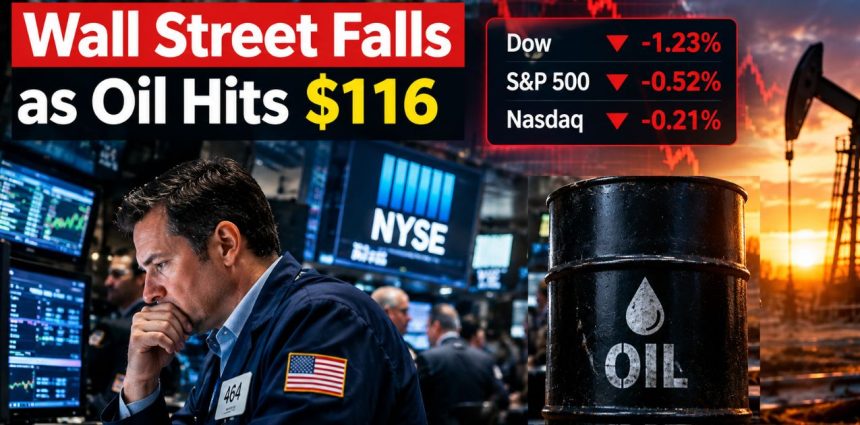
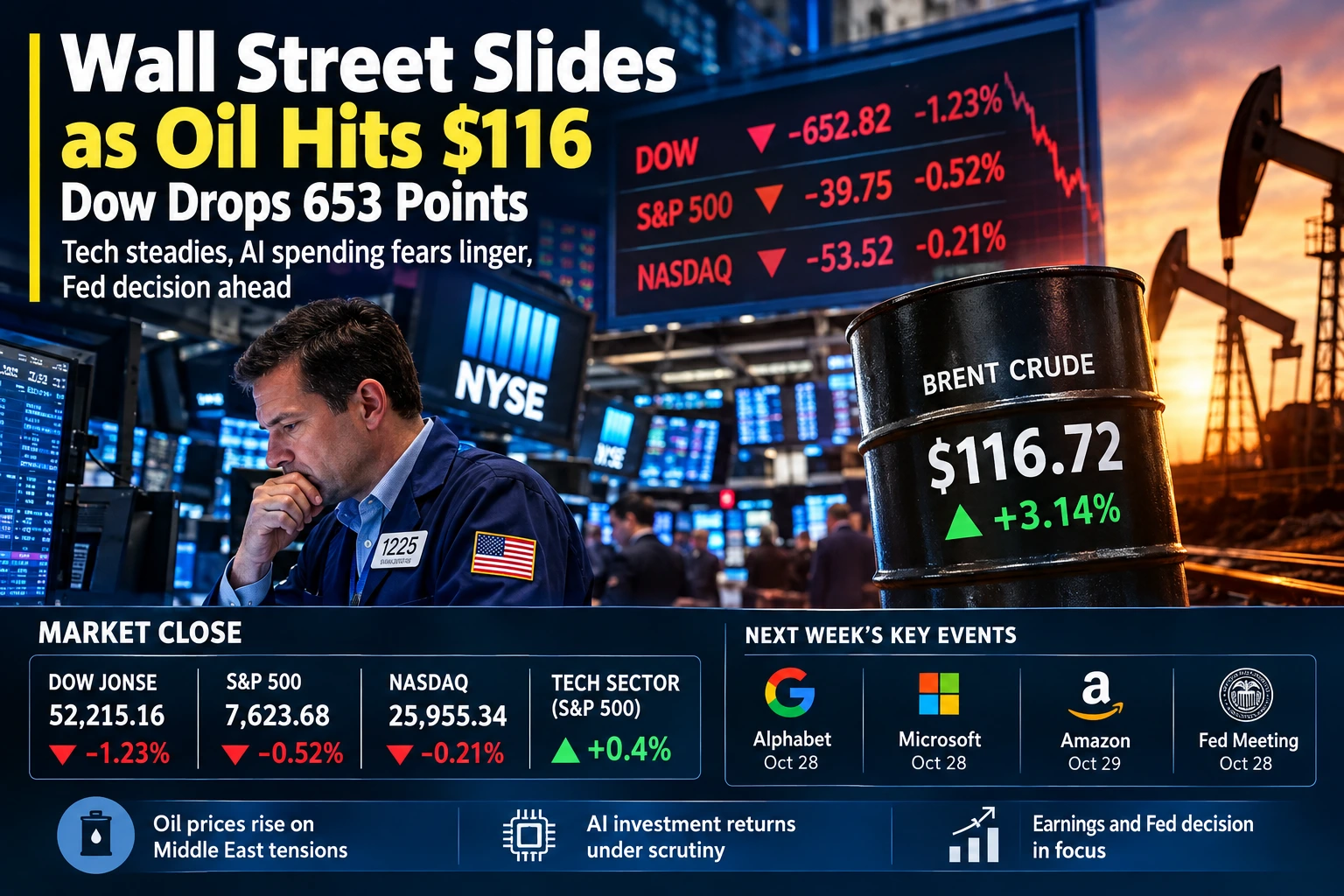
Wall Street ended lower on Friday, October 23, as Brent crude surged to $116.72 a barrel and investors reassessed the risks surrounding artificial intelligence (AI) spending. The Dow Jones Industrial Average fell 652.82 points, while the Nasdaq limited its loss to 0.21% as technology shares stabilised. With major tech earnings and a Federal Reserve decision approaching, investors face a critical test of whether corporate profit growth can withstand rising energy costs and uncertainty over AI investment returns.
Need to Know
- Dow Jones: Fell 652.82 points, or 1.23%, to 52,215.16.
- S&P 500: Lost 0.52% to close at 7,623.68.
- Nasdaq Composite: Declined 0.21% to 25,955.34, despite a 0.4% gain in the S&P 500 technology sector.
- Crude oil: Brent rose 3.14% to $116.72 a barrel, its highest settlement since April 29.
- Next week: Investors will track Alphabet, Microsoft and Amazon earnings alongside the Federal Reserve’s October 28 policy decision.
Wall Street Closing Figures: Dow, S&P 500 and Nasdaq
| Index | Friday’s Close | Daily Change | Weekly Change |
|---|---|---|---|
| Dow Jones Industrial Average | 52,215.16 | -1.23% | +0.4% |
| S&P 500 | 7,623.68 | -0.52% | -0.5% |
| Nasdaq Composite | 25,955.34 | -0.21% | -0.7% |
| Russell 2000 | 2,775.90 | -0.29% | +2.0% |
Source: Associated Press market-close report. Weekly changes are rounded.
The weekly performance reveals a divided market. The Dow extended its winning streak to three weeks, while the S&P 500 and Nasdaq finished lower. The Russell 2000 also gained approximately 2% for the week.
Friday’s technology-sector performance added another layer to the picture. The S&P 500 technology index advanced 0.4%, and the semiconductor index gained 0.4%, according to Reuters’ market report. Their resilience helped limit the Nasdaq’s decline, but it did not prevent losses across the broader market.
Brent Crude Hits $116.72 as Energy Stocks Rally
Oil was one of Friday’s biggest market drivers.
Brent crude futures settled at $116.72 a barrel, gaining $3.55, or 3.14%. US West Texas Intermediate (WTI) crude rose $3.80, or 3.8%, to $103.27. Brent advanced 6% over the week, while WTI gained 2.3%.
Renewed concerns about Middle East supply disruptions followed Houthi attacks in Saudi Arabia. An oil spill reported by authorities in the United Arab Emirates added to concerns about regional energy security.
The price surge lifted energy shares. The S&P 500 energy sector climbed 2.5%, reaching a record high, even as the broader market weakened.
The risk extends beyond the energy sector. Persistently high crude prices can increase costs for businesses and households, complicate the inflation outlook and make it harder for central banks to ease monetary policy. For equity investors, that creates an uncomfortable combination of higher input costs and potentially restrictive borrowing conditions.
The US 10-year Treasury yield also rose 3.7 basis points to 4.99%, according to Reuters.
Higher oil prices do not automatically mean stocks must fall further. However, if energy costs remain elevated while bond yields rise, investors may demand stronger earnings evidence before supporting expensive growth-stock valuations.
AI Investment Returns Face a Critical Test
The next major catalyst is the technology earnings season.
Investors have backed the AI investment cycle because spending on data centres, cloud infrastructure and semiconductors has created opportunities for technology companies and their suppliers. The market is now asking whether the resulting revenue and profits will justify the enormous capital commitments.
The scale is significant. Goldman Sachs Research estimates that the largest AI hyperscalers are on track to spend about $800 billion on capital expenditure in 2026, nearly double the previous year’s level. This is an estimate of expected spending, not a final tally of expenditure already completed. Read Goldman Sachs Research’s AI investment analysis.
The next set of results could help determine whether investor concerns are justified.
| Upcoming Event | Date | What Investors Will Watch |
|---|---|---|
| Alphabet Q3 2026 results | October 28 | Google Cloud growth, AI monetisation and spending plans |
| Microsoft FY2027 Q1 results | October 28 | Cloud demand, AI revenue and capital expenditure |
| Federal Reserve policy decision | October 28 | Inflation assessment and interest-rate guidance |
| Amazon Q3 2026 results | October 29 | AWS growth, AI infrastructure spending and returns |
| Broader US earnings season | Throughout next week | Profit growth, margins and company guidance |
Sources: Alphabet results announcement, Microsoft’s official announcement, Amazon’s official announcement and the Federal Reserve’s October calendar.
Corporate earnings remain an important support for US equities. LSEG IBES estimates cited in market reporting put third-quarter S&P 500 earnings growth at more than 32% year over year.
That strength, however, does not eliminate the risk. If companies increase AI spending forecasts without demonstrating a credible path to stronger cash flow and returns, investors could become more selective. Conversely, robust cloud growth and convincing AI monetisation could help ease concerns about the investment cycle.
Federal Reserve Decision: Inflation Remains the Risk
The Federal Reserve’s two-day policy meeting concludes on Wednesday, October 28.
Markets widely expect the Fed to leave rates unchanged at this meeting, but investors will pay close attention to its assessment of inflation and the potential path of rates in December. Expectations remain sensitive to incoming economic data and energy prices. A hold would not necessarily signal that interest-rate risks have disappeared.
Friday’s market moves underline the challenge. Oil prices are rising, Treasury yields remain close to 5%, and investors are questioning how much additional spending AI companies can sustain before returns become a greater concern.
The key uncertainty is whether the Fed can avoid further tightening while inflation pressures remain persistent. A more hawkish-than-expected message could weigh on growth stocks, particularly companies whose valuations depend on profits expected years into the future.
US Consumer Sentiment Remains Near a Record Low
The University of Michigan’s final October survey showed consumer sentiment edging down to 48.0 from 48.1 in September. Reuters reported that the reading was the second-lowest in the survey’s history.
The survey’s current economic conditions index dropped to 46.7 from 50.9, while the expectations index rose to 48.8 from 46.3. Consumers’ one-year inflation expectations increased to 4.7% from 4.6%, and long-term expectations climbed to 3.5% from 3.4%.
The results point to continued pressure on household purchasing power, even though the overall sentiment index barely changed. Persistently high energy prices could add to that pressure.
For equity investors, weak sentiment and rising inflation expectations create a difficult combination. Consumer spending could remain resilient, but sustained increases in living costs may threaten demand for discretionary goods and services.
Source: University of Michigan Surveys of Consumers and Reuters’ consumer-sentiment report.
What Wall Street’s Close Means for Indian Investors
Friday’s US market decline offers a cautionary signal for Indian equities, but it does not establish how the Nifty will trade at the next opening.
The more important macroeconomic variable may be crude oil. If Brent remains above $116, investors could reassess India’s oil-import costs, inflation risks and the outlook for fuel-sensitive businesses.
The impact will vary by sector and company. Higher energy prices can increase costs for fuel-intensive industries, while companies with different business models may experience different effects. A single session on Wall Street is not enough to forecast the direction of Indian stocks or foreign investor flows.
Indian traders should assess GIFT Nifty indications, the rupee, crude prices and the latest foreign and domestic institutional investor data before drawing conclusions about the next session.
Track Live: Nifty 50, Sensex, INDIA VIX, Gift Nifty
Bottom Line
Wall Street’s Friday decline exposed a tension at the heart of the current market: corporate earnings remain strong, but rising oil prices, higher bond yields and uncertainty over AI investment returns are making investors more cautious.
The Dow and Russell 2000 still recorded weekly gains, and technology shares stabilised on Friday. Yet the coming week could prove pivotal as Alphabet, Microsoft and Amazon report results and the Federal Reserve delivers its policy decision.
If earnings validate the scale of AI spending, markets could regain confidence. If investment commitments rise faster than credible returns—or oil-driven inflation pressures intensify—volatility could persist.
Read Next: FIIs Turn Buyers on Friday, but October Selling Still Tops ₹51,000 Crore
Disclaimer: This article is for informational purposes only and is not investment advice.