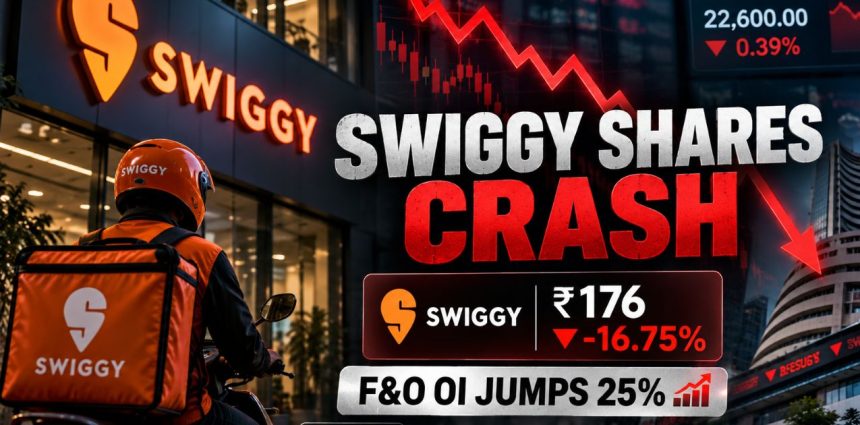
Swiggy shares closed at ₹176 on Friday, October 23, after plunging 16.75% following its Q2 FY27 earnings. While consolidated revenue rose 36% year-on-year, persistent losses in quick-commerce business Instamart weighed on sentiment. NiftyTrader data showed a 25.06% increase in stock-level futures open interest, signalling heightened derivatives positioning ahead of October expiry.
Friday, October 23, 2026
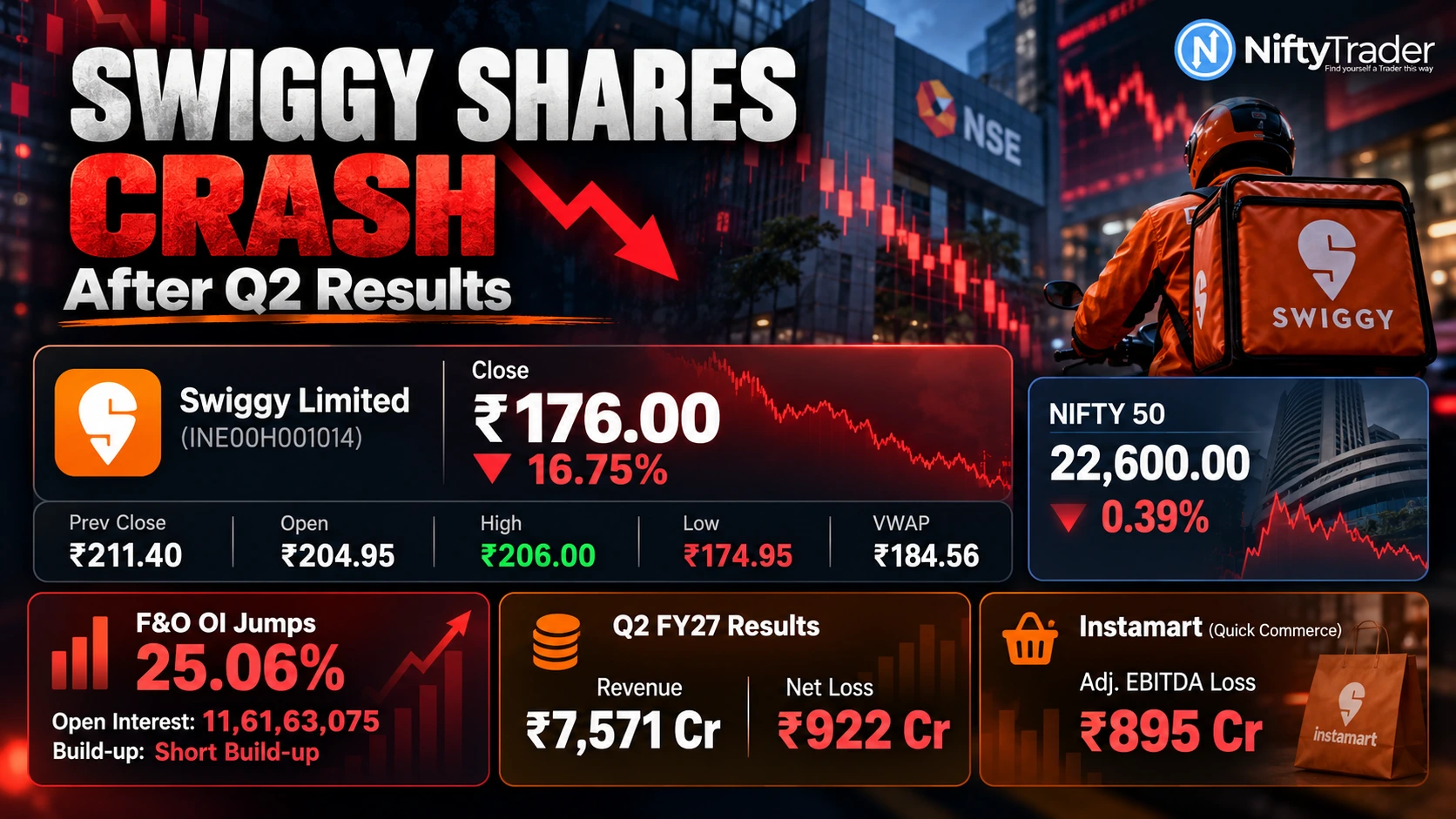
Swiggy’s share price crashed 16.75% on Friday, October 23, closing at ₹176 on the National Stock Exchange (NSE), down ₹35.40 from its previous close of ₹211.40. The sharp sell-off followed the company’s September-quarter earnings announcement, which highlighted continued profitability challenges in its quick-commerce business, Instamart.
The stock opened at ₹204.95, touched an intraday high of ₹206 and fell to a low of ₹174.95 before settling at ₹176, according to official NSE market data.
Swiggy reported a consolidated net loss of ₹922 crore for Q2 FY27, narrowing from ₹1,092 crore a year earlier but widening from ₹791 crore in the preceding quarter. Revenue from operations increased 36.14% year-on-year to ₹7,571 crore.
The derivatives market reflected increased positioning during the decline.
According to NiftyTrader’s OI Spurts dashboard, Swiggy’s stock-level futures open interest (OI) rose 25.06% to 11,61,63,075 units in the October 23 session.
NiftyTrader classified the combination of falling prices and rising open interest as a short build-up, a commonly used derivatives indicator associated with increasing outstanding positions during price weakness.
However, rising OI does not independently identify which participants initiated positions or guarantee further downside.
Track Live: SWIGGY Option Chain: Live NSE OI, PCR, IV & Greeks
Swiggy Share Price Today: Stock Closes at ₹176, Down 16.75%
Swiggy witnessed substantial selling pressure following the release of its quarterly financial results on October 22.
The NSE confirmed the following cash-market figures for October 23:
| NSE market indicator | Value |
|---|---|
| Previous closing price | ₹211.40 |
| Opening price | ₹204.95 |
| Intraday high | ₹206.00 |
| Intraday low | ₹174.95 |
| Official closing price | ₹176.00 |
| Daily price change | −₹35.40 |
| Daily percentage change | −16.75% |
| Volume-weighted average price (VWAP) | ₹184.56 |
Source: NSE Swiggy Equity Quote, October 23, 2026, as displayed at 3:55 PM IST.
The stock finished just ₹1.05 above its intraday low, highlighting the extent of price weakness during the session.
The decline was significantly sharper than the broader market. The Nifty 50 closed at 22,600, down 0.39% on Friday.
While weakness in the wider market formed part of the trading backdrop, Swiggy’s quarterly earnings and concerns over quick-commerce profitability were important company-specific developments.
Swiggy F&O Data: Open Interest Surges 25.06% During Sell-Off
One of the important developments for derivatives traders was the sharp increase in Swiggy’s futures open interest.
According to NiftyTrader OI Spurts, the following stock-level readings were recorded at 3:30 PM IST on October 23:
| F&O indicator | October 23 reading |
|---|---|
| Underlying share price | ₹176.00 |
| Price change | −16.75% |
| Current futures open interest | 11,61,63,075 units |
| Increase in OI | +2,32,79,700 units |
| Percentage OI change | +25.06% |
| NiftyTrader classification | Short Build-up |
Swiggy’s stock-level open interest increased from 9,28,83,375 units in the previous session to 11,61,63,075 units.
This is a significant change in outstanding derivatives positions during a single trading session.
What Does Short Build-Up Indicate?
In futures analysis, a short build-up is the conventional classification when a futures price declines while open interest increases.
It suggests that the number of outstanding contracts has expanded during a period of falling prices.
However, each futures contract has both a buyer and a seller. Open-interest data alone cannot determine whether every newly opened position represents speculative short selling, hedging or another strategy.
For Swiggy, the 25.06% rise in stock-level OI alongside a 16.75% cash-market decline is a notable positioning development. Its implications must be evaluated alongside individual futures contracts, broader market conditions and subsequent trading activity.
Swiggy Q2 FY27 Results: Revenue Rises 36%, Net Loss at ₹922 Crore
Swiggy’s official consolidated financial statement for the quarter ended September 30, 2026, reported revenue from operations of ₹7,571 crore, compared with ₹5,561 crore in Q2 FY26.
Revenue grew approximately 36.14% year-on-year and 11.14% sequentially.
The company’s consolidated net loss narrowed 15.57% year-on-year to ₹922 crore from ₹1,092 crore. However, the loss widened approximately 16.56% from ₹791 crore in the June quarter.
Total expenses increased to ₹8,703 crore from ₹6,711 crore a year earlier.
Swiggy Q2 FY27 Financial Highlights
| Financial metric | Q2 FY27 | Q2 FY26 |
|---|---|---|
| Revenue from operations | ₹7,571 crore | ₹5,561 crore |
| Consolidated net loss | ₹922 crore | ₹1,092 crore |
| Total expenses | ₹8,703 crore | ₹6,711 crore |
| Food-delivery adjusted EBITDA | ₹341 crore | ₹240 crore |
| Instamart adjusted EBITDA loss | ₹895 crore | ₹849 crore |
Sources: Swiggy’s official consolidated financial results filed on October 22, 2026, and its Q2 FY27 earnings press release.
The figures highlight a central issue for investors: while revenue growth remains strong, the company continues to report substantial consolidated losses.
The sequential increase in losses also suggests that improving profitability across the group’s operations remains a significant challenge.
Instamart Loss Widens to ₹895 Crore Despite Higher Order Value
Swiggy’s quick-commerce business, Instamart, remained a key concern following the September-quarter results.
According to the company’s official earnings release, Instamart reported a gross order value (GOV) of ₹9,230 crore, an increase of 16.7% quarter-on-quarter.
However, the business recorded an adjusted EBITDA loss of ₹895 crore, compared with approximately ₹849 crore in the year-ago quarter.
Its adjusted EBITDA margin stood at negative 9.7% of GOV, showing a slight improvement from negative 9.8% in the preceding quarter.
Instamart’s contribution margin stood at negative 1% of GOV. Although this represented an improvement of 157 basis points year-on-year, it deteriorated by 82 basis points sequentially.
The contrasting margin movements indicate that improvements in one profitability measure have not yet translated into consistent progress across the business’s operating economics.
Instamart Adds 69 Dark Stores
Swiggy expanded Instamart’s infrastructure during the quarter, adding 69 dark stores and taking its total network to 1,240 stores.
The network covered approximately 5.2 million square feet.
The expansion highlights the company’s efforts to strengthen its quick-commerce presence, even as competitive pressures and operating costs remain important considerations.
Swiggy competes with platforms such as Blinkit and Zepto in India’s quick-commerce market.
The company’s management has indicated that improving scale and strengthening existing markets will be important priorities for Instamart.
For investors, the question is whether increasing order volumes and operational efficiency can reduce losses without significantly affecting growth.
Food Delivery Business Reports Stronger Profitability
In contrast to Instamart, Swiggy’s core food-delivery operation delivered improved operating performance.
The segment recorded adjusted EBITDA of ₹341 crore in Q2 FY27, an increase of ₹101 crore year-on-year.
Its adjusted EBITDA margin improved to 3.4% of GOV, representing a 58-basis-point expansion from the previous year.
Food-delivery gross order value increased 17.7% year-on-year to ₹10,054 crore.
The business also reported 19.8 million monthly transacting users, up 15.2% year-on-year.
Swiggy continued expanding Toing, its affordable-meals platform, which operated in more than 50 cities during the quarter.
The improvement in food-delivery profitability provides an important counterbalance to the losses reported by Instamart.
However, the company’s consolidated financial performance remains dependent on how its different businesses evolve, particularly the pace of improvement in quick-commerce margins.
Swiggy October and November Futures Show Rising Open Interest
Contract-level futures data provides additional insight into the sharp increase in Swiggy’s derivatives positioning.
According to NiftyTrader’s Swiggy Futures dashboard, open interest increased across the October, November and December futures contracts.
The following readings were recorded on October 23 at 3:41 PM IST.
| Contract expiry | Futures price | Open interest | OI change |
|---|---|---|---|
| October 27, 2026 | ₹175.40 | 6,63,05,900 | +7.47% |
| November 23, 2026 | ₹176.30 | 4,81,47,150 | +58.72% |
| December 29, 2026 | ₹177.20 | 15,82,275 | +86.05% |
Source: NiftyTrader Swiggy Stock Futures, October 23, 2026, 3:41 PM IST.
NiftyTrader classified all three contracts as showing short build-up.
The October contract recorded an OI increase of 46,08,125 units, while November futures added 1,78,12,000 units.
Although December futures reported the largest percentage increase in OI, its outstanding positions were substantially smaller than those of the October and November contracts.
Why November Futures OI Matters Ahead of Expiry
Swiggy’s October futures contract is scheduled to expire on Tuesday, October 27, making the next trading session on Monday, October 26, important for monitoring derivatives positioning.
The increase of 58.72% in November futures OI is noteworthy because traders may adjust positions across contracts as the near-month expiry approaches.
However, rising November OI does not establish how much activity represents rollovers from October or entirely new positions.
The next session’s changes in contract-level open interest, futures prices and rollover measures will help traders assess how positioning develops.
The stock-level OI data and contract-specific futures data are separate NiftyTrader snapshots recorded at different times. Their figures should not be treated as identical measurements.
Why Did Swiggy Shares Fall Despite Revenue Growth?
Swiggy’s second-quarter results presented a mixed financial picture.
On one hand, consolidated revenue increased more than 36% year-on-year, food-delivery profitability improved and overall losses narrowed compared with the year-ago quarter.
On the other, consolidated losses widened sequentially, quick-commerce losses remained substantial, and margin improvement at Instamart was uneven.
These developments have increased investor attention on how quickly Swiggy can improve the profitability of its quick-commerce operations.
Competition, dark-store utilisation, delivery costs, customer acquisition expenses and inventory economics remain important factors in assessing Instamart’s financial performance.
Strong order-value growth does not automatically translate into higher profits, particularly when operating and expansion costs remain elevated.
The sharp decline in Swiggy shares reflects a negative market reaction to the company’s financial outlook, although price data alone cannot establish the precise contribution of each factor.
Brokerages Reassess Swiggy After Q2 Results
Swiggy’s quarterly performance prompted brokerage firms to revise their estimates.
According to Reuters, Jefferies maintained its Buy rating on Swiggy but reduced its price target to ₹330 from ₹435.
The brokerage highlighted concerns over continuing quick-commerce losses while maintaining a constructive view of the company’s food-delivery business and cash holdings.
Other brokerage firms also revised their target prices following the results.
These analyst assessments reflect expectations about future business performance and valuation. They should not be interpreted as guaranteed future share-price levels.
What Should Swiggy F&O Traders Watch on October 26?
Following the sharp fall in Swiggy shares and the increase in futures open interest, the next trading session will be important for assessing changes in market positioning.
1. Price movement and open interest
If the futures price continues to fall while open interest increases, the pattern may remain consistent with short build-up.
A recovery in futures prices accompanied by falling OI could instead suggest short covering.
These are conventional derivatives interpretations and must be considered alongside trading volume, contract expiry and other available information.
2. October–November futures positioning
With October expiry approaching, traders should monitor whether outstanding positions in the near-month contract decline while November OI continues to change.
Such movements may reflect expiry-related adjustments, new positioning or a combination of both.
3. Options-chain activity
Strike-wise call and put open interest, implied volatility and put-call ratios may provide additional context about options positioning.
However, they are not sufficient on their own to establish guaranteed support, resistance or future price direction.
Traders can monitor updated derivatives data through NiftyTrader OI Spurts and NiftyTrader Swiggy Futures.
Swiggy Share Price Outlook: Key Factors After the Q2 Sell-Off
Swiggy’s Q2 FY27 performance highlights the challenge of balancing expansion with profitability.
The company’s food-delivery business continues to report improving adjusted operating profits, while Instamart remains under pressure from substantial losses and intense competition.
For longer-term investors, key developments include Instamart’s contribution-margin trajectory, growth in order value, operating efficiency and the ability to reduce losses.
For F&O traders, attention will turn to the October 26 session and the October 27 futures expiry.
The critical question is whether fresh price and open-interest data indicate continued positioning during weakness or a moderation of the selling pressure.
The key takeaway: Swiggy shares closed 16.75% lower at ₹176 on October 23, while NiftyTrader recorded a 25.06% increase in stock-level futures open interest. Strong food-delivery performance was overshadowed by continuing quick-commerce profitability concerns. Rising October and November futures open interest adds another dimension to the sell-off, but subsequent market data will be necessary to assess whether the observed positioning persists.
Read Next: Stocks to Watch Today, Oct 23: Jio IPO, Infosys, Swiggy, HPCL in focus
Disclaimer: This article is for market information and educational purposes only. It does not constitute investment advice or a recommendation to buy or sell securities.