Indian IT Stocks Rise Despite Global Tech Rout: What Is Driving the Buying in TCS, Infosys and HCL Tech?
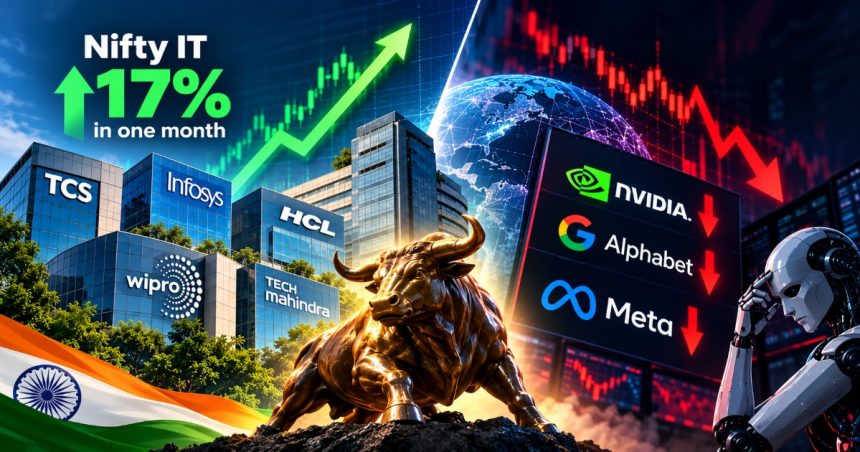
Indian IT stocks are showing unexpected strength while global technology shares face selling pressure. The Nifty IT index has gained around 17% this month, raising an important question for investors: can Indian IT companies continue to outperform as concerns over global artificial intelligence spending grow?
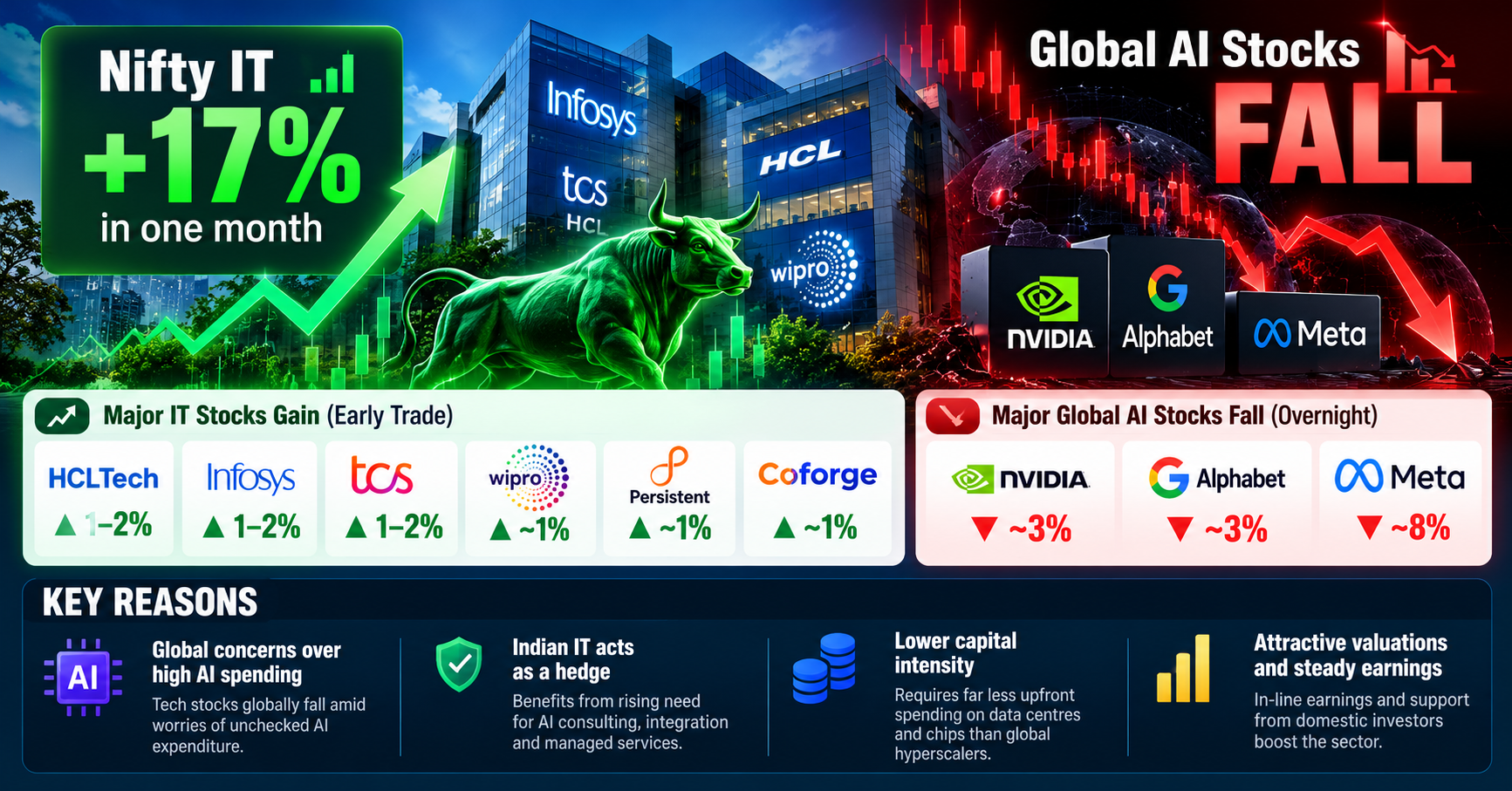
During Friday’s early trade, shares of HCL Technologies, Infosys and Tata Consultancy Services (TCS) advanced around 1–2%. Wipro, Persistent Systems and Coforge also gained approximately 1% each.
By noon, the Nifty IT index was marginally higher at 32,111.75, making it the only gaining sector in the domestic equity market at that time.
Track Live : NSE Option Chain — Live | BSE Option Chain — Live Sensex & Bankex Options Data Today
Indian IT Stocks Rise 17% in a Month: Every Important Point Explained
The key takeaway is that Indian IT stocks are rising even as global AI-related technology stocks face selling pressure. Investors are looking at Indian IT companies as a potentially less capital-intensive way to benefit from the growth of artificial intelligence, while domestic buying, attractive valuations and broadly in-line earnings are helping support the rally.
However, this does not automatically mean Indian IT stocks will continue rising or that they are completely protected from a global AI sell-off.
|
Key indicator |
Figure |
Details |
|---|---|---|
| Nifty IT monthly gain | +17% | Index gained 17% so far in October 2026, according to the report. |
| Nifty IT index at noon | 32,111.75 | Marginally higher at 12 pm on Friday, October 23, 2026. |
| Major Indian IT stocks | +1–2% | HCL Technologies, Infosys and TCS rose during early trade. Wipro, Persistent Systems and Coforge gained around 1%. |
| Nasdaq Composite | −2.60% | Closed at 26,008.86 on October 22, amid concerns about AI spending and technology stock valuations. |
Global AI Stocks Fall as Spending Concerns Weigh on Sentiment
The contrasting performance of Indian IT stocks and global AI shares comes as investors question whether massive investments in artificial intelligence will deliver sufficient returns.
Overnight, US technology stocks came under pressure, with Nvidia and Alphabet among the companies facing selling pressure. The Nasdaq Composite ended nearly 3% lower, reflecting growing caution around technology valuations and AI-related expenditure.
Meta shares dropped nearly 8% after the Facebook parent reported its first cash outflow in more than a decade, attributed to its AI-related spending.
Asian markets also felt the pressure. South Korea’s KOSPI and Japan’s Nikkei 225 fell around 1% each during Friday’s trading, following weakness in major technology and semiconductor stocks.
However, the regional sell-off later eased. SK Hynix shares rebounded around 4%, helping the KOSPI recover from a decline that had reached 4.1%.
Why Indian IT Stocks Are Emerging as a Relative AI Hedge
Indian IT stocks are attracting attention because their business models differ from those of global AI infrastructure companies.
Major Indian IT services firms provide AI consulting, software integration, implementation and managed services. As businesses adopt AI, they may require external technology partners to integrate these tools into existing operations.
This creates a potential opportunity for Indian IT companies without requiring them to match the enormous upfront investments in data centres and advanced chips made by global technology giants.
However, this relative advantage does not guarantee that Indian IT stocks will rise whenever global AI shares fall. Indian IT companies remain exposed to global technology spending, client budgets, currency movements and demand for outsourcing services.
What happened in the Indian stock market?
Indian IT shares rose during early trading on Friday, October 23, 2026, despite a sell-off in global AI-related technology stocks. HCL Technologies, Infosys and TCS gained 1–2% in early trade, while Wipro, Persistent Systems and Coforge rose around 1%, according to Moneycontrol.
| Company | Reported movement in early trade |
|---|---|
| HCL Technologies | +1–2% |
| Infosys | +1–2% |
| Tata Consultancy Services (TCS) | +1–2% |
| Wipro | Around +1% |
| Persistent Systems | Around +1% |
| Coforge | Around +1% |
What does this indicate?
-
Broad-based buying: Several large and mid-sized IT companies advanced, indicating sector-wide buying interest.
-
Resilience amid global weakness: Indian IT stocks gained despite concerns about heavy AI spending and falling global technology shares.
-
Sector leadership: The Nifty IT index was the only gaining sector in the domestic market at noon, trading at 32,111.75, according to the report.
-
Important caveat: These are the movements reported for early trade, not necessarily the final closing changes.
Track Live : Nifty Levels Today | Sensex Levels Today
Why has the Nifty IT index gained 17% in one month?
According to the report, several factors are supporting the rally.
1. Extremely cheap valuations
Analysts cited low valuations as a major reason investors are returning to IT stocks. When share prices are relatively low compared with earnings or historical valuations, investors may see an opportunity for recovery.
The important caveat is that low valuations alone do not guarantee that a stock is undervalued.
2. Quarterly earnings broadly met expectations
TCS, HCL Technologies and Tech Mahindra reportedly delivered September-quarter results that broadly met market expectations.
This helped reassure investors that the sector’s earnings were not materially disappointing relative to what analysts had anticipated.
3. Domestic institutional investor buying
Domestic institutional investors (DIIs), such as mutual funds and other domestic investment institutions, were identified as the primary buyers driving the rally.
According to Kotak Securities’ Sumit Pokharna, the rally was not being driven by foreign institutional investor (FII) inflows.
4. Investors are seeking relative safety
Some domestic investors are reducing exposure to sectors that could face pressure from higher raw-material costs in the second half of the financial year.
IT stocks may be benefiting as an alternative allocation. This is a relative preference, not proof that IT stocks are risk-free.
How did the global sell-off affect Asian markets?
The global AI-stock sell-off spread to Asian markets on Friday, October 23, 2026, as investors worried about rising AI investment costs and whether technology companies could generate sufficient returns. However, some markets recovered part of their early losses during the session.
|
Market or index |
Movement reported |
What it indicates |
|---|---|---|
| Nasdaq Composite (US) | −2.6% | AI and technology stocks dragged the index lower in the previous session. |
| South Korea’s KOSPI | Initially down around 1%; later mixed | Semiconductor-related volatility weighed on the market, followed by a partial recovery. |
| Japan’s Nikkei 225 | Initially down around 1% | Technology-stock weakness and inflation concerns pressured Japanese shares. |
| MSCI Asia Pacific equities | Down around 0.2% in the reported update | Regional losses narrowed as some markets recovered. |
| SK Hynix | Recovered from early losses | The chipmaker rebounded during trading, illustrating that the sell-off was not uniform. |
| Nasdaq 100 futures | Initially negative; subsequently improved | Futures movements reflected changing sentiment about US technology stocks. |
| European shares | Expected to open modestly higher in the earlier report | Futures and market expectations suggested a potentially more stable start despite recent global volatility. |
Read More : JSW Steel Q2 FY27 Results on Oct 23: Will Profit Jump 60-110%? What to Expect
Infosys Results Could Set the Next Direction for IT Stocks
Investors are now watching Infosys’ September-quarter results, which are due later on Friday, for fresh signals about demand, earnings growth and management commentary.
If the results meet expectations and the company provides a reassuring outlook, Indian IT stocks could receive further support. Disappointing guidance, however, could trigger profit-booking after the Nifty IT index’s sharp monthly advance.
Investors should also monitor global technology spending, AI-related capital expenditure and institutional fund flows. These factors could determine whether the rally has further room to run.
What the Indian IT Rally Means for Investors
The 17% monthly gain in the Nifty IT index highlights a sector that is outperforming despite weakness in global AI shares. Attractive valuations, broadly in-line earnings and domestic institutional buying are supporting sentiment.
However, investors should avoid assuming that Indian IT stocks are immune to a global technology correction. The sustainability of the rally will depend on earnings delivery, future demand and the outlook provided by major companies.