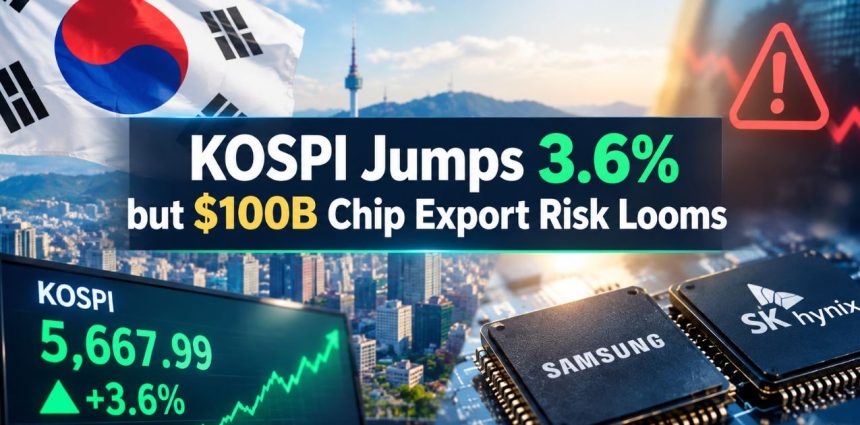
Synopsis: South Korea stocks rallied on October 27 as Anthropic’s IPO filing revived global AI enthusiasm, and stronger-than-expected GDP growth supported sentiment. The KOSPI rose 3.6% in a midday market snapshot, led by Samsung Electronics and SK Hynix. But the Bank of Korea has modelled a downside scenario in which semiconductor exports could fall $50 billion–$100 billion below earlier forecasts in 2027 if US technology companies slow AI spending, leaving investors to weigh near-term optimism against a significant forward-looking risk.
Need to Know
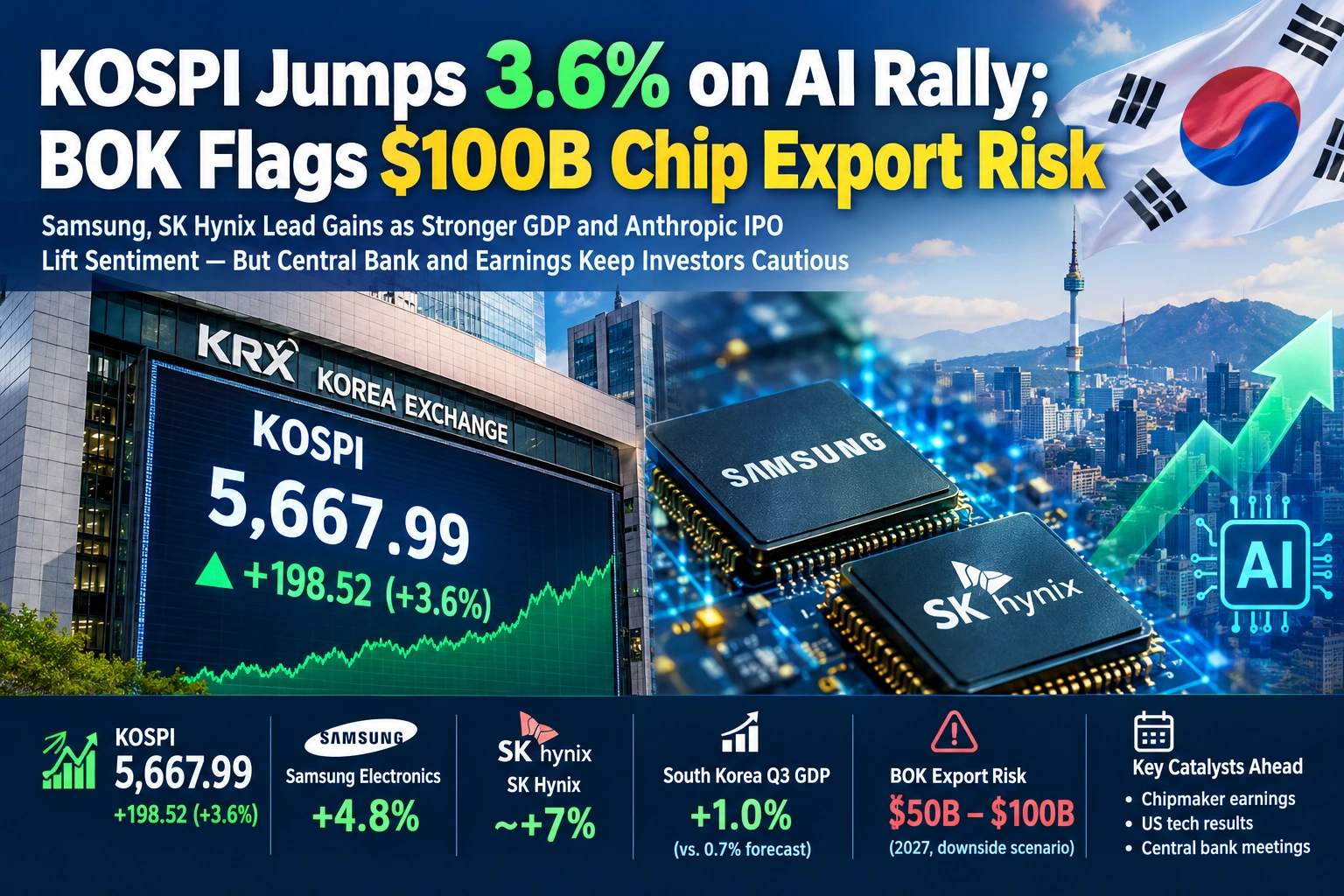
- The KOSPI stood at 5,667.99, up 198.52 points or about 3.6%, in AP’s midday Seoul snapshot.
- Samsung Electronics gained 4.8%, and SK Hynix rose about 7% in that report.
- South Korea’s Q3 GDP grew 1.0% quarter-on-quarter, beating the 0.7% economist consensus.
- The Bank of Korea’s pessimistic scenario puts the potential 2027 semiconductor export shortfall at $50 billion–$100 billion if major US technology firms cut AI infrastructure spending.
- SK Hynix and Samsung Electronics earnings, US big-tech results and central-bank decisions are the next major tests for the AI trade.
KOSPI Rebounds as AI Optimism Returns
South Korea stocks rallied on Tuesday as renewed enthusiasm for artificial intelligence (AI) investments on Wall Street lifted semiconductor shares. Stronger-than-expected economic growth added to the positive sentiment, but the rebound has yet to erase the market’s substantial October losses.
The benchmark Korea Composite Stock Price Index (KOSPI) was at 5,667.99, up 198.52 points or 3.6%, by midday in Seoul, according to the Associated Press. The gain followed Monday’s 1.46% decline, which left the index at 5,469.47.
The index had risen more than 4% earlier in Tuesday’s session before the reported gain moderated. The figures are intraday snapshots rather than a confirmed closing result.
The size of the recovery needs context. Based on the midday level and the September 30 close of 6,838.04, the KOSPI remained approximately 17.1% below its September-end level, according to a NiftyTrader calculation. Tuesday’s rally is therefore a sharp rebound from recent weakness, not evidence by itself of a sustained market recovery.
The advance was part of a broader Asian-market rebound. Japan’s Nikkei 225 gained 2.2% in AP’s snapshot, while Reuters reported that MSCI’s broadest index of Asia-Pacific shares outside Japan rose 1.2% earlier in the session.
Track Live : GIFT Nifty Live – Today Price, Chart, Timings and Nifty Opening Signal
Samsung, SK Hynix Lead the Semiconductor Rally
Chipmakers drove the Korean market higher as investors responded to renewed confidence in AI infrastructure demand.
| Stock or index | Reported change |
|---|---|
| KOSPI | +3.6% |
| Samsung Electronics | +4.8% |
| SK Hynix | About +7% |
| Japan’s Nikkei 225 | +2.2% |
| Philadelphia Semiconductor Index, previous US session | +2.8% |
Source: AP’s midday Asian-market report and Reuters’ October 27 global-market report. Figures are from different market snapshots and should not be treated as closing returns.
The gains followed a stronger session for US equities. On Monday, the S&P 500 rose 0.7%, the Nasdaq Composite advanced 0.8% and the Dow Jones Industrial Average gained 0.3%, according to AP. The Philadelphia Semiconductor Index climbed 2.8%, its biggest one-day gain in about a month, Reuters reported.
These moves helped improve sentiment towards Asian technology companies, particularly Samsung Electronics and SK Hynix, whose businesses are closely linked to demand for memory chips and computing infrastructure.
However, the advance comes as investors remain sensitive to changes in AI-related spending expectations. Semiconductor stocks can respond sharply to both improving demand forecasts and concerns that technology companies may struggle to earn adequate returns on their large infrastructure commitments.
Anthropic IPO Filing Revives the AI Trade
The immediate catalyst came from the United States, where Anthropic’s IPO filing revived investor interest in AI-related companies.
The Claude developer disclosed rapid revenue growth alongside substantial losses. Its filing has brought the industry’s growth opportunity and the cost of competing in advanced AI into sharper focus.
Meta Platforms’ reported fundraising plans also supported sentiment by highlighting the continued flow of capital into AI infrastructure.
The market’s reaction reflects a central question for investors: can rising AI usage and revenue justify the cost of building models, data centres and computing capacity?
That question matters for chipmakers because current investment plans support demand for semiconductors, but weaker spending could eventually affect sales growth, chip prices and earnings expectations. Investors are therefore looking for evidence of durable demand rather than relying solely on announcements of new AI investment.
South Korea GDP Beats Forecasts, but Consumer Demand Weakens
Economic data provided a second catalyst for Tuesday’s rally.
South Korea’s economy expanded 1.0% quarter-on-quarter in the July-September period, accelerating from 0.6% growth in Q2 and exceeding the 0.7% median forecast in a Reuters poll of economists, according to the Bank of Korea’s preliminary data.
| Economic indicator | Q3 2026 reading |
|---|---|
| GDP growth, quarter-on-quarter | +1.0% |
| Reuters economist consensus | +0.7% |
| Previous quarter’s GDP growth | +0.6% |
| GDP growth, year-on-year | +3.4% |
| Exports, quarter-on-quarter | +2.3% |
| Facilities investment, quarter-on-quarter | +4.1% |
| Private consumption, quarter-on-quarter | -0.2% |
Source: Bank of Korea data reported by Reuters.
Exports increased on demand for semiconductors, machinery and electrical equipment. Facilities investment also benefited from spending on machinery, including semiconductor manufacturing equipment. The Bank of Korea estimated that semiconductors accounted for approximately half of the economy’s growth.
Yet the headline growth figure masks weakness elsewhere. Private consumption contracted 0.2%, its first decline in nearly four years, Reuters reported.
This creates a gap between strong export-led activity and softer domestic demand. Semiconductor exports and investment are supporting output, but household consumption has not yet shown the same momentum. The durability of the recovery will depend partly on whether growth broadens beyond the technology sector.
Bank of Korea Models a $50 Billion–$100 Billion Chip Export Shortfall
The AI rally also comes with a significant downside risk.
In a report published on October 27, Reuters said the Bank of Korea had modelled a pessimistic scenario in which South Korea’s semiconductor exports could fall $50 billion–$100 billion below earlier forecasts in 2027 if major US technology companies slow their AI infrastructure spending.
This is a conditional scenario, not the central bank’s baseline forecast that exports will necessarily fall by that amount.
The model assumes a 10% decline in South Korean semiconductor unit prices. Under those conditions, the export shortfall could reduce the country’s GDP growth rate by approximately 0.4 percentage point and push the current-account surplus well below the Bank of Korea’s original $430 billion projection for 2027.
The central bank’s assessment highlights South Korea’s exposure to the semiconductor cycle: chips account for roughly half of the country’s exports.
Combined capital spending by five major US technology companies—Amazon, Google, Microsoft, Meta and Oracle—was reported at $40 billion in 2025, estimated at $80 billion in 2026 and projected to reach $110 billion in 2027.
The spending trajectory helps explain why AI optimism can lift Korean stocks and economic growth. But it also exposes the market to a reversal if technology firms reconsider their investment plans or if falling memory-chip prices weaken export receipts.
For investors, the key distinction is between the current strength of AI demand and the sustainability of the investment cycle that supports it.
Chipmaker Earnings and Central Banks Are the Next Tests
The next major catalyst is likely to come from corporate earnings and management commentary.
SK Hynix is scheduled to report its third-quarter results on Wednesday, October 28, followed by Samsung Electronics on Thursday, October 29. Their results and outlooks could offer fresh information about memory-chip demand, pricing and the durability of AI-related orders.
US technology earnings are also in focus. Alphabet and Microsoft are scheduled to report on Wednesday, with Amazon due on Thursday, according to AP’s market report. Investors will be watching whether revenue growth and profitability justify the industry’s high capital expenditure.
Central-bank decisions add another source of uncertainty. The Federal Reserve, European Central Bank and Bank of Japan are widely expected to leave interest rates unchanged at their upcoming meetings, according to Reuters’ global-market report. Their comments could nevertheless influence rate expectations and the cost of financing AI infrastructure.
The combination of chipmaker results, US technology earnings and central-bank guidance could determine whether Tuesday’s rebound develops into a more durable recovery or gives way to renewed volatility.
Bottom Line
South Korean shares rebounded sharply on October 27 as Anthropic’s IPO filing restored some confidence in the AI trade and a stronger-than-expected Q3 GDP supported sentiment. Samsung Electronics and SK Hynix led the advance, underscoring the importance of semiconductor demand to the Korean market.
But the recovery remains vulnerable to disappointment. Private consumption contracted in Q3, and the Bank of Korea’s downside scenario shows how a slowdown in AI capital spending could affect chip exports and economic growth.
Investors now have a clearer test: earnings and management guidance must support the optimism reflected in semiconductor shares. Until then, Tuesday’s rally is a strong improvement in sentiment, but not confirmation that the October sell-off has run its course.
Read Next: Stocks to Watch Oct 27: Paytm, REC, Tata Consumer, Jio Listing in focus
Disclaimer: This article is for informational and educational purposes only and is not investment advice. Market prices are subject to change. The KOSPI and stock-price figures above are intraday readings, not confirmed closing prices.