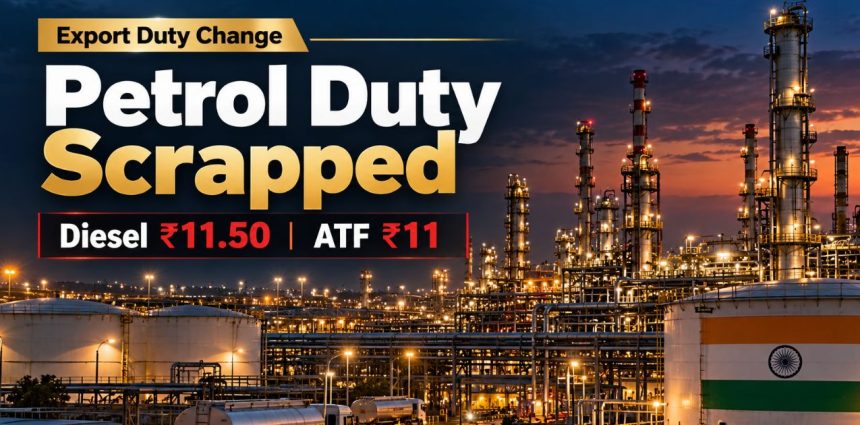
The Centre has removed the ₹2.50-per-litre petrol export levy while increasing diesel duty to ₹11.50 and aviation turbine fuel (ATF) duty to ₹11 per litre. The changes, effective October 31, 2026, could alter export economics for Indian refiners.
October 31, 2026
The Centre has removed the special additional excise duty (SAED) on petrol exports while increasing the export levies on high-speed diesel and aviation turbine fuel (ATF), effective October 31, 2026.
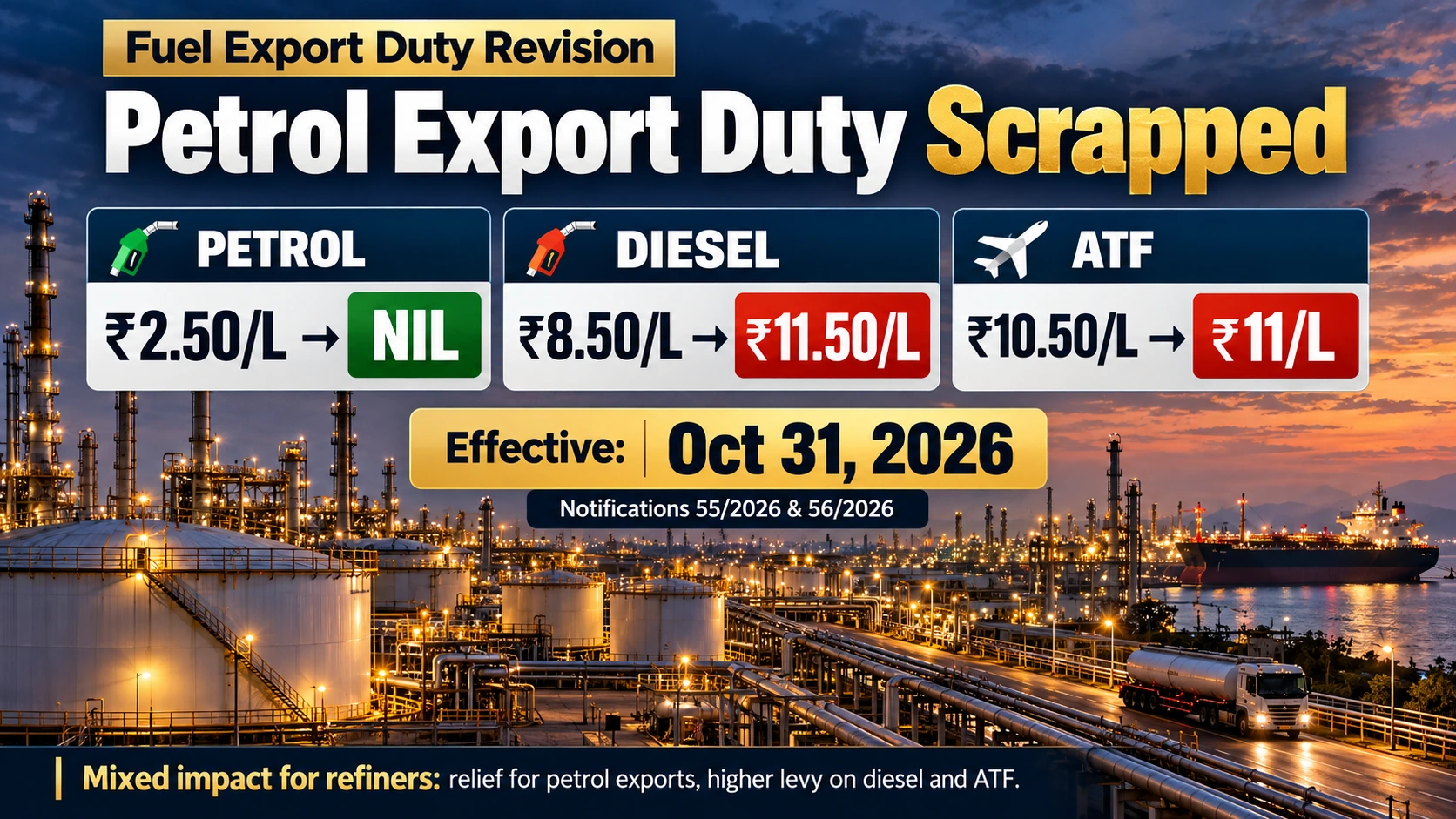
Under the revised structure, petrol exports will attract nil SAED, compared with ₹2.50 per litre earlier. The diesel export levy has increased by ₹3 to ₹11.50 per litre, while the ATF export duty has risen by 50 paise to ₹11 per litre.
The changes were notified by the Ministry of Finance through two separate Central Excise notifications published in the Official Gazette on Saturday.
The decision creates different tax outcomes for petroleum exporters, with petrol receiving duty relief while diesel and ATF face higher levies.
Petrol, Diesel and ATF Export Duty: New Rates From October 31
| Petroleum product | Previous duty | New duty | Change |
|---|---|---|---|
| Petrol | ₹2.50/litre | Nil | Reduced by ₹2.50 |
| High-speed diesel | ₹8.50/litre | ₹11.50/litre | Increased by ₹3 |
| Aviation turbine fuel | ₹10.50/litre | ₹11/litre | Increased by ₹0.50 |
The amendments were issued through Notification Nos. 55/2026-Central Excise and 56/2026-Central Excise, both dated October 31, 2026.
Notification 55/2026 revises the SAED applicable to petrol and diesel exports. Notification 56/2026 increases the ATF export levy to ₹11 per litre.
Both notifications specify that the changes take effect from their publication in the Official Gazette.
The earlier rates are documented in the Petroleum Planning and Analysis Cell’s (PPAC) export-duty history, updated through October 16. The October 31 Gazette notifications establish the new rates.
Why Has the Government Changed Fuel Export Duties?
The current export-levy regime was introduced with effect from March 27, 2026, following disruptions to international energy supplies linked to the West Asia crisis.
The government’s stated objective was to discourage the diversion of petroleum products towards overseas markets and support domestic fuel availability.
The government has been revising these export levies fortnightly based on average international prices of crude oil, petrol, diesel and ATF during the period since the previous review.
The changes are intended to balance domestic fuel availability with movements in international energy markets.
This mechanism was explained in a Ministry of Finance statement released through the Press Information Bureau on April 30, 2026.
The latest revision does not provide uniform relief across petroleum products. Instead, petrol’s export levy has been removed, while diesel and ATF duties have increased.
This distinction matters because refiners have different production profiles, export commitments and product-wise margins.
India’s Fuel Export Earnings Rise Nearly 50% Despite Lower Volumes
India’s petroleum product export earnings increased nearly 50% year-on-year in rupee terms to approximately ₹2.59 lakh crore during April–September 2026, despite a 16% decline in shipment volumes.
The figures were reported by The Economic Times on October 27, citing data from the petroleum ministry.
Higher international fuel prices and a weaker rupee contributed to the increase in export earnings.
Diesel remained the largest contributor to export earnings. Revenue from diesel exports increased 58% in rupee terms to approximately ₹1.20 lakh crore, even as shipment volumes declined 19%.
Petrol export earnings rose 21% to approximately ₹58,000 crore despite a 24% decline in shipment volumes.
Diesel accounted for around 42% of India’s petroleum product exports by volume, while petrol contributed approximately 23%.
These figures highlight the importance of international prices and currency movements for India’s refining industry.
However, higher export earnings do not automatically translate into equivalent improvements in refinery profitability, particularly when export duties and crude procurement costs are elevated.
Why the Diesel Duty Increase Matters More for Refiners
The diesel export levy has recorded the largest absolute increase in the latest revision, rising by ₹3 per litre.
Given diesel’s substantial contribution to India’s petroleum export volumes, the higher levy could reduce net realisations on affected overseas diesel shipments, assuming international prices and other costs remain unchanged.
However, the actual earnings impact will depend on international diesel prices, crude procurement costs, refining margins, freight expenses, export volumes and domestic sales commitments.
The withdrawal of petrol’s ₹2.50-per-litre SAED works in the opposite direction.
For covered petrol exports, the removal of the levy reduces the export-duty burden and could improve net realisations, all else being equal.
Meanwhile, ATF exporters face an additional ₹0.50-per-litre levy.
The changes should therefore be assessed product by product rather than interpreted as an across-the-board benefit or setback for the refining industry.
Reliance Industries, MRPL and Nayara Energy in Focus
The revised export-duty structure is relevant to Indian refiners with substantial exposure to overseas petroleum product markets.
Reliance Industries is a major participant in India’s fuel export business. An October 27 report by The Economic Times, citing industry and ministry data, estimated that Reliance accounts for approximately 70% of India’s fuel exports.
Nayara Energy, Mangalore Refinery and Petrochemicals (MRPL) and other refiners account for the remaining exports, according to the report.
The different treatment of petrol, diesel and ATF could influence the product-wise export economics of these refiners.
However, the duty notifications alone do not establish the direction or magnitude of the impact on any individual company’s earnings.
That will depend on export volumes, product mix, international price realisations and refinery operating margins.
Investors will need to monitor subsequent disclosures and company operating updates before drawing firm conclusions.
Also Read: Nayara Fuel Price Hike: ₹5 Petrol, ₹3 Diesel Amid $100+ Brent Streak
Will Petrol and Diesel Prices Fall After the Export Duty Changes?
The removal of petrol export duty does not automatically mean domestic petrol prices will decline.
Similarly, the higher diesel and ATF export levies do not directly establish an increase in domestic retail fuel prices.
The October 31 notifications concern duties on covered petroleum product exports, rather than a general revision to retail fuel pricing.
According to PPAC, Delhi’s retail petrol price stood at ₹102.12 per litre and diesel at ₹95.20 per litre as of October 30, 2026.
Domestic retail prices depend on several factors, including international crude prices, refining and marketing costs, exchange rates, central and state taxes, and oil marketing companies’ pricing decisions.
There is no basis to interpret the October 31 export-duty notification as an announcement of a corresponding change in domestic pump prices.
What Should Investors Watch on Monday, November 2?
The next regular NSE trading session is scheduled for Monday, November 2, 2026, providing the first opportunity for investors to assess listed refiners’ market response following the announcement.
The notifications were published on Saturday, October 31, when regular equity and derivatives trading was closed.
Consequently, share-price movements and futures positioning recorded on Friday, October 30, cannot be attributed to the new duty revision.
Investors may monitor Reliance Industries, MRPL and other listed companies with refining exposure while distinguishing the policy’s potential implications from broader movements in crude oil prices and the equity market.
The next important factors will be developments in international fuel prices, any subsequent export-duty revisions and company-specific disclosures.
Track Live: Nifty Energy Sector — Live Performance, Stocks
Bottom Line
The government’s October 31 decision removes the ₹2.50-per-litre petrol export levy while increasing diesel duty to ₹11.50 and ATF duty to ₹11 per litre.
The move comes as India’s petroleum export earnings have increased sharply despite lower shipment volumes, highlighting the importance of international fuel prices and currency movements.
For refiners, the implications are mixed: petrol exporters receive duty relief, while diesel and ATF exporters face higher levies.
The ultimate financial impact will depend on export volumes, product-wise margins and international energy prices rather than the duty revisions alone.
Read Next: Indian Oil Q2 FY27 Results: Profit Jumps 184% to ₹21,630 Crore; LPG Risk Persists
Disclaimer: This article is for informational and educational purposes only and does not constitute investment advice or a recommendation to buy or sell any security. The impact of export-duty changes on refiners may vary depending on global fuel prices, export volumes and operating margins. Investors should conduct independent research before making investment decisions.