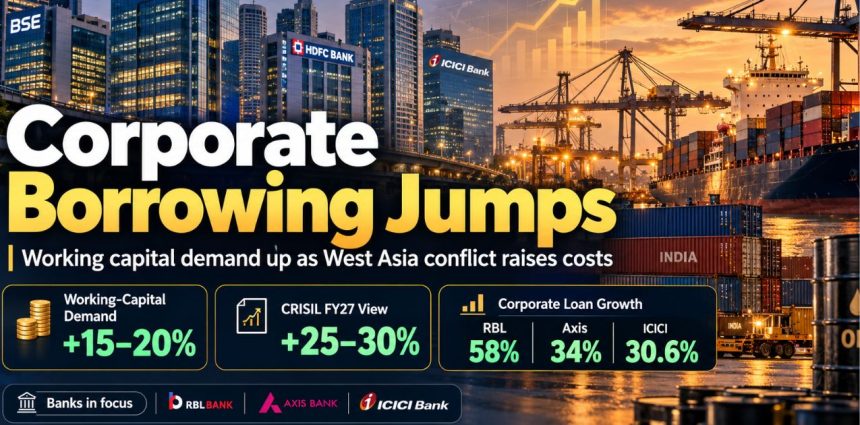
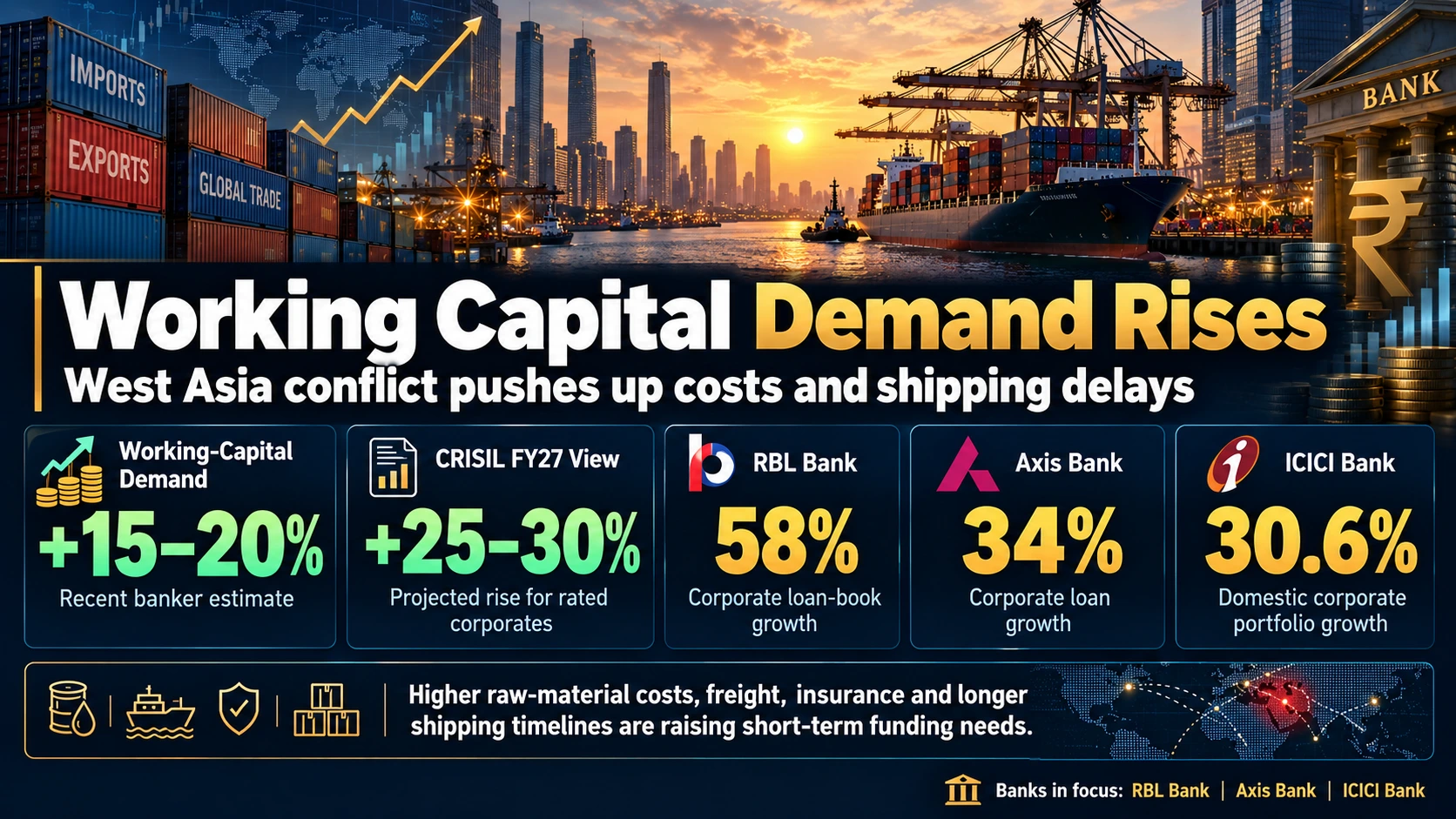
Indian banks are seeing stronger corporate borrowing as the West Asia conflict pushes up raw-material costs and extends shipping timelines. Bankers report a 15–20% increase in working-capital demand, while RBL Bank, Axis Bank and ICICI Bank have reported substantial corporate lending growth. An earlier CRISIL assessment had projected an even larger 25–30% increase in working-capital requirements among its rated corporates during FY27.
Need to Know
- Working-capital demand has increased 15–20% over recent months, according to bankers, with some companies reporting increases of up to 20%.
- RBL Bank’s corporate loan-book growth was reported at 58% by The Economic Times. Its Q2 earnings-call transcript separately disclosed 60% growth in the wholesale corporate segment and 56% growth in total wholesale advances.
- Axis Bank’s corporate loans increased 34% year-on-year, while ICICI Bank’s domestic corporate portfolio grew 30.6% in Q2 FY27.
- CRISIL had projected a 25–30% increase in working-capital requirements among its rated corporates for FY27 in June, highlighting the potential scale of the financing pressure.
What rising corporate borrowing means for banks and investors
The increase in working-capital demand presents an opportunity for Indian banks, but the underlying reason for the borrowing deserves closer attention.
Higher utilisation of cash-credit limits and short-term corporate facilities can support banks’ interest income. Increased trade-finance, cash-management and foreign-exchange activity can also create additional fee opportunities.
However, stronger loan growth does not automatically translate into higher net interest margins (NIMs). The actual benefit will depend on the interest rates banks earn on incremental loans relative to the cost of raising deposits and other funds.
There is also a borrower-side risk. Companies are seeking additional financing partly because more cash is being tied up in expensive inventories, delayed shipments and outstanding customer payments. If input costs remain elevated, businesses with limited pricing power could face simultaneous pressure on operating margins and interest expenses.
For investors, the important distinction is whether corporate borrowing reflects expanding business activity or a growing need to finance an elongated cash-conversion cycle.
RBL Bank, Axis Bank and ICICI Bank see strong corporate lending growth
Corporate lending has accelerated at several private sector banks in the September 2026 quarter, coinciding with the increase in working-capital requirements.
The Economic Times reported that RBL Bank’s corporate loan book expanded 58% year-on-year, followed by 34% growth at Axis Bank and 30.6% growth in ICICI Bank’s domestic corporate portfolio.
| Bank | Q2 FY27 corporate lending growth | Details |
|---|---|---|
| RBL Bank | 58% | Corporate loan-book growth reported by ET |
| Axis Bank | 34% | Corporate loans; official disclosure |
| ICICI Bank | 30.6% | Domestic corporate portfolio |
| Kotak Mahindra Bank | 25% | Corporate banking advances, including transferred loans |
RBL Bank’s figures require an additional distinction. Its October 12 Q2 FY27 earnings-call transcript disclosed 60% year-on-year growth in the corporate segment within wholesale advances, while total wholesale advances increased 56% to ₹62,849 crore. Commercial banking advances grew 47%.
RBL Executive Director Jaideep Iyer described the wholesale growth as predominantly working-capital-driven, while acknowledging some project-finance and longer-term lending.
The 58% corporate loan-book figure reported by ET and the 60% corporate-segment figure in RBL’s earnings-call transcript should retain their respective source labels rather than being treated as identical measurements.
Axis Bank reported 34% year-on-year growth in corporate loans and 29% growth in its mid-corporate portfolio. Its overall advances increased 23%.
ICICI Bank’s domestic corporate portfolio grew 30.6% year-on-year and 10.4% sequentially, while its business-banking portfolio expanded 33.8%.
Kotak Mahindra Bank reported 25% growth in corporate banking advances to ₹1,39,786 crore. However, this figure includes ₹8,915 crore of loans transferred from Kotak Mahindra Investments Limited during the quarter.
Excluding the transferred portfolio, the comparable advances work out to ₹1,30,871 crore against ₹1,12,134 crore a year earlier, implying approximately 16.7% growth, based on NiftyTrader’s calculation.
This adjustment provides a more meaningful indication of comparable portfolio expansion.
Source: Kotak Mahindra Bank Q2 FY27 Investor Presentation.
Why the West Asia conflict is increasing companies’ funding requirements
Working capital is the money businesses require to finance everyday operations between paying suppliers and collecting payments from customers.
When raw-material prices increase and shipments take longer to arrive, more cash remains tied up in inventory and goods in transit. Companies may also have to wait longer to receive payments after dispatching finished products.
This combination increases the financing needed to maintain normal operations.
Bankers quoted by The Economic Times said working-capital demand had increased approximately 15–20% over recent months. Mid- and large-sized companies reported increases of 12–15%, with some cases reaching 20%.
Anu Aggarwal, president and head of corporate and transaction banking at Kotak Mahindra Bank, attributed the increase to higher oil-linked input costs and longer transit times affecting both purchasing and sales cycles.
The problem is particularly significant for companies that depend on imported raw materials or operate with long international supply chains.
Disruptions around the Strait of Hormuz and Bab el-Mandeb have added to freight expenses, war-risk insurance premiums and shipment uncertainty.
UN Trade and Development (UNCTAD) reported that certain tanker freight rates between the Middle East and East Asia exceeded $120 per tonne in late August 2026, approximately three times their year-earlier levels.
It also highlighted how rerouting a Saudi crude shipment from Yanbu to South Korea to avoid Bab el-Mandeb could extend the journey from approximately 24 days to 54 days.
Although this is a specific shipping route rather than a standard transit time for all cargoes, it illustrates how disruptions can keep goods and working capital tied up for additional weeks.
For Indian businesses, higher freight and insurance costs can increase landed raw-material prices. Longer inventory cycles can also force manufacturers to maintain additional safety stocks, raising their dependence on bank credit.
CRISIL had projected a 25–30% rise in working-capital requirements
The latest banker-reported increase is not the first indication that geopolitical uncertainty could increase corporate financing needs.
In its June 16, 2026, assessment, CRISIL Ratings projected that working-capital requirements among its rated corporates could increase 25–30% during FY27 as the West Asia conflict disrupted supply chains and raised crude-linked input costs.
The estimate covered CRISIL-rated companies, rather than the entire universe of Indian businesses.
The agency identified several industries facing elevated pressure, including ceramics, airlines, auto components, diamond polishing and basmati rice exports, alongside crude-linked industries.
CRISIL expected improved realisations of 10–15% to partially offset higher input costs, although it also anticipated some moderation in volumes.
The rating agency estimated that the Emergency Credit Line Guarantee Scheme (ECLGS) 5.0 could initially fund approximately one-third of the incremental working-capital requirements of its rated companies, with the remaining funding expected through additional bank limits and internal accruals.
This June projection and the current 15–20% banker-reported increase should not be directly compared as identical measurements. They differ in timing, scope and methodology: one was a full-fiscal forecast for rated corporates, while the other is a recent estimate from bankers describing working-capital demand across their corporate relationships.
Nevertheless, both assessments point to the same underlying pressure: companies need additional funding to manage higher costs and longer trade cycles.
Corporate credit growth is expected to remain strong in FY27
CRISIL’s October assessment provides a broader view of the banking-sector opportunity.
The rating agency expects overall domestic bank credit to grow approximately 14.5–15.5% in FY27. Corporate bank credit is projected to expand 10–11%, compared with approximately 9.8% in FY26.
Two factors are expected to support corporate lending: higher working-capital requirements amid geopolitical uncertainty and companies shifting some borrowing from the bond market to bank loans because of relative funding-cost advantages.
However, CRISIL expects MSME and retail lending to remain the principal growth drivers of overall banking-sector credit.
The distinction is important. The working-capital increase is an additional support for corporate lending, not the sole explanation for the industry’s projected credit growth.
Will higher working-capital lending pressure corporate margins?
The additional financing is helping companies bridge longer procurement and collection cycles, but borrowing more does not necessarily protect profitability.
Businesses facing higher freight, insurance and raw-material expenses may struggle to pass the entire increase to customers.
Companies with strong pricing power, better liquidity and diversified suppliers should be relatively better positioned. Businesses operating with thin margins and high imported-input dependence could face greater pressure.
The impact could also differ by company size. Larger corporates generally have more borrowing alternatives, whereas smaller businesses may depend more heavily on bank working-capital limits.
Investors should therefore watch whether short-term debt increases faster than revenue, whether inventory and receivable days rise, and whether interest coverage weakens.
Asset quality remains a risk if supply-chain disruption persists
The increase in working-capital demand could support near-term loan growth, but prolonged geopolitical disruption may eventually affect repayment capacity among vulnerable borrowers.
ICRA warned on October 27 that fresh stressed-loan formation could rise during H2 FY27, particularly among MSMEs and unsecured retail borrowers, as West Asia-related cost pressures and deficient monsoon conditions affect borrowers.
Its forecast for the annualised fresh bad-loan generation rate at private banks rises from 1.4% in Q1 FY27 to 1.6% by March 2027. The corresponding estimate for public sector banks increases from 0.7% to 0.8%.
These are broader banking-sector forecasts, not evidence of defaults specifically among corporate working-capital borrowers.
For lenders, the challenge will be to distinguish temporary financing requirements from a lasting deterioration in borrowers’ financial health.
What investors should monitor in the coming quarters
The sustainability of corporate loan growth will depend on whether shipping conditions stabilise, commodity prices moderate and companies restore normal cash-conversion cycles.
Investors tracking banks should monitor:
- Corporate loan utilisation: Whether businesses are drawing more of their sanctioned working-capital limits.
- Net interest margins: Whether incremental lending yields adequately compensate for additional funding costs.
- Corporate asset quality: Whether delinquencies, restructuring or stressed exposures increase.
- Deposit costs: Whether banks can finance faster loan growth without sacrificing margins.
For corporate borrowers, inventory days, receivable days, short-term debt and interest coverage will be important indicators of financial resilience.
Bottom Line
The West Asia conflict is creating an additional financing requirement for Indian companies, with bankers reporting a 15–20% rise in working-capital demand over recent months.
Strong corporate lending growth at RBL Bank, Axis Bank and ICICI Bank highlights the renewed importance of business borrowing, while CRISIL’s earlier 25–30% working-capital projection underlines the potential scale of the pressure.
For banks, the increase can support loan growth and transaction-banking opportunities. For companies, however, it reflects a more difficult operating environment in which higher costs and longer shipping cycles are tying up cash.
The bigger question for FY27 is whether corporate borrowing will translate into sustainable business expansion or remain driven by the need to finance increasingly expensive and delayed supply chains. That distinction will matter for bank margins, corporate profitability and the quality of India’s next phase of credit growth.
Read Next: Nikkei Slumps 3% as AI Payback Fears Hit Japan’s Chip Stocks
Frequently Asked Questions
1. How much has corporate working-capital demand increased in India?
Bankers report a 15–20% increase over recent months, with several mid- and large-sized companies requiring up to 20% more funding.
2. Why is the West Asia conflict increasing working-capital requirements?
Higher oil-linked raw-material costs, freight expenses, insurance premiums and longer shipping timelines are increasing the amount of cash companies need to finance inventories and receivables.
3. Which banks are reporting strong corporate lending growth?
RBL Bank’s corporate loan-book growth was reported at 58% by ET. Axis Bank reported 34% corporate loan growth, while ICICI Bank’s domestic corporate portfolio increased 30.6%.
4. What was CRISIL’s working-capital forecast for FY27?
In June 2026, CRISIL projected a 25–30% increase in working-capital requirements among its rated corporates during FY27.
5. Will higher corporate lending improve bank profitability?
It can increase interest income and fee opportunities, but the effect on profitability depends on loan pricing, funding costs, credit quality and net interest margins.
Disclaimer: The information presented is for educational and informational purposes only and should not be considered investment advice. Banking-sector forecasts and corporate credit trends are subject to geopolitical, economic and market uncertainties. Investors should verify company disclosures and consult financial advisers before making investment decisions.