Japan’s Nikkei 225 fell as much as 3% on Friday as concerns over AI investment returns triggered heavy selling in semiconductor stocks. Ibiden plunged 15.2%, Lasertec dropped 13.8% and Advantest declined 9.1%. Amazon’s cash-flow outflow and a sharp after-hours fall in Intel shares intensified global technology concerns, while the Bank of Japan held interest rates at 1.25% but maintained an inflation outlook tilted towards the upside.
Japan’s stock market faced heavy selling pressure on Friday, October 30, as investors reassessed the financial returns from the global artificial intelligence (AI) investment boom. The Nikkei 225 fell as much as 3%, with semiconductor manufacturers and AI-linked companies leading the decline as concerns over technology companies’ capital expenditure and cash flows spread from Wall Street to Asian markets.
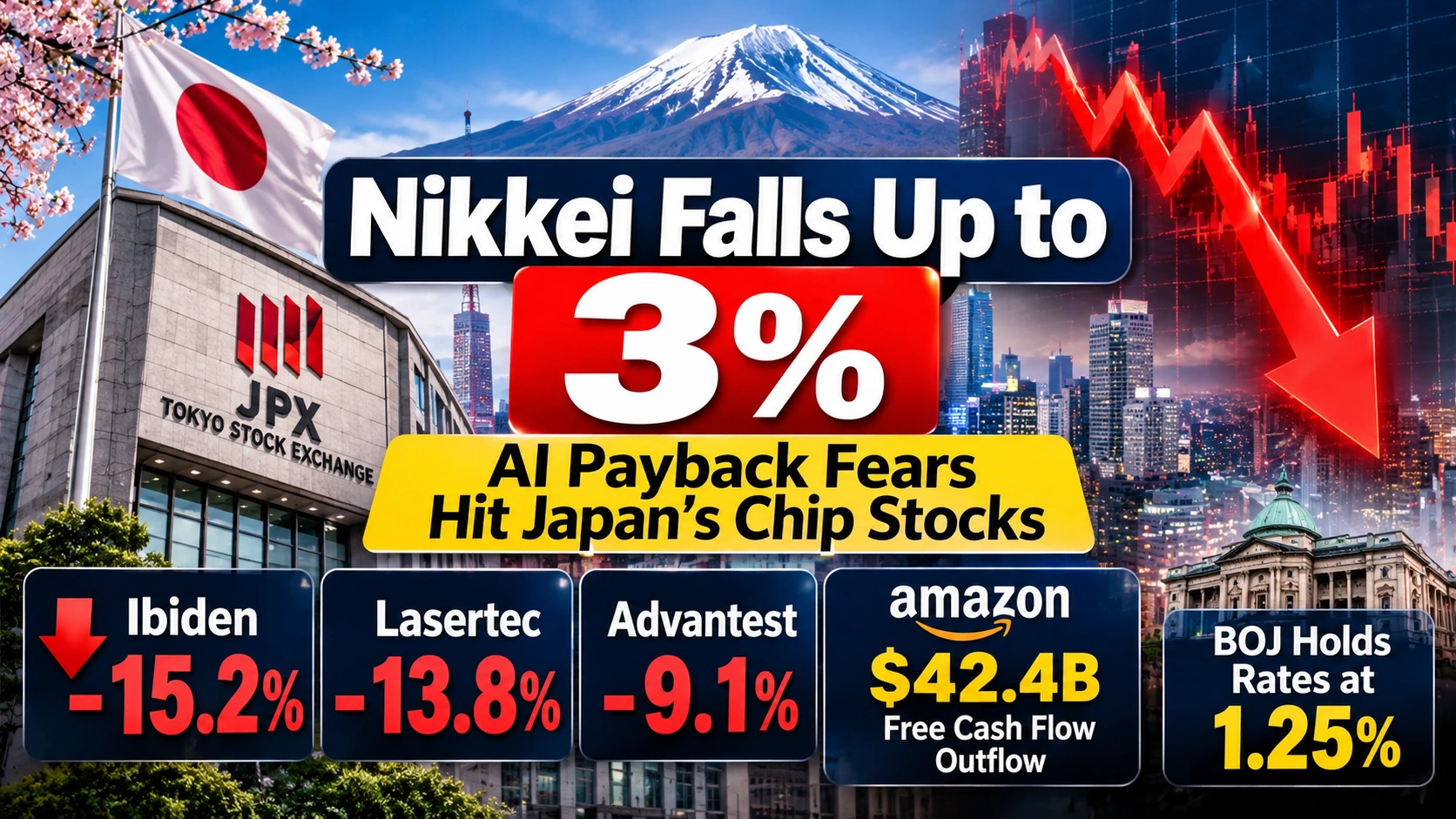
The sell-off exposed a growing tension in the AI investment story: demand for computing infrastructure remains strong, but investors increasingly want evidence that the enormous spending on data centres, advanced chips and AI infrastructure will translate into sustainable earnings and cash flows. Japanese semiconductor stocks bore the brunt of the selling, with Ibiden plunging 15.2%, Lasertec falling 13.8% and Advantest declining 9.1%.
Adding to the market developments, the Bank of Japan (BOJ) maintained its short-term policy rate at 1.25% in an 8-1 vote. However, one policymaker favoured a higher rate, while the central bank’s latest projections showed upside risks to inflation, keeping the possibility of further monetary tightening in focus.
Track Live: GIFT Nifty Live – Today Price, Chart, Timings and Nifty Opening Signal
Japan’s semiconductor stocks tumble as Nikkei falls as much as 3%
Japanese technology stocks faced significant selling pressure as concerns about the profitability of AI-related investments spread across the semiconductor supply chain.
Ibiden recorded a 15.2% decline, while semiconductor inspection equipment maker Lasertec fell 13.8%. Advantest, a major supplier of semiconductor testing equipment, dropped 9.1%, and Tokyo Electron declined 5.6%. SoftBank Group also lost 6.7% amid its exposure to the broader AI investment ecosystem.
Japan stock market: Major movers on October 30
| Stock | Intraday movement |
|---|---|
| Ibiden | -15.2% |
| Lasertec | -13.8% |
| Advantest | -9.1% |
| SoftBank Group | -6.7% |
| Tokyo Electron | -5.6% |
| Konami | +15.3% |
| Oriental Land | +6.6% |
Source: Reuters, October 30, 2026. These are movements reported during Friday’s trading session, not confirmed closing returns.
The declines highlight pressure across different parts of the semiconductor industry. Ibiden supplies semiconductor package substrates, Lasertec develops semiconductor inspection technology, and Advantest is exposed to demand for advanced chip-testing systems.
However, the weakness was not uniform across the Japanese market. Among the Nikkei’s 225 constituents, 123 stocks declined, 100 advanced and two remained unchanged.
Despite Friday’s decline, the Nikkei was still up 0.2% for the week at the time of Reuters’ report. The broader Topix index fell 1.3% on Friday and was on course to lose 0.4% for the week. The divergence indicated that technology-related selling was a major driver of the benchmark’s weakness rather than a uniform decline across Japanese equities.
Amazon’s $42.4 billion cash-flow outflow puts AI spending under scrutiny
The immediate trigger for the global technology sell-off came from Wall Street, where investors reacted negatively to the latest earnings from major technology companies.
Amazon’s September-quarter results highlighted the contrast between accelerating cloud revenue and the rising financial cost of expanding AI infrastructure.
The company reported the following financial performance:
| Amazon Q3 FY2026 | Performance |
|---|---|
| Net sales | $201.9 billion |
| Revenue growth | +12% YoY |
| AWS revenue | $46 billion |
| AWS revenue growth | +39.3% YoY |
| Operating income | $28.1 billion |
| Operating margin | 13.9% |
| Trailing 12-month operating cash flow | $168.3 billion |
| Trailing 12-month free cash flow | -$42.4 billion |
Source: Amazon’s official Q3 2026 earnings release, October 29, 2026. Free cash flow and operating cash flow figures are for the trailing 12 months ended September 30, 2026.
Amazon Web Services (AWS) remained a major growth contributor, with revenue increasing 39.3% year-on-year to $46 billion. AWS operating income also rose to $17.8 billion from $11.4 billion in the corresponding year-ago quarter.
However, Amazon’s trailing 12-month free cash flow turned into an outflow of $42.4 billion, compared with an inflow of $14.8 billion a year earlier.
The company attributed the deterioration primarily to a $94.8 billion year-on-year increase in net purchases of property and equipment, reflecting investment in AI infrastructure.
Importantly, Amazon’s operating cash flow increased 29% to $168.3 billion over the trailing 12 months. This shows that the pressure on free cash flow was primarily linked to the scale of infrastructure investment rather than a decline in operating cash generation.
For investors, the distinction is important. Strong AWS revenue growth demonstrates that demand for cloud and AI services remains substantial, but higher infrastructure expenditure is absorbing the cash generated by the business.
The market is increasingly looking for evidence that AI-related revenue growth can generate sufficient returns to justify the capital being deployed.
Intel earnings add to concerns over AI investment returns
Intel’s latest earnings added to the pressure on global technology shares, with investors scrutinising the company’s financial outlook and the cash requirements associated with the semiconductor industry.
Reuters reported that Intel shares plunged 23% in after-hours trading following its results, while Amazon shares fell 7% in extended trading. The reaction contributed to weakness in Nasdaq 100 futures and semiconductor stocks across Asian markets.
The broader concern is that strong demand for AI computing does not necessarily guarantee attractive near-term returns for companies supplying the infrastructure.
Technology companies are committing substantial resources to data centres, processors, networking equipment and computing capacity. Although these investments could support long-term revenue growth, the financial benefits may take time to materialise.
For semiconductor manufacturers and equipment suppliers in Japan, this creates uncertainty over the pace at which global AI spending will translate into fresh orders, earnings growth and sustainable demand.
The market is therefore becoming more selective about AI-linked businesses, particularly those whose future valuations depend heavily on continued investment growth.
BOJ holds interest rates at 1.25% in an 8-1 vote
Alongside the technology sell-off, the Bank of Japan maintained its short-term policy rate at 1.25% on Friday after concluding its two-day monetary policy meeting.
The decision was approved by an 8-1 majority. Board member Hajime Takata dissented and proposed increasing the policy rate to 1.50%, indicating that at least one policymaker favoured a faster pace of monetary tightening.
The decision maintained the existing borrowing-cost level, but the dissent highlighted differences within the policy board over the appropriate pace of interest-rate normalisation.
The BOJ’s October economic outlook also showed that inflation risks remain an important concern.
BOJ economic and inflation projections
| Forecast | FY2026 | FY2027 | FY2028 |
|---|---|---|---|
| Real GDP growth | 0.7% | 0.7% | 0.8% |
| CPI excluding fresh food | 2.5% | 2.6% | 2.0% |
Source: Bank of Japan, October 30, 2026 Outlook Report. Figures are median policy board forecasts; parentheses in the original report indicate changes from the July 2026 outlook.
The BOJ raised its FY2027 inflation forecast to 2.6% from 2.4% in the July outlook, while lowering its FY2027 GDP growth projection to 0.7% from 0.8%.
The central bank identified upside risks to prices, including developments in the Middle East, exchange-rate movements, higher semiconductor prices and stronger underlying inflation pressures.
It also noted that AI-related demand could support economic activity, while higher energy and raw-material costs could weigh on growth.
This creates a delicate policy balance for Japan. Continued investment in AI infrastructure could support technology-related demand, but stronger demand and higher input costs may also complicate the inflation outlook.
A further rate increase, including a possible move in December, remains a development investors will monitor rather than a commitment made by the central bank.
What investors should watch after the global AI sell-off
The next phase of the global technology market will depend on whether major companies can demonstrate that their AI investments are translating into sustainable financial returns.
Three developments will be particularly important.
AI monetisation and cash flow: Amazon’s expanding cloud business demonstrates that demand remains strong, but its negative free cash flow highlights the financial burden of infrastructure spending. Investors will watch whether cloud revenue growth can generate sufficient cash flow to justify continued investment.
Semiconductor demand and earnings guidance: The sharp losses in Ibiden, Lasertec and Advantest show how quickly changes in investor sentiment can affect companies linked to AI infrastructure. Upcoming earnings and guidance from chipmakers and equipment manufacturers will help determine whether the correction is temporary or reflects a broader reassessment of growth expectations.
BOJ policy and inflation expectations: The October rate hold provides continuity in borrowing costs, but the dissenting vote and higher FY2027 inflation forecast keep further monetary tightening in focus. Governor Kazuo Ueda’s communication will be important for investors assessing the next policy move.
The central uncertainty is whether the AI investment cycle can deliver financial returns quickly enough to justify the scale of spending. Strong demand alone may not protect valuations if capital expenditure continues rising faster than earnings and cash generation.
Track Live : Nifty Levels Today
Bottom Line
Japan’s sharp stock-market decline highlights a shift in investor expectations surrounding the global AI boom. Semiconductor demand and cloud revenue growth remain strong, but the financial cost of expanding AI infrastructure is attracting greater scrutiny.
Amazon’s $42.4 billion trailing 12-month free cash flow outflow and the sharp reaction to Intel’s earnings have reinforced the importance of profitability alongside growth.
Meanwhile, the BOJ’s decision to retain its 1.25% policy rate, combined with its higher inflation forecast and a dissenting vote in favour of a rate increase, adds another layer of uncertainty for Japanese equities.
The AI growth story remains intact, but investors are increasingly demanding proof that today’s enormous infrastructure spending can translate into tomorrow’s sustainable earnings and cash flows. This expectation gap could keep volatility elevated across global technology and semiconductor stocks.
Read Next: Stocks to Watch Today, October 30: RIL, Jio Q2; Equitas SFB, IndiGo and Suzlon in Focus
Disclaimer: This article is for informational purposes only and does not constitute investment advice or a recommendation to buy or sell any securities. Global market movements, corporate earnings and central-bank decisions involve risks and uncertainties. Investors should conduct independent research before making investment decisions.