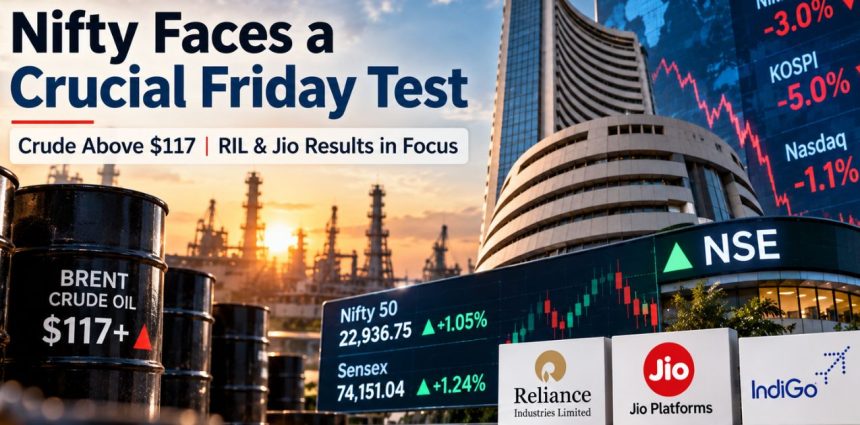
Indian equities face a mixed trading setup on Friday as global market weakness and rising crude oil prices test Thursday’s recovery. GIFT Nifty indicated a marginally positive opening at 22,981 at 7:42 AM IST, while Japan’s Nikkei and South Korea’s KOSPI recorded sharp declines. Reliance Industries and Jio Platforms are scheduled to announce Q2 FY27 results.
Equitas Small Finance Bank is in focus after its CEO resigned and shares fell as much as 20%. Meanwhile, IndiGo’s rising fuel costs, Suzlon’s margin pressure, Trent’s leadership transition, Coal India’s dividend and new corporate announcements from Motilal Oswal and Godrej Consumer Products could trigger stock-specific action.
Can Nifty Hold 22,900 as Brent Crude Crosses $117?
Can the Nifty 50 sustain its recovery above 22,900 when global equities are under pressure and Brent crude has climbed above $117 per barrel?
Indian markets enter Friday’s session with contrasting signals. The Nifty 50 rallied 237.91 points, or 1.05%, to close at 22,936.75 on Thursday, October 29. The Sensex gained 905.01 points, or 1.24%, to settle at 74,151.04.
The early global market picture, however, is less encouraging.
According to Reuters’ 7:42 AM IST market update, GIFT Nifty futures stood at 22,981, indicating a marginally positive start for domestic equities. At the same time, Japan’s Nikkei 225 was down approximately 3%, South Korea’s KOSPI declined around 5%, and the Nasdaq Composite lost more than 1% overnight.
Brent crude futures rose 2.2% to $117.40 per barrel after Yemen’s Houthis reported attacks on Saudi Arabia’s Ras Tanura oil refinery and airports, adding to concerns about energy supply disruptions.
Institutional flows also showed a contrasting trend. Foreign portfolio investors sold approximately ₹944 crore of Indian equities on Thursday, while domestic institutional investors purchased shares worth around ₹1,924 crore.
The rise in crude prices creates an additional risk for fuel-sensitive businesses such as IndiGo and puts the upcoming results of Indian Oil Corporation in focus.
Against this backdrop, Friday’s market action could be shaped by a combination of global developments, quarterly earnings and company-specific announcements.
Track Live: NIFTY 50, SENSEX, GIFT NIFTY
Stocks to Watch Today: 11 Companies and Their Key Triggers
1. Equitas Small Finance Bank: CEO Resignation Sends Shares Down 20%
Equitas Small Finance Bank is likely to remain one of the most closely monitored stocks after its Managing Director and CEO, P N Vasudevan, resigned on Thursday, October 29, citing persistent investor concerns over a perceived conflict of interest.
The issue relates to his daughter’s association with Unico Housing Finance, an unlisted non-banking financial company (NBFC).
In his resignation letter, Vasudevan said the arrangement had been disclosed to the bank’s board and the Reserve Bank of India and maintained that there was no conflict of interest. He added that investor concerns surrounding the association were affecting the bank’s stock performance.
Equitas said it had undertaken only one deposit transaction with Unico and reported no other transactions through August. The board has asked Vasudevan to continue until a successor is appointed and directed its nomination committee to identify suitable internal and external candidates.
The market reaction was sharp. Equitas SFB shares fell as much as 20% intraday on Thursday.
Interestingly, the resignation came despite a strong quarterly performance. The bank reported its highest-ever quarterly profit of approximately ₹218 crore for Q2 FY27, while its total business crossed ₹1 lakh crore.
The contrast between record quarterly profitability and the sharp share-price reaction makes the leadership transition particularly important.
What to watch: Successor selection, management continuity, investor confidence and developments concerning the perceived conflict-of-interest issue.
2. Reliance Industries: Q2 Results, NCD Proposal and Hamleys Disclosure
Reliance Industries (RIL) will be among the biggest earnings triggers on Friday as its board is scheduled to announce standalone and consolidated financial results for the September quarter of FY27.
The board will also consider raising funds through listed, secured or unsecured, redeemable non-convertible debentures (NCDs) on a private-placement basis.
Brokerage estimates indicate expectations of double-digit earnings growth, although forecasts differ.
Kotak Institutional Equities expects consolidated profit to rise approximately 30% year on year to ₹23,621.7 crore. Elara Capital expects consolidated EBITDA of ₹50,809 crore and PAT of ₹21,189 crore. Broader brokerage estimates place revenue growth in the 22–30% range and EBITDA growth at 11–15%.
The oil-to-chemicals (O2C) business is expected to receive support from improved refining conditions, while Reliance Jio could provide earnings support. However, Reliance Retail’s margins remain an important area of attention.
Investors should also distinguish between recurring and reported profitability when comparing the results. In Q1 FY27, RIL reported recurring consolidated EBITDA of ₹54,067 crore and recurring PAT of ₹23,196 crore. These figures excluded the effect of a one-off gain in the year-ago comparison.
Another disclosure: RIL informed exchanges that its UK step-down subsidiary, Hamleys (Franchising) Limited, has applied for voluntary strike-off. The UK Registrar of Companies published a notice on October 27 stating that the subsidiary could be dissolved no earlier than two months from that date, subject to the statutory process. Its contribution to RIL’s consolidated FY26 turnover was just 0.0048%, and it had nil net worth as of December 31, 2025.
The disclosure is unlikely to have a material earnings impact, but it is relevant to investors tracking the company’s corporate actions.
What to watch: Q2 revenue, EBITDA, PAT, O2C performance, Jio contribution, Retail margins and the board’s NCD decision.
3. Jio Platforms: First Q2 Results After Listing; ARPU in Focus
Jio Platforms will announce its first quarterly results as a listed company on Friday, October 30, making the announcement particularly important for investors who participated in its recent IPO.
The company’s shares made their market debut on October 28 at ₹1,358, representing a premium of 21.36% over the IPO issue price of ₹1,119.
The September-quarter performance will provide investors with an early assessment of the company’s revenue growth and profitability following its listing.
Nomura expects revenue from operations to increase 11% year on year to ₹40,400 crore. EBITDA is projected at ₹22,050 crore, with an operating margin of 54.6%. The brokerage estimates net profit at ₹7,610 crore.
Subscriber additions and average revenue per user (ARPU) are among the most important indicators.
Nomura expects ARPU to improve to around ₹219 per month from ₹215.60 in Q1 FY27, supported by subscriber additions and better monetisation. It also estimates that Jio could add around 80 lakh subscribers during the quarter.
For comparison, the company reported Q1 FY27 revenue of ₹39,173 crore, EBITDA of ₹20,865 crore and consolidated PAT of ₹7,764 crore.
What to watch: ARPU, subscriber additions, EBITDA margins, digital services growth and management’s monetisation outlook.
4. IndiGo: ₹1,879 Crore Loss Masks Deeper Forex-Adjusted Weakness
InterGlobe Aviation, the parent company of IndiGo, reported a consolidated net loss of ₹1,879.1 crore in Q2 FY27, compared with a loss of ₹2,582.1 crore in the corresponding quarter last year.
Although the reported loss narrowed 27.2% year on year, the improvement was largely supported by lower foreign-exchange losses.
Forex losses declined to ₹1,333.2 crore from ₹2,892.1 crore in Q2 FY26. However, excluding foreign-exchange effects, the airline reported a loss of ₹723.7 crore, compared with a profit of ₹103.9 crore in the year-ago quarter.
Revenue from operations increased 25.9% to ₹23,363.8 crore, but fuel expenses jumped 67.2% to ₹9,966.8 crore. Total expenses increased 18.6% to ₹26,188.4 crore.
The earnings therefore reveal an important expectation gap: stronger revenue has not translated into improved underlying profitability.
There is also a forward-looking risk.
During its post-results interaction, IndiGo management indicated that fare increases would become inevitable if elevated fuel costs persist. The airline expects low-single-digit capacity growth in the December quarter and forecasts passenger revenue per available seat kilometre (PRASK) growth of more than 25% year on year, based on October trends.
Brent crude’s overnight increase to $117.40 adds another concern for the airline’s cost outlook.
What to watch: Fuel expenses, forex losses, ticket pricing, passenger demand and the company’s December-quarter outlook.
5. Suzlon Energy: Revenue Rises 26%, but EBITDA Margin Falls to 14.8%
Suzlon Energy reported revenue from operations of approximately ₹4,869 crore in Q2 FY27, compared with ₹3,865.54 crore in the year-ago quarter, representing growth of around 26%.
The renewable energy company delivered a record 710 MW of wind turbines during the quarter, compared with 565 MW a year earlier.
However, consolidated net profit declined 69% to ₹394 crore from ₹1,279 crore in Q2 FY26.
The sharp reported decline was largely due to a high base. Suzlon’s CFO attributed the previous year’s profit to a one-time deferred tax asset benefit of ₹891 crore.
Excluding this benefit, comparable PAT increased approximately 1.3% to ₹394 crore from ₹389 crore.
The sequential performance was stronger. Revenue increased approximately 27% from the June quarter, EBITDA rose around 21% to ₹720 crore from approximately ₹595 crore, and PAT advanced 29% from ₹305 crore.
However, EBITDA remained almost flat year on year at ₹720 crore against ₹721 crore. The margin contracted to 14.8% from 18.6%.
The company also has a strengthened credit profile. CRISIL upgraded its long-term rating to AA-/Stable from A+/Stable and its short-term rating to A1+ from A1 on October 27.
Suzlon’s results therefore present two different signals: improving sequential financial performance and stronger credit ratings, but continuing year-on-year margin pressure.
What to watch: Order-book execution, wind turbine deliveries, EBITDA margins and the sustainability of sequential growth.
6. Trent: Profit Rises 25.3%; Noel Tata to Become Chairman Emeritus
Trent reported consolidated net profit of ₹468.09 crore in Q2 FY27, representing a 25.3% year-on-year increase from ₹373.42 crore.
Consolidated revenue from operations increased approximately 21.9% to ₹5,873.14 crore.
The company also crossed an important retail expansion milestone, opening its 1,000th Zudio store during the quarter. Its retail network included 311 Westside stores as of September 30.
However, the results should be viewed with the difference between standalone and consolidated profitability in mind. Standalone PAT increased 8.6% to ₹490 crore. The year-ago standalone profit comparison included a ₹96 crore pre-tax gain from asset sales, which lifted the previous year’s base.
The other major development is a leadership transition.
Noel N. Tata will retire as chairman and director at the close of business on November 11, 2026, and become chairman emeritus from November 12. Bahram Vakil will take over as chairman from November 12, in line with Tata Group governance guidelines.
Trent also appointed:
- Rajiv Dube as Additional Director (Non-Executive, Non-Independent).
- Kalpana Merchant as Additional Independent Director for a three-year term.
Both appointments take effect from October 30, subject to shareholder approval.
What to watch: Consolidated profit growth, retail expansion, Zudio’s performance and the leadership transition.
7. Coal India: Profit Grows 57%; ₹10.25 Interim Dividend Declared
Coal India reported consolidated net profit of ₹6,547.43 crore in Q2 FY27, compared with ₹4,167.14 crore in the corresponding quarter last year, representing growth of approximately 57%.
Revenue from operations increased 20.9% to ₹44,178.74 crore.
However, the quarter’s performance was not entirely positive. The company missed analyst profit expectations, while consolidated profit declined approximately 26% sequentially from ₹8,849.81 crore in Q1 FY27.
The company’s board also declared a second interim dividend of ₹10.25 per equity share for FY27.
The record date has been fixed as November 4, 2026, and payment is scheduled on or before November 27.
The combination of strong year-on-year profit growth and the interim dividend may keep the stock in focus, although the sequential decline and earnings-versus-estimates gap warrant attention.
What to watch: Profitability, production, coal offtake, sequential earnings and dividend-related activity.
8. Sagility: Promoter Reportedly Plans ₹2,377 Crore Stake Sale
Sagility is likely to remain in focus after reports that its promoter, Sagility B.V., is planning to sell approximately 12% of the company’s equity through a block deal.
The proposed transaction is valued at around ₹2,377 crore, with the reported floor price set at ₹42.45 per share. This represents a discount of approximately 4.94% to the October 29 closing price.
Sagility B.V. held a 50.95% stake in the company as of September 2026.
The company also reported a 13.3% year-on-year increase in reported profit to ₹284.2 crore, while revenue from operations increased 22.5% to ₹2,032.1 crore.
However, adjusted profit growth was approximately 8.1%, indicating a more moderate improvement after adjustments.
The immediate market focus will be on whether the proposed block deal is completed and how institutional investors respond to the additional share supply.
What to watch: Transaction completion, floor price, promoter shareholding and institutional demand.
9. Vedanta Power: First Quarterly Profit; Exceptional Items Change the Comparison
Vedanta Power reported a profit after tax of ₹83 crore in Q2 FY27, compared with a net loss of ₹1,688 crore in the year-ago quarter.
The previous year’s loss included exceptional items of ₹1,547 crore, making the reported turnaround appear significantly larger than the underlying operating improvement.
Before exceptional items, the company posted a profit of ₹101 crore, against a loss of ₹142 crore in Q2 FY26.
Revenue from operations increased 38% year on year to ₹2,908 crore, while EBITDA increased to ₹421 crore from ₹190 crore.
The company described the September quarter as its first reported quarterly profit.
The improvement is encouraging, although investors will need to assess whether the earnings recovery can be sustained through subsequent quarters.
What to watch: Operating profitability, power sales, EBITDA growth and the impact of exceptional items.
10. Motilal Oswal: Profit Jumps 198%; ₹3,000 Crore NCD Issue Approved
Motilal Oswal Financial Services reported consolidated net profit of ₹1,080.74 crore in Q2 FY27, compared with ₹362.42 crore a year earlier, representing growth of approximately 198%.
Revenue from operations increased 64.4% to ₹3,041.67 crore.
However, reported profit was supported by a significant increase in fair-value gains, which reached ₹833.05 crore compared with ₹9.15 crore in the year-ago quarter.
Operating PAT, which excludes treasury income, increased 29% to ₹718 crore.
The distinction is important because operating PAT provides a clearer view of recurring business performance, while reported profit also reflects changes in investment valuations.
Alongside the earnings announcement, the company’s board approved the issuance of NCDs worth up to ₹3,000 crore through a public issue or private placement in one or more series or tranches.
The board also designated Janak Dalal as Senior Management Personnel with effect from October 29.
What to watch: Operating PAT, fair-value gains, asset management profitability and the proposed NCD issuance.
11. Godrej Consumer Products: Profit Rises 13.8%; ₹5 Dividend Declared
Godrej Consumer Products reported consolidated profit after tax of ₹522.92 crore in Q2 FY27, an increase of 13.8% from ₹459.34 crore in the corresponding quarter last year.
Revenue from operations increased 19% to ₹4,413.09 crore.
EBITDA grew approximately 12% to ₹820 crore, while the EBITDA margin contracted to around 18.6% from 19.8%.
Although the company recorded healthy revenue and volume growth, its quarterly profit marginally missed analyst estimates, indicating that higher input costs continued to influence operating profitability.
The board also declared an interim dividend of ₹5 per equity share for FY27.
The record date is November 4, 2026, and the dividend will be paid on or before November 27.
What to watch: EBITDA margins, volume growth, commodity costs and the company’s dividend announcement.
Q2 Results Today, October 30: RIL, Jio, Sun Pharma and Other Companies
Apart from companies that have already reported their September-quarter earnings, several large listed companies are scheduled to announce their Q2 FY27 results on Friday.
The selected names include:
| Sector | Companies |
|---|---|
| Oil, gas and energy | Reliance Industries, Indian Oil Corporation, GAIL India |
| Banking and financial services | Bank of Baroda, Aditya Birla Capital |
| Pharmaceuticals and healthcare | Sun Pharmaceutical Industries, Max Healthcare |
| Technology and industrials | Bharat Electronics, GE Vernova T&D India |
| Consumer | Varun Beverages |
| Telecommunications | Jio Platforms |
Investors will monitor revenue growth, EBITDA margins, net profit and management commentary, especially at companies where valuations already reflect expectations of strong earnings.
Bottom Line: Global Weakness, Higher Oil and Earnings Gaps Shape Friday’s Watchlist
Friday’s session brings a combination of global uncertainty and major domestic corporate triggers.
Although Thursday’s rally lifted the Nifty above 22,900, weak Asian markets and Brent crude above $117 could limit the momentum. RIL and Jio Platforms will be the biggest scheduled earnings announcements, while Equitas SFB’s leadership change creates an important stock-specific event.
IndiGo’s forex-adjusted loss, Suzlon’s margin contraction, Trent’s leadership transition and Coal India’s earnings-versus-estimates gap offer investors several developments to assess.
Godrej Consumer’s interim dividend, Motilal Oswal’s NCD proposal, Sagility’s reported promoter stake sale and Vedanta Power’s return to profitability add further triggers.
The key uncertainty is whether strong domestic earnings can offset global risk factors and elevated crude prices. Investors will need to look beyond headline profit growth and assess recurring earnings, operating margins, exceptional items and management guidance.
Read Next: Ambuja Cements Q2 Results: Profit Falls 90%, Normalised PAT Drops 54%
Disclaimer: This article is for informational and educational purposes only and does not constitute investment advice or a recommendation to buy or sell any security. Stock prices are subject to market risks. Investors should independently verify company announcements and consult a SEBI-registered investment adviser before making investment decisions.