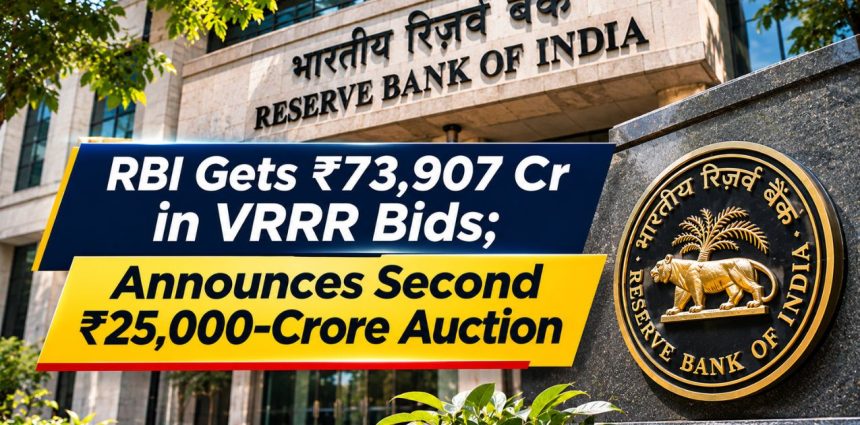
Banks offered nearly 1.48 times the notified amount in the November 4 ₹50,000-crore VRRR auction, reversing the weak participation seen a day earlier. The RBI accepted ₹50,015 crore at 5.49%, while latest data showed banking-system net liquidity absorption of ₹2.08 lakh crore.
The Reserve Bank of India’s (RBI) overnight variable rate reverse repo (VRRR) auction witnessed a sharp improvement in bank participation on November 4, with offers reaching ₹73,907 crore against the notified amount of ₹50,000 crore. This marked a strong reversal from November 3, when banks offered just ₹23,905 crore against the same auction size.
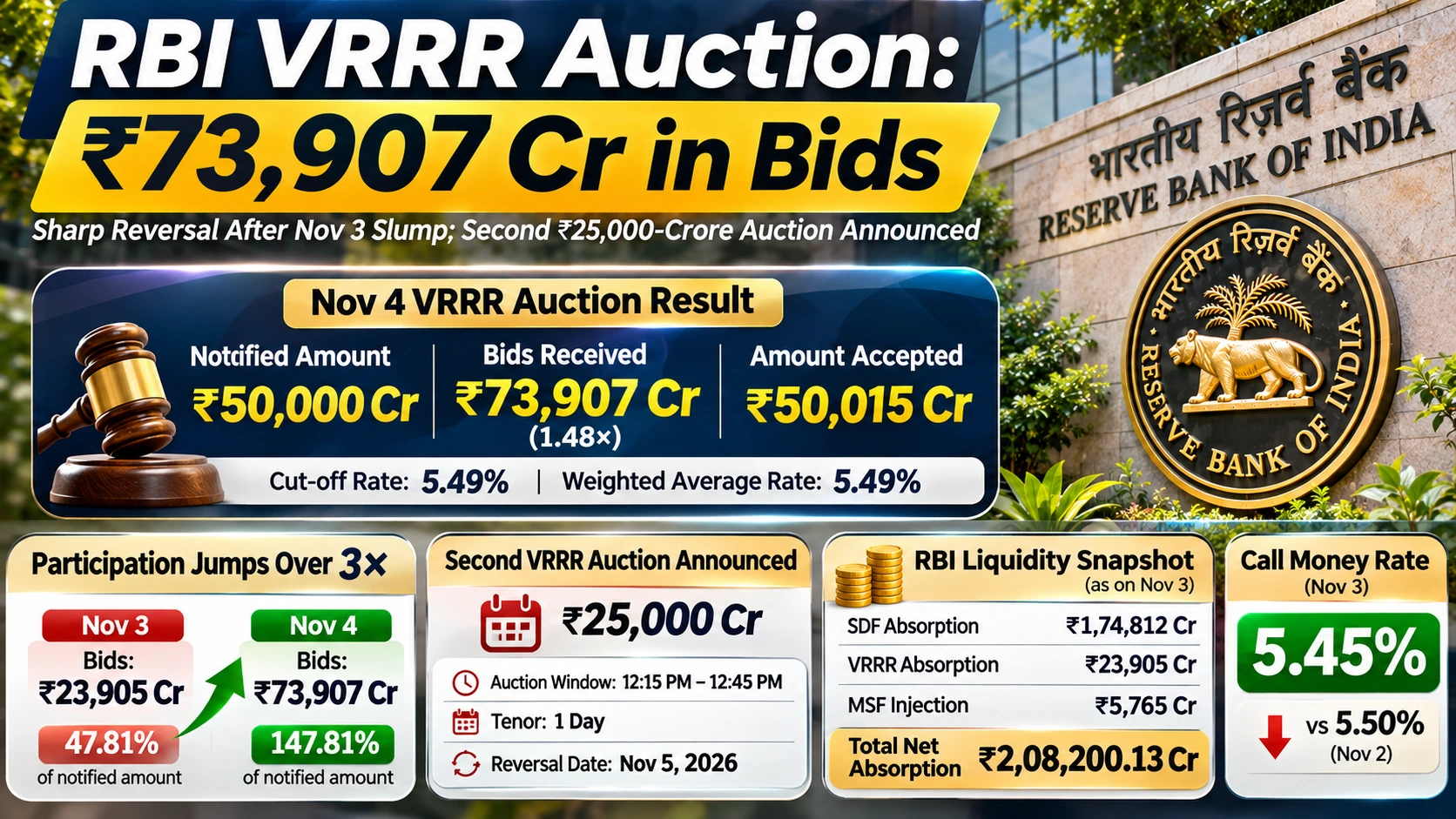
The RBI accepted ₹50,015 crore in the November 4 operation, with both the cut-off rate and weighted average rate at 5.49%. Offers received were approximately 1.48 times the notified amount.
The central bank also announced a separate second overnight VRRR auction worth ₹25,000 crore for November 4. This brought the total notified amount across the two operations to ₹75,000 crore.
Separately, the RBI’s latest Money Market Operations statement, published on November 4 for November 3, reported net liquidity absorption of ₹2,08,200.13 crore, including outstanding operations. The weighted average call money rate stood at 5.45% on November 3.
Track Live: Gap Up / Gap Down Stocks – Today’s NSE Opening Gaps
RBI VRRR Auction on November 4: Banks Offer ₹73,907 Crore
The RBI’s overnight VRRR auction under the Liquidity Adjustment Facility (LAF) received strong participation on Wednesday, November 4.
Against the notified amount of ₹50,000 crore, banks submitted offers worth ₹73,907 crore. The RBI accepted ₹50,015 crore, with the cut-off rate and weighted average rate both standing at 5.49%.
The central bank also reported a partial acceptance percentage of 67.64% for offers received at the cut-off rate.
November 4 VRRR auction: Key details
| Auction parameter | RBI-reported figure |
|---|---|
| Notified amount | ₹50,000 crore |
| Total offers received | ₹73,907 crore |
| Amount accepted | ₹50,015 crore |
| Tenor | 1 day |
| Cut-off rate | 5.49% |
| Weighted average rate | 5.49% |
| Partial acceptance at cut-off rate | 67.64% |
NiftyTrader calculation: Offers received were approximately 147.8% of the notified amount. In other words, banks submitted bids worth nearly 1.48 times the amount announced by the RBI.
The accepted amount was ₹15 crore above the notified amount. The RBI’s result reports ₹50,015 crore as the accepted amount.
November 3 vs November 4: VRRR Bids Rise More Than Threefold
The most important signal from the latest auction is the sharp change in participation over two consecutive days.
On November 3, the RBI had notified ₹50,000 crore for overnight liquidity absorption. However, banks submitted offers worth only ₹23,905 crore, and the central bank accepted the entire amount offered.
On November 4, offers increased to ₹73,907 crore against the same notified amount.
| Parameter | November 3 | November 4 |
|---|---|---|
| Notified amount | ₹50,000 crore | ₹50,000 crore |
| Offers received | ₹23,905 crore | ₹73,907 crore |
| Amount accepted | ₹23,905 crore | ₹50,015 crore |
| Cut-off rate | 5.49% | 5.49% |
| Weighted average rate | 5.49% | 5.49% |
| Offers as a share of notified amount | 47.81% | 147.81% |
NiftyTrader calculation: Offers increased by approximately 209.17% from November 3 to November 4. The November 4 auction received around 3.09 times the bids recorded a day earlier.
The change is notable because the notified amount and weighted average auction rate remained unchanged at ₹50,000 crore and 5.49%, respectively.
The results show a sharp reversal in auction participation. However, the RBI releases do not identify the specific reason behind the increase in bids.
Track Live: NSE Option Chain — Live | BSE Option Chain — Live Sensex & Bankex Options Data Today
Banking System Liquidity Crosses ₹2.08 Lakh Crore: Latest RBI Data
The November 4 Money Market Operations statement, which reports liquidity operations as on November 3, showed net liquidity absorption of ₹2,08,200.13 crore, including outstanding operations.
This was higher than the ₹2,03,088.13 crore reported for November 2.
The latest statement provides a more current picture of the RBI’s liquidity operations ahead of the November 4 auctions.
RBI liquidity position as on November 3
| RBI liquidity operation | Amount |
|---|---|
| Standing Deposit Facility (SDF) absorption | ₹1,74,812 crore |
| VRRR absorption | ₹23,905 crore |
| Marginal Standing Facility (MSF) injection | ₹5,765 crore |
| Net absorption from operations on November 3 | ₹1,92,952 crore |
| Net absorption from outstanding operations | ₹15,248.13 crore |
| Total net liquidity absorption | ₹2,08,200.13 crore |
The RBI’s statement calculates net liquidity using injections and absorptions from its operations. The MSF is a liquidity injection, whereas SDF and VRRR operations absorb liquidity.
The total figure of ₹2,08,200.13 crore includes both current and outstanding operations. It is a November 3 liquidity snapshot published on November 4, and does not include the outcome of the November 4 VRRR auctions.
The latest data is important because it shows that substantial liquidity absorption was already taking place in the banking system before the two November 4 operations.
Weighted Average Call Money Rate at 5.45% on November 3
The RBI’s latest Money Market Operations statement also showed that the weighted average call money rate declined to 5.45% on November 3, compared with 5.50% on November 2.
The overall overnight money-market segment recorded a weighted average rate of 5.44%.
Overnight money-market rates on November 3
| Money-market segment | Weighted average rate |
|---|---|
| Overall overnight segment | 5.44% |
| Call money | 5.45% |
| Triparty repo | 5.43% |
| Market repo | 5.48% |
| Repo in corporate bonds | 5.70% |
The call money market reflects unsecured overnight borrowing and lending between banks and other eligible participants. Its weighted average rate provides an indication of short-term funding conditions.
The decline in the call money rate from 5.50% to 5.45% indicates a five-basis-point easing in the average overnight borrowing rate between the two reporting days.
It is important to distinguish the call money rate from the VRRR auction rate. The former reflects transactions in the overnight unsecured money market, while the latter is determined through the RBI’s liquidity-absorption auction.
RBI Announces Second ₹25,000-Crore VRRR Auction on November 4
Alongside the completed ₹50,000-crore auction, the RBI announced a separate second overnight VRRR operation after reviewing current and evolving liquidity conditions.
The central bank notified an additional amount of ₹25,000 crore for the one-day operation on Wednesday, November 4.
Second VRRR auction: Schedule and details
| Parameter | Details |
|---|---|
| Auction date | November 4, 2026 |
| Notified amount | ₹25,000 crore |
| Tenor | 1 day |
| Auction window | 12:15 PM–12:45 PM |
| Reversal date | November 5, 2026 |
| RBI press release | 2026-2027/1437 |
This operation is separate from the ₹50,000-crore auction for which the RBI published the result.
The two operations together represent ₹75,000 crore in notified auction amounts for November 4. This is the combined notified amount, not the amount actually accepted by the RBI.
The second auction’s bids, accepted amount and auction rate need to be assessed separately using its official result. These figures should not be assumed to match the earlier operation.
What Does the VRRR Auction Activity Mean for Money Markets?
A variable rate reverse repo is a liquidity-management instrument used by the RBI to absorb surplus funds from the banking system.
Under a VRRR operation, eligible banks place funds with the central bank for a specified period. The interest rate is determined through the auction process.
The November 4 developments provide three indicators for money-market participants to monitor.
1. Bank participation: Offers of ₹73,907 crore against a ₹50,000-crore notified amount indicate stronger participation in the completed operation compared with November 3.
2. RBI’s liquidity absorption: The RBI’s November 3 statement showed total net liquidity absorption of ₹2.08 lakh crore, including outstanding operations. The separate ₹25,000-crore operation provides another opportunity for liquidity absorption.
3. Overnight funding conditions: The call money rate of 5.45% and the overall overnight segment rate of 5.44% provide additional reference points for assessing short-term funding conditions.
Importantly, the VRRR auction rate is not the RBI’s policy repo rate. Changes in auction participation or the VRRR rate should not automatically be interpreted as changes in monetary policy.
What Should Traders and Market Participants Watch Next?
The latest RBI operations make the following developments important to monitor:
- The official result of the separately announced ₹25,000-crore second VRRR auction.
- Whether banks continue to submit offers above the notified amount in subsequent liquidity operations.
- The amount accepted by the RBI across its overnight liquidity-absorption operations.
- Changes in overnight call money and other short-term money-market rates.
The second auction result is particularly important because it will show whether the strong participation seen in the ₹50,000-crore operation continued in the additional operation.
Bottom Line
The RBI’s ₹50,000-crore overnight VRRR auction received offers worth ₹73,907 crore on November 4, compared with just ₹23,905 crore on November 3. The central bank accepted ₹50,015 crore at a cut-off and weighted average rate of 5.49%.
The latest RBI liquidity statement, based on November 3 operations, reported net absorption of ₹2,08,200.13 crore, including outstanding operations. The weighted average call money rate stood at 5.45%, down from 5.50% a day earlier.
Separately, the RBI announced another overnight VRRR auction worth ₹25,000 crore for November 4, with a one-day tenor and reversal scheduled for November 5.
Together, the two operations represent ₹75,000 crore in notified auction amounts. The key liquidity signal is the sharp recovery in participation in the completed auction, while the result of the additional operation will help complete the picture of banks’ demand for overnight liquidity-absorption facilities.
Disclaimer: This article is for informational and educational purposes only and should not be considered investment advice or a recommendation to buy or sell any financial instrument. Readers should verify details through official sources and consult a SEBI-registered investment adviser before making investment decisions.