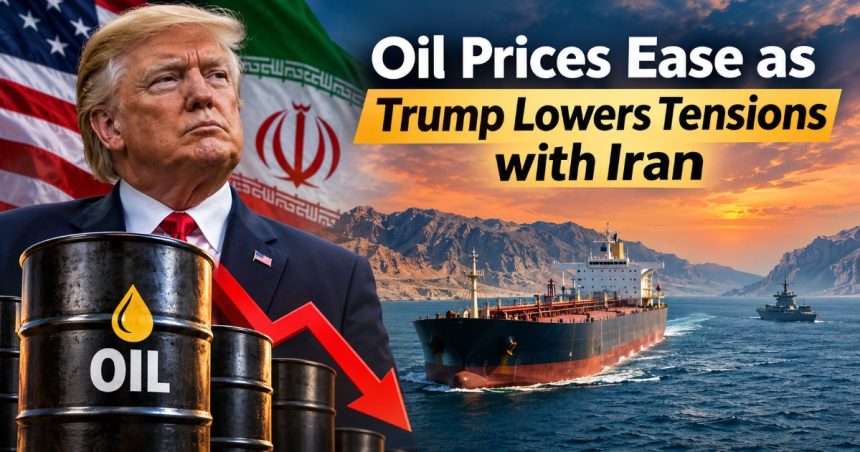
Brent Crude Falls Nearly 6% as Trump Eases Iran Tensions
Global crude oil prices remained under pressure on Tuesday as US President Donald Trump softened his stance on Iran, easing fears of a prolonged military conflict in the Middle East. The development has reduced concerns about major disruptions to global oil supplies, putting pressure on crude oil prices.
For investors, the latest decline in crude oil prices could become an important factor for energy stocks, inflation expectations and the broader stock market. However, uncertainty surrounding the Strait of Hormuz means the oil market may remain sensitive to geopolitical developments.
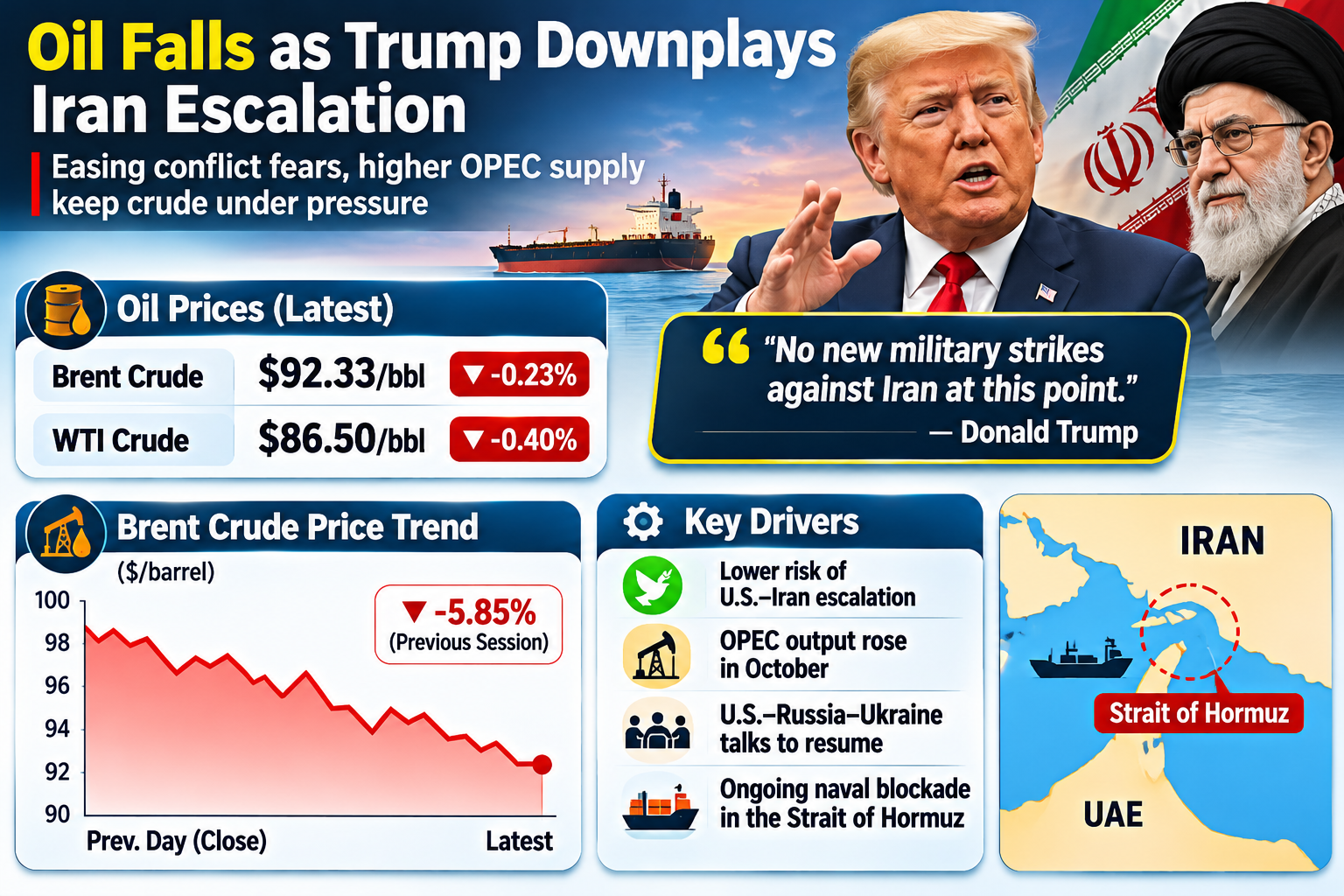
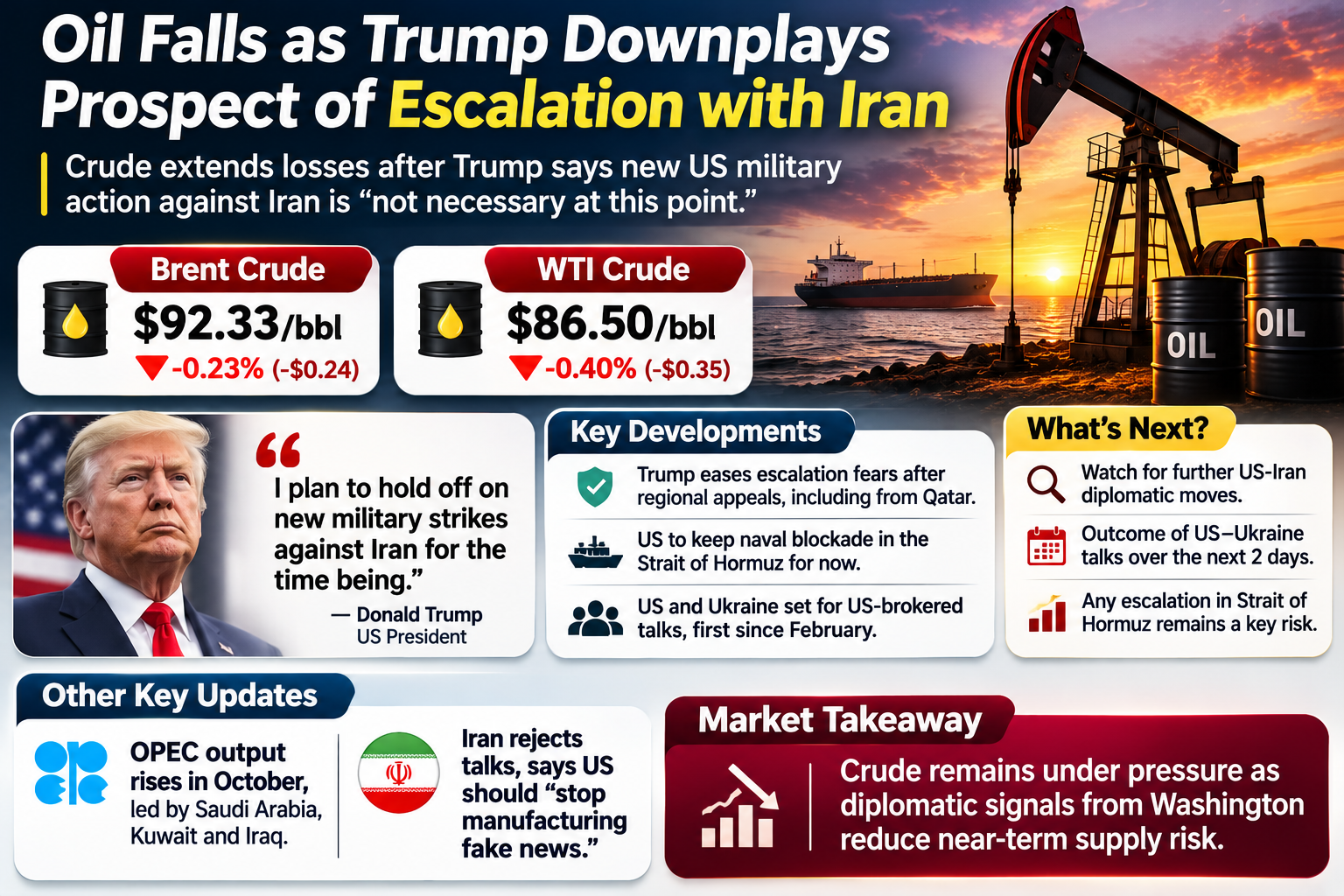
Brent crude futures declined 24 cents, or 0.23%, to $92.33 per barrel by 0102 GMT. US West Texas Intermediate (WTI) crude futures fell 35 cents, or 0.40%, to $86.50 per barrel.
The latest decline extended losses from Monday, when Brent crude settled 5.85% lower after falling to its lowest level since August 31.
Track Live : NSE Option Chain — Live | BSE Option Chain — Live Sensex & Bankex Options Data Today
Brent Crude Falls : Strait of Hormuz Remains a Major Risk for Global Oil Supply
Despite the decline in oil prices, the Middle East situation remains uncertain.
The Strait of Hormuz is one of the world’s most important energy transportation routes. Any prolonged disruption could affect crude oil shipments and push global energy prices higher.
Senior US and Gulf officials have also questioned the possibility of an immediate peace agreement between Washington and Tehran.
Iranian security council chief Mohsen Rezaei rejected claims of ongoing negotiations, saying the US should “stop manufacturing fake news about imaginary talks”.
These developments suggest that traders cannot completely rule out another rise in crude oil prices if diplomatic efforts fail or shipping disruptions intensify.
Crude oil prices declined on November 10
International crude oil benchmarks moved lower during Tuesday’s trading session.
| Benchmark | Price | Change |
|---|---|---|
| Brent crude | $92.33/barrel | -0.23% |
| US WTI crude | $86.50/barrel | -0.40% |
These prices were recorded at 01:02 GMT on November 10, 2026.
The decline followed a much sharper fall in the previous trading session, when Brent crude settled 5.85% lower.
Track Live : NSE Commodity Option Chain — Live MCX Options Data for Crude Oil, Gold, Silver & More
OPEC Production and Russia-Ukraine Talks Add to Market Uncertainty
Supply-side developments are also influencing the global oil market.
A Reuters survey found that OPEC oil production increased in October, supported by higher output from Saudi Arabia, Kuwait and Iraq despite continued export constraints.
Higher production could provide additional supply to the global market and limit upward pressure on crude oil prices.
Meanwhile, Russian and Ukrainian officials were scheduled to begin two days of US-brokered talks on Tuesday. These were expected to be their first discussions since February.
Trump has suggested that a broader peace agreement could be possible, potentially incorporating Europe’s security concerns.
| Production indicator | October 2026 |
|---|---|
| OPEC production | 22.87 million barrels/day |
| Monthly increase | 1.38 million barrels/day |
| February production | 25.48 million barrels/day |
| Recovery against February level | Approximately 90% |
The survey covered 11 OPEC members.
Why did production increase?
Saudi Arabia, Kuwait and Iraq contributed to the increase despite export restrictions and transportation challenges caused by the Iran conflict and the US blockade on Iranian shipments.
Seven OPEC+ countries had agreed to keep production steady in October after increasing production quotas each month since April.
However, geopolitical disruptions prevented producers from fully delivering on their planned production increases.
Why is this important for crude prices?
Higher oil production can improve supply availability and reduce pressure on prices, provided that the additional crude can reach international buyers.
There is an important distinction between producing oil and exporting it. Increased production does not necessarily translate into increased global availability when shipping routes remain disrupted.
Trump’s decision to hold off on fresh strikes changed market sentiment
One of the biggest factors behind the decline was Trump’s announcement that the United States would not immediately launch additional military strikes against Iran.
On Monday, November 9, Trump indicated that he intended to hold off on new attacks for the time being following appeals from regional countries.
Qatar’s Prime Minister, Sheikh Mohammed bin Abdulrahman Al-Thani, was among the regional leaders involved in diplomatic discussions at the White House.
Trump also indicated that Saudi Arabia favoured a peaceful solution.
However, his position does not represent a complete withdrawal of the military option.
He said the United States remained prepared to resume military action if necessary.
Track Live : Nifty Levels Today | Sensex Levels Today
Shipping attacks are continuing despite Trump’s softer position
An important detail missing from the supplied content is that the security situation around the Strait of Hormuz remains serious.
According to Reuters’ November 9 reporting:
-
Attacks on tankers in the Gulf and Strait of Hormuz increased sharply during October.
-
Shipping attacks continued at the highest rate recorded since the beginning of the conflict.
-
Iran reportedly said a tanker had struck a mine east of the Strait.
-
Iranian state television claimed that 11 tankers had been disabled over the preceding 10 days.
Reuters also reported that US strikes had targeted radar systems used for air defence and ship navigation, as well as missile-launcher and mine-laying bases on Iran’s Qeshm Island.
Iranian media reported the strikes, while the US had not commented on those reports at the time of Reuters’ publication.
Russia and Ukraine are preparing for US-brokered peace talks
The oil market report also mentions another major geopolitical development: planned discussions between Russia and Ukraine.
According to Reuters, officials from both countries were scheduled to meet in Abu Dhabi on November 10 and 11, 2026, for two days of US-brokered negotiations.
These were expected to be their first such talks since February 2026.
Important details of the proposed discussions:
-
Venue: Abu Dhabi, United Arab Emirates.
-
Dates: November 10–11, 2026.
-
Mediator: United States.
-
US representatives: Steve Witkoff and Jared Kushner were expected to represent Washington.
-
Key subjects: Ending the war, post-war security arrangements, de-escalation and humanitarian measures.
-
European participation: France, Germany and the European Commission planned to send officials.
However, Russia opposed European participation in the negotiations themselves. Ukrainian representatives were expected to brief their European allies separately.
Indian Companies That Could Benefit From Falling Crude Oil Prices
A decline in Brent crude oil prices can benefit several Indian listed companies, particularly in aviation, paints, tyres, chemicals and oil marketing.
The potential benefit comes from lower fuel costs, cheaper petroleum-based raw materials and reduced operating expenses. However, the actual impact on profitability depends on inventory costs, product prices, hedging and how quickly lower crude prices translate into cheaper inputs.
The following companies are worth monitoring. Market capitalisations are approximate and need to be read alongside the date of the latest available market data.
Market Capitalisation of Indian Companies That Could Benefit
Market data: November 9, 2026 (latest completed trading session before November 10). Figures rounded to ₹ crore.
| Company | NSE Symbol | Market Cap |
|---|---|---|
| Asian Paints | ASIANPAINT | ₹2,40,700 Cr |
| InterGlobe Aviation (IndiGo) | INDIGO | ₹2,10,000 Cr |
| Indian Oil Corporation | IOC | ₹2,02,000 Cr |
| Pidilite Industries | PIDILITIND | ₹1,62,000 Cr |
| Bharat Petroleum (BPCL) | BPCL | ₹1,37,000 Cr |
| Hindustan Petroleum (HPCL) | HINDPETRO | ₹81,300 Cr |
| Berger Paints | BERGEPAINT | ₹54,800 Cr |
| MRF | MRF | ₹52,960 Cr |
| Apollo Tyres | APOLLOTYRE | ₹26,520 Cr |
| JK Tyre & Industries | JKTYRE | ₹10,300 Cr |
Which sectors could benefit the most?
| Sector | Companies to watch | Potential benefit |
|---|---|---|
| Oil marketing | IOC, BPCL, HPCL | Lower crude procurement costs; potentially better marketing margins |
| Aviation | IndiGo | Reduced aviation fuel expenses |
| Paints | Asian Paints, Berger Paints | Lower costs for crude-derived solvents and chemicals |
| Tyres | MRF, Apollo Tyres, JK Tyre | Cheaper synthetic rubber and petroleum-linked inputs |
| Adhesives and chemicals | Pidilite Industries | Lower costs for certain petrochemical raw materials |
What Falling Crude Oil Prices Mean for Indian Investors
India imports a significant portion of its crude oil requirements, making international oil prices an important factor for the domestic economy.
A sustained decline in Brent crude prices could benefit oil marketing companies (OMCs), including Indian Oil Corporation, BPCL and HPCL, by potentially reducing crude procurement costs and easing pressure on marketing margins.
Lower crude prices could also help reduce imported inflation, support the rupee and improve cost conditions for aviation, paints, chemicals and other oil-dependent industries.
However, the impact on individual companies will depend on refining margins, inventory valuations, currency movements and domestic fuel pricing.
On the other hand, upstream oil producers could face pressure if crude prices continue declining, as lower realisations may affect their earnings.
What Traders and Investors Should Watch in Coming Sessions
The immediate direction of crude oil prices will depend on developments between the US and Iran, the situation around the Strait of Hormuz and changes in global oil production.
Investors should also monitor Brent crude prices, the rupee-dollar exchange rate and movements in energy stocks.
For now, easing geopolitical tensions have provided relief to the oil market. However, any fresh escalation in the Middle East could quickly reverse the recent decline.