
Indian equities are entering Samvat 2083 after a six-session rally lifted the Nifty 50 by more than 8%. On November 5, the Nifty surged 576 points, or 2.40%, to close at 24,536.60, while the Sensex jumped 2,008.61 points, or 2.60%, to settle at 79,310.01, marking the biggest single-day gains in seven months.
The recovery was supported by renewed foreign investor buying and a sharp decline in crude oil prices during the previous session. Foreign investors purchased ₹7,284 crore worth of Indian shares on November 4, their largest single-day purchase since October 2025. Brent crude, after falling 8.7% in the previous session, rebounded around 1% to $96 per barrel on Thursday.
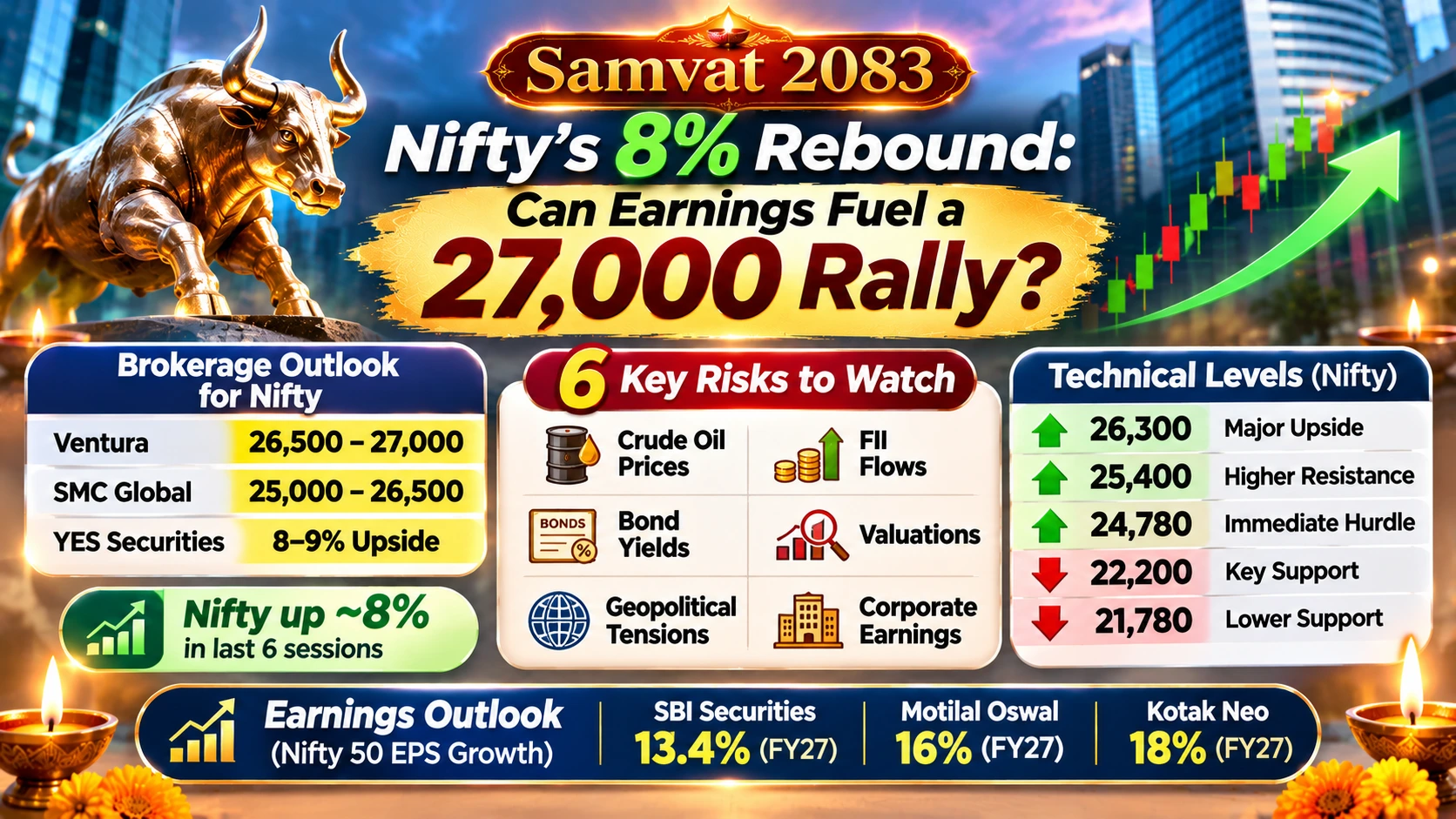
But the rebound faces a bigger test: brokerages see the Nifty potentially reaching 27,000 during Samvat 2083, while technical analysts warn that a sustained trend reversal is not yet confirmed.
With Muhurat Trading scheduled for November 8, investors are watching six major risks involving crude oil, FII flows, bond yields, valuations, geopolitical tensions and corporate earnings.
Track Live: NIFTY 50 | SENSEX | FII DII DATA | NIFTYTRADER
Samvat 2083 Outlook: What Are Brokerages Predicting for Nifty and Sensex?
Brokerages broadly expect Indian equities to recover during Samvat 2083, supported by improving corporate earnings, more comfortable valuations and domestic investment flows. However, their index targets indicate different expectations about the pace and strength of the recovery.
According to Business Standard’s November 5 brokerage outlook, the major projections include:
| Brokerage / Analyst | Nifty 50 Outlook | Sensex Outlook |
|---|---|---|
| Ventura – Vinit Bolinjkar | 26,500–27,000 | 85,500–87,000 |
| SMC Global – Seema Srivastava | 25,000–26,500 | 82,000–87,000 |
| YES Securities – Hitesh Jain | 8–9% upside | Not specified |
Ventura sees the Nifty reaching 26,500–27,000 by the next Samvat year, implying approximately 11–13% upside from its reference level of 23,700.
SMC Global expects the index to trade between 25,000 and 26,500, while YES Securities has adopted a relatively conservative approach, expecting single-digit returns amid elevated bond yields, foreign investor outflows and subdued earnings growth.
Anand Rathi Advisors also expects the possibility of benchmark indices moving beyond their previous highs, particularly if geopolitical tensions ease and global energy supply conditions improve.
The difference between these forecasts suggests that a recovery is possible, but its magnitude remains uncertain.
Nifty Technical Outlook: 24,780 Is the Immediate Hurdle
Despite the recent recovery, technical analysts have cautioned against interpreting the rebound as confirmation of a sustained trend reversal.
According to Business Standard’s November 5 technical outlook, the Nifty’s important reference levels include:
| Nifty 50 Levels | Technical Significance |
|---|---|
| 26,300 | Major upside reference |
| 25,400 | Higher resistance |
| 24,800 | Immediate upside zone |
| 22,200 | Important downside support |
| 21,780 | Lower support |
Individual analyst assessments also differ:
- Kotak Neo: Expects a broad consolidation range of 21,700–26,300 during Samvat 2083.
- Mirae Asset Sharekhan: Sees potential movement towards 24,700–25,400 over six months, provided the index holds above 22,000.
- YES Securities: Expects a broader range of 22,000–26,000 and believes a fresh lifetime high will be difficult without stronger market breadth.
- Choice Broking: Identifies 24,780 as an immediate hurdle, above which the Nifty could gradually move towards 26,300. A stronger rally could open the possibility of 28,380.
The technical outlook therefore supports a recovery scenario, but the market needs broader participation and sustained buying to confirm a stronger trend.
Samvat 2082 Performance: Sensex and Nifty End the Year Lower
Samvat 2082 was a challenging period for Indian equities, with benchmark indices facing pressure from foreign investor selling, geopolitical uncertainty, elevated crude oil prices and earnings concerns.
According to Business Standard’s November 5 report, the Sensex declined 7.9%, and the Nifty 50 fell 6.8% through November 4.
The comparison uses the October 17, 2025, last regular-session closing levels as the starting reference, rather than the October 21, 2025, Muhurat Trading close.
| Index | October 17, 2025 Close | November 4, 2026 Close | Approximate Decline |
|---|---|---|---|
| Sensex | 83,952.19 | 77,301.40 | 7.9% |
| Nifty 50 | 25,709.85 | 23,960.60 | 6.8% |
This distinction matters because calculations beginning with the October 21 Muhurat-session closing levels will produce different annual return percentages. The two comparison methods should not be mixed.
The correction also brought benchmark valuations closer to their long-term averages, although valuation comfort has not been uniform across large-, mid- and small-cap stocks.
Nifty Earnings Outlook: Brokerages Expect 13.4–18% Growth in FY27
Corporate earnings are likely to be among the biggest drivers of Indian equities during Samvat 2083.
Three major brokerage forecasts highlight the variation in expectations:
| Brokerage | FY27 Nifty 50 EPS Growth | FY28 Nifty 50 EPS Growth |
|---|---|---|
| SBI Securities | 13.4% | 10.1% |
| Motilal Oswal | 16% | 14% |
| Kotak Neo | 18% | 13% |
SBI Securities expects Nifty 50 earnings per share to reach ₹1,290 in FY27 and ₹1,420 in FY28.
Motilal Oswal expects earnings growth to recover to 16% in FY27 and 14% in FY28, compared with its estimated 5% growth for FY26.
Kotak Neo has the most optimistic FY27 earnings forecast among these three brokerages, projecting approximately 18% growth.
September Quarter Results Provide Early Support
SBI Securities has highlighted encouraging September-quarter earnings trends in its sample of 240 companies.
The brokerage reported:
- Revenue growth of 23.2% year-on-year.
- Profit after tax growth of 28.8% year-on-year.
Excluding banks and NBFCs, the remaining 179 companies recorded revenue growth of 24.5% and PAT growth of 38%.
These results suggest that earnings momentum may be strengthening beyond a few large companies. However, this remains a brokerage-specific company sample, not the final growth rate for the entire listed market.
Nifty Valuations and FII-DII Flows: Where Does the Market Stand?
The correction during Samvat 2082 has improved valuations in parts of the market, particularly large-cap stocks.
According to Motilal Oswal, the Nifty is trading at approximately 17.5 times forward earnings, around 16% below its long-term average. Midcap valuations are approximately 6% below their historical average, while small-cap stocks continue to command a premium of approximately 25%.
This creates an important valuation gap across market segments, making selective stock picking particularly relevant.
Domestic Institutions Offset Foreign Selling
SBI Securities estimates that foreign investors sold approximately ₹3.6 lakh crore of Indian equities in the secondary market over the preceding 12 months.
Domestic institutional investors invested approximately ₹8.5 lakh crore during the same period, absorbing much of the selling.
Other indicators of domestic participation include:
| Indicator | SBI Securities Data |
|---|---|
| Monthly mutual fund SIP inflows | Close to ₹32,000 crore |
| Demat accounts | More than 24 crore |
| Domestic mutual fund ownership in NSE 500 | Record 12.2% |
| FII ownership in NSE 500 | 17-year low of 16.2% |
The ownership figures relate to the June 2026 quarter.
The November 5 foreign investor buying provides an encouraging near-term signal, but it does not erase the substantial cumulative outflows of the preceding 12 months. Sustained foreign buying will remain important for a stronger and more durable market recovery.
TRACK LIVE: Participant Wise OI — FII, DII, Client, Pro Positions Today
Samvat 2083: Four Investment Themes Brokerages Are Tracking
Brokerage outlooks point towards opportunities in sectors benefiting from domestic investment, manufacturing expansion, exports and changing consumption patterns.
Motilal Oswal has identified four broad investment themes:
1. BFSI and Capital Markets: Steady loan growth, improving margins and rising participation in equity markets could support banks, financial intermediaries and market infrastructure businesses.
2. Manufacturing and Engineering: Healthcare devices, aerospace, auto components and other manufacturing businesses could benefit from capacity expansion and stronger order books.
3. Global Outsourcing and Exports: Pharmaceutical ingredients, garments and port cargo could benefit from global outsourcing opportunities and trade agreements, although export demand and currency movements remain important variables.
4. Consumption and Digital Businesses: Organised jewellery, quick commerce, food delivery and other consumer-facing digital platforms could benefit from increasing market penetration and changing consumer preferences.
Nuvama has separately highlighted IT, PSU banks and pharmaceuticals as sectors to watch in Samvat 2083.
The key consideration across these themes will be earnings delivery, competitive positioning and valuations rather than sector popularity alone.
Six Risks That Could Test the Samvat 2083 Market Recovery
Despite improving earnings expectations and more comfortable valuations, the next Samvat year will remain exposed to interconnected macroeconomic and market risks.
SAMCO Securities’ assessment, reported by Business Standard, identifies six major concerns.
1. Rising Bond Yields
Higher government bond yields increase the relative attractiveness of fixed-income investments compared with equities. Rising US Treasury yields could also divert capital away from emerging markets and pressure Indian stocks.
2. Inflation, Crude Oil and Interest Rates
India’s dependence on imported energy makes crude oil inflation a significant risk. Higher oil prices can increase corporate costs, weaken household purchasing power, widen the import bill and restrict the RBI’s ability to ease monetary policy.
3. Foreign Investor Outflows
Sustained FII selling could pressure the rupee, valuations and benchmark indices. Strong domestic institutional participation and SIP inflows may provide a cushion but cannot indefinitely compensate for rising global yields.
4. Equity Valuation Risks
Higher risk-free rates increase the discount rate applied to future corporate earnings. Expensive growth-oriented and long-duration stocks could face valuation de-rating, especially if earnings fail to meet expectations.
5. Geopolitical Tensions
Escalation in West Asia or disruption of global energy supply routes could push crude prices higher. This could increase operating costs for aviation, paints, chemicals and logistics companies while creating additional currency pressure.
6. Slowing Economic Growth and Earnings Downgrades
If inflation, higher borrowing costs and global uncertainty weaken economic activity, companies could face slower revenue and profit growth. An earnings downgrade cycle would restrict market returns even if domestic liquidity remains supportive.
SAMCO’s broader assessment is that Samvat 2083 could see heightened volatility, valuation rationalisation and selective wealth creation rather than an uninterrupted broad-based bull market.
Muhurat Trading 2026: Date and NSE-BSE Timings
Samvat 2083 begins on Sunday, November 8, 2026, coinciding with Diwali Laxmi Pujan.
The NSE and BSE will conduct a special Muhurat trading session to mark the occasion.
According to the NSE’s October 19 capital-market circular, the cash-market schedule is:
| Trading Session | Timing (IST) |
|---|---|
| Block deal session | 1:50 PM–2:05 PM |
| Pre-open session | 2:05 PM–2:20 PM |
| Normal market opens | 2:20 PM |
| Continuous trading for CAS-eligible securities | 2:20 PM–3:15 PM |
| Closing auction for CAS securities | 3:20 PM–3:35 PM |
| Normal market for non-CAS securities | 2:20 PM–3:30 PM |
The closing auction applies to eligible securities under the exchange’s Closing Auction Session framework. The schedule also includes separate provisions for IPO and relisted securities.
Muhurat trading marks the beginning of the new Hindu financial year and is traditionally considered an auspicious occasion for market participation. However, its symbolic significance does not guarantee investment returns.
Bottom Line
Samvat 2083 begins with improving earnings expectations, renewed foreign investor buying and more comfortable large-cap valuations. Ventura’s Nifty 27,000 target provides an optimistic scenario, but technical analysts continue to identify resistance and downside risks.
The difference between the 13.4% and 18% FY27 earnings forecasts also shows that the strength of the recovery is far from settled.
Falling crude oil prices, sustained foreign inflows and stronger corporate earnings could support the next leg of the rally. However, bond yields, inflation, geopolitical tensions and valuation risks could interrupt the recovery.
For investors entering Samvat 2083, the bigger question is not simply whether the Nifty can reach 27,000, but whether earnings growth and market breadth will be strong enough to sustain that move.
Read Next: Oil Price Today: Brent Tests $94, but Iran Peace Is No Sure Bet
Disclaimer: This article is for informational and educational purposes only and does not constitute investment advice. Brokerage forecasts, market targets and earnings estimates are subject to change and do not guarantee future returns. Investors should conduct their own research and consult a SEBI-registered financial advisor before making investment decisions.