
Auto stocks surge as Nifty Auto Up nearly 3%, Ashok Leyland leads gains
Automobile stocks witnessed strong buying interest on Thursday, November 5, with Ashok Leyland, Maruti Suzuki, Tata Motors Passenger Vehicles (TMPV) and Mahindra & Mahindra leading the rally.
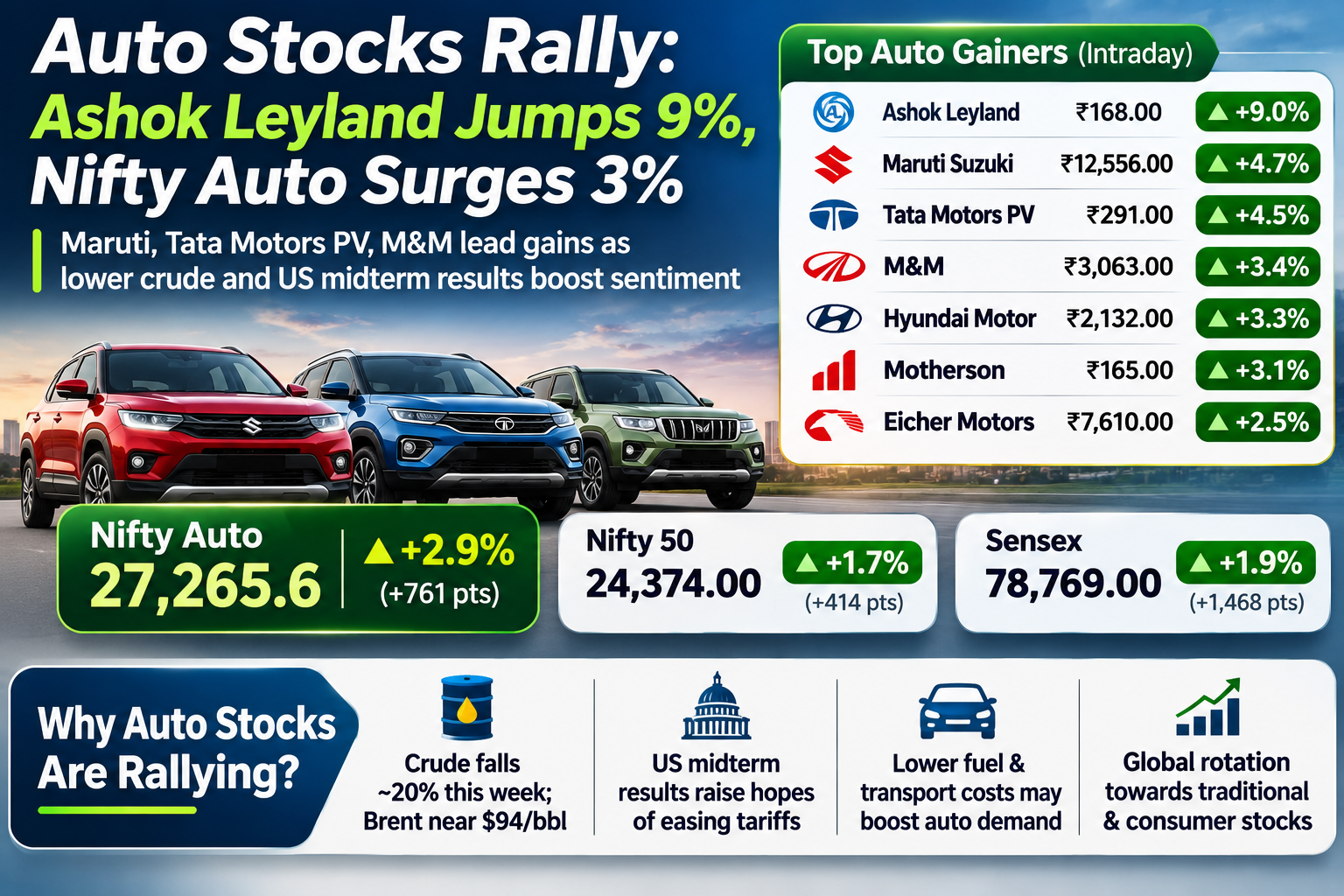
The Nifty Auto index surged nearly 2.9%, gaining around 761 points to 27,265, making it the best-performing sectoral index on the NSE during morning trade.
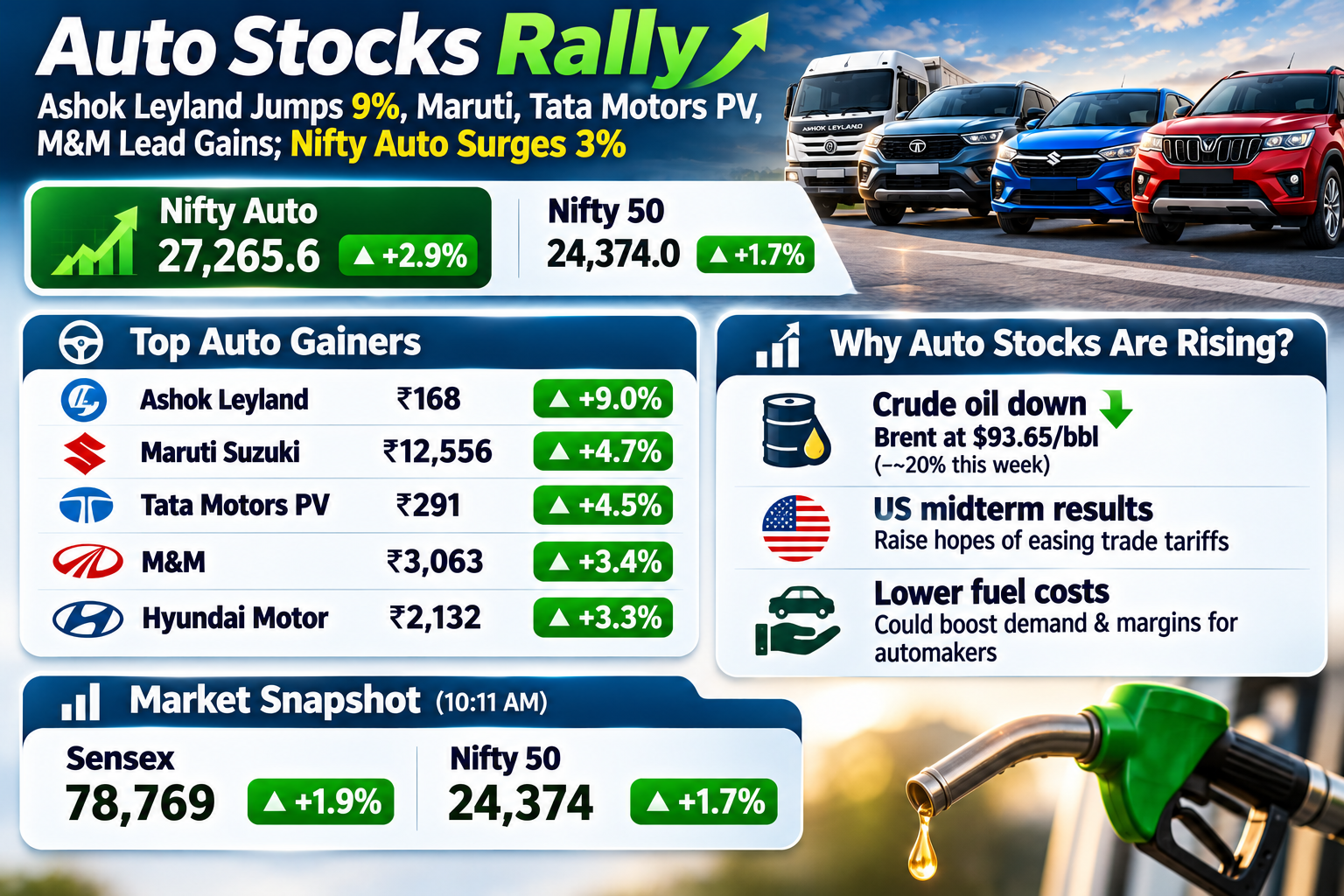
Ashok Leyland emerged as the biggest gainer, jumping 9% to ₹168. Maruti Suzuki advanced 4.7% to ₹12,556, while Tata Motors PV climbed 4.5% to ₹291.
Mahindra & Mahindra shares also gained 3.4% to ₹3,063.
The rally came amid improving global market sentiment, falling crude oil prices and expectations of possible changes in US trade policies following the Democratic victory in the US midterm elections.
But can the latest rally sustain, and which automobile stocks are attracting the strongest buying interest?
Track Live : NSE Option Chain — Live | BSE Option Chain — Live Sensex & Bankex Options Data Today
Nifty Auto Up: surges nearly 3%, outperforms Nifty 50
The Nifty Auto index emerged as one of the strongest-performing sectoral indices on the National Stock Exchange on November 5.
According to the supplied market snapshot, the index gained approximately 2.9%, or around 761 points, to trade near 27,265.
The broader market also witnessed strong buying interest.
| Market index | Level / movement |
|---|---|
| Nifty Auto | Around 27,265 |
| Nifty Auto gain | Approximately 2.9% |
| Nifty 50 | 24,374 |
| Nifty 50 gain | Approximately 1.7% |
| Sensex | 78,769 |
| Sensex gain | Approximately 1.9% |
The reported Nifty Auto level contains a formatting error in the supplied text (“27,2656”). The approximately 27,265 level is consistent with the reported 761-point gain and 2.9% rise.
Ashok Leyland, Maruti Suzuki and Tata Motors PV lead automobile stocks rally
Buying interest extended across passenger vehicles, commercial vehicles, two-wheelers and auto component manufacturers.
Here is how major automobile stocks performed during Thursday’s morning session:
| Automobile Stock | Price (₹) | Gain |
|---|---|---|
| Ashok Leyland | 168 | 9% |
| Maruti Suzuki | 12,556 | 4.7% |
| Tata Motors PV | 291 | 4.5% |
| M&M | 3,063 | 3.4% |
| Hyundai Motor India | 2,132 | 3.3% |
| Samvardhana Motherson | 165 | 3.1% |
| Eicher Motors | 7,610 | 2.5% |
| TVS Motor | 4,440 | 2.5% |
| Uno Minda | 1,226 | 2.4% |
Bharat Forge, Hero MotoCorp and Bosch also advanced between 1.5% and 2%.
However, Bajaj Auto slipped 0.1%, while Tube Investments of India declined 0.6%.
Falling crude oil prices provide fresh support to automobile companies
One of the biggest triggers behind Thursday’s automobile stocks rally was the sharp correction in international crude oil prices.
Brent crude futures declined 1.03% to $93.65 per barrel in early Asian trade after falling nearly 9% on Wednesday.
US West Texas Intermediate (WTI) crude also dropped 1.29% to $86.98 per barrel.
Brent crude has lost approximately 20% this week, reflecting changing geopolitical and market expectations.
Lower crude oil prices can benefit automobile manufacturers by easing transportation and logistics costs. They can also reduce inflationary pressure and potentially improve consumer purchasing power.
For investors, sustained weakness in crude oil could provide additional support to automobile stocks, particularly companies dependent on domestic consumer demand.
Track Live : Nifty Levels Today | Sensex Levels Today
US midterm election results improve global automobile sector sentiment
The Democratic victory in the US midterm elections has added another dimension to the global market rally.
Investors are assessing whether the new political balance in Washington could limit Trump’s trade policies and create opportunities for changes in existing tariffs.
Automobile stocks also gained across Asian markets as investors shifted towards traditional industries and consumer-oriented businesses.
Japanese automakers Toyota Motor and Honda Motor advanced around 5% each, reflecting the broader strength in the automobile sector.
However, changes to US tariffs are not guaranteed, and investors will need to monitor actual policy announcements.
Read More : BSE Is Up 41.6% This Year While the Nifty Is Down 6.9%: Can the Rally Last?
Sensex and Nifty rally as buying spreads across sectors
The automobile stocks rally coincided with strong gains in the broader Indian stock market.
At 10:11 AM on November 5, the Sensex surged 1,468 points, or 1.9%, to 78,769.
The Nifty 50 advanced 414 points, or 1.7%, to 24,374.
The strong benchmark performance further supported buying interest in automobile, banking and other cyclical stocks.
October automobile sales provide additional support to the rally
The improvement in automobile stocks is also supported by encouraging wholesale sales trends during October 2026.
According to Kotak Institutional Equities, wholesale volumes increased more than 15% year-on-year across most automobile segments, except tractors.
The passenger vehicle and two-wheeler segments recorded strong wholesale growth, while commercial vehicle demand remained resilient.
However, retail sales presented a mixed picture.
| Automobile segment | October 2026 trend |
|---|---|
| Passenger vehicles | Wholesale growth above 15% |
| Two-wheelers | Wholesale growth above 15% |
| Medium and heavy commercial vehicles | Wholesale growth above 15% |
| Light commercial vehicles | High-single-digit growth |
| Tractors | Wholesale decline |
Here’s what happened today and why traders reacted
Three major factors supported automobile stocks on Thursday.
-
Falling crude oil prices: Brent crude declined towards $94 per barrel, easing concerns about fuel costs and inflation.
-
US political developments: Investors assessed the possibility of changes in American trade and tariff policies.
-
Broad market recovery: Strong buying across Indian equities supported interest in automobile companies.
The Nifty Auto index outperformed the Nifty 50, which gained approximately 1.7% during morning trade.
What should investors watch in automobile stocks?
Thursday’s rally has brought Ashok Leyland, Maruti Suzuki, Tata Motors PV and Mahindra & Mahindra into focus.
Investors should monitor crude oil prices, vehicle sales, demand trends, commodity costs and developments in international trade policies.
A sustained decline in crude oil could improve sentiment towards automobile manufacturers. However, rising competition, input costs and changes in consumer demand remain important risks.
Why falling crude oil prices are positive for automobile companies
Lower crude oil prices can benefit automobile manufacturers through several direct and indirect channels.
A. Improved consumer purchasing power
Lower petrol and diesel prices, if passed on to consumers, can reduce vehicle ownership costs and improve household purchasing power.
This could support demand for passenger vehicles, two-wheelers and commercial vehicles.
B. Lower transportation and logistics expenses
Automobile manufacturers depend on extensive supply chains involving transportation of raw materials, components and finished vehicles.
Lower diesel and fuel costs can reduce logistics expenses for manufacturers and dealerships.
C. Reduced inflationary pressure
Crude oil is an important component of India’s inflation basket.
A sustained decline in international oil prices could ease inflationary pressure, potentially improving consumer confidence and borrowing conditions.
D. Better operating economics for fleet operators
Commercial vehicle operators spend a substantial portion of their operating budgets on fuel.
Lower diesel prices could improve fleet operators’ profitability and encourage vehicle replacement and expansion.
E. Potential improvement in automobile demand
If lower energy prices support household disposable income and business confidence, automobile purchases could receive an additional boost.
However, the benefit is not immediate or uniform. Vehicle demand also depends on financing costs, income growth, vehicle prices, employment and consumer confidence.