
Mukesh Ambani’s Wealth Surges as Reliance Shares Jump 12%
A strong earnings performance has reshuffled Asia’s billionaire rankings, bringing Mukesh Ambani back to the top. Reliance Industries Chairman Mukesh Ambani has overtaken ByteDance co-founder Zhang Yiming to become Asia’s richest person after a sharp rally in Reliance Industries shares boosted his personal fortune.
According to Forbes’ Real-Time Billionaires List on Tuesday, Ambani’s net worth climbed 10.5% to $88.8 billion. The development follows a nearly 12% surge in Reliance Industries shares on Monday, adding more than $19 billion to the company’s market value.
The rally highlights how strongly corporate earnings can influence investor sentiment, stock valuations and billionaire wealth.
Track Live : NSE Option Chain — Live | BSE Option Chain — Live Sensex & Bankex Options Data Today
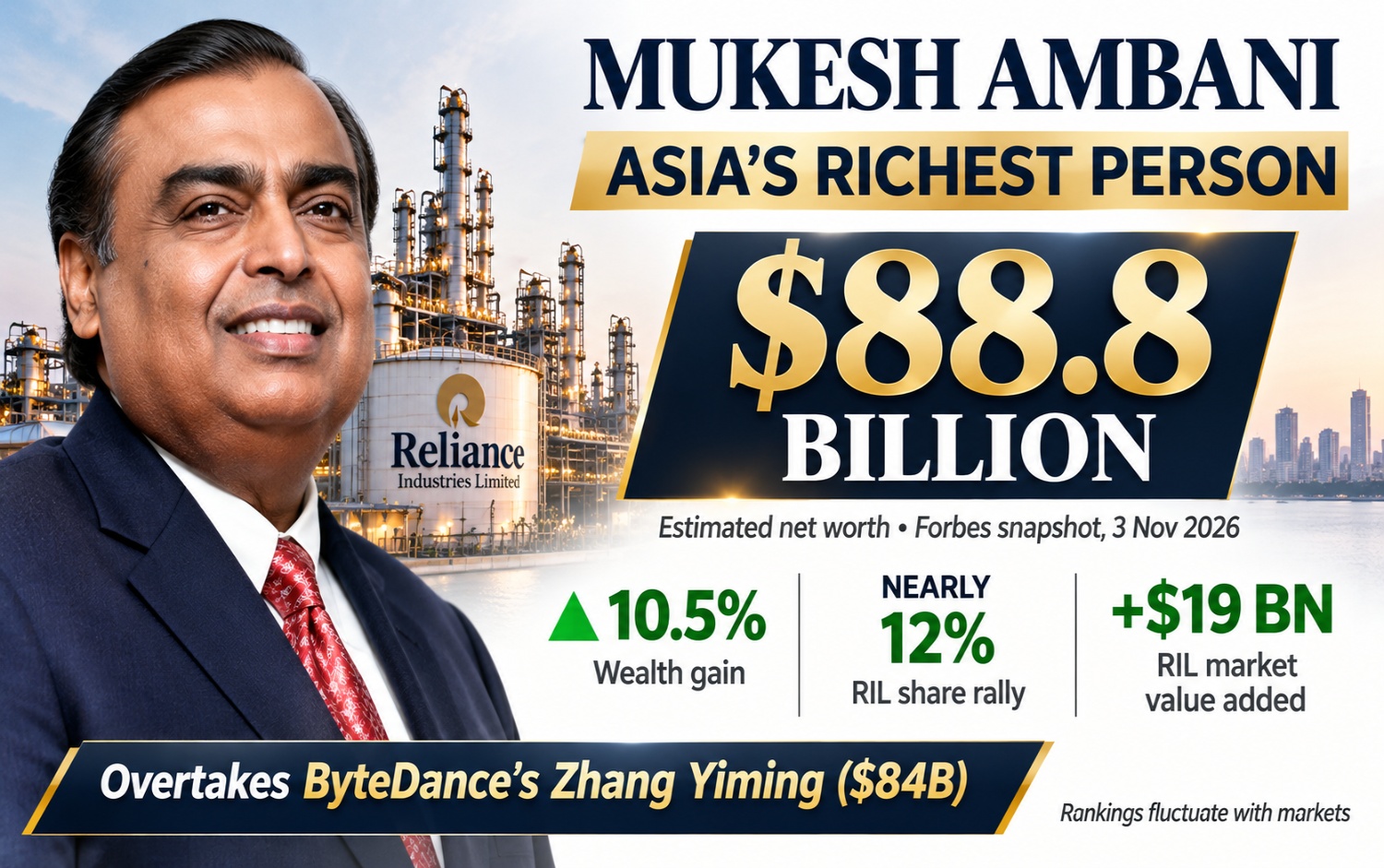
Reliance Shares Jump 12% Mukesh Ambani Overtakes Zhang Yiming in Global Billionaire Rankings
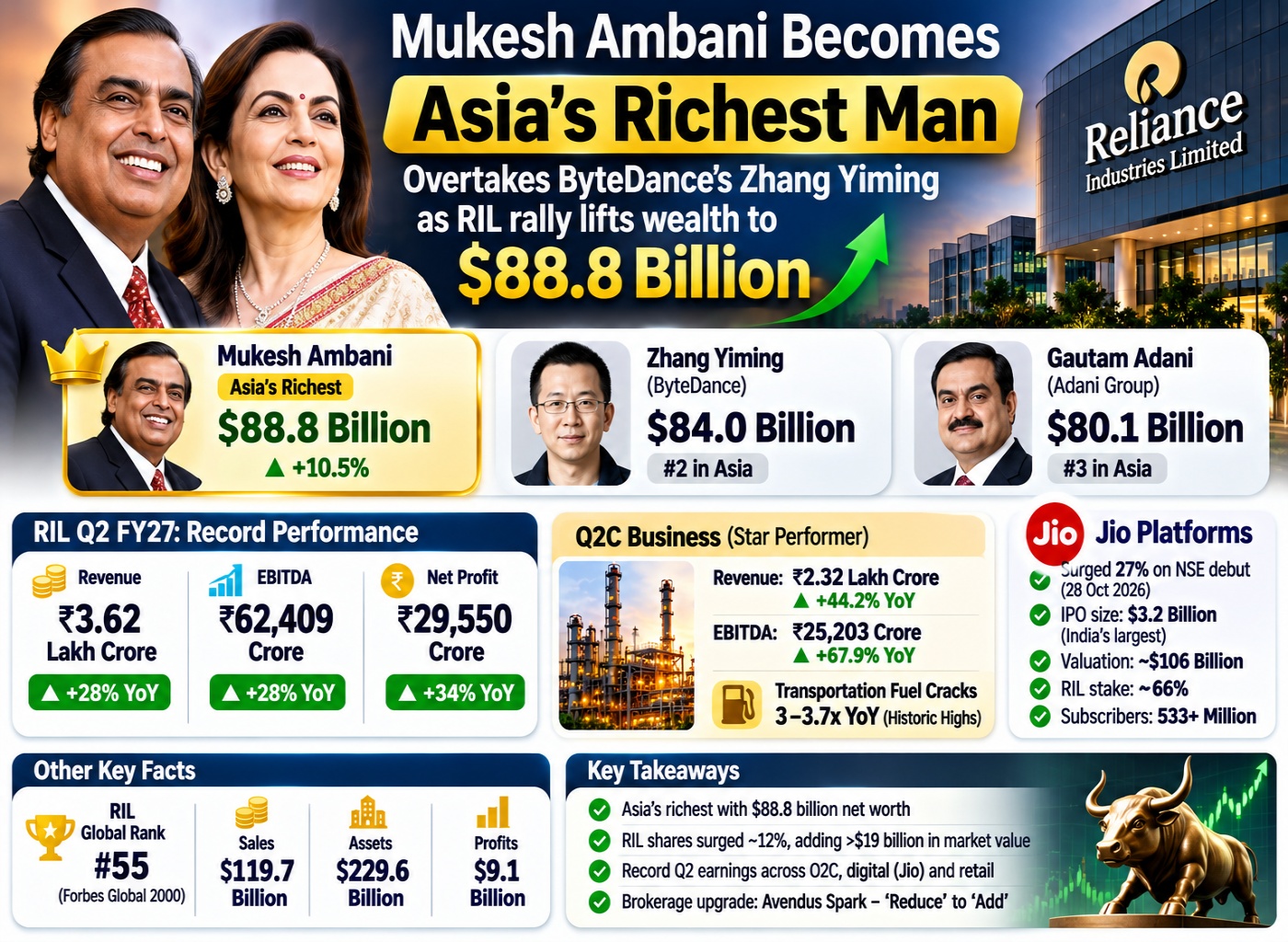
With a net worth of $88.8 billion, Ambani has moved ahead of Zhang Yiming, whose estimated fortune stands at $84 billion. Ambani is ranked 22nd globally, while Yiming occupies the 25th position.
Adani Group Chairman Gautam Adani is ranked 26th, with an estimated net worth of $80.1 billion.
The latest rankings underline the growing influence of India’s largest business groups and their performance in the stock market.
| Billionaire | Estimated net worth |
|---|---|
| Mukesh Ambani | $88.8 billion |
| Zhang Yiming | $84 billion |
| Gautam Adani | $80.1 billion |
-
Ambani’s wealth increased approximately 10.5%.
-
His reported wealth gain was around $8.5 billion.
-
Zhang Yiming slipped behind him in the Asian rankings.
-
Gautam Adani was also among the world’s 30 richest individuals.
Reliance Industries Q2 Results Deliver Record Quarterly Performance
The biggest trigger behind the Reliance Industries share price rally was its strong Q2 FY27 earnings performance. The company delivered record revenue, EBITDA and net profit for the July–September quarter.
Here are the key financial highlights:
-
Consolidated revenue: Increased 27.8% year-on-year to ₹3.62 lakh crore.
-
EBITDA: Rose 23.9% to a record ₹62,409 crore.
-
Net profit: Jumped 33.8% to ₹29,550 crore.
-
Capital expenditure: Stood at ₹38,153 crore during the quarter.
The results reflect strong contributions from Reliance’s oil-to-chemicals (O2C), digital services and retail businesses.
The O2C business remained a major growth driver. Its revenue increased 44.2% year-on-year to ₹2.32 lakh crore, while EBITDA surged 67.9% to ₹25,203 crore.
Transportation fuel cracks, which indicate refining profitability, increased three to 3.7 times compared with the previous year. This supported the company’s refining margins and overall profitability.
Track Live : Nifty Levels Today | Sensex Levels Today
Reliance Industries shares record their biggest rally in years
Reliance Industries shares witnessed a remarkable rally on Monday, November 2, 2026.
The stock gained approximately 11.6%, closing at around ₹1,300 on the NSE. This was its biggest single-day gain since April 2020, according to market reports.
The rally added approximately ₹1.83 lakh crore to Reliance’s market capitalisation, taking its total market value close to ₹17.6 lakh crore.
-
Share price gain: 11.6%.
-
Closing price: approximately ₹1,300.
-
Additional market capitalisation: approximately ₹1.83 lakh crore.
-
Market capitalisation after rally: approximately ₹17.57 lakh crore.
Jio Platforms Listing Adds Another Growth Trigger for Reliance
Another important development supporting Reliance’s market valuation was the stock market debut of Jio Platforms on October 28.
Jio Platforms surged 27% on its NSE trading debut following its record $3.2 billion IPO. The listing valued the digital and telecommunications business at approximately $106 billion at its IPO price.
Reliance Industries holds around 66% of Jio Platforms, making the listing an important value-unlocking opportunity for its parent company.
Jio is also India’s largest mobile operator, with more than 533 million subscribers as of June. Its market debut has strengthened investor interest in Reliance’s digital business and future growth opportunities.
Read More : Capital Gains Tax Relief for Foreign Investors? What SEBI Has Proposed Before the Budget
Jio Platforms began trading on the NSE and BSE on October 28, 2026, following its IPO.
The IPO became India’s largest public offering, raising approximately $3.2 billion.
| IPO indicator | Details |
|---|---|
| IPO proceeds | Approximately $3.2 billion |
| IPO valuation | Approximately $106 billion |
| Listing date | October 28, 2026 |
| Debut-day gain | Approximately 27% |
| Reliance’s reported stake | Approximately 66% |
Jio shares closed at ₹1,417.50 against an IPO price of ₹1,119, giving the stock a roughly 26.7% listing-day gain. Its market capitalisation reached approximately $137 billion after the debut.
Reliance Industries Q2 FY27 results: Record-breaking financial performance
Reliance Industries announced its Q2 FY27 financial results on October 30, 2026, for the quarter ended September 30, 2026.
The company delivered record quarterly gross revenue, EBITDA and profit after tax.
| Financial indicator | Q2 FY27 | YoY growth |
|---|---|---|
| Gross revenue | ₹3,62,268 crore | 27.8% |
| EBITDA | ₹62,409 crore | 23.9% |
| EBITDA margin | 17.2% | Down 60 bps |
| Profit after tax, including JVs | ₹29,550 crore | 33.8% |
| Capital expenditure | ₹38,153 crore | — |
| Net debt | ₹1,17,140 crore | — |
What do these financial numbers indicate?
There are three important takeaways:
-
Revenue growth: Gross revenue increased 27.8%, indicating substantial growth in the company’s overall business.
-
Operating profitability: EBITDA increased 23.9%, showing that operating earnings expanded significantly.
-
Profit growth: Profit after tax, including associates and joint ventures, increased 33.8%, faster than revenue growth.
However, there is one detail investors should not overlook: EBITDA margin declined from 17.8% to 17.2%. This means the company generated higher absolute operating earnings, but its overall EBITDA margin was slightly lower year-on-year.
Oil-to-Chemicals business becomes the biggest earnings driver
The Oil-to-Chemicals (O2C) business was one of the biggest contributors to Reliance Industries’ impressive quarterly performance.
The segment benefited from stronger refining margins, higher transportation fuel prices and improved petrochemical margins.
| O2C financial indicator | Q2 FY27 |
|---|---|
| Revenue | ₹2,32,000 crore approximately |
| Revenue growth | 44.2% |
| EBITDA | ₹25,203 crore |
| EBITDA growth | 67.9% |
The most significant development was the sharp increase in transportation fuel cracks.
What impact could this have on investors?
The latest rally could keep Reliance Industries shares in focus during upcoming trading sessions. Strong earnings and improved analyst sentiment may support further investor interest.
For traders, the sharp 12% move could also bring profit-booking and volatility, particularly after such a strong rally.
For long-term investors, the performance of O2C, Jio, retail and New Energy businesses will remain important factors when assessing Reliance’s growth outlook.
However, investors should avoid judging the stock solely by Mukesh Ambani’s billionaire ranking. His wealth is closely linked to Reliance’s shareholding value, while investment decisions should depend on earnings growth, valuations and future business performance.