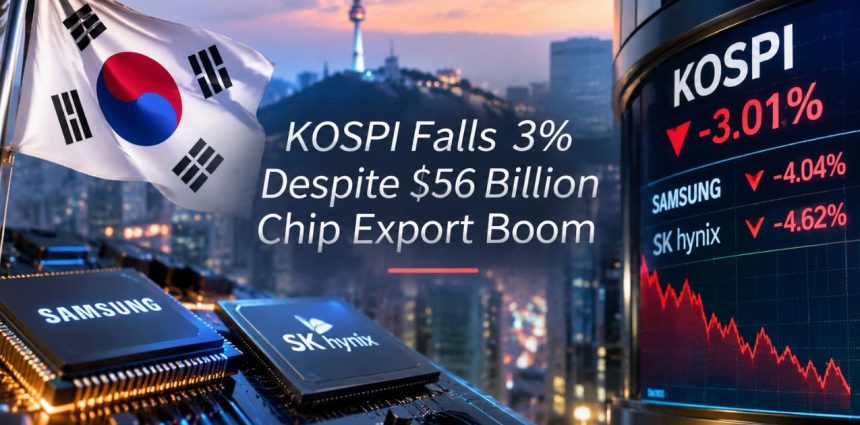
South Korea’s semiconductor exports surged 259% in October, but renewed concerns over AI investment returns triggered selling in Samsung Electronics and SK Hynix despite exceptional quarterly operating results.
South Korean shares faced renewed selling pressure on Tuesday, November 3, as concerns over the returns from massive artificial intelligence (AI) investments weighed on global technology stocks. The weakness hit semiconductor heavyweights Samsung Electronics and SK Hynix, reversing much of the previous session’s recovery despite strong third-quarter operating results and booming semiconductor exports.
The benchmark KOSPI stood at 5,682.59, down 176.49 points, or 3.01%, in an early-session snapshot around 9:30 a.m. South Korean time, according to Aju Press. Samsung Electronics declined 4.04% to KRW 219,750, while SK hynix fell 4.62% to KRW 1,404,000. Reuters subsequently reported that South Korean shares had fallen as much as 4.1% during Asian trading, highlighting the volatility of the session.
Foreign investors were net sellers of KRW 388.1 billion worth of South Korean equities, while institutional investors sold KRW 308.2 billion. Domestic retail investors bought shares worth KRW 670.4 billion, partially absorbing the selling pressure.
The decline came against an exceptionally strong semiconductor backdrop. South Korea’s October semiconductor exports jumped 259.4% year-on-year to $56.44 billion, accounting for almost half of the country’s total exports. Samsung and SK Hynix had also reported substantial increases in quarterly operating profit.
The contrasting developments highlight the growing disconnect between semiconductor earnings and stock-market sentiment. Investors are increasingly questioning whether enormous investments in AI infrastructure will generate enough sustainable revenue and cash flow to justify technology-sector valuations.
Track Live: GIFT Nifty Live – Today Price, Chart, Timings and Nifty Opening Signal
Key Highlights
- KOSPI: Fell 3.01% to 5,682.59 in the reported 9:30 a.m. KST snapshot.
- Samsung Electronics: Declined 4.04% to KRW 219,750.
- SK Hynix: Fell 4.62% to KRW 1,404,000.
- Foreign investors: Net sellers of KRW 388.1 billion.
- Institutional investors: Net sellers of KRW 308.2 billion.
- Retail investors: Net buyers of KRW 670.4 billion.
- October semiconductor exports: Surged 259.4% to $56.44 billion.
- SK Hynix Q3 operating profit: Increased 38% sequentially to KRW 83.33 trillion, although net income declined 58%.
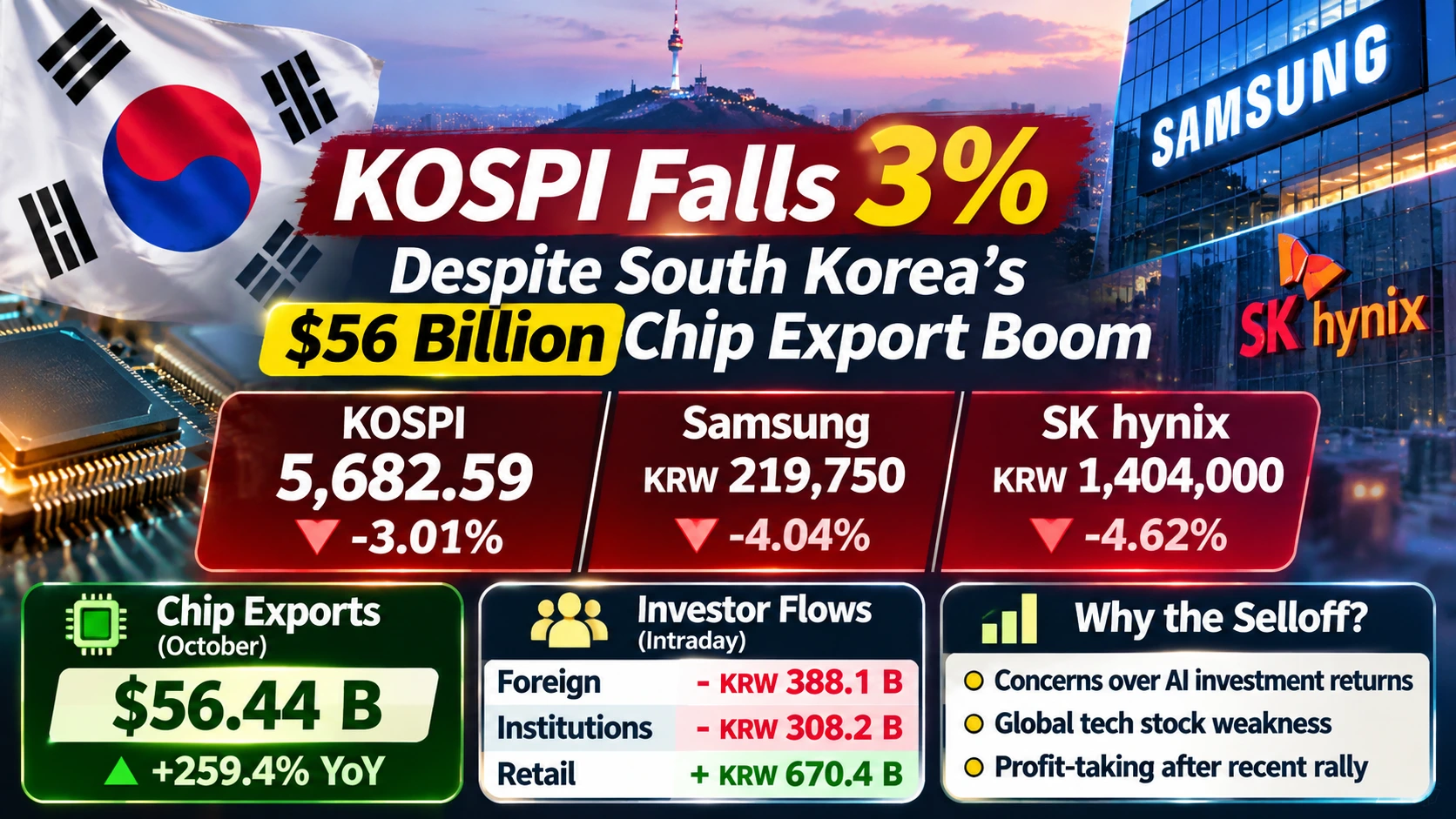
Market prices and investor flows above are intraday figures, not closing data.
KOSPI Reverses Monday’s Recovery as Foreign Selling Returns
Tuesday’s decline came just one session after the KOSPI registered a strong recovery.
On Monday, November 2, the benchmark gained 128.34 points, or 2.24%, to close at 5,859.08. Institutional investors purchased approximately KRW 1.23 trillion worth of shares, helping Samsung Electronics and SK hynix advance 1.78% and 3.81%, respectively.
However, the recovery proved fragile as global technology-sector weakness returned.
The KOSPI opened Tuesday at 5,715.19, down 2.46%, before extending its losses. Around 9:30 a.m. in Seoul, the index had fallen to 5,682.59, declining 3.01%. Reuters separately reported that South Korean shares had fallen as much as 4.1% during Asian trading.
Selling pressure extended well beyond semiconductor heavyweights. In the early-session market snapshot, 649 stocks declined against 197 advancing. This indicated broader weakness across the South Korean equity market rather than an isolated correction in Samsung Electronics and SK hynix.
Investor positioning added another dimension to the session. Foreign investors and institutions were net sellers, while retail investors were buying shares. The KRW 670.4 billion in retail purchases indicated that domestic investors were absorbing some of the institutional and overseas selling, although that demand was insufficient to prevent the index from declining.
The reversal is significant because Monday’s recovery had attracted substantial institutional buying. Tuesday’s renewed weakness suggests that investors remained reluctant to increase exposure while uncertainty around global technology valuations persisted.
Samsung and SK hynix Face Selling Despite Strong Q3 Operating Results
The sharp decline in semiconductor stocks is particularly notable because both companies had recently announced exceptional quarterly operating performance.
Samsung Electronics reports KRW 107.4 trillion operating profit
Samsung Electronics reported consolidated revenue of KRW 195.3 trillion for the third quarter of 2026, up 14% quarter-on-quarter. Consolidated operating profit reached KRW 107.4 trillion, making it the company’s highest quarterly operating profit.
Its semiconductor-focused Device Solutions (DS) division generated KRW 147.1 trillion in revenue and KRW 106.5 trillion in operating profit.
Samsung’s Memory Business also recorded its highest-ever quarterly revenue and operating profit, supported by strong server demand, higher memory prices and increased sales of AI-related products.
However, performance was not uniform across the company. Samsung’s Device eXperience (DX) division reported an operating loss of KRW 0.8 trillion, despite an increase in revenue from the previous quarter.
The results reflect the importance of the semiconductor business to Samsung’s current earnings performance. The company also expects AI infrastructure investment to remain strong in 2027 and sees AI-driven memory demand continuing to expand.
SK hynix delivers strong operating growth, but net income declines
SK hynix reported third-quarter revenue of KRW 104.6155 trillion, an increase of 32% sequentially and 328% year-on-year. Operating profit rose 38% quarter-on-quarter to KRW 83.3338 trillion, representing an operating margin of approximately 80%.
However, net income moved in the opposite direction on a sequential basis.
SK hynix reported net income of KRW 39.7756 trillion, down approximately 58% from KRW 93.9226 trillion in the second quarter. Despite the sequential decline, net income remained 216% higher year-on-year.
The distinction is important. Revenue and operating profit continued to expand, even as the quarterly movement in net income was significantly weaker. The second-quarter comparison also started from an unusually high net margin of 118%, compared with 38% in the third quarter. The sequential decline should therefore not be interpreted as an equivalent deterioration in the company’s core operating performance.
SK hynix also reported substantial forward demand visibility. Long-term agreements with 14 major customers, including leading cloud service providers, cover more than 50% of its production capacity for 2027 and 2028.
The company expects HBM4 to become its mainstream product in the fourth quarter of 2026 and plans to ramp up its M15X facility to maximum capacity by year-end to support increasing demand.
SK hynix Expects Memory Supply-Demand Imbalance to Continue Through 2030
One of the most important developments in SK hynix’s latest earnings announcement is its long-term outlook for the global memory market.
The company expects the memory supply-demand imbalance to persist through 2030, citing the growing complexity of advanced semiconductor manufacturing and the considerable time required to expand production capacity.
Rising demand for high-bandwidth memory (HBM), advanced DRAM and other high-performance memory products is increasing the need for specialised manufacturing facilities.
SK hynix is preparing to expand production capacity to meet this demand. Its plans include ramping up the M15X facility to maximum capacity by the end of 2026 to increase HBM4 production.
The company believes demand from AI data centres, enterprise AI adoption and emerging applications such as autonomous driving and robotics could sustain pressure on memory supply.
For investors, this creates an important contrast with the latest stock-market reaction. While short-term concerns about AI investment returns are weighing on semiconductor valuations, manufacturers are preparing for what they expect to be a prolonged period of strong demand.
However, the 2030 outlook remains the company’s assessment rather than a guaranteed industry outcome. Changes in AI infrastructure spending, memory pricing, competition and future capacity additions could alter the supply-demand balance.
South Korea’s October Semiconductor Exports Surge 259%
The latest government trade figures provide further evidence of the strength of South Korea’s semiconductor industry.
According to the Ministry of Trade, Industry and Resources, total exports increased 93.7% year-on-year to $115.28 billion in October 2026.
Semiconductor exports reached $56.44 billion, surging 259.4% from the previous year. They accounted for approximately 49% of the country’s total export value.
The growth extended beyond semiconductor shipments. Computer exports increased 496.6% year-on-year to $5.85 billion, reflecting stronger demand for AI-related server infrastructure and server solid-state drives (SSDs).
Cumulative exports between January and October reached $930 billion, while the October trade surplus stood at $42.50 billion.
These figures demonstrate that the AI infrastructure investment cycle is supporting several parts of South Korea’s export economy, including memory chips, server storage and related technology products.
The export performance also provides an important counterpoint to the market’s weakness. There is little indication in these figures of an immediate collapse in semiconductor demand. Instead, investors appear to be reassessing how much future growth and profitability should already be reflected in share prices.
Explore FII-DII data and institutional positioning.
Wall Street’s AI Selloff Adds Pressure to Asian Semiconductor Stocks
The weakness in Seoul followed another difficult session for US technology shares.
On Monday, November 2, the Nasdaq Composite declined 1.07% to 25,164.32, while the S&P 500 fell 0.51% to 7,541.40. The Dow Jones Industrial Average moved in the opposite direction, gaining 0.41% to close at 51,983.98.
The technology-led weakness reflected investor concerns over the financing requirements and expected returns from large-scale AI infrastructure investment.
Oracle declined 8.8% after announcing plans to raise around $20 billion through debt and share sales. Intel fell 8.83%, while AMD declined 7.52% and Micron Technology lost 5.80%.
The scale of planned AI investment remains enormous. Goldman Sachs analysts estimate that major US hyperscalers are on track to spend approximately $800 billion on capital expenditure in 2026, with spending projected to reach around $1.2 trillion in 2027.
This spending is creating opportunities for semiconductor suppliers, data-centre operators and infrastructure companies. However, investors are increasingly evaluating whether future AI-related revenue and cash flows will justify the investment.
The weakness also extended across other Asian technology markets. Reuters reported that Taiwan’s Taiex declined 3.3%, while the MSCI Asia-Pacific index excluding Japan fell 1.4% in its regional market snapshot.
For South Korea, the concentration of semiconductor leaders in its benchmark index has made the market particularly sensitive to changes in global technology sentiment.
Apple Highlights the Other Side of Rising Memory Prices
Rising semiconductor prices are not necessarily positive for every company in the technology supply chain.
Apple’s latest results provided an example of how higher memory costs could affect major hardware manufacturers.
Although Apple reported stronger-than-expected quarterly results, it forecast a December-quarter gross margin of 45% to 46%, below the 47.9% reported for the September quarter.
The company cited rising memory-chip costs as one of the factors behind the expected margin pressure. It also projected services revenue growth of 8% to 9%, below analysts’ expectations.
This creates a different earnings impact across the semiconductor supply chain. Higher memory prices can improve revenue and margins for suppliers such as Samsung and SK hynix, but they increase component costs for major technology customers.
For investors, the important question is whether semiconductor manufacturers can sustain higher prices without creating significant cost pressure for the companies purchasing their products.
Won Remains Broadly Stable as Oil Markets Turn Uncertain
The South Korean currency offered little directional support during the reported early-session trading.
The won was quoted at approximately KRW 1,344 per US dollar, compared with its previous close of KRW 1,343.8. The small movement indicated that the currency was broadly stable rather than extending the earlier appreciation reported in a different market snapshot.
Oil markets presented a more uncertain global backdrop.
Brent crude prices fell more than 7% on Monday after discussions involving Iranian and Qatari officials raised hopes of diplomatic progress towards ending the Middle East conflict.
However, reports of US strikes on Iran added fresh uncertainty. Reuters reported that a US official confirmed the strikes. Brent crude subsequently recovered around 0.5% to $105.30 in early Asian trading on Tuesday.
The movement in oil prices matters for Asian economies that rely heavily on imported energy. Any renewed escalation around the Strait of Hormuz could increase concerns over energy supplies, inflation and corporate costs.
Consequently, the earlier decline in crude prices should not yet be treated as a dependable supportive factor for global equities.
What Investors Will Watch Next
The immediate focus for semiconductor stocks remains on global AI infrastructure investment and the financial returns generated by that spending.
Upcoming earnings updates and capital expenditure guidance from major US technology companies will help determine whether aggressive AI investment plans remain intact.
For Samsung Electronics and SK hynix, investors will monitor HBM4 shipments, memory pricing, production expansion and the ability to convert strong demand into sustainable earnings and cash flows.
The key uncertainty is whether AI infrastructure spending will continue to expand at the pace currently expected. Any moderation in cloud-company investment, weaker memory pricing or delays in data-centre expansion could increase volatility across semiconductor stocks, even if underlying demand remains strong.
Bottom Line
South Korea’s latest stock-market weakness highlights the growing gap between semiconductor fundamentals and investor expectations.
October chip exports surged 259.4%, Samsung reported record consolidated operating profit, and SK hynix recorded strong sequential growth in revenue and operating profit. The company also expects tight memory supply conditions to persist through 2030.
Yet those developments have not prevented renewed selling as global investors reassess AI infrastructure spending, technology valuations and the sustainability of future returns.
The next phase of the semiconductor rally may depend less on how quickly AI investment grows and more on whether that spending generates sufficient revenue, margins and cash flow. Until there is greater clarity, Samsung, SK hynix and other technology-linked stocks could remain sensitive to changes in global risk appetite.
Read Next: ITC Q2 FY27 Results: Profit Falls 18.5%; FMCG Revenue Growth Hits a 14-Quarter High
Disclaimer: This article is for informational and educational purposes only and does not constitute investment advice. Global market movements, geopolitical developments and semiconductor-sector volatility may affect stock prices. Investors should assess their risk tolerance and consult a qualified financial adviser before making investment decisions.