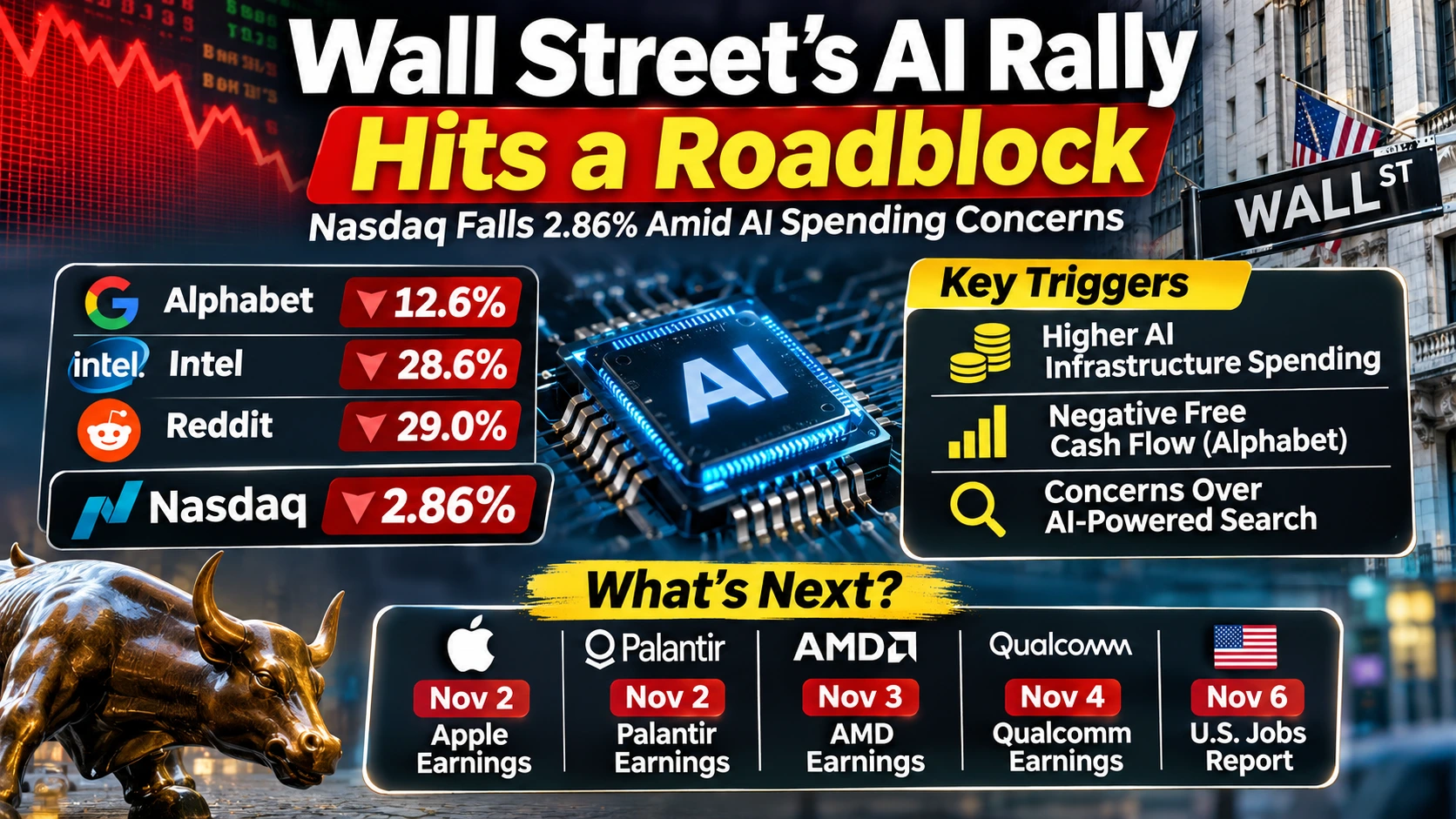
Wall Street’s AI-driven rally faces a crucial test in November after the Nasdaq Composite fell 2.86% on October 30, Alphabet shares plunged 12.6%, Intel crashed 28.6% and Reddit lost 29%. The selloff reflects growing concerns over AI infrastructure spending, negative free cash flow, weaker forecasts and the threat of AI-powered search to existing internet businesses.
However, cloud demand and corporate earnings remain strong. Apple and Palantir results on November 2, followed by AMD and Qualcomm earnings, could determine whether technology stocks stabilise or face another round of selling.
Track Live: GIFT Nifty Live – Today Price, Chart, Timings and Nifty Opening Signal
Need to Know
- Nasdaq selloff: The Nasdaq Composite fell 2.86% to 25,437 on October 30, while the S&P 500 declined 1.82% and the Dow lost 1.09%.
- Alphabet’s cash-flow warning: Google Cloud revenue surged 103%, but quarterly free cash flow turned negative at $9.065 billion.
- Amazon’s AI spending: Trailing 12-month free cash flow reached a negative $42.4 billion as infrastructure investment accelerated.
- Intel and Reddit: Intel plunged 28.6% after issuing weaker Q4 guidance, while Reddit dropped 29% as concerns over Google AI search referrals intensified.
- November catalysts: Apple and Palantir report on November 2, AMD on November 3, Qualcomm on November 4 and the US October employment report on November 6.
Nasdaq Falls 2.86% as AI Spending Fears Spread Across Technology Stocks
Wall Street’s technology-led rally came under renewed pressure on Friday, October 30, as investors reassessed the financial returns from the artificial intelligence investment boom.
The Nasdaq Composite declined 747.73 points, or 2.86%, to close at 25,437.00. The S&P 500 dropped 140.32 points, or 1.82%, to 7,580.07, while the Dow Jones Industrial Average lost 572.25 points, or 1.09%, to finish at 51,770.31.
The Nasdaq recorded its largest single-day percentage decline since June 5 and ended approximately 7.8% below its October 6 closing record.
Friday’s weakness extended across the semiconductor industry:
| Stock or index | October 30 change |
|---|---|
| Intel | -28.6% |
| AMD | -10.9% |
| Nvidia | -4.2% |
| Philadelphia Semiconductor Index | -7.2% |
| Nasdaq Composite | -2.86% |
| S&P 500 | -1.82% |
| Dow Jones | -1.09% |
The selloff followed quarterly results and outlooks from major technology companies. Investors became increasingly concerned about the amount of capital required to build AI infrastructure and the time needed for those investments to generate sufficient returns.
However, the weakness does not mean that corporate earnings have broadly collapsed. Reuters reported that 82% of the 299 S&P 500 companies that had reported third-quarter results had beaten analyst expectations, while analysts were forecasting earnings growth of approximately 31.6%.
The developing market concern is increasingly about valuations, cash generation and the sustainability of earnings growth rather than the absence of AI demand.
Track Live: NSE Option Chain — Live | BSE Option Chain — Live Sensex & Bankex Options Data Today
Alphabet’s 12.6% Crash Exposes the Cost of Its AI Infrastructure Expansion
Alphabet became one of the biggest sources of concern after its shares plunged 12.6% on Thursday, October 29, marking their worst single-day decline in more than 20 years, according to the Associated Press.
The market reaction came despite strong revenue and operating performance.
Alphabet reported the following Q3 2026 results:
| Financial metric | Q3 FY2026 |
|---|---|
| Consolidated revenue | $127.58 billion |
| Revenue growth | 25% |
| Google Services revenue | $96.30 billion |
| Google Cloud revenue | $30.71 billion |
| Google Cloud growth | 103% |
| Operating income | $40.58 billion |
| Operating income growth | 30% |
| Net income available to common stockholders | $26.17 billion |
Google Cloud’s performance highlighted the strength of enterprise AI demand. Revenue from the business increased 103% year-on-year, reaching $30.71 billion.
However, the company’s investment spending created a different picture for cash generation.
Alphabet spent approximately $51.36 billion on property and equipment during the September quarter. Operating cash flow was $42.29 billion, resulting in a negative quarterly free cash flow of $9.065 billion.
This is compared with a positive free cash flow of approximately $24.46 billion in Q3 FY2025. Trailing 12-month free cash flow, however, remained positive at approximately $19.75 billion.
The distinction is important: Alphabet experienced a quarterly cash-flow reversal, not an established collapse in its overall trailing cash generation.
Another financial development was the decline in net income available to common stockholders. It fell approximately 25.2% to $26.17 billion despite operating income increasing 30%.
This decline was largely influenced by a reversal in other income and expense. Alphabet recorded a $12.76 billion gain in the year-ago quarter, compared with an $8.22 billion expense in Q3 FY2026, mainly reflecting the swing in gains and losses on equity securities.
Consequently, the weaker net income figure should not be interpreted as a contraction in its core operating business.
The central expectation gap is that Google Cloud is expanding rapidly, but capturing that demand requires substantial infrastructure investment. Investors now need clearer evidence that the investment can translate into sustainable cash generation.
Amazon’s $220 Billion Spending Plan Raises Fresh Free-Cash-Flow Concerns
Amazon added another dimension to the technology selloff after reporting its third-quarter results on October 29.
The company delivered strong cloud growth, but its cash-flow position and holiday-quarter revenue outlook attracted investor attention.
Amazon reported:
| Financial metric | Q3 2026 |
|---|---|
| Net sales | $201.9 billion |
| Revenue growth | 12% |
| AWS revenue | $46.0 billion |
| AWS revenue growth | 39.3% |
| Operating income | $28.1 billion |
| Operating margin | 13.9% |
| Operating cash flow, TTM | $168.3 billion |
| Free cash flow, TTM | -$42.4 billion |
| Expected 2026 capital expenditure | Approximately $220 billion |
AWS recorded its fastest growth in nearly five years, reaching an annualised revenue run rate of approximately $184 billion.
However, Amazon’s trailing 12-month free cash flow turned negative at $42.4 billion, compared with positive free cash flow of $14.8 billion in the corresponding year-ago period.
The deterioration was primarily driven by an additional $94.8 billion in year-on-year property and equipment purchases, reflecting the company’s expanding AI infrastructure investments.
Amazon also maintained its approximately $220 billion capital expenditure expectation for 2026.
Its fourth-quarter revenue guidance of $240 billion to $247 billion was another concern. The midpoint of $243.5 billion was slightly below the analyst consensus estimate of $244.51 billion, according to LSEG data cited by Reuters.
This created a valuation challenge for investors. AWS continues to expand rapidly, but the wider company is spending heavily to build the infrastructure required to capture future AI demand.
Whether that expenditure eventually generates sufficient incremental earnings and cash flow remains a key question for the market.
Intel Crashes 28.6% Despite 78% Growth in Data Centre and AI Revenue
Intel was the biggest casualty of Friday’s semiconductor selloff.
Its shares plunged 28.6%, marking their worst single-day decline since 1974, according to market reporting by Reuters and the Associated Press.
The decline was particularly notable because Intel reported strong growth in its data-centre business.
Its Q3 2026 financial performance included:
| Financial metric | Q3 2026 |
|---|---|
| Revenue | $16.5 billion |
| Revenue growth | 21% |
| Data Center and AI revenue | $7.3 billion |
| Data Center and AI growth | 78% |
| Client Computing and Physical AI revenue | $8.1 billion |
| Client Computing and Physical AI growth | -5% |
The pressure emerged from the company’s forward outlook.
Intel projected fourth-quarter revenue of $15 billion to $16 billion, more than $1 billion below the analyst expectations reported by Reuters.
Management also indicated that weakness in the PC market could continue through the first half of 2027.
At the same time, the company highlighted supply constraints and the need to expand capacity to meet demand for its Xeon processor family.
Intel’s results therefore exposed an important distinction in the AI investment cycle: rising demand for data-centre processors does not automatically remove manufacturing constraints or weakness in traditional computing markets.
Reddit Falls 29% as Google AI Search Threatens Referral Traffic
Reddit’s selloff highlighted a different risk associated with artificial intelligence: AI-powered search could disrupt existing internet business models.
Reddit shares plunged approximately 29% on October 30 after the company warned that declining search referrals could affect future user growth.
The company’s Q3 financial performance was considerably stronger than its share-price reaction suggested.
| Reddit Q3 FY2026 metric | Reported performance |
|---|---|
| Revenue | $895 million |
| Revenue growth | 53% |
| Net income | $283 million |
| Global daily active uniques | 130.3 million |
| Global DAUq growth | 12% |
| US daily active uniques | 50.7 million |
| US DAUq growth | -2% |
| Adjusted EBITDA | $402 million |
| Free cash flow | $363 million |
Reddit CEO Steve Huffman attributed weaker search referrals partly to Google’s AI-powered search features.
According to Reuters, search-engine referrals to Reddit declined by more than one million on average each week during October.
US daily active unique visitors fell 2% year-on-year to 50.7 million, marking the first reported annual decline since Reddit’s 2024 IPO.
Management warned that total daily active unique visitors could decline by a low double-digit percentage in Q4 from approximately 130 million if search-referral weakness continued.
However, logged-in and app-based daily active users increased sequentially in the US and internationally.
The distinction is important. Reddit is still reporting strong global revenue and user growth, but its dependence on external search traffic creates a potential risk to future audience acquisition.
For technology investors, the episode also highlights how AI can generate new business opportunities while simultaneously disrupting companies built around existing internet traffic models.
AI Infrastructure Spending Is Rising Faster Than Investor Confidence
The latest results suggest that investors are beginning to differentiate between companies benefiting from AI demand and those capable of converting that demand into sustainable financial returns.
Alphabet’s Google Cloud growth, Amazon’s AWS expansion and Intel’s data-centre revenue indicate that the underlying demand for AI infrastructure remains significant.
However, the increasing cost of servers, data centres, networking equipment, electricity and computing capacity is adding pressure to corporate cash flows.
Goldman Sachs expects hyperscaler capital expenditure to reach approximately $800 billion in 2026 and rise further to $1.2 trillion in 2027.
At the same time, the bank expects S&P 500 earnings growth to slow from nearly 30% in 2026 to approximately 18% in 2027, according to Reuters’ November 2 market report.
This creates a potential mismatch between investment expectations and future earnings growth.
If infrastructure spending continues accelerating while earnings growth moderates, investors could become less willing to pay premium valuations for technology companies.
That does not necessarily mean the AI investment cycle is ending. It does suggest that the market may become more selective about which companies can demonstrate measurable returns from their investments.
Nasdaq Outlook: Apple, Palantir and AMD Earnings in Focus This Week
The November 2–6 trading week brings several important corporate and economic events that could influence technology stocks.
November 2 – Apple Q4 FY2026 results
Apple is scheduled to report its fourth-quarter fiscal 2026 results on Monday.
Reuters cited analyst expectations of approximately $2 in earnings per share on revenue of around $113 billion.
Investors will monitor iPhone 18 demand, rising memory costs, the company’s AI strategy and management’s holiday-quarter outlook.
Apple’s relatively lighter direct data-centre investment compared with major hyperscalers makes its results an important comparison for the market. However, rising component costs could still affect its margins.
November 2 – Palantir Q3 FY2026 results
Palantir is scheduled to release its third-quarter results after the US market closes, followed by an earnings webcast at 5 p.m. ET.
Investors will look for commercial AI demand, revenue growth and management’s outlook for enterprise software spending.
Its results could offer another perspective on whether companies are translating AI adoption into measurable commercial growth.
November 3 – AMD Q3 FY2026 results and US general election
AMD is scheduled to report its fiscal third-quarter results after Tuesday’s market close.
Its revenue performance, data-centre business and AI accelerator demand will be important indicators for semiconductor sentiment.
The US federal general election is also scheduled for November 3. Investors may monitor policy signals around technology regulation, infrastructure and energy, although the immediate market impact remains uncertain.
November 4 – Qualcomm Q4 FY2026 results
Qualcomm will release its fourth-quarter and fiscal 2026 results after Wednesday’s market close.
Investors will watch smartphone demand, processor margins, AI-enabled devices and its expansion into other computing markets.
November 6 – US October employment report
The US Bureau of Labor Statistics is scheduled to release the October Employment Situation report at 8:30 a.m. Eastern Time on Friday.
The employment figures could influence expectations around Federal Reserve policy, Treasury yields and financing costs for capital-intensive technology companies.
Together, these events will provide fresh evidence on corporate demand, AI monetisation and the economic environment facing technology businesses.
Monday Market Update: US Futures Recover Ahead of Apple’s Earnings
There were early signs of stabilisation on Monday, November 2, following Friday’s sharp selloff.
Reuters reported that Asian equity markets rebounded and US equity futures moved higher as investors looked ahead to Apple’s earnings.
In Reuters’ early Monday market snapshot, published at 00:41 UTC (06:11 IST):
- S&P 500 futures gained approximately 0.5%.
- Nasdaq futures advanced approximately 0.9%.
- Brent crude fell 3.3% to $109.70 a barrel.
- US crude declined 3.4% to $100.58 a barrel.
These are timestamped early-session figures, not live market quotes.
The futures recovery suggests that buyers have not completely abandoned technology stocks. However, it does not establish that Friday’s selloff has ended.
The market still faces questions around AI capital expenditure, cash-flow pressure, semiconductor supply and the pace of future earnings growth.
Is the Worst Over for AI-Driven Technology Stocks?
The November outlook for technology shares will depend on whether companies can demonstrate that their AI investment is generating sufficient financial returns.
Three developments deserve particular attention.
First, hyperscalers need to show that rising demand for cloud computing and AI services can translate into sustainable operating profits and free cash flow.
Second, semiconductor companies must demonstrate that AI demand can support earnings without being offset by manufacturing constraints, rising memory costs or weaker traditional computing demand.
Third, internet platforms and digital businesses need to show that AI-powered search and automation will not materially weaken their customer acquisition channels or existing revenue models.
The upcoming Apple, Palantir, AMD and Qualcomm results could help investors distinguish between temporary sentiment pressure and more persistent earnings risks.
However, one positive trading session or a strong earnings release may not be enough to reverse the broader market trend.
Bottom Line
The latest Nasdaq selloff has exposed the financial challenges building beneath the AI investment boom. Alphabet’s quarterly free-cash-flow reversal, Amazon’s negative trailing 12-month free cash flow, Intel’s weaker outlook and Reddit’s search-referral concerns represent different risks across the technology sector.
At the same time, strong cloud growth, rising enterprise AI demand and robust corporate earnings show that the underlying AI opportunity remains significant.
The market’s expectation is changing: investors increasingly want evidence of monetisation, cash generation and sustainable returns rather than capital-spending announcements alone.
Until that evidence becomes clearer, AI-linked technology stocks could remain vulnerable to sharp price swings, even as demand for artificial intelligence continues to expand.
Read Next: Stocks to Watch Today, Nov 2: RIL, Jio, Maruti, Affle, Coal India in focus
Disclaimer: This article is for informational and educational purposes only and does not constitute investment advice. Technology stocks carry valuation, earnings, cash-flow, interest-rate and business-model risks. Investors should conduct independent research and assess their risk tolerance before making investment decisions.