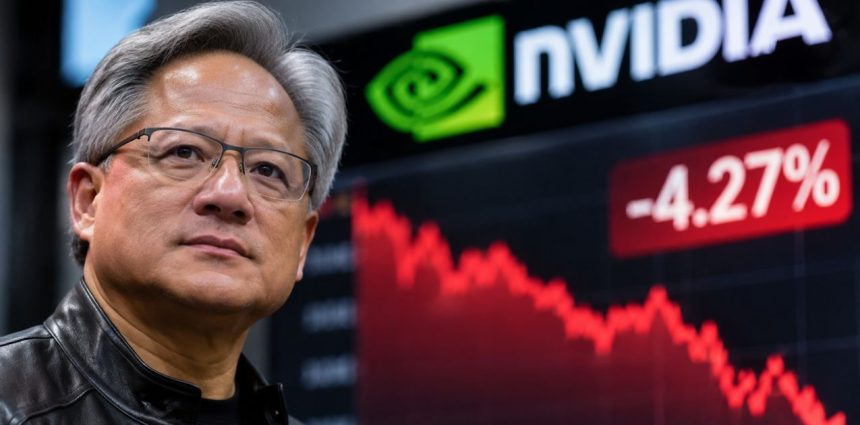
Nvidia shares fell 4.27% to $178.67 on Monday, November 9, wiping approximately $190 billion off the company’s market value. The decline followed the board’s decision to investigate reports that CEO Jensen Huang had been targeted by a foreign intelligence effort. Investors are now watching the investigation, congressional scrutiny and potential implications for Nvidia’s semiconductor business and US-China technology relations.
The controversy has put the leadership of the world’s most valuable AI chipmaker under scrutiny at a sensitive moment for the artificial intelligence industry. Huang has been central to Nvidia’s rise, leading its transformation into a major supplier of processors powering AI data centres worldwide.
However, the investigation does not establish that Huang knowingly participated in any intelligence operation or that Nvidia’s confidential information was compromised. The board is examining reports that he may have been targeted by a foreign intelligence effort.
Track Live: NIFTY50, SENSEX, GIFT NIFTY, FII DII DATA | NIFTYTRADER
Why Nvidia Shares Fell: What Triggered the Investigation?
Nvidia announced on November 8 that its board had initiated an independent investigation following reports that Huang had been targeted by a foreign intelligence effort.
The development followed a New York Times report linking Huang to Alice Huang, an unrelated former executive of Singapore-based company Megaspeed. According to the newspaper’s reporting, US intelligence officials believed Alice Huang was a Chinese intelligence asset who had passed information to Beijing.
The allegations have drawn additional attention because Megaspeed has also been associated with concerns about China’s potential access to advanced Nvidia AI processors restricted under US export controls.
Separately, Huang told Nvidia employees that he had been unfaithful to his wife, without disclosing details of the relationship.
China’s Foreign Ministry rejected the allegations on November 9. Spokesperson Guo Jiakun described the so-called Chinese spy allegation as groundless and a smear against China.
The competing positions have added uncertainty to the controversy. The intelligence allegations have not been independently established, and Nvidia’s board has not reported any compromise of company secrets or US national security.
Nvidia Board Launches Independent Investigation and Backs Huang
Nvidia’s board appointed a committee of independent directors, assisted by outside independent legal counsel, to oversee the investigation.
In its November 8 statement, the company said the board had no reason to believe that either US national security or Nvidia’s confidential information had been compromised. However, the inquiry would examine all available information.
Huang has agreed to cooperate fully with the investigation. The board also expressed confidence in him and his leadership team.
This distinction is important for shareholders. Nvidia has not announced Huang’s suspension, removal or resignation. He remains committed to leading the company while the investigation continues.
Trump Says FBI Is Looking Into Allegations Against Huang
The controversy acquired an additional political dimension on November 9 after US President Donald Trump confirmed that he had spoken directly with Huang.
Trump said he had asked the Nvidia CEO whether he knew the woman was allegedly a spy. According to Trump, Huang told him that he had no idea about her alleged intelligence links.
Trump also said the FBI was looking into the matter, although he did not provide details about the scope of any federal inquiry.
The president expressed confidence in Huang and said he believed the CEO’s explanation.
The comments have added to the broader debate surrounding Washington’s semiconductor policy. Nvidia is a central player in the US artificial intelligence industry, while its ability to sell advanced processors to Chinese customers remains a sensitive political and regulatory issue.
US Lawmakers Request Jensen Huang Briefing for November 18
Congressional scrutiny had already begun before Nvidia announced its board investigation.
In a press release dated November 5, the House Foreign Affairs Committee announced that Chairman Brian Mast, Select Committee on China Chairman John Moolenaar and House Intelligence Committee Chairman Rick Crawford had sent a letter requesting a joint, closed-door briefing with Huang.
The lawmakers want to discuss his reported interactions with Alice Huang and Nvidia’s security protocols against foreign intelligence activities.
Their letter raised concerns about China’s potential access to sensitive US technology and information.
The committees requested November 18, 2026, for the briefing and asked Huang to accept the date or propose an alternative session by November 11.
The requested meeting creates another important near-term development for investors. Further scrutiny of Nvidia’s security procedures or business relationships could increase uncertainty around the company’s exposure to US-China technology restrictions.
Nvidia and Jensen Huang Face Proposed Shareholder Class-Action Lawsuit
The controversy also reached the courts on November 9.
Nvidia and Huang were named in a proposed shareholder class-action lawsuit filed in federal court in San Jose, California.
The complaint alleges that the company and its CEO misled investors by failing to disclose Huang’s reported relationship with Alice Huang and the potential national-security implications.
The plaintiffs argue that the alleged nondisclosures exposed shareholders to risks involving Nvidia’s reputation and business prospects.
The lawsuit seeks unspecified damages. Its allegations have not been established in court, and the filing does not prove that Nvidia or Huang violated securities laws.
Nevertheless, the legal proceedings introduce another potential source of uncertainty for investors alongside the independent board investigation and congressional scrutiny.
Nvidia Shares Fall 4.27%, Wiping Out Approximately $190 Billion
Nvidia closed Monday’s session at $178.67, declining $7.97, or 4.27%, from its previous close of $186.64.
The stock touched an intraday low of $170.24 before recovering some losses. Trading volume reached approximately 457 million shares, compared with around 180 million shares during the previous session on November 6.
The unusually high trading activity reflected increased investor attention as the controversy unfolded.
According to Reuters, the sell-off reduced Nvidia’s market capitalisation by approximately $190 billion in a single session.
The decline also needs to be viewed against the stock’s recent performance. Nvidia had already experienced considerable volatility, including a 9.26% fall on November 5, followed by a 2.78% recovery on November 6.
There was also a notable divergence between Nvidia and the broader US technology market on November 9. The Nasdaq 100 gained 3.5% and the S&P 500 advanced 2.4%, even as Nvidia shares fell 4.27%.
This suggests that the latest decline involved company-specific concerns in addition to broader uncertainty surrounding AI-related valuations.
Nvidia’s Strong Financial Results Contrast With Its Share-Price Decline
Despite the recent market pressure, Nvidia’s reported financial results continue to show substantial business growth.
For the second quarter of fiscal year 2027, ended July 26, Nvidia reported revenue of $96.22 billion, up 106% year-on-year.
Data Centre revenue reached $89 billion, registering 117% growth from the year-ago quarter.
The company reported GAAP net income of $59.69 billion, while non-GAAP net income stood at $53.95 billion.
Nvidia also provided revenue guidance of approximately $108 billion, plus or minus 2%, for the third quarter of fiscal 2027.
An important detail in that outlook is that Nvidia was not assuming any Data Centre compute revenue from China.
This means the company’s published revenue guidance already excluded that particular revenue stream. However, the new controversy could bring additional attention to its customer relationships, export-control compliance and geopolitical exposure.
The contrast between strong financial growth and a falling share price is significant. Investors are assessing not only Nvidia’s earnings trajectory but also the potential consequences of governance, leadership and national-security uncertainty.
Also Read: Nasdaq Falls 5.5% as Nearly $3 Trillion Rout Puts AI Returns on Trial
What Investors Should Watch Next
1. Outcome of the independent investigation
Investors will look for clarity on whether the reported relationship created any national-security, corporate governance or information-security exposure. Nvidia’s board currently says it has no reason to believe its confidential information or US national security was compromised.
2. November 11 congressional response deadline
The House committees have requested that Huang accept November 18 for a closed-door briefing or propose an alternative by November 11. Any further developments could influence discussions around semiconductor exports and US-China technology relations.
3. Nvidia’s upcoming quarterly results
Nvidia has scheduled its third-quarter fiscal 2027 results announcement for November 17 in the US. The conference call is scheduled for 2 p.m. Pacific time.
The results will be closely watched for signs of continued AI infrastructure demand. The company’s revenue guidance of $108 billion provides an important benchmark.
Strong financial performance could support investor confidence, although it may not immediately resolve the governance and national-security questions.
Bottom Line
Nvidia’s $190 billion market-value loss highlights how quickly corporate governance and geopolitical concerns can affect investor confidence, even when a company’s underlying financial performance remains strong.
The board has expressed confidence in Jensen Huang and has not identified evidence that Nvidia’s secrets or US national security were compromised. China has rejected the intelligence allegations, while Trump says the FBI is looking into the matter.
The immediate focus is now on the independent investigation, the congressional response deadline and Nvidia’s upcoming earnings announcement.
For shareholders, the bigger uncertainty is whether the controversy remains a temporary confidence shock or develops into a longer-running legal, political and regulatory challenge for the world’s leading AI chipmaker.
Read Next: F&O Build-Up November 6: 86 Stocks Show Long Signals as Nifty Tops 25,000
Disclaimer: This article is for informational and educational purposes only and does not constitute investment advice or a recommendation to buy or sell any security. Investors should conduct their own research or consult a SEBI-registered financial adviser before making investment decisions. Allegations discussed in this article remain subject to investigation and have not been established as facts.