
India’s Festive Shopping Boom Reach ₹1.41 Lakh Crore as Growth Loses Momentum
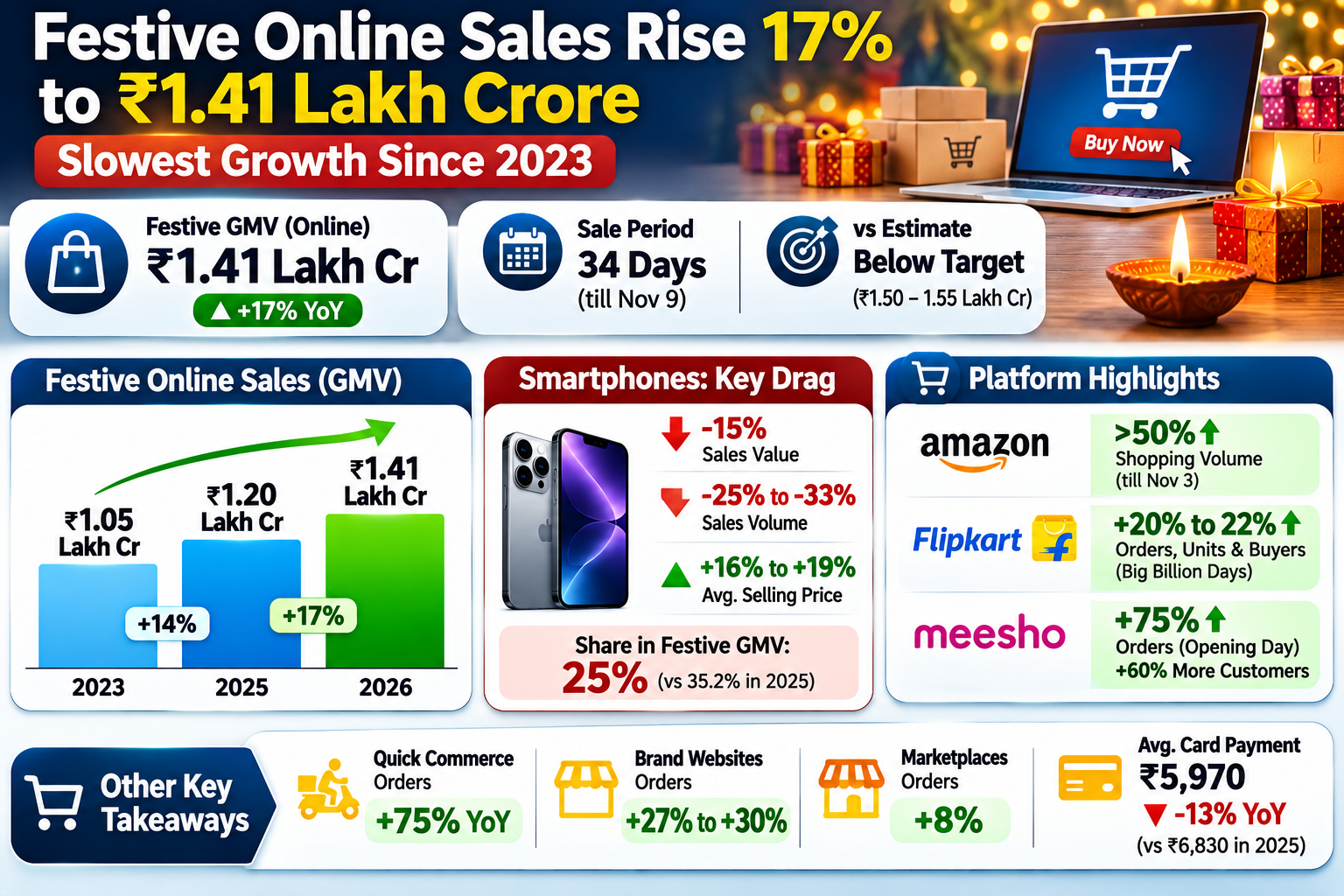
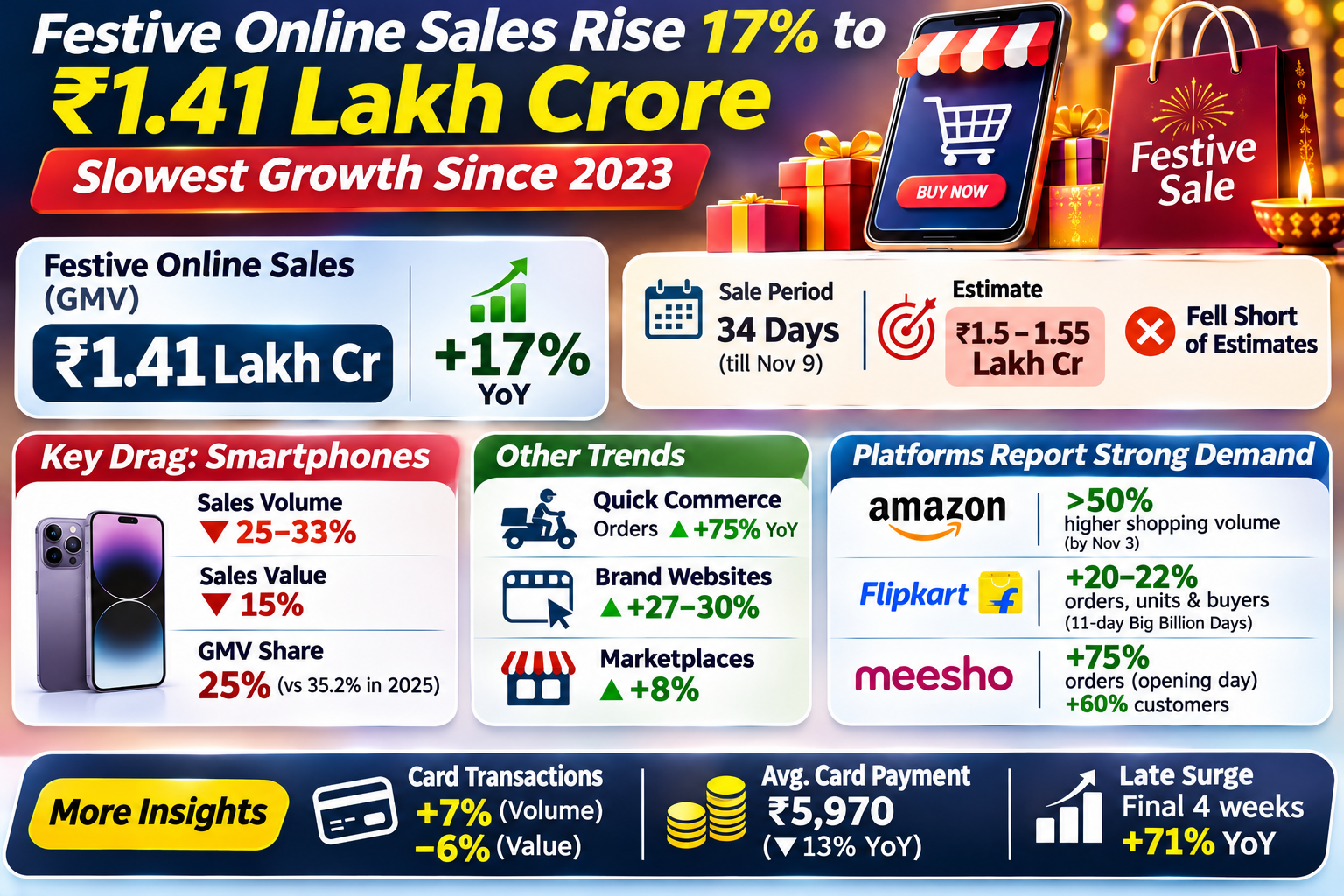
India’s festive online shopping market delivered another year of growth, but the latest numbers suggest that consumer spending is losing some momentum. Online festive sales increased 17% year-on-year to ₹1.41 lakh crore in 2026, marking the slowest growth since 2023, as weaker smartphone demand and smaller shopping baskets weighed on overall performance.
According to market research firm Datum Intelligence, gross merchandise value (GMV) reached approximately ₹1,40,800 crore over 34 sale days until November 9. However, the figure remained below the earlier industry expectations of ₹1.5–1.55 lakh crore.
In comparison, online festive sales stood at ₹1.2 lakh crore in 2025, when the festive shopping period lasted 30 days.
The numbers raise an important question for investors: Is India’s consumer spending story beginning to weaken, or are shoppers simply changing where and how they spend?
Track Live : NSE Option Chain — Live | BSE Option Chain — Live Sensex & Bankex Options Data Today
Amazon, Flipkart and Meesho Report Strong Festive Shopping Boom
Despite the slower industry-wide growth, major e-commerce platforms reported healthy festive demand.
Amazon said its shopping volume had increased more than 50% by November 3 compared with the previous festive season.
Flipkart reported 20% to 22% growth in orders, units sold and buyers during its 11-day Big Billion Days sale.
Meesho also reported strong initial demand, with orders increasing 75% on the opening day of its Mega Blockbuster Sale. The number of customers placing orders rose 60% year-on-year.
However, these platform disclosures cover different periods and performance metrics, so they should not be directly compared with the overall market GMV figures.
| E-commerce Platform | Reported Performance |
|---|---|
| Amazon | Shopping volume increased over 50% by November 3 |
| Flipkart | Orders, units sold and buyers increased 20–22% |
| Meesho | Opening-day orders increased 75% |
| Meesho | Number of customers increased 60% |
However, these figures cover different sale periods and measurement categories, so they should not be directly compared with the overall industry GMV growth of 17%.
The platform-level numbers indicate that consumer demand remained strong in selected categories, even as total spending across the broader online retail market fell short of expectations.
Festive Online Sales Reach ₹1.41 Lakh Crore in 2026
India’s festive online sales increased from approximately ₹1.20 lakh crore in 2025 to ₹1.41 lakh crore in 2026.
| Key Metric | Festive 2026 |
|---|---|
| Total online sales (GMV) | ₹1,40,800 crore |
| Year-on-year growth | 17% |
| Festive sale period | 34 days |
| Previous year’s GMV | ₹1.20 lakh crore |
| Earlier market estimate | ₹1.50–₹1.55 lakh crore |
| Growth expectation | 25–29% |
The actual performance fell short of expectations, indicating that higher order volumes were not translating into proportionately higher sales value.
According to Datum Intelligence, smartphone purchases were the biggest drag on festive sales.
Track Live : Nifty Levels Today | Sensex Levels Today
Smartphone Sales Decline 15%, Becoming the Biggest Drag
Smartphones traditionally account for a significant portion of festive e-commerce spending. However, their contribution declined sharply in 2026.
| Smartphone Sales Indicator | 2026 |
|---|---|
| Share of festive GMV | Around 25% |
| Share in 2025 | 35.2% |
| Projected GMV share | 29.8% |
| Sales volume decline | 25–33% |
| Average selling price increase | 16–19% |
| Sales value decline | Approximately 15% |
Higher memory chip prices pushed smartphone prices upwards, discouraging consumers from upgrading their devices.
Datum Intelligence estimated that without the decline in smartphone sales, overall festive online sales growth could have reached approximately 22%, instead of 17%.
Quick Commerce Emerges as a Major Winner During Festive Sales
One of the biggest changes in India’s online shopping market was the growing popularity of quick commerce.
According to Datum Intelligence, orders through quick commerce platforms increased 75% year-on-year. Brand-owned websites also recorded growth of 27% to 30%.
In comparison, orders through traditional online marketplaces grew just 8%.
This suggests that consumers are increasingly using quick commerce for convenience and immediate purchases rather than relying exclusively on traditional e-commerce platforms.
The shift could create opportunities for companies operating in online grocery delivery, last-mile logistics and digital retail infrastructure.
| Sales Channel | Year-on-Year Growth |
|---|---|
| Quick commerce orders | +75% |
| Brand-owned websites | +27–30% |
| Online marketplaces | +8% |
Quick commerce platforms are gaining traction in grocery, personal care, household essentials and festive gifting.
The shift indicates that consumers are increasingly distributing their spending across frequent, smaller transactions rather than concentrating purchases on large marketplace orders.
Read More : Why Bajaj Finance Plans to Raise Rs 17,500 Crore, Its First Major Equity Raise Since 2023
Smaller Shopping Baskets Highlight Pressure on Consumer Spending
Another concern emerging from the report is the decline in average transaction values.
Online card transactions increased 7% during the first 32 sale days, but their overall value declined 6%.
The average card payment fell 13% to ₹5,970 from ₹6,830 in 2025.
This indicates that consumers may be placing more emphasis on smaller purchases and spending cautiously despite festive discounts.
Interestingly, sales momentum improved towards the end of the season. The fourth week and final four days together recorded 71% growth over the corresponding period last year, indicating stronger shopping activity closer to Diwali.
Average Online Shopping Transaction Value Falls 13%
Despite an increase in transaction volumes, consumers spent less per online card transaction.
According to Datum Intelligence, online card transactions increased 7% during the first 32 sale days, but their total value declined 6%.
| Payment Indicator | 2025 | 2026 |
|---|---|---|
| Average card payment | ₹6,830 | ₹5,970 |
| Year-on-year change | — | -13% |
| Number of transactions | — | +7% |
| Total transaction value | — | -6% |
The decline indicates that consumers preferred smaller shopping baskets and lower-value purchases.
What Does the Slowdown Mean for India’s E-commerce Industry?
The latest festive sales figures highlight a change in India’s online shopping market.
While overall sales continue to increase, growth is increasingly being driven by order volumes, quick commerce and everyday consumer purchases rather than expensive electronics.
For companies operating in the sector, the key developments to monitor include:
-
Amazon and Flipkart: Their ability to maintain marketplace growth despite weaker big-ticket purchases.
-
Meesho: Continued growth in affordable products and value-conscious consumers.
-
Quick-commerce companies: Increasing order frequency and expansion into festive shopping.
-
Retail brands: Greater focus on direct-to-consumer websites and customer retention.
The biggest challenge for e-commerce companies will be maintaining revenue growth while consumers become more selective about spending.
Here’s What Happened Today and Why Traders Reacted
The biggest reason behind the slower festive sales growth was the sharp decline in smartphone purchases.
Mobile phones traditionally contribute a significant portion of India’s festive e-commerce spending. However, their contribution to total festive GMV declined to around 25% in 2026 from 35.2% in 2025.
The report also highlighted a decline in online smartphone sales volumes of approximately 25% to 33%.
Higher average selling prices, which increased 16% to 19% partly because of rising memory costs, failed to compensate for weaker demand. Consequently, smartphone sales value declined around 15%.
Datum Intelligence estimated that without the smartphone sales contraction, overall festive sales growth could have reached approximately 22% instead of 17%.
What Festive Sales Slowdown Means for Investors and Retail Stocks
The latest festive sales numbers offer a mixed picture for India’s consumer and retail sectors.
Weaker smartphone demand could create challenges for mobile manufacturers, electronics retailers and companies exposed to smartphone supply chains.
However, the strong performance of quick commerce and brand-owned websites highlights opportunities in emerging digital retail channels.
Investors should monitor upcoming quarterly results from e-commerce-linked businesses, electronics manufacturers, retail companies and logistics providers to understand whether the slowdown is temporary or reflects a broader moderation in consumer demand.