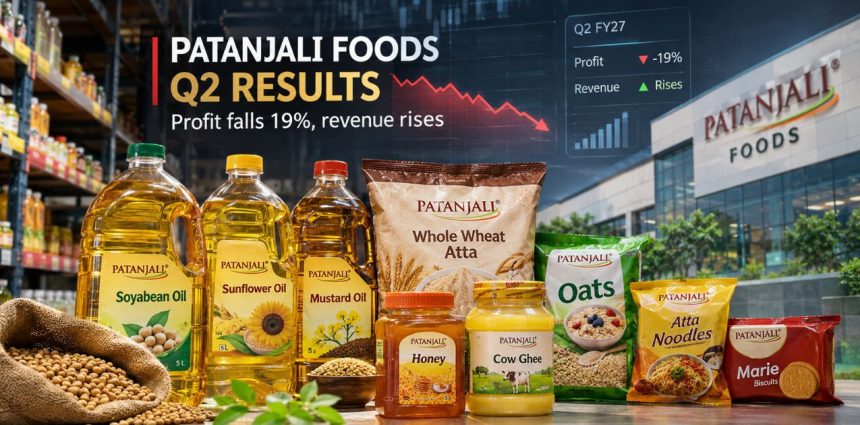
Patanjali Foods reported an 18.76% year-on-year decline in consolidated Q2 FY27 net profit to ₹419.77 crore despite 15.55% revenue growth. Operating EBITDA margin also contracted to 3.76% on a standalone basis, while consolidated FMCG segment results fell approximately 39%.
Patanjali Foods Q2 Results, November 14, 2026: Patanjali Foods reported a consolidated net profit of ₹419.77 crore for the September quarter of FY27, declining 18.76% from ₹516.70 crore in the corresponding quarter last year. Revenue from operations increased 15.55% year-on-year to ₹11,322.58 crore from ₹9,798.84 crore.
The difference between sales growth and profitability was the key feature of the quarterly results. Consolidated total expenses increased 17.68% to ₹10,997.51 crore from ₹9,344.98 crore, outpacing revenue growth. Consequently, profit before tax declined 19.03% to ₹408.98 crore against ₹505.09 crore in Q2 FY26.
The results also highlighted contrasting performances across the company’s edible oils and FMCG businesses, with FMCG profitability coming under considerable pressure despite largely unchanged revenue.
Track Live: PATANJALI FOODS Option Chain (NSE) — Live OI, PCR & Greeks
Patanjali Foods Q2 Results: Key Financial Figures
| Particulars | Q2 FY27 | Q2 FY26 | YoY change |
|---|---|---|---|
| Revenue from operations | ₹11,322.58 cr | ₹9,798.84 cr | +15.55% |
| Total income | ₹11,406.50 cr | ₹9,850.07 cr | +15.80% |
| Total expenses | ₹10,997.51 cr | ₹9,344.98 cr | +17.68% |
| Profit before tax | ₹408.98 cr | ₹505.09 cr | -19.03% |
| Net profit | ₹419.77 cr | ₹516.70 cr | -18.76% |
| Earnings per share | ₹3.86 | ₹4.75 | -18.74% |
The consolidated tax statement also requires attention. Net profit exceeded profit before tax because the quarter recorded a net tax credit of approximately ₹10.78 crore. This included a tax credit relating to earlier years of ₹115.31 crore, compared with ₹141 crore in Q2 FY26.
Separately, the company’s standalone financial disclosures showed operating EBITDA, excluding exceptional items, of ₹425.63 crore, with a margin of 3.76%. Based on a calculation using the corresponding standalone financial statement figures, operating EBITDA declined approximately 22.91% from ₹552.09 crore in Q2 FY26. The margin narrowed from 5.63%, representing a contraction of 187 basis points.
These standalone operating figures should be distinguished from the consolidated financial results above.
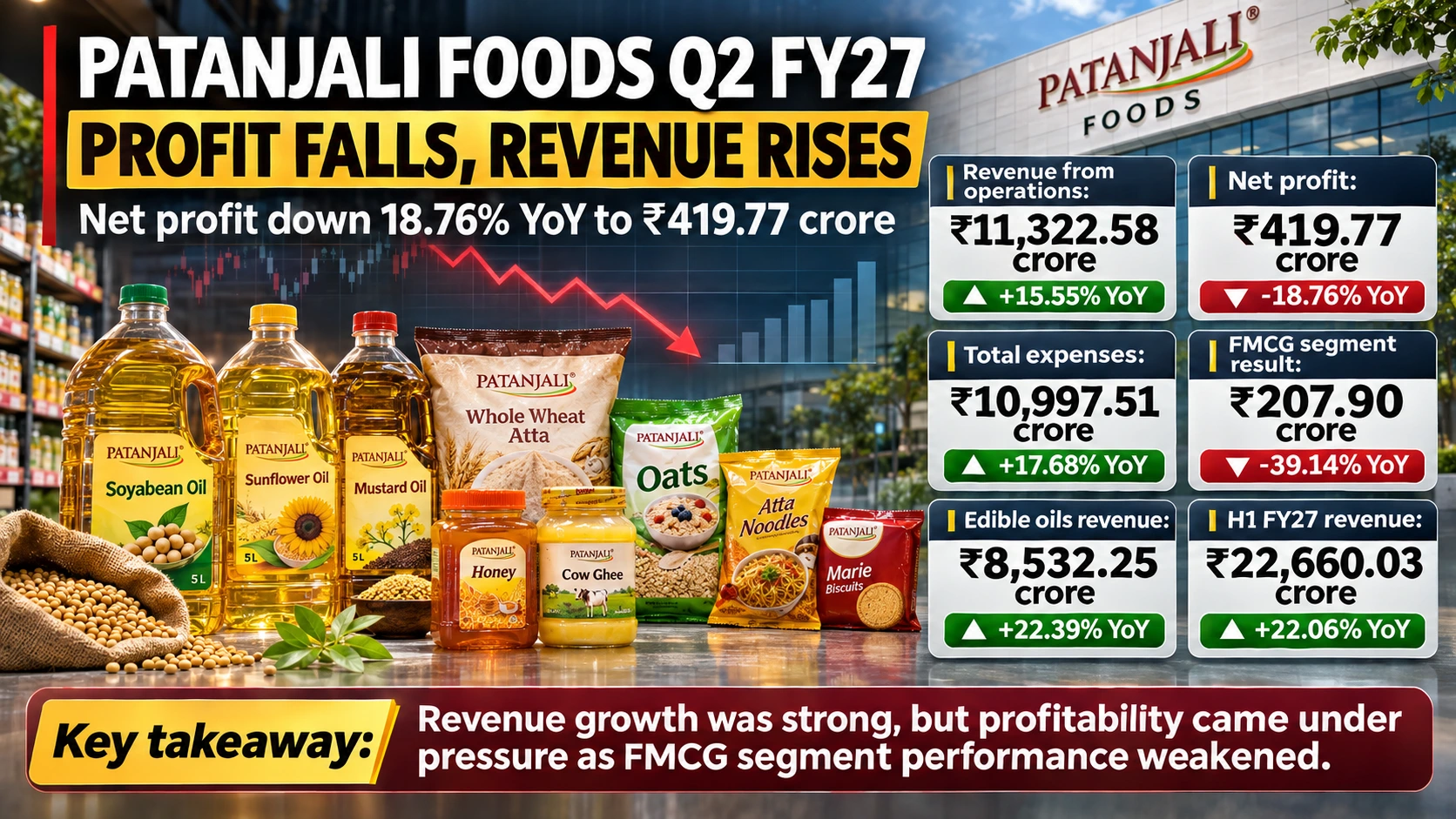
FMCG Segment Profit Drops 39% Despite Stable Revenue
The company’s consolidated segment disclosures reveal where profitability weakened during the quarter.
FMCG segment revenue stood at ₹2,923.48 crore in Q2 FY27, compared with ₹2,914.24 crore in the year-ago quarter, representing marginal growth of approximately 0.32%.
However, the segment’s result before finance costs and tax declined to ₹207.90 crore from ₹341.63 crore, a fall of approximately 39.14%.
The edible oils business delivered a stronger revenue performance. Its segment revenue increased 22.39% year-on-year to ₹8,532.25 crore from ₹6,971.64 crore. Segment results before finance costs and tax also improved to ₹223.39 crore from ₹207.76 crore, an increase of approximately 7.52%.
The contrasting performance indicates that growth in edible oils was not sufficient to offset the sharp decline in FMCG segment profitability.
Biscuits and Home Care Businesses Deliver Growth
Despite the pressure on overall FMCG profitability, several individual product categories reported growth in the company’s accompanying press release.
On a standalone operating-performance basis, the biscuits division recorded quarterly revenue of ₹638.31 crore, increasing 27.69% year-on-year. Its EBITDA margin improved to 11.91% from 9.79% in Q2 FY26.
The home and personal care category generated revenue of ₹713.88 crore, up 11.06% year-on-year.
Within this business, skin care revenue reached ₹187.50 crore, increasing 25.58%, while home care revenue stood at ₹91.07 crore, up 17.53%.
Textured soya products generated revenue of ₹185.56 crore, registering 16.40% year-on-year growth.
The company also reported an upward trend in wheat, milk and sugar prices during the quarter, highlighting the continuing input-cost challenge for its food businesses. However, the filing does not quantify how much each input contributed to the decline in FMCG profitability.
Edible Oils Record Highest-Ever Quarterly Revenue
Patanjali Foods reported its highest-ever quarterly revenue from the edible oils segment at ₹8,532.25 crore, an increase of 22.39% year-on-year.
The accompanying press release separately reported standalone edible oil EBITDA of ₹256.22 crore, with a margin of 3%.
The oil palm plantation business generated revenue of ₹742.29 crore during Q2 FY27. As of September 30, 2026, the area under cultivation stood at 1,27,265 hectares, with approximately 34% of the cultivated area in the prime yielding phase.
The performance highlights the scale of the edible oils business, although its reported EBITDA margin remains an important operating metric to monitor.
H1 FY27 Revenue Grows 22% as Profit Rises 8%
Despite the September-quarter profit decline, Patanjali Foods reported positive growth in its consolidated first-half financial performance.
For the six months ended September 30, 2026, revenue from operations increased 22.06% year-on-year to ₹22,660.03 crore from ₹18,564.86 crore.
Consolidated net profit improved 8.38% to ₹755.50 crore from ₹697.06 crore in the corresponding period last year.
The first-half performance indicates that the quarterly earnings pressure has not reversed the company’s cumulative year-on-year profit growth.
Also Check: PATANJALI FOODS Ltd Futures — Live Price, OI & Basis
Management Expects Growth Momentum to Continue in H2 FY27
Commenting on the quarterly performance, Sanjeev Asthana, Chief Executive Officer of Patanjali Foods, said festive demand shifted between the two quarters.
Navratri commenced in October this year compared with September last year, while Pitru Paksha during September deferred some festive-led purchases, influencing the timing of demand and revenue.
Management expects growth momentum to continue following the recent festive season and the upcoming wedding season.
The company also highlighted its focus on premiumisation, expanding its edible oils and FMCG portfolios, growing its oil palm plantation business and improving operational efficiencies.
However, the sharp decline in FMCG segment profitability and the contraction in standalone operating margins leave uncertainty over how quickly revenue growth can translate into stronger earnings.
What the Results Mean for Investors
Patanjali Foods delivered strong revenue growth in Q2 FY27, but the 18.76% decline in consolidated net profit highlights the challenge of converting higher sales into earnings growth.
The biggest concern is the FMCG segment, where revenue remained almost flat while segment results before finance costs and tax fell approximately 39%. Standalone operating EBITDA also declined approximately 23%, with the margin narrowing by 187 basis points.
Edible oils supported the topline, while biscuits and home and personal care recorded encouraging growth. Investors will be watching whether the expected festive and wedding-season demand translates into better margins and stronger earnings in H2 FY27.
Read Next: India’s Trade Deficit Jumps 32% to $39.88 Billion as Record Exports Face an Import Surge