
Yes Bank Cyber Fraud: Denies $3.4 Million Cyber Fraud Allegations
A reported cyber fraud involving millions of dollars has put YES Bank in the spotlight, but the private lender has strongly rejected the claims. The bank has clarified that neither its systems were compromised nor did it suffer any financial loss in the alleged incident involving government accounts.
In a clarification issued on November 13, YES Bank described the report as “factually incorrect” and said the allegations did not reflect the actual situation.
The development comes at a time when cybersecurity risks remain an important concern for India’s banking industry. For investors, the bank’s clarification is particularly significant because reports of financial fraud can influence market sentiment and confidence in banking stocks.
Track Live : NSE Option Chain — Live | BSE Option Chain — Live Sensex & Bankex Options Data Today
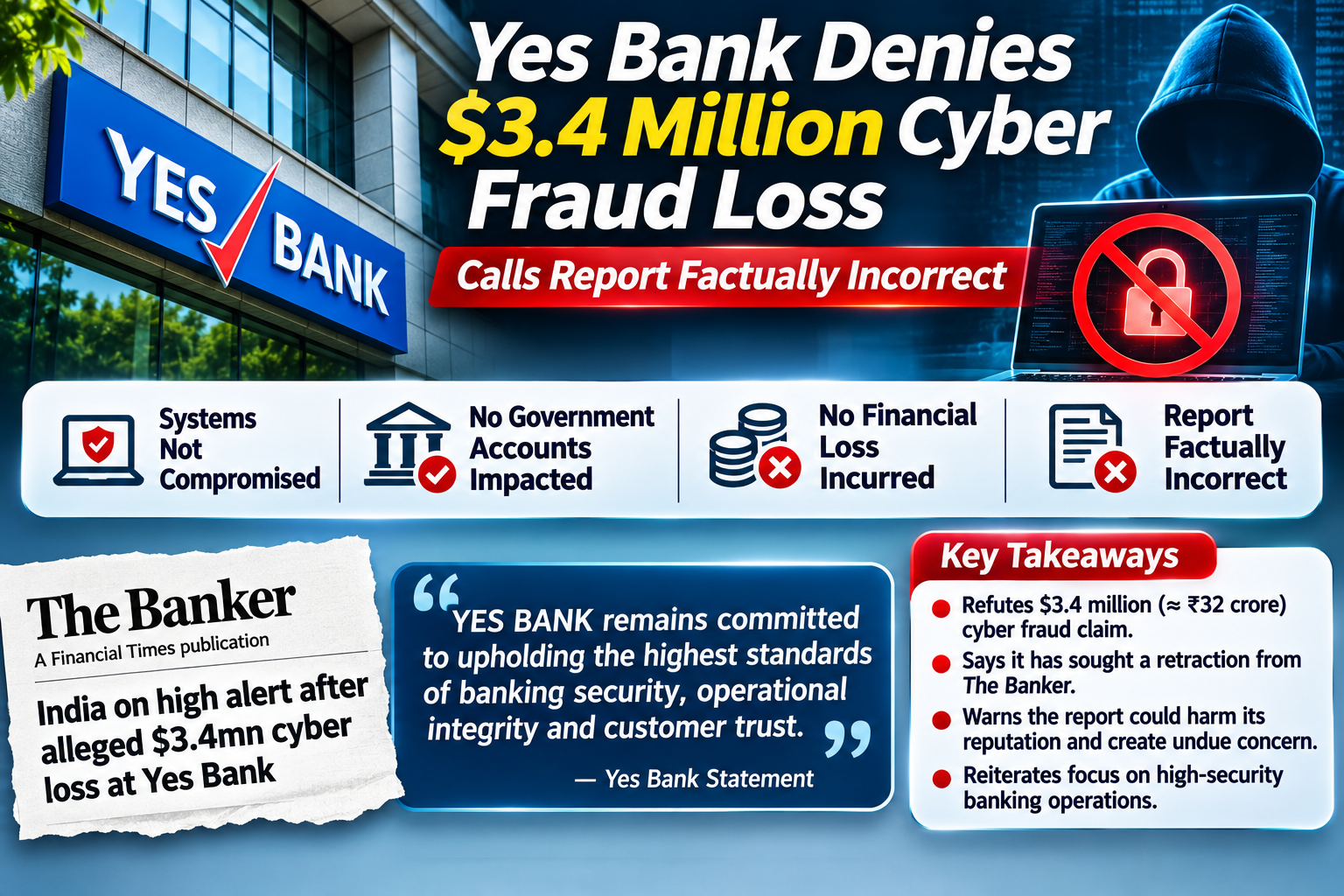
Yes Bank Cyber Fraud: What Did YES Bank Say About the Alleged $3.4 Million Cyber Fraud?
The controversy began after The Banker, a publication of the Financial Times Group, published a report titled ‘India on high alert after alleged $3.4mn cyber loss at Yes Bank‘.
The report alleged that YES Bank had suffered a cyber fraud loss of approximately $3.4 million, equivalent to around Rs 32 crore, involving government accounts towards the end of October 2026.
However, the lender rejected the allegations and clarified three important points:
- Its banking systems had not been compromised.
- No government accounts had been affected.
- The bank had not incurred any financial loss in connection with the alleged incident.
YES Bank also said it had taken up the matter with the publication, highlighted the factual inaccuracies and requested a retraction.
Key Highlights of Yes Bank’s Clarification
- No System Compromise. The bank confirmed that its internal systems remain secure and have not been breached.
- No Impact on Government Accounts. Contrary to the report’s claim regarding public funds, no government-linked accounts were affected.
- Zero Financial Loss. Yes Bank stated it has not incurred any financial losses connected to the alleged late-October 2026 incident.
- Demand for Retraction. The lender has formally contacted the Financial Times Group publication to highlight the inaccuracies, warning that the report could cause unwarranted concern among stakeholders and harm its reputation
What did The Banker report about the alleged cyber incident?
The original report by The Banker, published on November 13, 2026, alleged that YES Bank had suffered a cyber fraud loss of up to $3.4 million, equivalent to approximately ₹32 crore.
The publication cited sources familiar with assessments of the incident.
It also placed the alleged incident within a broader pattern of cyberattacks targeting banks and non-banking financial companies (NBFCs) in India.
According to The Banker:
-
The alleged incident took place towards the end of October.
-
Government accounts were reportedly involved.
-
The estimated loss was up to $3.4 million.
-
The incident raised concerns about the security of public funds.
-
Banking sources described a wider increase in cyber-related attacks on financial institutions.
The publication also cited estimates that cyber-related losses in the NBFC sector had reached between $90 million and $113 million.
Track Live : Nifty Levels Today | Sensex Levels Today
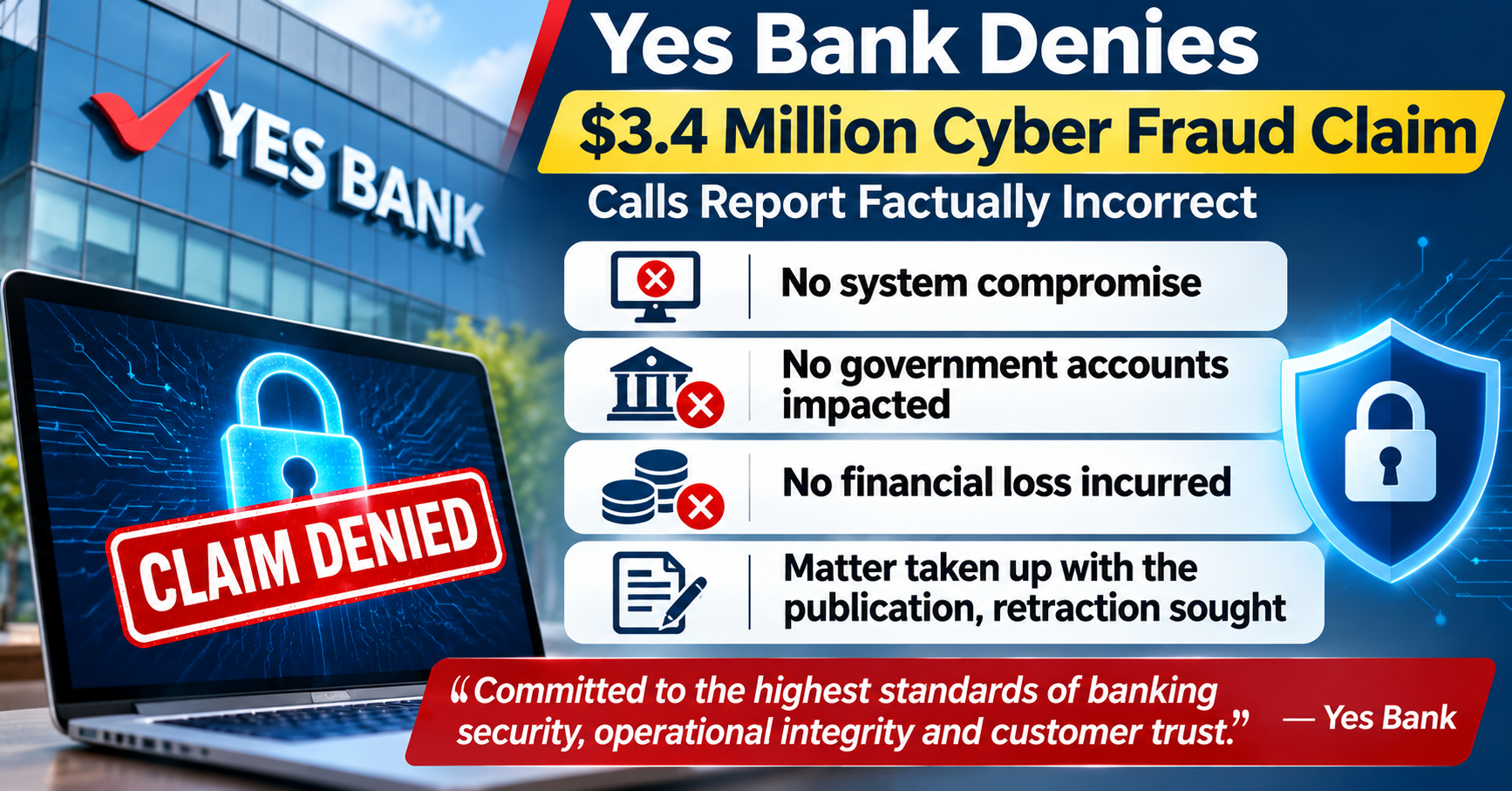
YES Bank Raises Concerns Over Reputation and Customer Trust
The lender said the publication of incorrect information could damage its reputation and create unnecessary concerns among customers, investors and other stakeholders.
In its official statement, YES Bank said, “YES BANK remains committed to upholding the highest standards of banking security, operational integrity and customer trust.”
The clarification is important because allegations involving cyber fraud and government-linked accounts can raise concerns about banking infrastructure, transaction security and operational controls.
However, the bank has maintained that the reported incident did not result in a compromise of its systems or financial losses.
A separate ₹5.10 crore cyber fraud involving YES Bank accounts
One important development missing from the original report is a separate cyber fraud disclosure by SG Finserve Limited, a listed non-banking financial company.
On November 3, 2026, SG Finserve informed the stock exchanges that it had detected 15 unauthorised debit transactions totalling ₹5.10 crore from two current accounts maintained with YES Bank’s South Extension II branch in New Delhi.
According to SG Finserve’s regulatory filing:
| Particulars | Details |
|---|---|
| Company | SG Finserve Limited |
| Incident disclosure | November 3, 2026 |
| Bank involved | YES Bank |
| Branch | South Extension II, New Delhi |
| Number of unauthorised transactions | 15 |
| Total amount | ₹5.10 crore |
| Transaction channel | Bank payment API |
| Accounts affected | Two current accounts |
Read More : Where Are the PLI Jobs? NITI Aayog Shows Hiring Is at 28% of Target, Investment at 76%
What did SG Finserve say?
The company said the transactions were executed without its knowledge or authorisation through the bank’s payment API.
Following the discovery, SG Finserve:
-
Activated its incident response procedures.
-
Isolated the affected systems.
-
Took steps to freeze beneficiary accounts.
-
Initiated efforts to recover the funds.
-
Reported the matter to the Cyber Crime Cell, RBI and CERT-In.
-
Appointed an independent investigating agency.
The company also clarified that its core business operations, customer data and day-to-day functioning remained unaffected.
The ₹5.10 crore SG Finserve incident and the alleged $3.4 million YES Bank government-account fraud are separate reported developments.
The SG Finserve transaction incident is supported by a stock-exchange filing. It does not establish that the separate $3.4 million allegation is true.
RBI increases cybersecurity scrutiny of banks following a series of attacks
The YES Bank controversy comes at a time when the RBI is increasing its scrutiny of cybersecurity arrangements across India’s financial system.
On October 30, Reuters reported that the central bank had asked banks to examine their cybersecurity preparedness, particularly vulnerabilities in application programming interfaces (APIs).
The RBI’s concerns include:
-
Weaknesses in connections between banks and NBFCs.
-
Security of third-party service providers.
-
Misuse of banking credentials.
-
Vulnerabilities in payment and loan-disbursement systems.
-
Preparedness against artificial intelligence-assisted cyberattacks.
Reuters reported that the RBI had also sought information from banks about their compliance with existing cybersecurity requirements.
RBI’s October cybersecurity instructions
An Economic Times report published on October 23, 2026, provided details of cybersecurity measures communicated by the RBI to regulated financial institutions.
| Cybersecurity measure | Purpose |
|---|---|
| Multi-factor authentication | Strengthen administrative login security |
| API inventory management | Identify and monitor active APIs |
| Disable dormant APIs | Reduce unnecessary entry points |
| Credential rotation | Replace potentially compromised credentials |
| Restricted backend access | Limit unauthorised access to critical systems |
| Real-time API monitoring | Identify suspicious transaction patterns |
| Third-party security audits | Strengthen external service-provider controls |
The RBI also advised financial institutions to strengthen monitoring of unusual automated requests, bulk data extraction and suspicious account registrations.
Earlier cyberattacks also affected other Indian financial institutions
The cybersecurity concerns are not limited to YES Bank.
Reuters reported on October 30 that two Mumbai-based NBFCs had suffered approximately $2 million in losses through more than 700 unauthorised instant transfers from accounts maintained with ICICI Bank on October 8 and 9.
According to a police complaint reviewed by Reuters, hackers had compromised the API connection used to send loan-disbursement instructions.
Separately, data belonging to approximately 3,900 State Bank of India customers was reportedly leaked.
The incidents prompted increased scrutiny of banking APIs and third-party technology arrangements.
What YES Bank’s Clarification Means for Investors and Banking Stocks
For YES Bank shareholders, the immediate focus will remain on the bank’s official disclosures, operational performance and market reaction to the controversy.
The denial of financial losses removes the alleged $3.4 million amount as a confirmed financial impact. Nevertheless, investors should distinguish between the reported allegations and the bank’s official response.
The development also highlights the importance of cybersecurity across India’s banking sector. Banks are increasingly dependent on digital transactions, electronic payment systems and technology-driven financial services.
Any confirmed security breach can create reputational and operational risks, while effective cybersecurity controls remain important for maintaining customer confidence.