Qucik Snapshot
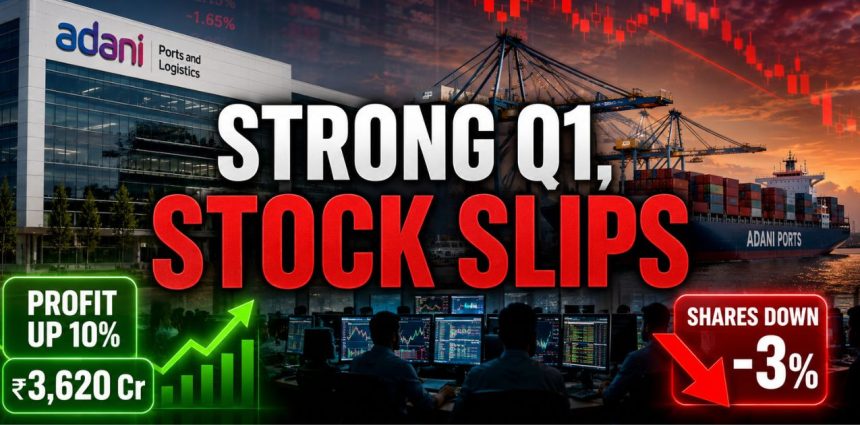
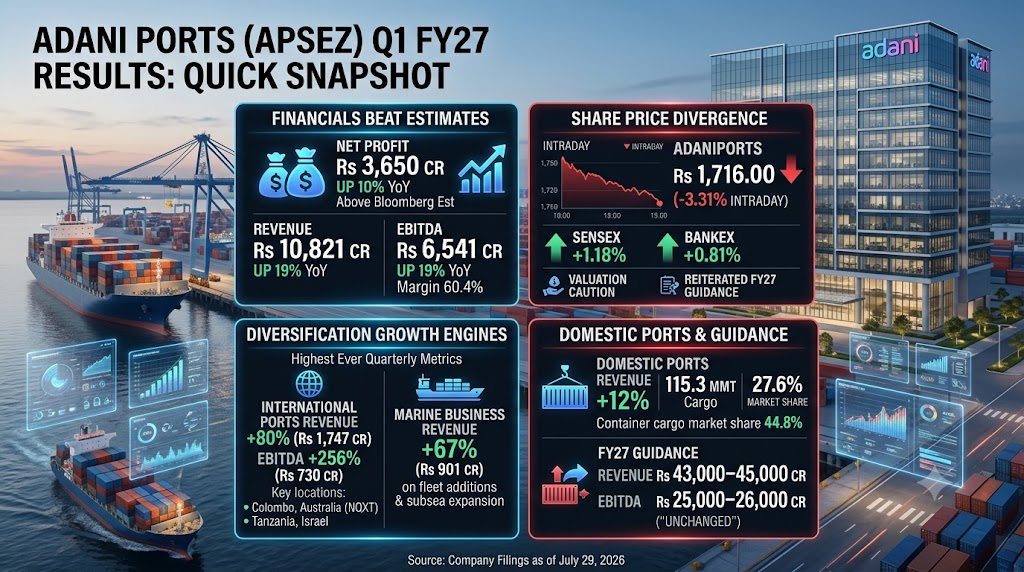
- Adani Ports (APSEZ) consolidated net profit rose 10% YoY to Rs 3,650 crore in Q1 FY27, beating the Bloomberg consensus estimate of about Rs 3,419 crore
- Consolidated revenue climbed 19% YoY to Rs 10,821 crore; EBITDA rose 19% to Rs 6,541 crore with margin at 60.4%
- Shares fell over 3% intraday despite the profit beat — NSE at Rs 1,716.00, BSE at Rs 1,714.70, as of around 1:55 PM IST — even as the Sensex and Bankex traded higher
- International ports revenue surged 80% to Rs 1,747 crore; EBITDA jumped 256% to Rs 730 crore
- Marine business revenue grew 67% YoY to Rs 901 crore on fleet additions and European subsea expansion
- Company guided for FY27 revenue of Rs 43,000–45,000 crore and EBITDA of Rs 25,000–26,000 crore, unchanged from earlier guidance
Adani Ports and Special Economic Zone Ltd (APSEZ) on Wednesday, July 29, 2026, reported a 10% year-on-year rise in consolidated net profit to Rs 3,650 crore for the April–June quarter (Q1 FY27), up from Rs 3,311 crore a year earlier and ahead of the Bloomberg consensus estimate of about Rs 3,419 crore, according to the company’s stock exchange filing.
Consolidated revenue grew 19% YoY to Rs 10,821 crore from Rs 9,126 crore, while EBITDA rose 19% to Rs 6,541 crore from Rs 5,495 crore, with EBITDA margin improving marginally to 60.4% from 60.2% a year earlier. Despite the beat, ADANIPORTS shares fell more than 3% during the session.
Why Shares Fell
As of 1:54 PM IST on the NSE, Adani Ports traded at Rs 1,716.00, down Rs 58.70 or 3.31%, against Tuesday’s close of Rs 1,774.70, moving in a day’s range of Rs 1,705.10–1,792.00. On the BSE, the stock quoted at Rs 1,714.70 at 1:55 PM IST, down 3.51% from a previous close of Rs 1,777.15.
The decline stood out because it came on a day the broader market was firmly positive: the BSE Sensex was up 1.18% and the BSE Bankex up 0.81% at the same 1:55 PM mark.
Several verifiable factors likely fed the reaction. The stock was trading roughly 38% above its 52-week low of Rs 1,291.00 heading into results, per BSE data, after an extended run-up over the past year.
Brokerage InCred Equities had already turned more cautious on the stock in a note dated July 15, citing rich valuations following a 28% rally over the preceding six months; the note pegged APSEZ at 16.8 times FY27F EV/EBITDA, a 24% premium to its eight-year median, per BusinessToday.
Separately, Nomura had projected 21% YoY revenue growth heading into the results; the actual 19% growth came in a shade below that estimate, even as EBITDA growth and margin held up better than the contraction Nomura had modelled.
Management also reiterated its FY27 guidance rather than raising it, which may have limited the upside case for a stock that had already re-rated sharply over the past year.
Check Live: ADANI PORTS AND SPECIAL ECONOMIC ZONE Options Chart
Why This Quarter Matters
Q1 FY27 is a milestone quarter for APSEZ’s diversification story. The international ports business delivered its highest-ever quarterly revenue and EBITDA, while the marine business kept scaling, together signalling APSEZ’s shift from a domestic-port-led company toward a broader global ports-and-logistics platform.
The results also landed on one of the busiest days of the Q1 FY27 season, with large-caps including Asian Paints, Eicher Motors, Dabur, Bajaj Housing Finance, Prestige Estates and Colgate-Palmolive India all reporting the same day, per Tradebrains, making APSEZ’s numbers one data point in a broader market mood-check.
As India’s largest private port operator, handling over a quarter of the country’s cargo, APSEZ’s 15% YoY growth in overall cargo volumes this quarter is also widely read as a proxy for the health of India’s trade and export activity.
The quarter is also being measured against the company’s long-term Ambition 2031 roadmap, including its plan to nearly double domestic port capacity to 1,000 MMT by 2030.
Domestic Ports Remain Core Earnings Driver
APSEZ’s domestic ports business, its largest segment, posted 12% YoY revenue growth, aided by a better cargo mix, higher realisations and volume growth, the company said in its filing.
Domestic ports handled 115.3 MMT of cargo during the quarter, with EBITDA margin at 74%. The company’s all-India cargo market share stood at 27.6%, while container cargo market share was 44.8%, per its disclosures.
APSEZ said it is executing one of its largest-ever capacity expansion programmes, with domestic port capacity at 653 MMT as of June 30, 2026, targeted to rise to 1,000 MMT by December 2030.
International Ports and Marine Business Post Sharp Gains
The international ports business delivered record quarterly revenue and EBITDA, per the company’s filing, with revenue up 80% YoY to Rs 1,747 crore and EBITDA up 256% to Rs 730 crore.
Cargo volumes rose to 22.8 MMT from 7.7 MMT a year earlier, led by the addition of NQXT Australia and continued ramp-up at Colombo: Australia contributed 10 MMT, Colombo 6.9 MMT, Tanzania 3.7 MMT and Israel 2.2 MMT.
Colombo’s EBITDA margin expanded to 41.8% from 21.1%, with revenue up roughly five-fold, while Tanzania’s revenue rose 36%.
The marine business posted 67% YoY revenue growth to Rs 901 crore, supported by fleet additions and expansion of European subsea operations.
APSEZ said it recently partnered with Oceaneering International to strengthen deepwater engineering and offshore capabilities in Europe, and secured a 10-year contract supporting Argentina’s first LNG exports to India.
FY27 Guidance and Leverage
For FY27, Adani Ports has guided for revenue of Rs 43,000–45,000 crore and EBITDA of Rs 25,000–26,000 crore, with net debt-to-EBITDA guided at up to 2.5x. The ratio stood at 1.9x at the end of Q1 FY27, per the company’s investor presentation.
Also Check: Adani Ports (ADANIPORTS) Option Chain — Live Strike Data, OI & Greeks
Management Commentary
Ashwani Gupta, Whole-time Director and CEO, said the quarter’s results reflected the strength of APSEZ’s diversified, multi-modal business model spread across geographies and customers.
He noted that domestic ports continued to anchor earnings, while the international ports, marine and logistics businesses have moved from a scale-up phase toward scale and value, per the company’s statement.
Track real-time institutional money flow on the NiftyTrader FII-DII Tracker before the next trading session.
NiftyTrader Desk View
| Stock | Key Technical Trigger | Trader View |
|---|---|---|
| Adani Ports (APSEZ) | Down 3.31% (NSE) / 3.51% (BSE) intraday to around Rs 1,715, against Tuesday’s close of Rs 1,774.70–1,777.15; day’s range Rs 1,705–1,792 | Profit beat consensus and benchmark indices traded higher, yet the stock extended losses through the session — a divergence that may reflect valuation caution flagged by brokerages ahead of results; participants may watch whether price holds above the day’s low near Rs 1,705 |
What Investors Should Watch Next
Attention now turns to APSEZ’s investor call scheduled for 6:00 PM IST on July 29, 2026, where management is expected to elaborate further on the quarter, per company filings.
Beyond that, market participants may track the pace of ramp-up at newer international assets such as Colombo and the recently added Australian terminal, cargo volume trends in the second half of FY27 relative to this quarter’s 15% growth, movement in the net debt-to-EBITDA ratio against the guided 2.5x ceiling, progress on the capacity build-out toward the 1,000 MMT domestic target, and whether margins hold up against the more conservative assumptions some brokerages had built in ahead of results.
Bottom Line
Adani Ports delivered broad-based growth across ports, marine and logistics in Q1 FY27, with profit and revenue both beating expectations and the international business emerging as a genuine second growth engine.
Yet the stock’s more-than-3% intraday fall, even as benchmark indices rose, is a reminder that a strong quarter and a rich valuation don’t always point the same way; the next re-rating trigger is likely to come from execution on capacity expansion and international scale-up rather than this quarter’s numbers alone.
Disclaimer: This article is for informational purposes only and should not be construed as investment advice. Investors are advised to consult a SEBI-registered financial advisor before making any investment decisions.