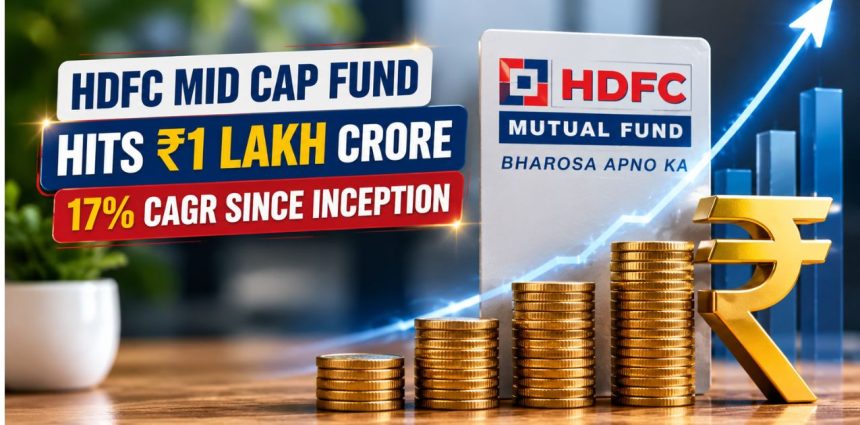
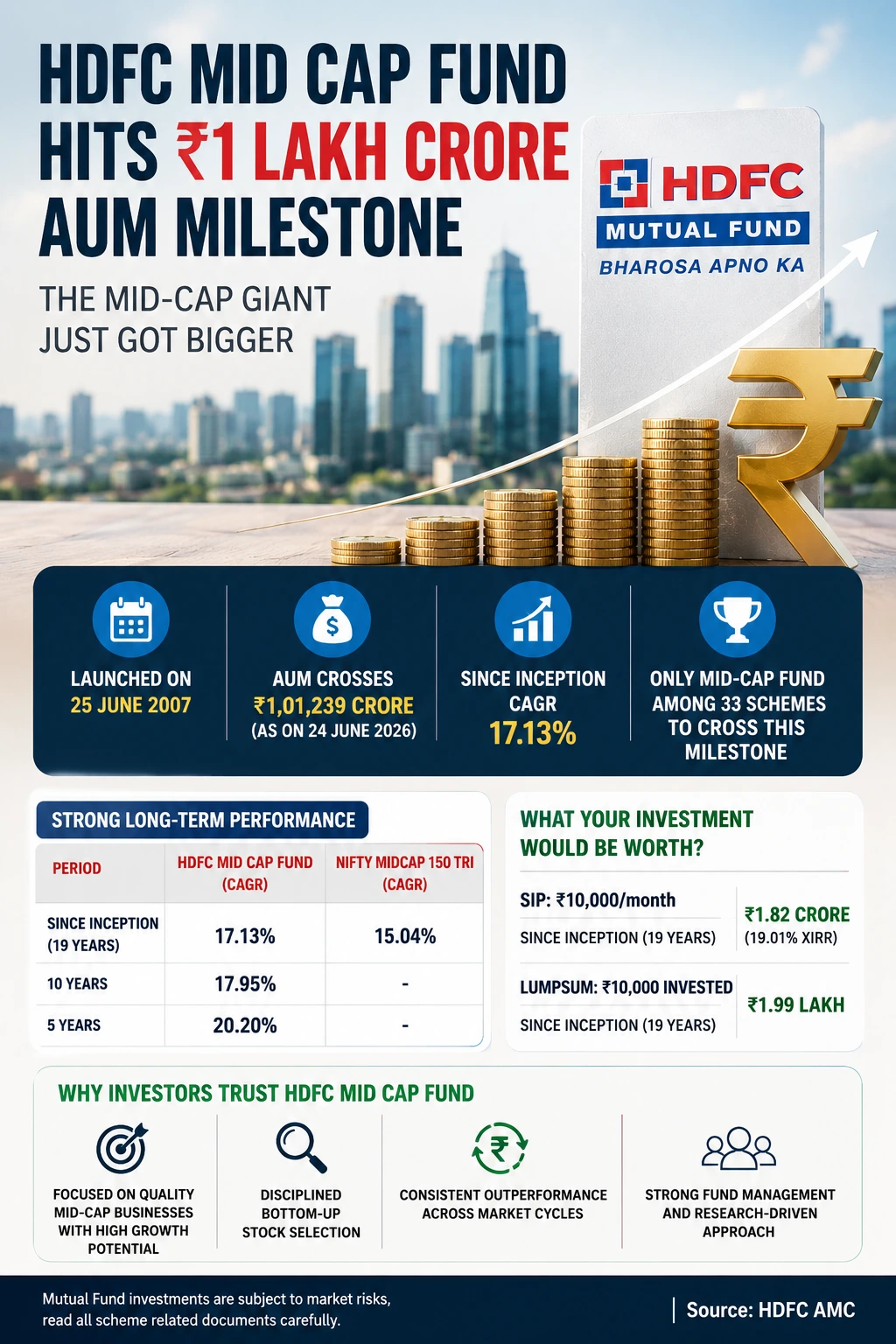
HDFC Mid Cap Fund has crossed ₹1 lakh crore in Assets Under Management, making it the only scheme among 33 mid-cap funds in India to achieve this scale. Launched on June 25, 2007, the fund’s AUM stood at ₹1,01,239 crore as of June 24, 2026, cementing its position as the largest and longest-running mid-cap scheme in the country.
The milestone arrives as the fund enters its 20th year, having compounded investor wealth through the 2008 global financial crisis, the 2020 COVID crash, multiple rate cycles, and a complete transformation of India’s economic landscape.
17.13% CAGR Since Inception: The Performance Record
The numbers behind the milestone are equally compelling.
Since inception, the Regular Plan Growth Option has delivered a 17.13% CAGR, against the Nifty Midcap 150 Total Returns Index benchmark of 15.04% CAGR over the same period. That 209 basis point alpha, sustained over 19 years, is the clearest evidence of what disciplined active management can achieve.
To put it in rupee terms: ₹1 lakh invested at inception would be worth approximately ₹20 lakh today. The same amount in the benchmark index would have grown to roughly ₹14.2 lakh, a gap of nearly ₹6 lakh per lakh invested.
| Period | CAGR (Regular Plan) |
|---|---|
| Since Inception (2007) | 17.13% |
| 10 Years | 17.95% |
| 5 Years | 20.20% |
| Benchmark (Nifty Midcap 150 TRI, since inception) | 15.04% |
 Check Live: MidCap Nifty Contributors — Today’s Stock-Wise Impact
SIP and Lumpsum: What Investors Actually Earned
The compounding story is even more striking when viewed through a systematic investment lens.
SIP Returns (₹10,000/month from inception):
| Investment Period | Current Value | XIRR |
|---|---|---|
| Since Inception (2007) | ₹1.82 crore | 19.01% |
| Last 15 Years | ₹88.26 lakh | 19.11% |
| Last 10 Years | ₹32.44 lakh | 18.92% |
Lumpsum Returns (₹10,000 invested):
| Investment Period | Current Value |
|---|---|
| Since Inception | ₹1.99 lakh |
| Last 10 Years | ₹52,109 |
A ₹10,000 monthly SIP started in 2007, total outflow of roughly ₹23 lakh over 19 years, is now worth ₹1.82 crore. That is the compounding arithmetic that has driven investor trust at scale.
Navneet Munot: “Two Decades of Disciplined Investing”
HDFC AMC’s Managing Director and CEO Navneet Munot acknowledged the significance of the moment, calling it a milestone built on nearly two decades of disciplined investing through changing market conditions. He noted that the fund has consistently identified quality businesses with long-term growth potential and credited both investors and distribution partners for their sustained confidence in the scheme.
The statement signals no change in investment philosophy, the fund remains committed to the same research-driven approach that built its 19-year track record.
Also Check: HDFC ASSET MANAGEMENT COMPANY Options Chart
How the Fund Invests: Bottom-Up, 40–60 Stocks, No Index Mirroring
Unlike passive mid-cap trackers, HDFC Mid Cap Fund runs a concentrated, research-driven portfolio of 40 to 60 stocks. The fund manager does not mirror benchmark sector weights. Instead, the team builds positions in mid-sized companies with durable business models, proven management, sustainable competitive advantages, and reasonable valuations.
Chirag Setalvad, who has managed the fund since March 2007, brings rare continuity, nearly two decades of unbroken stewardship over a single fund, which is itself unusual in the Indian mutual fund industry.
The process has remained unchanged even as the corpus has scaled. As AUM grew, the portfolio expanded for diversification and liquidity management, but the core stock-selection philosophy has not drifted.
HDFC AMC Now Runs Three ₹1 Lakh Crore Funds
The Mid Cap milestone gives HDFC Mutual Fund an unprecedented position in the Indian asset management industry, three distinct schemes, each exceeding ₹1 lakh crore in AUM simultaneously.
| Fund | AUM (May–June 2026) |
|---|---|
| HDFC Balanced Advantage Fund | ₹1.04 lakh crore |
| HDFC Flexi Cap Fund | ₹1.01 lakh crore |
| HDFC Mid Cap Fund | ₹1.01 lakh crore |
In the mid-cap category specifically, no other fund house has come close to this level of concentration of investor capital in a single scheme.
Also Read: HDFC Mutual Fund Caps Gold ETF Lump-Sum at Rs 10 Lakh Amid Import Concerns
Category Context: HDFC Mid Cap Holds ~20% of All Mid-Cap AUM
The broader mid-cap category managed approximately ₹4.88 lakh crore in AUM as of May 2026, according to AMFI data. HDFC Mid Cap Fund’s ₹1 lakh crore corpus represents roughly one-fifth of the entire segment, a concentration that underlines both investor conviction and the structural challenge the fund now faces.
Risks Investors Must Not Ignore
The milestone warrants celebration, but it comes with structural cautions that every investor should understand before adding to this fund.
AUM-size liquidity risk: At ₹1 lakh crore in a mid-cap strategy, deploying capital without moving stock prices becomes increasingly difficult. Mid-cap stocks have finite liquidity, and a fund of this size may face challenges entering or exiting positions quickly — particularly during market stress.
Valuation risk: Strong inflows into this fund and the mid-cap category broadly have pushed up valuations. The fund’s PE ratio stands at 25.90 versus the mid-cap category average PE of 33.76, offering some margin, but the space is no longer cheap.
Stress test scrutiny: SEBI has urged fund houses managing large mid-cap portfolios to conduct formal stress tests on liquidity and redemption resilience. This reflects a broader regulatory awareness of the risks that come with concentrated, large-corpus mid-cap strategies.
Expectation gap risk: Past 17% CAGR was delivered against a different base. Future returns will depend on the earnings growth of the underlying portfolio companies, prevailing valuations at entry, and macro conditions, not on historical compounding.
The fund carries a “Very High” risk rating. It suits investors with a minimum 7–10-year horizon, an ability to hold through 30–40% drawdowns, and an existing large-cap allocation for portfolio balance.
Mutual fund investments are subject to market risks. Read all scheme-related documents carefully before investing. Past performance is not indicative of future returns. This article is for informational purposes only and does not constitute investment advice. Readers are advised to consult their SEBI-registered financial advisor before making investment decisions.