
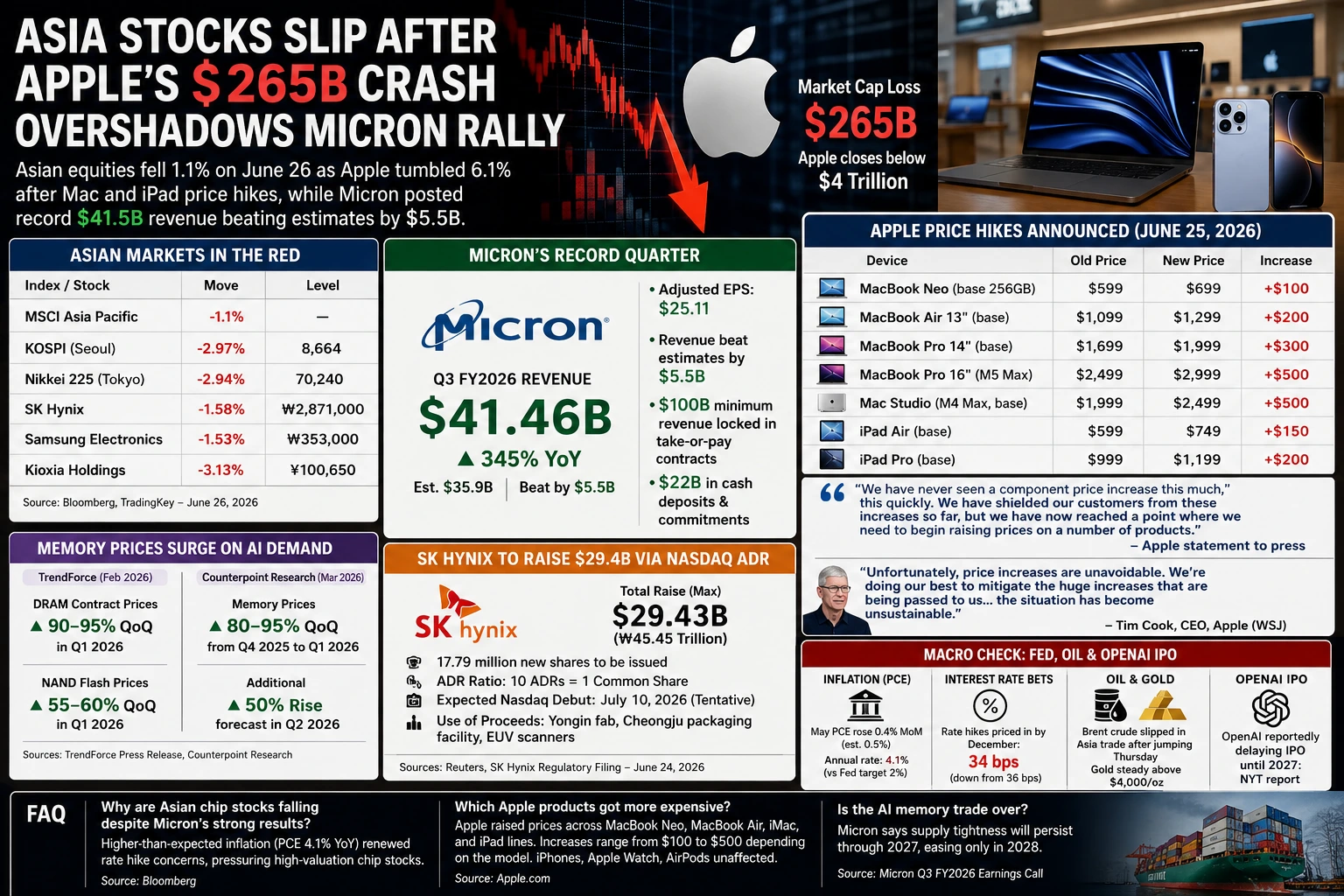
Asian equities retreated on Friday, June 26, with the MSCI Asia Pacific gauge falling 1.1% in early trade, according to Bloomberg, as chip stocks in Seoul and Tokyo surrendered Thursday’s gains, a session in which Apple’s 6.1% crash wiped roughly $265 billion from its market value even as Micron Technology delivered a record-shattering $41.5 billion quarter.
Analysts said the divergence reflects different parts of the AI supply chain responding differently to the same shortage, memory chip makers printing record profits, while the hardware companies buying those chips are now being forced to pass costs on to consumers.
Seoul and Tokyo Open in the Red
South Korea’s KOSPI dropped 2.97%, shedding 265 points to 8,664, while Japan’s Nikkei 225 declined 2.94%, falling over 2,000 points to 70,240 in early Friday trade.
Both moves came on top of a bruising Tuesday when the KOSPI plunged 9.99% to 8,203, triggering a circuit breaker and a 20-minute trading halt, with SK Hynix and Samsung both tumbling around 12%.
In Friday’s session, Kioxia fell 3.13% to ¥100,650, SK Hynix slipped 1.58% to ₩2,871,000, and Samsung Electronics dropped 1.53% to ₩353,000, giving back much of what Micron’s Thursday earnings had restored. US futures were little changed.
| Index / Stock | Move | Level |
|---|---|---|
| MSCI Asia Pacific | -1.1% | — |
| KOSPI (Seoul) | -2.97% | 8,664 |
| Nikkei 225 (Tokyo) | -2.94% | 70,240 |
| SK Hynix | -1.58% | ₩2,871,000 |
| Samsung Electronics | -1.53% | ₩353,000 |
| Kioxia Holdings | -3.13% | ¥100,650 |
Source: Bloomberg, TradingKey — June 26, 2026
Apple’s $265B Crash — What Actually Happened
Apple closed Thursday down 6.12%, its worst single-day performance in more than a year, wiping out about $265 billion of its market value, leaving the company valued at just over $4 trillion.
The company announced price increases across its MacBook Neo, MacBook Air, iMac, and iPad product lines. iPhones, Apple Watch, and AirPods were not affected.
In a statement to the press, Apple said: “We have never seen a component price increase this much, this quickly.
We have shielded our customers from these increases so far, but we have now reached a point where we need to begin raising prices on a number of products.
We know this is not welcome news, and we are working tirelessly to find solutions.”
CEO Tim Cook had told The Wall Street Journal the prior week: “Unfortunately, price increases are unavoidable.We’re doing our best to mitigate the huge increases that are being passed to us, and we’ve been trying to shield our customers from the increases, but the situation has become unsustainable.”
Here are the confirmed new prices across key Apple devices:
| Device | Old Price | New Price | Increase |
|---|---|---|---|
| MacBook Neo (base 256GB) | $599 | $699 | +$100 |
| MacBook Air 13″ (base) | $1,099 | $1,299 | +$200 |
| MacBook Pro 14″ (base) | $1,699 | $1,999 | +$300 |
| MacBook Pro 16″ (M5 Max) | $2,499 | $2,999 | +$500 |
| Mac Studio (M4 Max, base) | $1,999 | $2,499 | +$500 |
| iPad Air (base) | $599 | $749 | +$150 |
| iPad Pro (base) | $999 | $1,199 | +$200 |
Source: AppleInsider, TechCrunch, Notebookcheck, 9to5Mac, all independently verified against Apple’s online store, June 25, 2026
JPMorgan analysts wrote in a note that “the magnitude of the increase on the announced products is higher than we anticipated” and predicted higher prices could hurt sales.
Analyst Daryanani noted the hikes were “broad-based and ranging from +17% to +25% across the core Mac/iPad lineup on base-model configs,” adding: “Today’s move is a clear signal that memory inflation is biting harder and faster than expected, even for Apple.”
Analysts linked the increases to sharply higher memory costs. According to TrendForce’s February 2026 market outlook, conventional DRAM contract prices rose 90–95% quarter-on-quarter in Q1 2026, while NAND Flash prices rose 55–60% over the same period, driven by AI data centre construction diverting chip supply away from consumer hardware.
Counterpoint Research separately confirmed that memory prices surged 80–90% quarter-on-quarter from Q4 2025 into Q1 2026, with an additional 50% rise forecast through Q2 2026.
Micron’s $41.5B Quarter and $100B in Locked Contracts
Thursday was not uniformly negative. Micron reported Q3 fiscal 2026 revenue of $41.46 billion, surging past analyst expectations of approximately $35.9 billion by more than $5.5 billion. Adjusted earnings per share came in at $25.11.
The more structural development came alongside those results. According to Micron’s earnings call, the company signed 16 Strategic Customer Agreements with binding, multi-year take-or-pay commitments.
Fourteen of those 16 agreements carry cumulative minimum revenue commitments of approximately $100 billion at floor prices, per the company’s earnings presentation.
Under agreements signed so far, Micron will receive $22 billion in cash deposits and related financial commitments, with approximately $18 billion as actual cash and $4 billion as letters of credit.
CEO Sanjay Mehrotra said the company has signed agreements with four “very large customers” and three “medium-sized customers”, clients that previously had not committed to long-term arrangements. The contracts run five years from 2026 to 2030.
Jake Behan, head of capital markets at Direxion, offered the clearest independent read on risk: “The bull case is built on tightness. Once supply starts to creep back, pricing power is the first thing at risk.”
SK Hynix Files for $29.4B Nasdaq Listing — Among the Largest ADR Offers Ever
South Korea’s SK Hynix filed with regulators on June 24 to raise up to 45.45 trillion won ($29.43 billion) by listing American Depositary Receipts on Nasdaq, with trading expected to begin July 10, subject to change.
The company plans to issue 17.79 million new shares, with BofA Securities, Citigroup Global Markets, Goldman Sachs, and JP Morgan Securities managing the offering, according to Reuters.
If completed at the top of its range, the deal would rank as one of the largest ADR offerings ever, surpassing Alibaba’s $21.8 billion New York debut in 2014.
Proceeds will be used to build a chip factory in Yongin, an advanced packaging facility in Cheongju, and purchase chipmaking equipment including extreme ultraviolet scanners.
None of the funded capacity comes online in time to ease the current shortage.
| Detail | Data |
|---|---|
| Total raise (maximum) | $29.43B / ₩45.45 trillion |
| New shares to be issued | 17.79 million |
| ADR ratio | 10 ADRs = 1 common share |
| Expected Nasdaq debut | July 10, 2026 (tentative) |
| Managing banks | BofA, Citi, Goldman Sachs, JP Morgan |
| Use of proceeds | Yongin fab, Cheongju packaging, EUV scanners |
Source: Reuters, SK Hynix regulatory filing — June 24, 2026
Fed, Oil, and the OpenAI IPO Question
The Fed’s preferred inflation gauge, the PCE price index, rose 0.4% in May, below economists’ median estimate of 0.5%, while the annual rate accelerated to 4.1%, well above the Fed’s 2% target. Interest-rate swaps priced in roughly 34 basis points of tightening by December, down from 36 basis points the prior day.
Oil remained in focus after a projectile strike on a vessel in the Strait of Hormuz sent Brent crude climbing on Thursday, snapping a three-day decline, before prices edged lower in early Asian trade on Friday. Gold held steady above $4,000 an ounce.
OpenAI is leaning toward holding off on an initial public offering until 2027, the New York Times reported, citing three people involved in the company’s deliberations. SoftBank shares also traded lower during the session, falling over 12% to 6,246 yen in morning trade on Friday
Check here to explore:
What Next
Samsung’s preliminary Q2 results, expected in early July, will be the next hard data point, HBM pricing guidance from Seoul will directly confirm or challenge the $100 billion minimum contracted revenue threshold Micron disclosed in its earnings presentation this week.
FAQs
Why are Asian chip stocks falling even though Micron beat estimates by $5.5 billion?
The 4.1% annual PCE reading, a near three-year high, reinforced expectations for further Federal Reserve rate hikes, compressing valuations on high-multiple semiconductor names in Friday’s Asia session. Strong earnings and rising discount rates moved in opposite directions. The AI earnings thesis remains intact; valuations are being re-rated under a higher-rate environment.
Which Apple devices got more expensive on June 25, 2026?
Apple raised prices across its MacBook Neo, MacBook Air, iMac, and iPad product lines, with increases of up to $200 on several models. iPhones, Apple Watch, and AirPods were not affected. Analysts linked the increases to sharply higher memory costs, while Apple announced higher pricing across several Mac and iPad products. Full updated pricing is available on Apple’s official online store.
Is the AI memory trade over or is this a valuation reset?
Micron’s CEO said, according to the company’s earnings call, that memory supply will remain insufficient through 2027 and may improve only gradually in 2028. The structural demand case remains intact. As Direxion’s Jake Behan put it: “The bull case is built on tightness. Once supply starts to creep back, pricing power is the first thing at risk.” This is a multiple compression event under rate pressure — not a fundamental breakdown in AI infrastructure demand.
Disclaimer: This article is for informational purposes only and does not constitute investment advice. Please consult a SEBI-registered financial advisor before making investment decisions. Data sourced from Bloomberg, Reuters, TechCrunch, AppleInsider, TrendForce, Counterpoint Research, Micron Q3 2026 earnings call, and SK Hynix regulatory filings as of June 26, 2026.