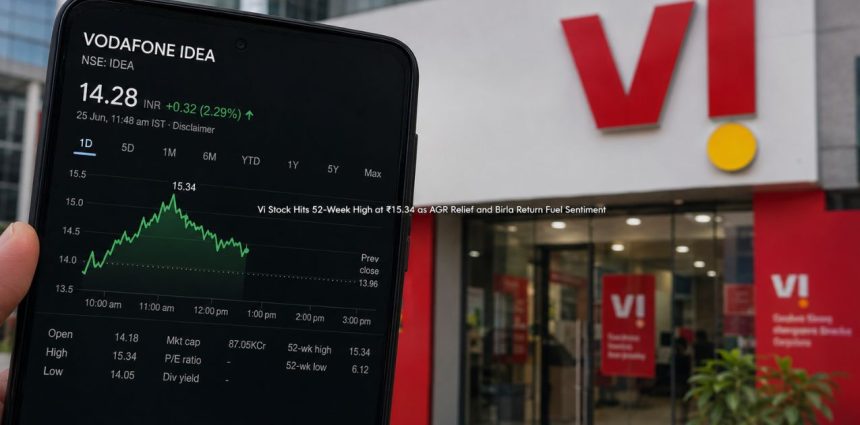
Vi Stock Hits 52-Week High at ₹15.34 as AGR Relief and Birla Return Fuel Sentiment
Vodafone Idea (NSE: IDEA) shares have surged nearly 80% in under three months, touching a 52-week high of ₹15.34 on the NSE before pulling back slightly. The stock was trading around ₹14.2–₹14.3 on June 25 after hitting that high earlier this month.
The one-year gain is now close to 100%, while the stock has jumped nearly 75% from its April low and almost 89% at the recent high.
The catalyst? A 27% reduction in Adjusted Gross Revenue (AGR) dues by the Department of Telecommunications (DoT) slashed Vi’s total AGR liability to ₹64,046 crore as of December 31, 2025, down sharply from ₹87,695 crore earlier.
Repayments have been deferred largely to the FY32–FY41 window, with ₹609 crore in Spectrum Usage Charges (SUC) dues payable in annual instalments through FY31. That one regulatory move triggered a ₹57,491 crore exceptional gain in Q4 FY26 books.
Check Here: VODAFONE IDEA Share Price Chart: Live
The Numbers Behind the Rally
Vodafone Idea’s Q4 FY26 revenue rose 2.9% year-on-year to ₹11,332 crore. Customer ARPU improved to ₹190 in Q4 FY26 from ₹175 in Q4 FY25, an 8.3% YoY uptick driven largely by subscriber upgrades.
For the full year, Vi swung to a reported net profit of ₹34,552 crore in FY26 from a loss of ₹27,383 crore in FY25, though that profit is almost entirely an accounting artifact of the AGR exceptional gain.
The Aditya Birla Group has separately committed to infuse $500 million, approximately ₹4,730 crore, through warrant issuances. Net cash flows from operating activities came in at ₹19,411 crore in FY26, up from ₹9,290 crore in FY25.
Here’s a snapshot of where Vi stands versus its two main rivals:
| Metric | Vodafone Idea | Bharti Airtel | Reliance Jio |
|---|---|---|---|
| Q4 FY26 ARPU | ₹190 | ₹257 | ₹214 |
| Subscriber base | 192.8 million | 482 million+ India users | 524 million+ |
| Profitability | Exceptional-gain profit | Profitable | Profitable |
| Key issue | Capex + debt | Premium ARPU | Scale advantage |
Source: Company Filings, DoT, BSE, Reuters, Economic Times
What’s Actually Driving the Stock
Beyond the AGR cut, two corporate signals accelerated the move. Kumar Mangalam Birla returned as non-executive chairman, roughly five years after stepping down during the company’s bleakest period. Markets read that as a confidence signal, not just optics.
Then came the ₹1,182 crore promoter infusion via warrants issued to Suryaja Investments at ₹11 per warrant, followed by the broader ₹4,730 crore Aditya Birla Group commitment.
ICRA upgraded its ratings, citing continued Aditya Birla Group support for timely debt servicing and operational continuity.
That rating action mattered, banks and institutional lenders had been waiting for exactly that signal before softening their stance on Vi’s credit.
CRISIL separately assigned an ‘A-/Stable’ rating to proposed bank facilities worth ₹35,000 crore. Two credit events in quick succession is not routine; it reflects a genuine shift in lender sentiment.
Also Check: VODAFONE IDEA Options Chart | Nifty Trader
What Analysts Are Saying: Traders’ Stock, Not an Investor’s Bet
Technical signals are mixed but not bearish. Nishchal Jain, Quant Researcher at Share. Market by PhonePe sees ₹20 as a viable medium-term target but cautions that the 14-day RSI has entered deep overbought territory at ~85 and suggests accumulating near ₹13–₹13.50 on dips for targets of ₹18 and ₹20.
Angel One’s Hitesh Rathi, Technical Analyst (Equity & Derivatives), notes that despite the 75–80% rally from lows, the stock hasn’t formed a sustained sequence of higher highs and higher lows. “A decisive breakout above ₹20 would be the first meaningful higher high in several years,” he said, adding that the primary trend remains neutral to bearish absent such a breakout.
Harshal Dasani, Business Head at INVasset PMS, was more direct. The 80% rally is “a sentiment-and-positioning event rather than a fundamental re-rating.” Short-covering, improved going-concern visibility, and near-term liquidity relief were the drivers. “Survival improving is not the same as the investment case improving,” he added.
Vi’s ARPU of ₹190 remains well below Airtel’s ₹257 and Jio’s ₹214, and the subscriber bleed, though slowing, hasn’t reversed at scale.
JM Financial estimates Vi would need ARPU of ₹340 by FY29 to meet cash flow requirements internally, nearly double the current level. Motilal Oswal retains a neutral call with a price target of ₹10.
The Part Most Investors Are Missing
The company’s monthly subscriber additions turned net positive since February 2026, the first such turnaround in years. That is structurally different from simply slowing losses.
5G is now live in over 80 cities, and Vi holds mid-band 5G spectrum across 17 circles and mmWave spectrum in 16 circles.
Vi’s 4G/5G subscriber base stands at 128.9 million, an underappreciated asset if network execution improves. That spectrum bank, accumulated during leaner years, adds to the long-term optionality case.
Key Metrics at a Glance
| Parameter | FY25 | FY26 |
|---|---|---|
| Revenue | ₹43,572 crore | ₹44,873 crore |
| Net Profit / Loss | –₹27,383 crore | +₹34,552 crore* |
| ARPU (Q4) | ₹175 | ₹190 |
| Operating Cash Flow | ₹9,290 crore | ₹19,411 crore |
| Subscriber Base | ~198 million | 192.8 million |
| AGR Dues | ₹87,695 crore | ₹64,046 crore |
| 52-Week Low | ₹6.12 | ₹8.13 (Apr 2026) |
| 52-Week High | ₹19 | ₹15.34 (Jun 2026) |
*Includes one-time exceptional gain of ₹57,491 crore | Source: BSE Filings, DoT, Vi Earnings Call Transcript
Bottom Line
The next hard trigger for Vi is the Aditya Birla Group’s full ₹4,730 crore warrant conversion timeline and whether subscriber net adds sustain through Q1 FY ’27. A confirmed second consecutive quarter of net positive subscriber adds would shift the conversation from a speculative play to something more durable. Until then, the ₹20 resistance level is where this story gets tested.
Disclaimer: This article is for informational purposes only and does not constitute investment advice. Please consult a SEBI-registered investment advisor before making any financial decisions. Investments in securities are subject to market risk.