Key Takeaways
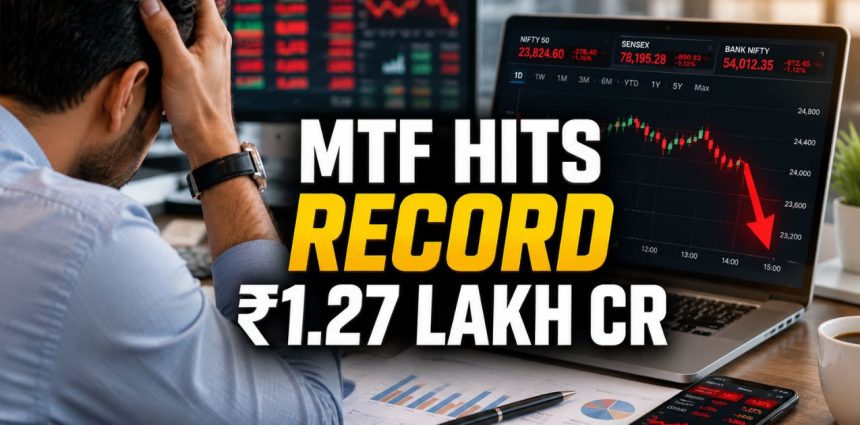
- India’s average MTF book surged 65.4% YoY to an all-time high of Rs 1.27 lakh crore in May 2026, per CareEdge Ratings
- The Nifty 50 has returned -4.38% over the past 12 months, while leverage in the same period grew over 65%
- NSE commands 96% of total MTF market share; its book stands at Rs 1.22 lakh crore
- Nearly 50% of MTF industry exposure sits in non-F&O, illiquid mid- and small-cap stocks
- Some brokers are running MTF books at close to 500% of net worth, the SEBI-permitted ceiling
- MTF has jumped from Rs 24,920 crore in FY23 to Rs 1.27 lakh crore in May 2026, a 5x rise in under 3 years
- RBI’s revised collateral framework for brokers activates July 1, 2026, one week away
India’s MTF Book Breaks All-Time Record in May 2026 as Nifty Posts Negative 1-Year Returns
India’s average Margin Trading Facility book hit an all-time high of Rs 1.27 lakh crore in May 2026, surging 65.4% year-on-year, according to CareEdge Ratings, even as FIIs pulled out Rs 2.8 lakh crore from Indian equities in the same calendar year.
The outstanding MTF book on the NSE climbed to Rs 1,22,151 crore as of May 15, 2026.
The pace of leverage growth has significantly outstripped gains in benchmark indices: the Nifty 50 has returned -4.38% over the past 12 months, even as investor borrowing to buy stocks expanded by over 65% in the same window.
That divergence, record leverage against negative index returns, is the structural problem regulators and brokers are now openly flagging.
How the MTF Book Has Grown: FY23 to May 2026
The MTF book has increased from Rs 24,920 crore in FY23 to Rs 1,16,000 crore as of December 2025, a figure as large as India’s entire daily equity cash segment turnover. By May 2026, it has crossed Rs 1.27 lakh crore: more than a fivefold increase in under three years.
| Period | Average MTF Book | YoY Growth |
|---|---|---|
| FY23 | Rs 0.25 lakh crore | — |
| September 2025 | Rs 1.02 lakh crore | ~19% |
| January 2026 | Rs 1.20 lakh crore | 42.9% |
| April 2026 | Rs 1.14 lakh crore | 60% |
| May 2026 (ATH) | Rs 1.27 lakh crore | 65.4% |
Source: CareEdge Ratings, PPFAS Asset Management (FY23 figure), NSE
PPFAS Asset Management flagged that the pace of growth warrants careful monitoring, particularly due to the increasing concentration of margin trading activity at the broker level.
NSE at 96%, F&O Volumes Stall on Higher STT
| Exchange | MTF Book (May 2026) | YoY Change |
|---|---|---|
| NSE | Rs 1.22 lakh crore | ~65% |
| BSE | Rs 0.05 lakh crore | +58.3% |
| Total Industry | Rs 1.27 lakh crore | +65.4% |
Source: CareEdge Ratings
Overall ADTO across F&O and equities nudged up just Rs 0.2 lakh crore sequentially in May, while cash market ADTO rose 5.7% to Rs 1.52 lakh crore.
The Finance Ministry’s increase in Securities Transaction Tax rates on derivatives trading in Union Budget 2026–27 made F&O more expensive, pushing traders toward the cash market’s MTF facility.
The migration from expensive derivatives to leveraged delivery has been one of the structural drivers of the MTF book’s recent acceleration.
Where the Real Risk Sits: The MTF Exposure Mix
The composition of India’s MTF book matters as much as its size.
| MTF Segment | Approximate Share of Industry Book |
|---|---|
| F&O-eligible stocks (liquid, large-cap) | ~50% |
| Non-F&O stocks (illiquid, mid/small-cap) | ~50% |
Source: Nithin Kamath, X (May 2026); Zerodha
Nearly 50% of the industry’s MTF exposure is linked to non-F&O stocks. These are predominantly mid- and small-cap names that hit lower circuits fast when sentiment turns.
Once a circuit fires, trading halts. Brokers typically cover defaults by liquidating pledged collateral, but if a stock’s price falls significantly, brokers trying to dump illiquid mid-caps do not find any buyers.
The result: a margin call goes out, investor has no cash, the broker sells into a frozen market, losses compound, and bad debt migrates from investor to intermediary, and potentially to the broader ecosystem.
Broker-Level Risk: Zerodha at 25%, Others Approaching the 500% Ceiling
| Broker Category | MTF as % of Net Worth |
|---|---|
| Zerodha (disclosed) | ~25% |
| Several industry brokers | Approaching 500% |
| SEBI regulatory ceiling | 500% |
Source: Nithin Kamath, X (May 2026); SEBI regulations
Zerodha’s MTF book remains at roughly 25% of the firm’s net worth. But some brokers may have MTF exposure approaching 500% of net worth, the maximum limit permitted by regulators. At that level, a concentrated selloff in the wrong stocks would not just hurt investors; it could threaten the broker’s own financial stability.
Kamath highlighted risks in “layered leverage”, where a customer pledges Stock A, gets 80% margin on it, and uses that to take further positions worth 400% in the same stock, creating a highly concentrated house of cards. Zerodha currently does not permit collateral margin for MTF purchases, though competitive pressure may eventually change that.
July 1 Is the Hard Test: RBI’s New Framework Kicks In
From July 1, bank guarantees and intraday funding facilities used by brokers for proprietary trading must be backed by 100% cash or cash-equivalent collateral, with no indication from regulators that the timeline will shift.
The RBI’s Commercial Banks, Credit Facilities Amendment Directions, 2026, mandates 100% collateralisation of all credit to capital market intermediaries and a minimum 40% haircut on equity collateral.
In practice, if a broker pledges Rs 100 in shares to borrow from a bank, the bank counts only Rs 60. Borrowing capacity compresses. Higher broker funding costs feed directly into higher retail MTF interest rates; the pass-through begins July 1.
Broker associations have made multiple representations to the RBI, exchanges, clearing corporations, and the Industry Standards Forum but have received no indication from regulators on whether the implementation timeline or the framework could be revised.
What Traders Should Watch
| Trigger | Why It Matters |
|---|---|
| July 1, 2026 — RBI norms activate | Could raise broker funding costs and push retail MTF interest rates higher |
| CareEdge June 2026 MTF data (due mid-July) | First reading under new regulatory regime confirms if leverage is still expanding |
| Mid/small-cap correction | First real stress test of non-F&O collateral quality, where 50% of exposure sits |
| FII flow reversal | Tests whether retail leveraged absorption can hold without institutional buying support |
Bottom Line
India’s MTF book rising from Rs 24,920 crore in FY23 to Rs 1.27 lakh crore in May 2026 is a leverage story, not a bull market story. The Nifty has returned -4.38% in the past year. Leverage has grown 65.4%. Half the book sits in illiquid stocks with no exit during a crash.
Some brokers are at the regulatory ceiling. And the RBI framework that will raise borrowing costs for the entire system goes live in seven days. The CareEdge June 2026 MTF data, due mid-July, will be the first real signal of whether India’s record leverage pile is beginning to deflate or still growing into a tighter funding regime.
Track live NSE MTF data and FII flows on the [NiftyTrader FII-DII Tracker →]
Disclaimer: This article is for informational purposes only and does not constitute investment advice. Margin trading carries significant risk of loss. Consult a SEBI-registered financial advisor before taking leveraged positions.