
Axis Bank Prices $300 Million Notes at 5.348%; Moody’s Assigns Baa3 Rating
Axis Bank has tapped global debt markets with a $300 million fund raise, a move that signals growing confidence in India’s banking sector and rising demand for foreign currency resources.
The private sector lender has priced its 5-year Senior Unsecured Notes due June 30, 2031, at a fixed coupon rate of 5.348 percent, according to a regulatory filing.
The development comes at a time when major Indian banks are actively strengthening their foreign currency funding base to support overseas deposit growth and meet rising demand from NRI customers.
Axis Bank raises $300 million through overseas bond issue
Axis Bank said the notes were issued under its $500 million Global Medium Term Note Programme through its GIFT City International Banking Unit (IBU).
The bond issuance allows the bank to access international capital markets and diversify its funding sources beyond domestic deposits.
The successful pricing of the notes indicates investor appetite for high-quality Indian banking assets despite global interest rate uncertainties.
Read More : Govt Expects Rs 2 Lakh Crore ECLGS 5.0 Demand as Firms Seek Credit Buffer
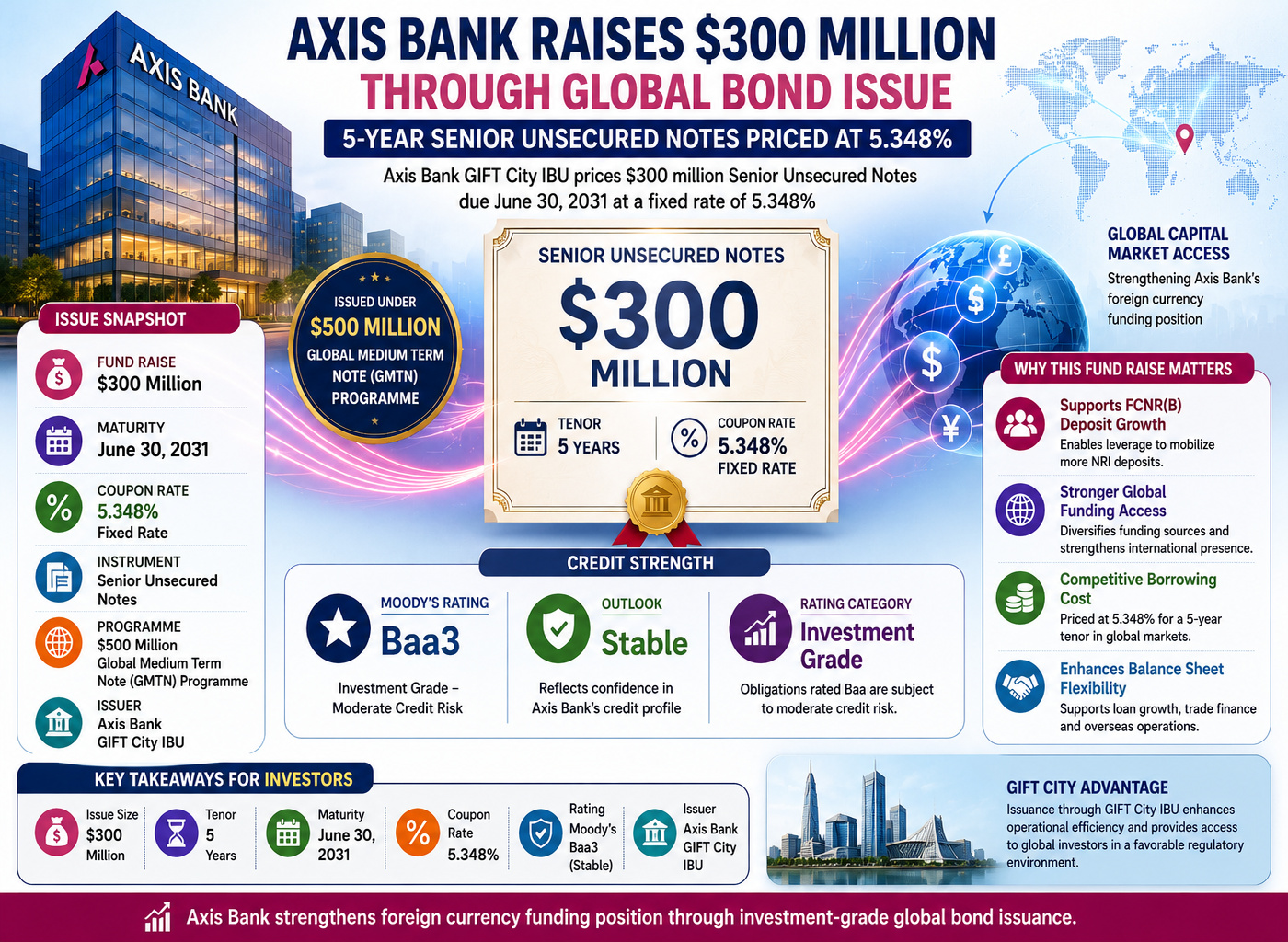
| Metric | Details |
|---|---|
| Issue Size | $300 Million |
| Instrument | Senior Unsecured Notes |
| Tenor | 5 Years |
| Maturity Date | June 30, 2031 |
| Coupon Rate | 5.348% Fixed Rate |
| Rating | Moody’s Baa3 (Stable Outlook) |
| Issuer | Axis Bank GIFT City IBU |
| Programme | Global Medium Term Note (GMTN) Programme |
| Risk Category | Investment Grade / Moderate Credit Risk |
Strategic Drivers and Market Context
1. Funding NRI Client Leverage
2. Capital and Balance Sheet Optimisation
3. Low Structural Risk
Why the timing of the fund raise is important
The fund raise comes as several Indian banks seek additional foreign currency resources to support FCNR (B) deposit mobilisation.
Banks have been looking to provide leverage and attractive products to Non-Resident Indian (NRI) customers who are placing fresh foreign currency deposits.
Accessing overseas debt markets enables lenders to secure longer-term funding while strengthening their foreign currency balance sheets.
Market participants believe such capital-raising efforts could gain momentum if demand for FCNR deposits continues to rise.
Essential Portfolio Risks for Noteholders
- Interest Rate Risk: The fixed 5.348% coupon exposes investors to capital losses if global benchmark interest rates (such as US Treasuries) rise prior to the 2031 maturity.
- Credit Rating Boundary: The Moody’s “Baa3” rating represents the lowest tier of investment grade; any financial deterioration could trigger a downgrade to speculative (“junk”) status.
- Unsecured Structure: In a liquidation event, noteholders rank equally with other senior creditors but have no direct claim or backing from specific bank assets.
Moody’s assigns Baa3 rating with stable outlook
At the request of Axis Bank, Moody’s Ratings assigned a Baa3 rating with a Stable Outlook to the bond issue.
According to Moody’s rating scale, obligations rated Baa are considered investment grade and carry moderate credit risk.
The rating agency noted that such instruments are regarded as medium-grade obligations, although they may possess certain speculative characteristics.
The investment-grade rating is expected to support investor confidence and improve the attractiveness of the notes among global fixed-income investors.
What are senior unsecured notes?
Senior unsecured notes are debt instruments that are not backed by specific assets of the issuer.
However, they rank ahead of subordinated debt holders in the event of liquidation or bankruptcy.
Because these instruments do not carry collateral backing, investors closely track the issuer’s financial strength, profitability, capital adequacy, and credit ratings before investing.
For Axis Bank, the successful issuance reflects continued confidence in its credit profile and long-term growth prospects.
What impact could this have on investors and the market?
For investors, the bond issuance highlights Axis Bank’s ability to raise capital from international markets at competitive rates.
A stronger foreign currency funding base can help the bank support overseas business growth, NRI banking operations, and foreign currency deposit mobilisation.
For banking sector investors, the transaction signals that global investors continue to show confidence in leading Indian financial institutions despite an uncertain global macroeconomic environment.
Traders may also view the development as a positive indicator for large private sector banks seeking diversified funding sources.
If overseas borrowing activity increases across the banking sector, it could improve liquidity flexibility and support future business expansion, particularly in international banking and foreign currency lending segments.