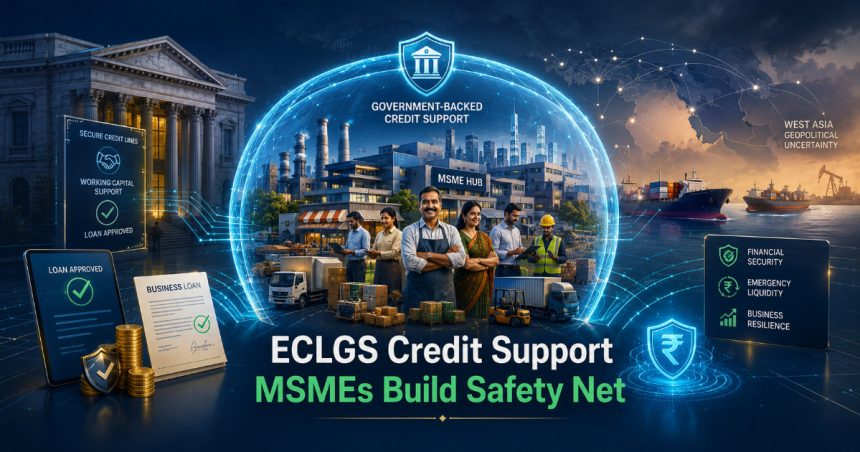
Govt Expects Rs 2 Lakh Crore ECLGS 5.0 Demand as Firms Seek Credit Buffer
A growing number of Indian businesses are rushing to secure emergency credit lines even though many have no immediate need for funds. The trend is raising an important question for investors: Are companies preparing for a larger economic shock from the ongoing West Asia crisis?
The government expects businesses to secure nearly ₹2 lakh crore of credit under ECLGS 5.0 by FY27, highlighting rising demand for financial safety nets despite stable economic conditions.
ECLGS 5.0 Businesses are securing credit lines before they actually need them
The Emergency Credit Line Guarantee Scheme (ECLGS) 5.0 was approved by the government to help businesses manage disruptions linked to the West Asia conflict.
While companies are applying aggressively for guaranteed loans, many are not immediately drawing down the sanctioned amount.
A senior government official said:
“Many businesses want to keep a liquidity line available as a precaution. They may not draw down the entire amount immediately, but they want access to credit if the need arises.”
The government believes businesses are seeking financial flexibility rather than responding to an immediate liquidity crisis.
Read More : Meta Appoints Kunal Shah to Grow WhatsApp India Into a $1 Billion Business
Key Highlights of ECLGS 5.0
-
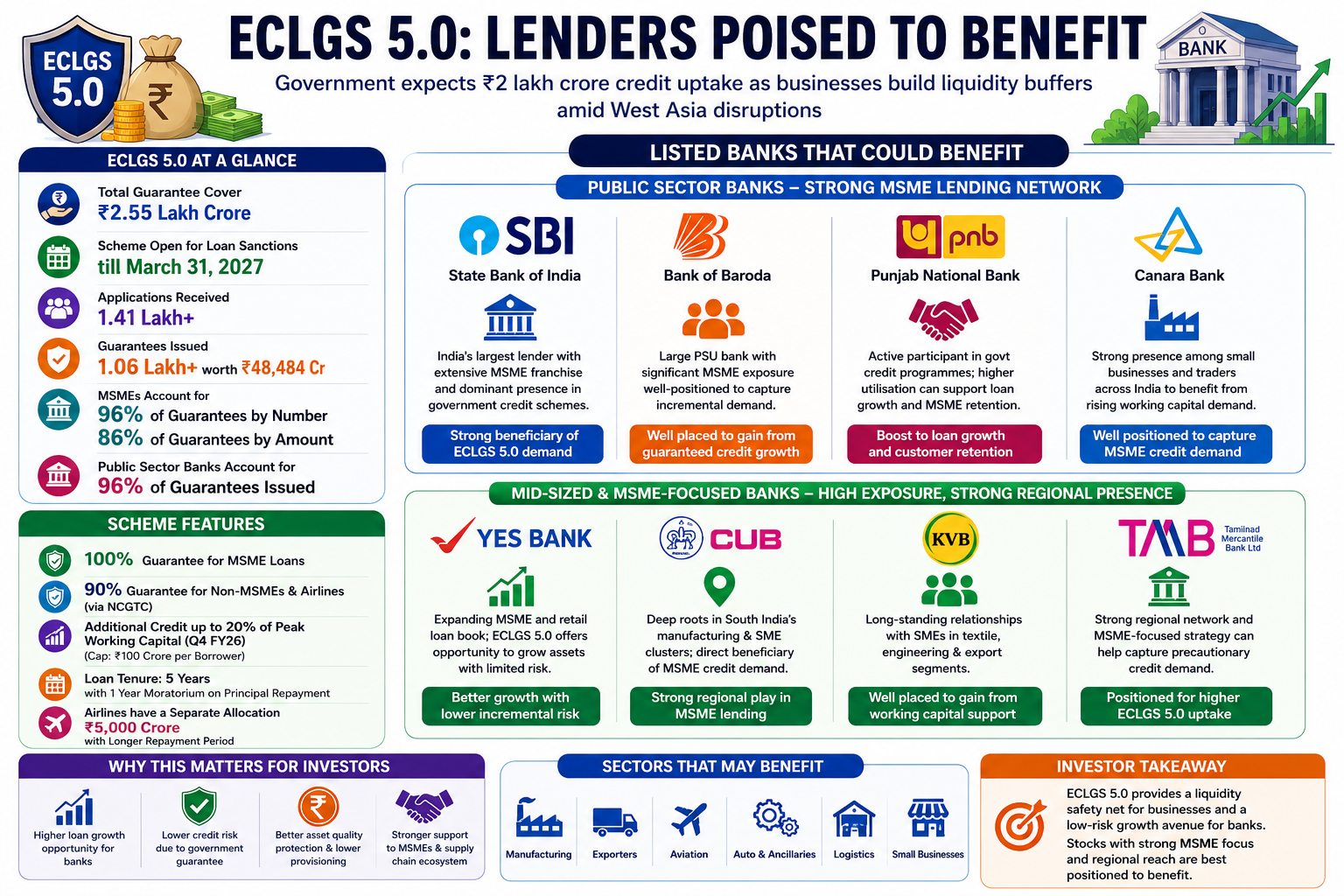
- Total Cover: Offers a guarantee pool of ₹2.55 lakh crore.
- Deadline: Open for loan sanctions until March 31, 2027.
- Current Status: Over ₹48,000 crore in guarantees have already been issued.
- Application Volume: Over 1.41 lakh applications received with 1.06 lakh guarantees approved.
Target Beneficiaries & Guarantee Structure
-
- MSMEs: Secure a 100% government guarantee on eligible loans.
- Non-MSMEs & Airlines: Receive a 90% guarantee cover via NCGTC.
- Dominant Sector: MSMEs make up 96% of guarantees by number and 86% by amount.
Primary Purpose
- Safety Net: Provides emergency credit lines against West Asia trade disruptions.
- Precautionary Liquidity: Firms are securing credit lines without immediate full drawdown to maintain a cash buffer.
Strong demand under ECLGS 5.0 signals rising caution among firms
The early response to ECLGS 5.0 has been strong.
According to official data, the scheme has already received 1.41 lakh applications, while more than 1.06 lakh guarantees worth ₹48,484 crore have been issued.
Public sector banks account for nearly 96 percent of all guarantees issued so far.
The scheme carries a total guarantee cover of ₹2.55 lakh crore and remains open for loan sanctions until March 31, 2027.
Government officials expect demand to remain strong as businesses continue building precautionary liquidity buffers.
Listed Stocks That Could Benefit From ECLGS 5.0
The government’s ₹2.55 lakh crore ECLGS 5.0 guarantee programme is expected to support credit growth across banks with large MSME portfolios. Since the scheme carries 90%-100% sovereign-backed guarantees, lenders can expand loan books while keeping credit risk relatively contained.
Public Sector Banking Stocks
| Stock | Current Price | Change |
|---|---|---|
| State Bank of India (SBIN) | ₹1,041.70 | +1.74% |
| Bank of Baroda (BANKBARODA) | ₹280.05 | +0.94% |
| Punjab National Bank (PNB) | ₹107 . 89 | +0.43% |
| Canara Bank (CANBK) | ₹130 . 58 | +0.16% |
Mid-Sized & MSME-Focused Banks
| Stock | Current Price | Change |
| Yes Bank (YESBANK) | ₹25 . 03 | +1.91% |
| City Union Bank (CUB) | ₹200.65 | +1.21% |
| Karur Vysya Bank (KARURVYSYA) | ₹294 . 85 | +0.15% |
| Tamilnad Mercantile Bank (TMB) | ₹764.00 | +0.64% |
Track Live : Live Stock Screener for Indian Markets
MSMEs emerge as the biggest beneficiaries of the scheme
MSMEs have emerged as the largest users of the ECLGS 5.0 programme.
The sector accounts for nearly 96 percent of guarantees issued by number and approximately 86 percent by value.
The government provides a 100 percent guarantee cover for eligible MSME loans, making the scheme highly attractive for small businesses seeking working capital support.
Non-MSME borrowers and airlines are eligible for a 90 percent government guarantee, backed through the National Credit Guarantee Trustee Company (NCGTC).
Why the government believes the economy remains resilient
Despite concerns surrounding geopolitical tensions in West Asia, the government says broader economic indicators remain stable.
Officials noted that economic activity, borrowing demand, and business operations have largely remained intact.
According to the government’s assessment, businesses are not responding to a severe disruption. Instead, they are creating financial cushions to remain prepared for any unexpected shocks.
That distinction is important because it suggests confidence in the economy remains relatively strong.
The MSME credit gap remains a major challenge
Government officials acknowledge that a significant portion of India’s MSME credit gap stems from limited access to formal banking channels.
Many businesses that cannot obtain bank loans often rely on NBFCs, gold-loan companies, or informal borrowing sources.
Officials said one of the key objectives of ECLGS 5.0 is to bring more business borrowing into the formal financial system.
Under the scheme, eligible borrowers can access additional credit of up to 20 percent of peak working capital utilised during the fourth quarter of FY26, subject to a maximum limit of ₹100 crore per borrower.
Loans carry a five-year tenure, including a one-year moratorium on principal repayment.
Why ECLGS 5.0 Matters for Investors
1. Banking Sector: Growth Without the Credit Risk
-
- Margin Expansion: Banks can grow their loan books and earn interest income without increasing their provisioning costs.
- Sovereign Backing: The 90% to 100% government guarantee effectively drops the risk weight on these loans to zero, protecting bank balance sheets from Non-Performing Assets (NPAs).
- Liquidity Channeling: Large state-backed lenders and private banks with strong MSME portfolios are positioned to deploy excess liquidity safely.
2. Corporate Sector: Protection of Profit Margins
-
- Suppressed Capital Costs: Access to government-backed credit prevent companies from relying on expensive shadow banking or unorganised credit markets.
- Working Capital Protection: Industries reliant on import/export or global supply chains can absorb freight hikes and shipping delays without halting operations.
- Survival Rates: The 100% guarantee for MSMEs ensures that smaller suppliers to publicly listed companies stay solvent, preventing supply chain breakages for larger corporations.
3. Macro Market Signals: Precaution Over Panic
- Hidden Stress Indicator: The rush for liquidity indicates that corporate India is experiencing higher anxiety over external geopolitical shocks than headline GDP growth numbers suggest.
- Dividend Conservatism: Investors should expect companies in vulnerable sectors to hoard this cash, potentially leading to more conservative dividend payouts or deferred capital expenditure (CapEx) plans in the near term.
Step-by-Step Application Process
1. Digital Registration & Pre-Approval
-
- Visit the JanSamarth Portal.
- Register using your mobile number and email.
- Select “Emergency Credit Line Guarantee Scheme (ECLGS) 5.0” from the business loan categories.
- Enter your Udyam Registration Number (mandatory for MSMEs) and PAN.
- Fill in your existing business loan/credit details as requested.
- The portal will check your preliminary eligibility and generate a digital approval letter.
2. Lender Matching & Submission
-
- Select your existing primary bank or NBFC (called a Member Lending Institution or MLI) from the drop-down list on the portal.
- Submit the digital application. The portal automatically routes it directly to your bank’s branch.
3. Bank Verification & Disbursal
-
- Your bank will verify that your credit facilities were active and classified as “Standard” (not SMA-2 or NPA) as of March 31, 2026.
- The bank calculates your eligible amount: up to 20% of your peak fund-based working capital outstanding during Q4 of FY 2025–26 (Jan 1 to Mar 31, 2026).
- Once satisfied, the bank obtains the collateral-free guarantee certificate from the NCGTC and disburses the credit line to your account.
Essential Checklist & Required Documents
- Identity & Business Proof: PAN card, GSTIN number, and Udyam Registration Certificate.
- Financial Statements: Bank statements for the last 6 months and audited financials.
- Loan Details: Existing working capital sanction letters to prove your credit history before March 31, 2026.