Need to Know
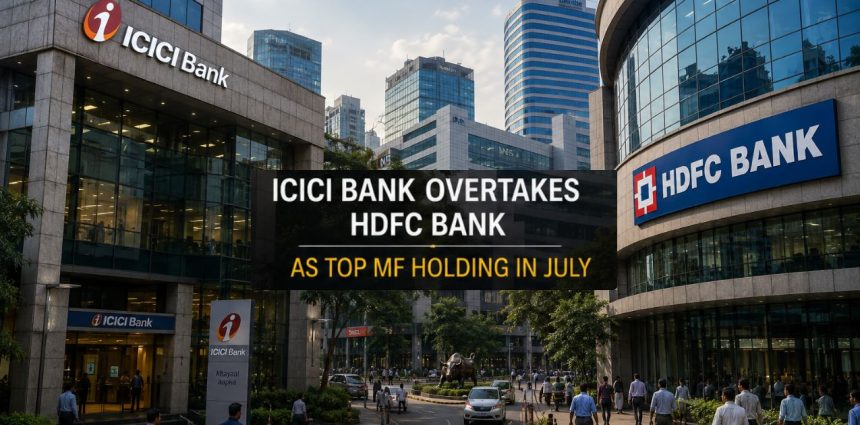
- ICICI Bank overtook HDFC Bank in July as the most-valued stock in mutual fund portfolios, ending its rival’s three-year run at the top.
- Mutual funds held about 2.10 billion ICICI Bank shares worth ₹3.01 lakh crore, versus 3.94 billion HDFC Bank shares worth ₹2.96 lakh crore.
- The shift comes despite HDFC Bank remaining the larger lender by market value and trading at a lower 1.78x price-to-book, against 2.43x for ICICI Bank.
- HDFC Bank shares are down nearly 27% in 2026 and hit a fresh 52-week low of ₹722 on August 12, while ICICI Bank is up about 7%.
- ICICI Bank CEO Sandeep Bakhshi’s two-year reappointment (Oct 4, 2026 – Oct 3, 2028) has already received RBI approval; HDFC Bank CEO Sashidhar Jagdishan’s current term ends October 26, 2026.
Mutual funds have just changed the pecking order among India’s two biggest private-sector banking stocks. In July, ICICI Bank overtook HDFC Bank as the most-valued stock in mutual fund portfolios for the first time in three years. The interesting part isn’t simply that one bank moved ahead of the other, it’s that funds now have more money invested in the lender trading at the higher price-to-book multiple, while the larger rival remains considerably cheaper on that measure. That’s a valuation tension worth watching.
Check Live: ICICI BANK Options Chart | Nifty Trader
ICICI Bank Overtakes HDFC Bank as Top MF Holding
Mutual funds held about 2.10 billion shares of ICICI Bank worth ₹3.01 lakh crore in July, compared with around 3.94 billion HDFC Bank shares worth ₹2.96 lakh crore. ICICI Bank represented 5.35% of equity MF holdings, versus 5.24% for HDFC Bank. The number of schemes holding the two stocks also favoured ICICI Bank: about 552 MF schemes held it, compared with 514 schemes holding HDFC Bank.
The change ends HDFC Bank’s run as the most-valued MF portfolio holding since July 2023. Its MF holding value had crossed ₹3.39 lakh crore in November 2025, underlining how sharply the ranking has shifted since then. This isn’t simply a story of mutual funds abandoning HDFC Bank, though, MF ownership actually increased in both lenders. That distinction matters for investors.
The Valuation Puzzle: Why Is the Costlier Stock Winning?
On valuation, the numbers look counterintuitive. HDFC Bank trades at around 1.78 times price-to-book, compared with 2.43 times for ICICI Bank. Both sit below their respective five-year averages of roughly 2.90 times and 2.99 times. So the cheaper bank remains the bigger lender by market value, yet the more expensive stock now commands the larger MF portfolio value.
Analysts attribute part of HDFC Bank’s valuation discount to governance, leadership succession and foreign-investor selling. Rajesh Palviya of Axis Securities said FII selling concentrated in HDFC Bank has contributed to its underperformance.
Siddharth Rajpurohit of Systematix Group pointed to governance concerns following former chairman Atanu Chakraborty’s abrupt resignation and the subsequent scrutiny involving senior management. The takeaway isn’t that mutual funds have declared one bank permanently superior, the data shows institutional positioning has shifted while the valuation gap remains unresolved.
HDFC Bank’s Leadership Question Remains a Market Trigger
HDFC Bank’s leadership situation remains an important variable. The RBI extended Keki Mistry’s tenure as interim part-time chairman until September 18, 2026, or until a regular chairman is appointed, whichever comes earlier.
Meanwhile, CEO Sashidhar Jagdishan’s current term runs until October 26, 2026; the board acted on an internal review into issues linked to the earlier governance controversy, but his reappointment remains an important event for investors to monitor.
The contrast with ICICI Bank is significant. The RBI has already approved Sandeep Bakhshi’s reappointment for another two years, beginning October 4, 2026 and running through October 3, 2028, with shareholder approval still to be sought.
That gives ICICI Bank a clearer near-term management runway, while HDFC Bank still faces a leadership decision that could influence how investors value the stock.
Check Live: HDFC BANK Options Chart | Nifty Trader
The Stock Performance Gap Has Become Impossible to Ignore
The market has been moving in opposite directions. HDFC Bank fell 6.2% in July and is down nearly 27% for 2026, having touched a fresh 52-week low of ₹722 on August 12. ICICI Bank gained 4.4% in July and is up about 7% for the year.
That performance gap has helped narrow the valuation difference between the two lenders, but the bigger point is that MF investors have increased exposure to both banks, not rotated wholesale out of HDFC Bank.
MF ownership in HDFC Bank rose to around 30.04%, from 26.7% at end-December 2025, while ICICI Bank’s MF stake increased to around 29.6%, from 26.09%. The July ranking is better read as a relative shift in portfolio value, not an institutional exit from HDFC Bank.
Track live FII/DII flow data shaping bank ownership trends on the NiftyTrader FII-DII Tracker.
HDFC Bank Is Still Bigger — But the Gap Has Narrowed
HDFC Bank remains India’s larger bank by market capitalisation, at around ₹11.20 lakh crore against roughly ₹10.19 lakh crore for ICICI Bank.
That means the MF ranking and market-cap ranking now tell two different stories: HDFC Bank stays ahead on market cap and stays cheaper on price-to-book, while ICICI Bank has moved ahead on MF portfolio value and has significantly outperformed on 2026 stock returns.
That divergence is what makes this relevant for traders, not just fund-tracker watchers.
NiftyTrader Desk View
| Stock | Key Trigger | Trader View |
|---|---|---|
| ICICI Bank | Overtook HDFC Bank as the top MF holding in July; CEO reappointment already RBI-approved through Oct 2028 | Higher P/B at 2.43x vs 5-yr average of 2.99x; up about 7% YTD |
| HDFC Bank | CEO Jagdishan’s term ends Oct 26, 2026 — reappointment an open governance trigger; interim chairman’s extension runs to Sept 18 | Fresh 52-week low of ₹722 (Aug 12); down nearly 27% YTD; P/B at 1.78x vs 5-yr average of 2.90x |
Source: Economic Times, NSE, AMFI-linked fund data
Bottom Line
ICICI Bank’s rise to the top of mutual fund portfolios is significant, but it isn’t yet a verdict on the ICICI-HDFC contest. The smaller lender now has the higher MF portfolio value and stronger 2026 stock performance, while its rival remains the larger bank and trades at a considerably lower price-to-book multiple.
The real question is what happens next: if HDFC Bank resolves its leadership uncertainty without further disruption, its valuation discount could narrow; if that uncertainty persists while ICICI Bank keeps delivering steady performance, the institutional preference gap could widen further. That outcome is still open, which is what makes this more than a mutual-fund ranking story.
Read Next: RBI Loan Recovery Rules 2027: Can Banks Lock Your Phone?
FAQs
Which bank is now the top MF holding in India?
ICICI Bank overtook HDFC Bank in July 2026, with mutual funds holding about ₹3.01 lakh crore of ICICI Bank shares versus ₹2.96 lakh crore of HDFC Bank shares.
Why did ICICI Bank overtake HDFC Bank in MF portfolio value?
The shift reflects a combination of relative stock performance, portfolio positioning and concerns around HDFC Bank’s governance and leadership outlook — the data doesn’t establish that governance concerns alone caused the switch.
Is HDFC Bank still bigger than ICICI Bank?
Yes. HDFC Bank remains larger by market capitalisation despite ICICI Bank overtaking it in mutual fund portfolio value.
Is ICICI Bank’s CEO reappointment approved?
Yes. The RBI approved Sandeep Bakhshi’s reappointment for a two-year term from October 4, 2026 to October 3, 2028. Shareholder approval is still to be sought.
When does HDFC Bank CEO Sashidhar Jagdishan’s current term end?
His current term is scheduled to end on October 26, 2026.
Disclaimer: This article is for informational purposes only and does not constitute investment advice. Please consult a SEBI-registered investment advisor before making any investment decisions. NiftyTrader does not take responsibility for investment decisions made based on this content.