
FM Sitharaman: Banking Panel Likely This Month; PSBs Post Record Rs.1.98 Lakh Crore Profit
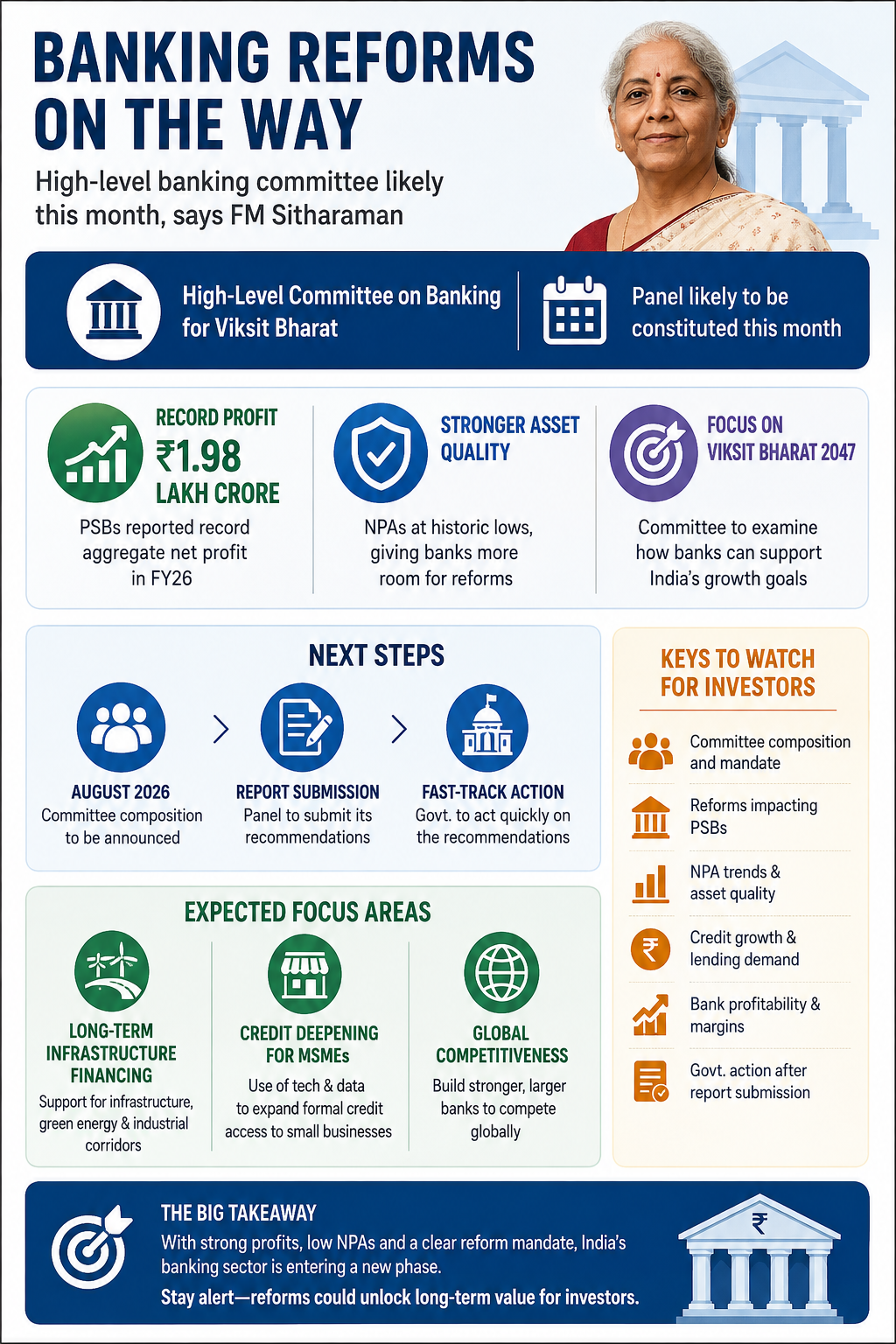
India’s banking sector could be heading towards another major reform phase. Finance Minister Nirmala Sitharaman said the government will soon announce the composition of a high-level banking committee, with a senior Finance Ministry source indicating that the panel could be constituted this month.
The development comes at a time when Indian banks are reporting their strongest financial performance in years. With public sector banks (PSBs) posting record profits and asset quality improving sharply, the government appears ready to examine what the banking sector needs to support India’s long-term growth ambitions.
Track Live : Bank Nifty Levels Today
FM Sitharaman: Banking Why the government is setting up a high-level banking committee
Speaking at the first day of the two-day PSB Confluence 2026 in New Delhi, Sitharaman said the government would move quickly once the committee submits its recommendations.
“Once the committee gives its report, we will move fast on the recommendations,” the finance minister said.
The High-Level Committee on Banking for Viksit Bharat was first proposed in the Union Budget 2026-27. The objective is to review the banking sector and examine whether banks are adequately aligned with India’s economic and development goals.
The committee has not yet been formally constituted, but the government is now expected to announce its composition soon.
Why Now? The Core Triggers
-
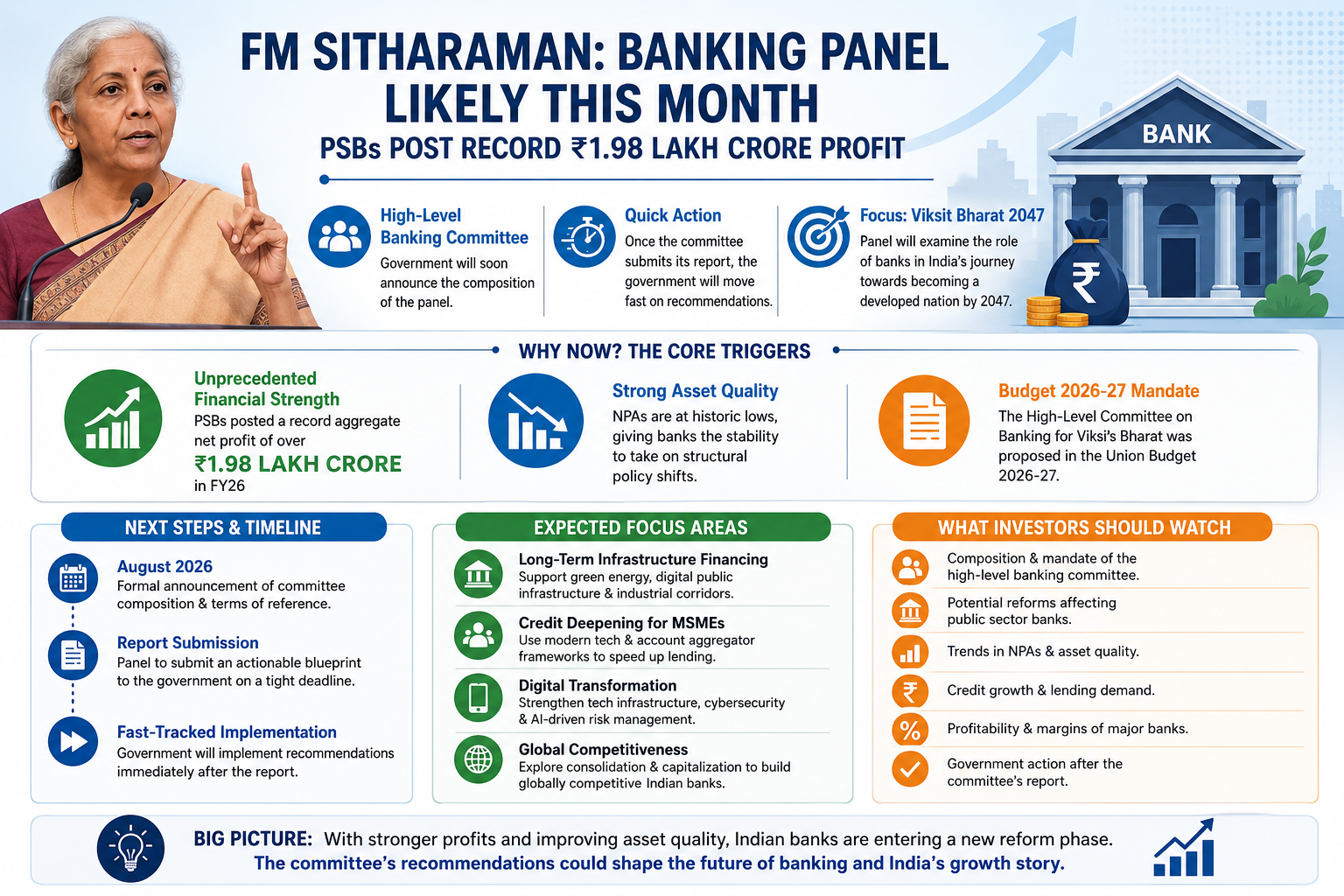
- Unprecedented Financial Strength: Public Sector Banks (PSBs) clocked a record aggregate net profit of over ₹1.98 lakh crore in FY26. Non-Performing Assets (NPAs) are at historic lows, making the banking system stable enough to absorb structural policy shifts.
- Budget 2026-27 Mandate: The panel, officially termed the High-Level Committee on Banking for Viksit Bharat, was originally proposed during the Union Budget announcement earlier this year.
- Viksit Bharat 2047 Timeline: The finance ministry wants to rapidly modernise credit delivery systems to sustain the high GDP growth required over the next two decades.
Banking sector reform is being linked to India’s 2047 ambition
The committee’s broader focus will be the role of banks in helping India achieve its Viksit Bharat 2047 objective.
Sitharaman said the panel would examine how banks can contribute to the country’s ambition of becoming a developed economy by 2047.
“The committee will look at the role of banks towards Viksit Bharat,” she said, adding that “2047 is not too far away.”
For investors, this signals that the committee could look beyond traditional banking reforms. Its recommendations may potentially address how banks support infrastructure, businesses, credit growth and other areas considered important for long-term economic expansion.
Next Steps and Execution Timeline
- August 2026: Formal announcement of the committee’s composition and official terms of reference by the Ministry of Finance.
- Report Submission: The panel will operate on a tight deadline to submit its actionable blueprint to the central government.
- Fast-Tracked Legislation: Finance Minister Nirmala Sitharaman explicitly confirmed that the government will bypass bureaucratic delays and implement the recommendations immediately upon receiving the report.
Track Live : NSE Option Chain — Live
Expected Focus Areas of the Committee
- Long-Term Infrastructure Financing: Creating dedicated frameworks for banks to fund green energy, digital public infrastructure, and heavy industrial corridors without creating systemic asset-liability mismatches.
- Credit Deepening for MSMEs: Leveraging modern tech stacks and account aggregator frameworks to formalise and speed up lending to small businesses.
- Global Competitiveness: Exploring consolidation or capitalization pathways to elevate at least a few Indian banks into the global top-tier brackets by asset size.
Improving asset quality gives banks room for fresh reforms
The timing of the proposed banking committee is also significant because Indian banks are currently in a much stronger financial position.
Sitharaman highlighted the improvement in asset quality, pointing to the significant reduction in non-performing assets (NPAs).
“NPAs are the lowest that Indian banks have seen, better position to take on reforms now,” she said.
Lower NPAs can strengthen banks’ balance sheets and provide greater room to increase lending. For public sector banks in particular, the improvement in asset quality has helped change investor perception after years of concerns surrounding bad loans.
This could make the proposed banking reforms more significant for the PSB segment.
Record PSB profits put the banking sector in a stronger position
The financial performance of public sector banks also provides an important backdrop to the government’s latest move.
Public sector banks reported a record aggregate net profit of more than ₹1.98 lakh crore in FY26.
The strong profitability indicates that PSBs have entered this potential reform cycle from a considerably healthier position.
For investors, sustained profitability and improving asset quality could support the case for stronger valuations in select public sector banking stocks, although future performance will still depend on credit growth, margins, asset quality and the eventual recommendations of the committee.
Why This Matters for Bank Stocks
The proposed banking committee could become an important trigger for bank stocks, but the actual impact will depend on what the panel recommends. The government has confirmed that it will review the sector’s role in India’s next phase of growth, while the specific reforms are yet to be decided.
Investors could watch for potential changes in:
- PSB governance and competitiveness
- Capital allocation and credit growth
- Technology and digital banking
- Infrastructure and strategic-sector lending
- Risk management and asset quality
- Priority-sector lending
The ongoing PSB Confluence is already discussing areas such as deposit mobilisation, investment financing, agriculture infrastructure and priority-sector lending, which could provide inputs for the future committee.
Here’s what happened today and why traders reacted
The immediate market significance is not simply the announcement of another government panel. The bigger signal for traders is that the government appears willing to act on banking reforms while the sector is financially stronger.
The proposed committee could become an important trigger for PSU bank stocks, particularly if its recommendations address structural reforms, lending capacity, governance or the future role of public sector banks.
However, investors should avoid treating the announcement itself as a guaranteed positive trigger. The actual impact will depend on the committee’s composition, the scope of its review and the recommendations eventually accepted by the government.
Banking stocks now have a fresh policy trigger to watch
The proposed High-Level Committee on Banking for Viksit Bharat gives the banking sector a new policy catalyst after a period of improving profitability and asset quality.
For traders, the committee announcement and subsequent government actions could create short-term opportunities in PSU bank stocks. For long-term investors, however, the more important factor will be whether the recommendations lead to meaningful structural improvements.
With the government indicating that it will move quickly after receiving the committee’s report, the banking sector could remain firmly on investors’ radar in the months ahead.