
India Buys Record 2.6 Million Bpd of Russian Oil in June as Refiners Diversify Supply
India has quietly achieved something that could reshape the outlook for energy markets, inflation and oil stocks. As geopolitical tensions continue to dominate global headlines, the country imported a record volume of Russian crude in June while securing enough crude oil and LPG supplies through August. The development not only strengthens India’s energy security but also shifts investor attention to companies that could benefit if crude prices remain stable.
India’s Russian oil imports climbed to a record high in June
India’s Russian oil imports reached a record 2.6 million barrels per day (bpd) in June, helping the country’s total crude imports climb to 4.93 million bpd, the highest ever recorded for the month.
According to commodity analytics firm Kpler, Russian crude imports jumped 37% from 1.9 million bpd in May, as Indian refiners increased purchases amid supply disruptions across West Asia.
The record buying highlights India’s continued strategy of securing competitively priced crude while diversifying supply sources.
“The ability to sustain record import levels while increasing purchases from Russia underscores the success of Indian refiners in diversifying supply and managing refinery economics,” said Sumit Ritolia, Lead Analyst for Refining Supply and Modelling at Kpler.
Track Live : Live Stock Screener for Indian Markets
Key Import Statistics
- Total June Imports: Reached a record 4.93 million bpd for the month.
- Russian Share: Accounted for 2.6 million bpd of the total volume.
- Month-on-Month Growth: Russian imports surged 37 per cent from 1.9 million bpd in May.
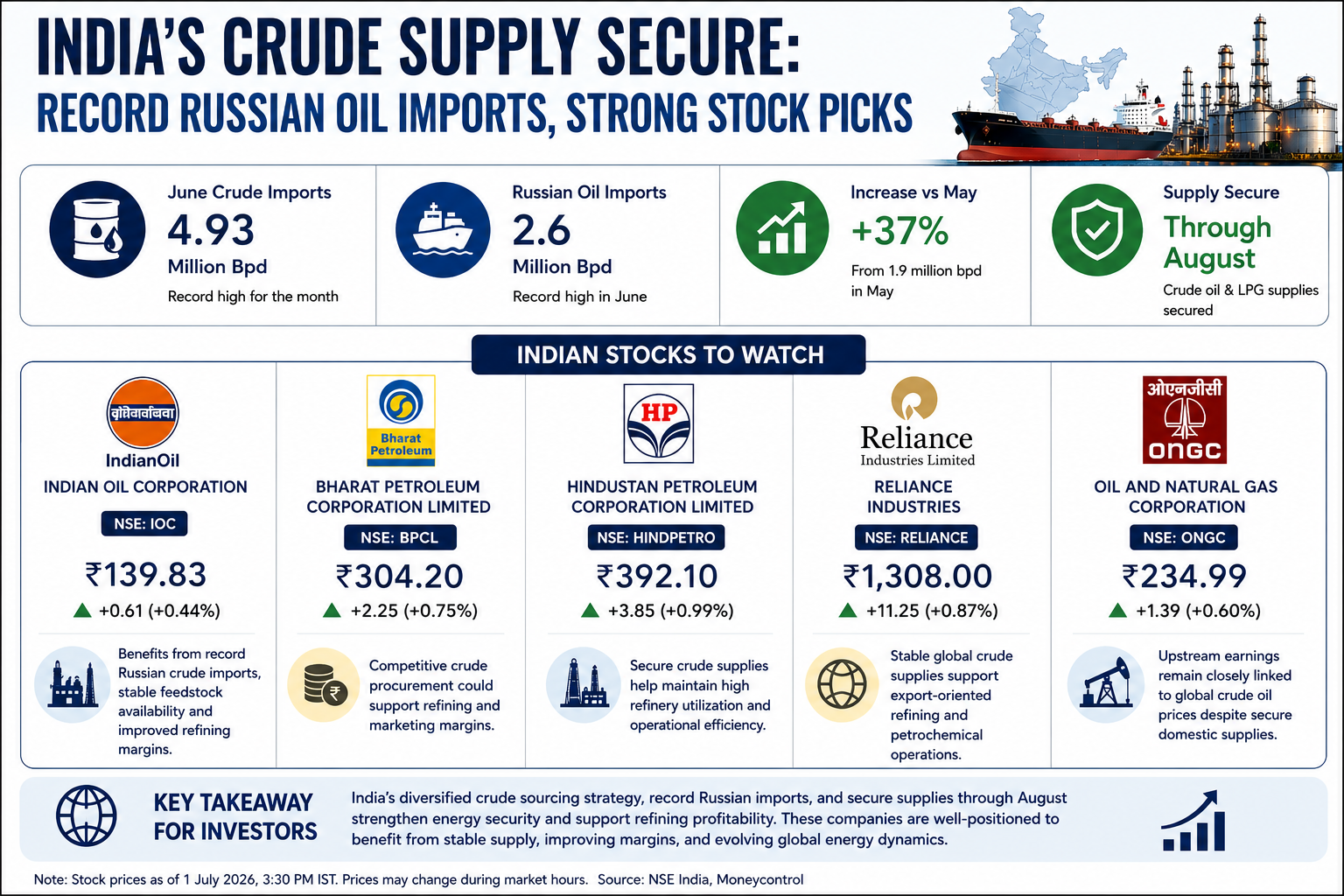
Indian Stocks to Watch
| Company | NSE Ticker | Current Stock Price* | Why Investors Should Watch |
|---|---|---|---|
| Indian Oil Corporation | IOC | ₹139.83 | Benefits from record Russian crude imports, stable feedstock availability and improved refining margins. |
| Bharat Petroleum Corporation Limited | BPCL | ₹304.20 | Competitive crude procurement could support refining and marketing margins. |
| Hindustan Petroleum Corporation Limited | HINDPETRO | ₹392.10 | Secure crude supplies help maintain high refinery utilization and operational efficiency. |
| Reliance Industries | RELIANCE | ₹1,308.00 | Stable global crude supplies support export-oriented refining and petrochemical operations. |
| Oil and Natural Gas Corporation | ONGC | ₹234.99 | Upstream earnings remain closely linked to global crude oil prices despite secure domestic supplies. |
*Latest available NSE prices from recent market data. Prices may change during market hours.
India’s crude supply remains secure through August
Alongside record imports, India has also secured adequate supplies of crude oil and liquefied petroleum gas (LPG) through August.
The reopening of the Strait of Hormuz has restored smoother energy flows from the Gulf, easing concerns over domestic fuel availability that had emerged during recent geopolitical tensions.
Industry officials say refiners typically purchase crude cargoes one to two months in advance, meaning most refinery requirements through August have already been locked in.
According to Kpler, the global supply outlook also remains favourable.
“Rising exports from Africa, Russia and Venezuela, together with higher OPEC+ production and continued crude flows through the Strait of Hormuz, should provide ample sourcing options.”
The recent decline in crude oil prices also indicates that global markets have become more comfortable with supply availability despite ongoing geopolitical risks.
Supply Security and Outlook
- Short-Term Security: India has secured adequate crude and LPG supplies through August.
- Strait of Hormuz: The reopening of this vital shipping lane has allowed Gulf energy supplies to flow back into the market, easing domestic availability concerns.
- Future Sourcing: The global supply outlook beyond August remains stable due to rising exports from Africa, Russia, and Venezuela, alongside higher OPEC+ production.
Read More : Apple India Price Hike: MacBook, iPad Costs Rise Up to 70%, May Slow 2026 Sales
India’s diversified sourcing strategy is paying off
India has steadily expanded its crude procurement beyond traditional suppliers.
Today, the country sources oil from Russia, the United States, Venezuela, Oman, Brazil, Angola, West African producers and several South American exporters.
This diversified sourcing strategy has reduced dependence on any single region and strengthened India’s ability to manage disruptions caused by geopolitical conflicts.
Industry officials also noted that the market currently has more sellers than buyers, giving Indian refiners greater flexibility during procurement.
Iranian crude is unlikely to return immediately
Despite easing geopolitical tensions, analysts believe a significant return of Iranian crude to India remains unlikely in the near term.
According to Kpler, Indian refiners already have sufficient supplies for the first half of August, leaving little urgency to buy additional cargoes.
Moreover, the current sanctions waiver expires on 21 August, creating uncertainty over future purchases.
Analysts believe India could import one or two opportunistic Iranian cargoes during July or August. However, any sustained increase is likely only after the first half of August and only if the regulatory environment becomes more favourable.
Here’s what happened today and why traders reacted
India reported its highest-ever June crude oil imports, driven by record purchases of discounted Russian crude.
At the same time, confirmation that crude and LPG supplies are secured through August reassured markets that India faces no immediate risk of fuel shortages despite geopolitical uncertainty.
The combination of strong supply security, diversified sourcing and softer crude prices strengthened investor confidence in India’s energy outlook.
Which companies could benefit if crude prices remain stable?
Lower and stable crude prices generally improve profitability for companies that consume petroleum products or refine crude into fuels.
Investors may closely watch:
- Indian Oil Corporation
- Bharat Petroleum Corporation
- Hindustan Petroleum Corporation
- Reliance Industries
Lower energy costs could also support airlines, paint manufacturers, logistics companies and chemical producers by reducing operating expenses.
However, investors should remember that refining margins, inventory gains and government fuel pricing policies will continue to influence company earnings.
What impact could this have on investors?
For investors, the latest import data reinforces India’s ability to secure affordable crude despite an uncertain geopolitical environment.
A stable crude supply could help contain fuel inflation, support the rupee by reducing energy supply risks and improve the earnings outlook for oil marketing companies if international prices remain favourable.
Going forward, investors should closely monitor Brent crude prices, OPEC+ production decisions, developments surrounding Russia and Iran sanctions, and India’s crude import trends during July and August. These factors will determine whether India’s energy advantage continues through the second half of the year or faces fresh challenges.