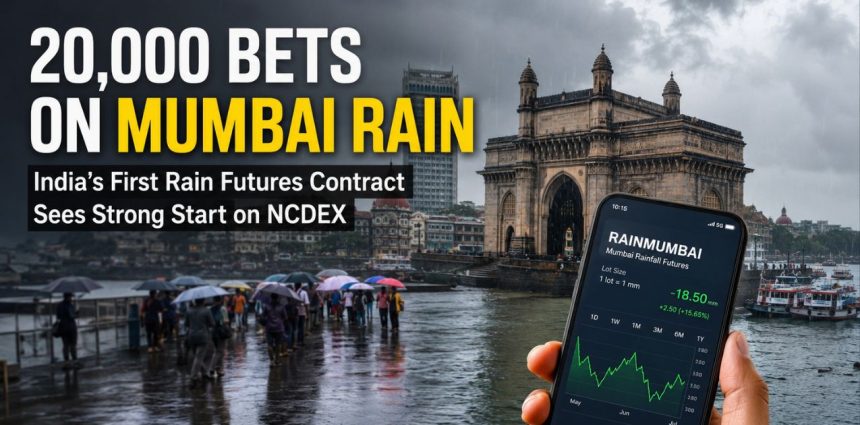
Mumbai’s monsoon showed up late this year, and that turned out to be good timing for India’s newest financial product. RAINMUMBAI, the country’s first exchange-traded rainfall futures contract, has traded roughly 20,000 lots in its debut month on the National Commodity & Derivatives Exchange (NCDEX), the exchange told Moneycontrol.
How RAINMUMBAI Actually Works
RAINMUMBAI opened for trading on May 29, 2026, as India’s first SEBI-approved, exchange-traded weather derivative, developed jointly with the Indian Institute of Technology (IIT) Bombay and built on rainfall data from the India Meteorological Department (IMD).
The product sits on fairly new legal ground, weather derivatives were only written into the Securities Contracts (Regulation) Act in 2024, which is what let commodity exchanges list them in the first place.
The contract doesn’t price rainfall directly. It tracks the Cumulative Deviation Rainfall (CDR) index, the gap between Mumbai’s actual rainfall and its Long Period Average of 2,206.7 mm, benchmarked against 30 years of IMD data from 1991 to 2020.
IMD feeds rainfall readings from the Santacruz and Colaba stations to NCDEX by 9:00 am each trading day, and the exchange locks in one updated CDR spot value by 9:15 am.
| RAINMUMBAI Contract Specs | Detail |
|---|---|
| Underlying index | Cumulative Deviation Rainfall (CDR) |
| Benchmark | Long Period Average — 2,206.7 mm (1991–2020) |
| Tick size | 1 mm = ₹50 |
| Max order size | 50 lots |
| Contracts traded | June, July, August, September only |
| Trading hours | 10:00 am–11:30/11:55 pm, Mon–Fri |
| Settlement | Cash-settled, T+2, no physical delivery |
| Data source | IMD — Santacruz & Colaba stations |
Source: NCDEX Mumbai Rainfall Product Note; PL Capital; Business Upturn
Also Read: The Monsoon Trade: Which Stocks Win or Lose If Rainfall Disappoints?
A Reluctant Monsoon Set Up The Test
The launch coincided with a monsoon that didn’t cooperate. After reaching Kerala on June 4, the southwest monsoon stalled well short of Mumbai even as conditions initially favoured a quicker advance into Maharashtra.
IMD’s own bulletin shows the monsoon only pushed further into Maharashtra, including Mumbai, on June 23. Rainfall through early June ran well behind the same period a year earlier, extending a pattern of late arrivals last seen in 2019 and 2023. Even after rain picked up later in the month, Mumbai closed June with rainfall below its long-term average, per the exchange.
Volumes Built Steadily—But The Numbers Are Wire-Only For Now
NCDEX told Moneycontrol that average daily volumes ran near 1,000 lots through the first month, with the busiest session, June 15, hitting 2,039 lots. The exchange said participation strengthened week after week, clustering around weather updates and rainfall events, and that futures prices broadly tracked and anticipated how the season was evolving.
Awareness, Not Appetite, Is The Stated Hurdle
NCDEX’s own read is that market education is the binding constraint, not demand. Participants are still building frameworks that combine weather data with trading strategy, and many potential users have historically absorbed rainfall risk or covered it through insurance rather than a tradable hedge.
NCDEX has pitched the contract at farmers, construction firms, power utilities, logistics operators, retailers, and banks with agricultural loan exposure, against a backdrop of roughly $180 billion in weather-linked losses across India over the past three decades.
What’s Next
The exchange expects trading intensity to build through July and August, when rainfall volatility typically rises and the hedge becomes more relevant to real exposures. Early trading in the July and September contracts, NCDEX said, is already showing forward-looking pricing rather than pure reaction to daily rainfall prints.
Longer term, NCDEX has flagged plans to extend the framework beyond Mumbai, rainfall contracts for agricultural districts and temperature-linked indices for northern India are both under consideration.
The next real test lands with the July contract, live through the heart of the monsoon, the window NCDEX itself says should bring sharper volatility and, if the thesis holds, deeper liquidity than June’s opening month managed.
Read Next: Why Is RITES Stock Up 16% Today? Rs 175 Crore Order Explained
FAQs
What is RAINMUMBAI on NCDEX?
India’s first SEBI-approved, exchange-traded weather derivative, a cash-settled futures contract tracking Mumbai’s monsoon rainfall deviation from its historical average.
How does the RAINMUMBAI futures contract work?
It settles on the CDR index, not absolute rainfall. Each 1 mm shift in the index is worth ₹50 per lot, with no physical delivery.
When did NCDEX launch rainfall futures?
Trading opened May 29, 2026.
Who can trade Mumbai rainfall futures?
Anyone with a NCDEX-enabled commodity account, though the exchange has positioned it primarily for businesses with genuine rainfall-linked exposure, agriculture, construction, insurance, and logistics.
This article is for informational purposes only and does not constitute investment advice. Trading in futures and derivatives carries the risk of financial loss. Readers should consult a SEBI-registered financial advisor before making investment decisions.