Key Takeaways
- Intel posted $16.13 billion in Q2 2026 revenue, up 25% YoY, its strongest quarterly growth in more than 15 years, and beat both revenue and EPS estimates.
- Data Center & AI revenue surged 59% YoY to $6.3 billion as enterprises ramped AI infrastructure spending.
- Intel Foundry revenue rose 31% YoY to $5.8 billion, and management raised 2026 capex to over $20 billion to expand manufacturing capacity.
- Shares jumped over 12% in the immediate reaction as Intel guided Q3 2026 revenue of $15.8–16.8 billion, above consensus.
- On a GAAP basis, Intel reported an $11 billion net loss, driven by a one-off $12.5 billion mark-to-market charge tied to its CHIPS Act escrowed shares, not an operating shortfall.
Intel’s Earnings Say More About AI Than Intel
For much of the past two years, the artificial intelligence investment story has revolved around Nvidia. Every surge in AI spending appeared to reinforce one conclusion: GPU makers were capturing the biggest share of the opportunity.
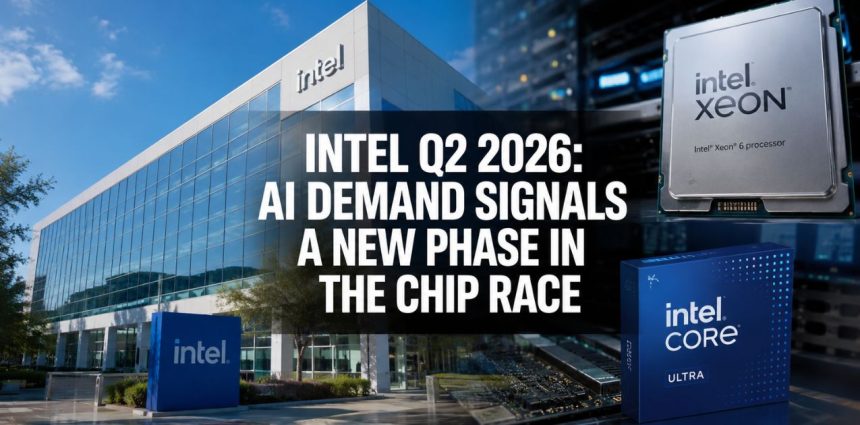
Intel’s Q2 2026 results, reported on July 23, suggest that picture is becoming more nuanced. Rather than simply beating estimates, Intel’s numbers indicate enterprise AI spending is broadening across the semiconductor ecosystem, no longer limited to AI accelerators alone, but increasingly benefiting server CPUs, networking infrastructure, manufacturing services and advanced chip packaging as companies expand data-centre capacity.
AI Infrastructure Spending Is Outpacing Expectations
Intel reported second-quarter revenue of $16.13 billion, up 25% year-on-year, comfortably ahead of the $14.42 billion Wall Street had estimated. Adjusted EPS came in at $0.42, roughly double the $0.21 consensus. Management guided third-quarter revenue of $15.8–16.8 billion, also above expectations.
The standout was the Data Center and AI (DCAI) segment, where revenue climbed 59% year-on-year to $6.3 billion, driven largely by Xeon 6 server demand.
Client Computing revenue rose 13% to $8.9 billion. Unlike the first wave of AI spending, which centred on model training, enterprises are now investing across broader computing environments to support AI deployment at scale.
Why the Headline Number Doesn’t Tell the Whole Story
Intel’s GAAP results told a different story on paper: a net loss of $11 billion, or $2.16 per share.
That loss was driven almost entirely by a $12.5 billion non-cash, mark-to-market accounting charge tied to shares Intel escrowed as part of its CHIPS Act agreement with the U.S. government, not by weaker underlying operations.
On a non-GAAP basis, the company was solidly profitable. Investors appeared to look through the accounting item: shares rose more than 12% in the immediate reaction.
Why CPUs Still Matter in the AI Era
The AI boom is often framed as a GPU story, but every AI workload also depends on CPUs, memory, networking and storage. Intel is positioning itself to benefit from this broader ecosystem rather than compete head-on with Nvidia’s dominance in accelerators.
Its Xeon processors remain widely deployed in enterprise servers, and AI inference, running trained models in production, continues to require large CPU deployments alongside GPUs.
Foundry Progress Could Be the Bigger Long-Term Story
Intel Foundry revenue rose 31% year-on-year to $5.8 billion, supported by new customer engagements and progress on the next-generation 14A manufacturing process.
Intel also raised planned 2026 capital expenditure to over $20 billion, with a further increase expected in 2027, to expand manufacturing capacity as AI-related demand accelerates.
For investors, this matters because Intel is trying to build two growth engines rather than one, designing chips and manufacturing them for outside customers.
What Comes Next
Intel still faces intense competition from Nvidia in AI accelerators, AMD in server processors, and TSMC in contract manufacturing. Continued execution on product launches, factory expansion and foundry customer wins will determine whether this quarter’s momentum becomes a sustained recovery rather than a one-off.
What Investors Should Watch Next
| Trigger | Why It Matters |
|---|---|
| AI Server Demand | Indicates whether enterprise spending on AI infrastructure remains strong. |
| Data Center Revenue | Reflects adoption of Intel’s Xeon processors and AI-focused server solutions. |
| Foundry Customer Wins | Measures the commercial success of Intel’s contract manufacturing business. |
| Capital Spending (Capex) | Signals Intel’s confidence in long-term AI and semiconductor demand. |
| Q3 Guidance Execution | Shows whether the current growth momentum can be sustained in the coming quarters. |
NiftyTrader Desk View
| Aspect | NiftyTrader View |
|---|---|
| Global Cue | Positive. The strong earnings reinforce that the global AI capex cycle remains healthy, supporting sentiment for semiconductor and hardware companies. |
| India Read-Through | Indirectly Positive. While the results have limited direct impact on Nifty IT, they support the long-term outlook for data centre, networking, electronics manufacturing and AI infrastructure-related businesses. |
| Market Sentiment | Constructive. Intel’s earnings and upbeat guidance strengthen confidence in global semiconductor stocks and could provide a positive lead for Wall Street-linked markets. |
| Key Risk | Intel must sustain execution and continue gaining market share amid intense competition from Nvidia, AMD and TSMC. |
| NiftyTrader View | Intel’s results reinforce the global AI investment theme but are not a standalone catalyst for the Nifty 50. The bigger takeaway is continued strength in enterprise AI infrastructure spending, which could support the broader semiconductor ecosystem. |
Check Live: NIFTY IT, NIFTY50, SENSEX
Bottom Line
Intel’s Q2 2026 print was more than an earnings beat, it offered evidence that AI spending is expanding across the semiconductor value chain rather than staying concentrated in a handful of companies.
Whether that becomes a durable trend remains uncertain, but the results have shifted investor attention from Intel’s turnaround story to its potential role in the next stage of AI infrastructure growth.
The challenge now is execution: sustaining demand, winning more foundry customers, and proving one exceptional quarter can become a lasting recovery.
Read Next: Reliance’s Next Growth Phase: Why Analysts See a Shift Beyond Heavy Capex
FAQs
Q1. What was Intel’s revenue in Q2 2026?
Intel reported Q2 2026 revenue of $16.13 billion, up 25% year-on-year, its strongest quarterly growth in more than 15 years, beating the $14.42 billion Wall Street estimate.
Q2. Why did Intel stock rise after Q2 2026 results?
Shares rose more than 12% after Intel beat both revenue and EPS estimates, posted 59% growth in its Data Center and AI segment, and issued stronger-than-expected Q3 guidance.
Q3. Did Intel report a profit or loss in Q2 2026?
Intel reported a GAAP net loss of $11 billion ($2.16/share) due to a one-off $12.5 billion mark-to-market charge on CHIPS Act escrowed shares. On a non-GAAP basis, EPS was a positive $0.42.
Q4. What is Intel’s Q3 2026 guidance?
Intel guided Q3 2026 revenue of $15.8–16.8 billion, non-GAAP EPS of $0.38, and non-GAAP gross margin of approximately 42%.
Q5. How is Intel’s Foundry business performing?
Intel Foundry posted $5.8 billion in Q2 2026 revenue, up 31% year-on-year, as Intel advanced its 14A manufacturing process and raised 2026 capital spending to over $20 billion.
Track FII/DII Activity Live
Get real-time FII and DII net buy-sell data, sector-wise flows and daily trend analysis on the NiftyTrader FII-DII Dashboard.
Disclaimer: This article is for informational purposes only and does not constitute investment advice. NiftyTrader is not a SEBI-registered investment advisor. Stock market investments are subject to market risks; please consult a registered financial advisor before making investment decisions. Data and figures are sourced from Intel Corporation’s official Q2 2026 earnings release and are believed accurate as of publication.